What is global brand reach: a guide for UK businesses

TL;DR:
- Global brand reach reflects recognition and influence across international markets through consistent messaging and local adaptation. UK SMEs often confuse exporting with sustainable internationalisation, risking operational failure and missed growth opportunities. Building structural readiness, measuring performance accurately, and using local partners are key to successful global branding.
Global brand reach is defined as the extent to which a brand’s presence, recognition, and influence extend across multiple international markets through consistent yet locally adapted messaging. For UK entrepreneurs, understanding this concept is the difference between exporting a product and building a brand that genuinely resonates abroad. The industry term you will encounter in professional circles is international brand presence, though “global brand reach” captures the measurable, campaign-level dimension more precisely. This guide covers what shapes it, how to measure it, what stands in your way, and how to build a strategy that works.
What is global brand reach and what shapes it?
Global brand reach is not simply the number of countries where your product is sold. It is the degree to which consumers recognise and trust your brand across borders, and the influence that recognition carries in purchasing decisions. A brand can ship to 40 countries and still have negligible reach if no one there knows who you are.

Three forces define how far a brand’s reach extends. The first is consistent core messaging: your brand’s values, tone, and visual identity must remain stable regardless of market. The second is cultural adaptation: the way that message is expressed must reflect local behaviour, language, and expectations. The third is operational readiness: your fulfilment, customer service, and legal compliance must match the promise your marketing makes.
| Element | Consistent brand strategy | Localised brand strategy |
|---|---|---|
| Messaging | Same core narrative globally | Adapted tone and references per market |
| Visual identity | Uniform logo, colours, typography | Adjusted imagery and cultural cues |
| Pricing | Standardised where possible | Market-specific pricing tiers |
| Regulatory compliance | Global baseline standards | Country-specific legal requirements |
| Customer service | Centralised support model | Local language and time zone support |
Cultural relevance is where most UK brands stumble first. A campaign that performs well in London can fall flat in Singapore or São Paulo if the creative assumes shared cultural references. Legal and regulatory compliance adds another layer: data privacy rules, advertising standards, and labelling requirements differ significantly across the EU, North America, and Asia-Pacific markets.
Pro Tip: Before entering a new market, audit your brand messaging against that country’s advertising standards body. What is acceptable in the UK may be restricted or require modification elsewhere.
How can UK business owners measure and track global brand reach?
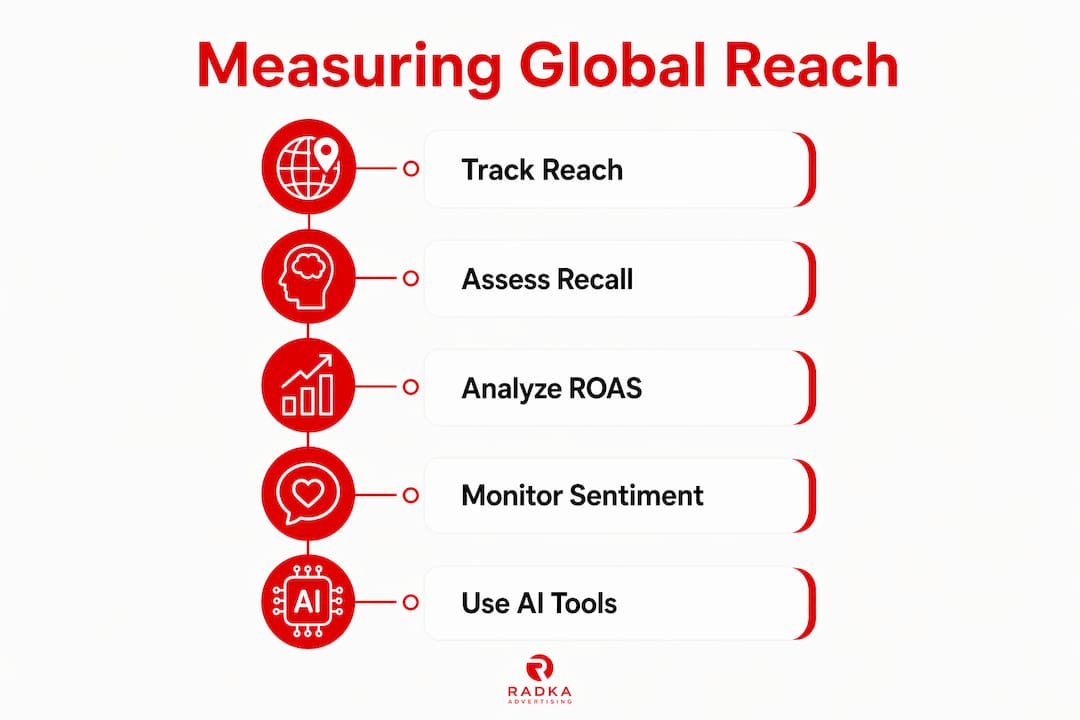
Measurement is where global brand strategy moves from aspiration to evidence. The core metrics for any international campaign are unique reach, brand recall lift, return on advertising spend (ROAS), click-through rates, and sentiment analysis. 2026 global brand campaigns aim for 10–50 million unique reach, a 15–25% lift in brand recall, and ROAS of 3:1 to 5:1, with click-through targets of 2–8% and 70%+ positive sentiment. Those benchmarks give you a realistic frame for setting market-specific goals rather than applying a single global target.
The challenge is that media measurement is not consistent across regions. Regional benchmarks vary significantly, and brands report performance in ranges with confidence bands rather than single figures because of this variability. A conversion rate that sits at 6% in Western Europe may land anywhere between 4–8% in Southeast Asia depending on platform, device mix, and local internet infrastructure. Treating a single number as a global truth produces misleading conclusions.
Modern global brand tracking platforms address this by providing continuous data across regions, unifying metrics like Mental Market Share and Media Impact Value (MIV) into a single view. The best platforms monitor performance across 200+ countries and eliminate the fragmented, delayed reporting that previously made global oversight impractical.
Key metrics to track across all markets:
- Unique reach: the number of distinct individuals exposed to your brand per market
- Brand recall lift: the percentage increase in unprompted brand recognition after a campaign
- ROAS: revenue generated per pound of advertising spend
- Sentiment score: the ratio of positive to negative brand mentions across social and earned media
- Mental Market Share: the proportion of consumers who think of your brand first in a category
Pro Tip: Use AI-powered brand measurement tools to consolidate regional data into a single dashboard. Manual aggregation across markets introduces errors and delays that cost you decision-making speed.
What challenges do UK SMEs face when expanding their global brand reach?
The most common mistake UK SMEs make is confusing exporting with true internationalisation. Many UK SMEs mistake exporting for genuine international presence, which exposes them to operational risks without the structural frameworks needed to sustain growth. Shipping a product abroad is not the same as building a brand in that market.
The 2024 DBT national survey found that 71% of UK businesses believe they have the financial resources to export, yet 39% cite time and 32% cite cost and knowledge gaps as the primary barriers to international expansion. That gap between confidence and capability is where most international ambitions stall.
The hidden costs are the ones that catch businesses off guard:
- VAT and import duties: each market has its own tax treatment for imported goods and services
- Logistics complexity: last-mile delivery standards and costs vary enormously between markets
- Intellectual property protection: your trademark in the UK does not automatically protect you in Japan or Brazil
- Currency risk: pricing in local currency exposes you to exchange rate fluctuation
- Customer service expectations: response times and communication norms differ by culture
Over-reliance on overseas consultants is another trap. Consultants can open doors, but they cannot substitute for internal structural readiness. A business that has not built pricing, VAT compliance, and logistics frameworks before scaling internationally will find that growth amplifies its problems rather than solving them.
Pro Tip: Protect your margins before you protect your market share. Calculate the full landed cost of your product in each target market, including duties, local taxes, and fulfilment, before setting your retail price.
How to develop a global brand strategy that actually works
The most successful UK SMEs in 2026 treat internationalisation as a risk-mitigation strategy, not just a growth play. They identify niche competitive advantages, such as intellectual property, design heritage, or specialist expertise, and use those to enter markets where they face less direct competition on price.
Building brand visibility before physical distribution is a principle that consistently outperforms the reverse approach. Brands that invest in awareness campaigns, PR, and digital presence in a target market before launching fulfilment operations arrive with demand already forming. That sequence reduces the cost of customer acquisition and gives you negotiating power with local distributors.
A practical global brand strategy for UK businesses follows these steps:
- Define your brand’s non-negotiable core. Identify the values, visual identity, and tone that must remain consistent in every market.
- Select markets by fit, not size. A smaller market with strong cultural alignment and low competition often delivers better returns than a large market with entrenched local players.
- Build structural readiness first. Establish pricing frameworks, VAT compliance, and logistics partnerships before launching marketing campaigns.
- Use resellers or fulfilment partners as your entry point. Local fulfilment partners manage costs and administrative complexity far better than immediately setting up a local legal entity.
- Adapt creative for each market without abandoning brand identity. Localise imagery, copy, and channel mix while keeping the core narrative intact.
- Set market-specific campaign goals. Apply the benchmarks relevant to each region rather than a single global target.
- Measure continuously and adjust quarterly. Use unified tracking platforms to compare performance across markets and reallocate budget to where ROAS is strongest.
Licensing and intellectual property monetisation are underused routes for UK brands with strong design or technology assets. Licensing your brand to a local operator in a target market generates revenue and builds recognition without the operational burden of direct market entry. It is a particularly effective approach for premium and heritage brands where the “made in Britain” association carries genuine commercial value.
Key takeaways
Global brand reach requires consistent identity, local cultural adaptation, and structural operational readiness working together before any campaign can deliver lasting international results.
| Point | Details |
|---|---|
| Define reach precisely | Global brand reach measures recognition and influence across markets, not just the number of countries where you sell. |
| Measure with confidence bands | Regional benchmarks vary, so report performance in ranges rather than single figures to make accurate decisions. |
| Build structure before scale | Pricing, VAT compliance, and logistics frameworks must be in place before international marketing campaigns launch. |
| Use partners as entry points | Local resellers and fulfilment partners reduce cost and complexity compared to setting up foreign legal entities immediately. |
| Treat internationalisation as risk mitigation | UK SMEs with niche IP or design heritage gain more by targeting markets with less competition than by chasing the largest audiences. |
What I have learned about global brand reach the hard way
Working with UK businesses on international campaigns, the pattern I see most often is this: a brand invests in creative, launches a campaign, and then discovers that the operational side cannot support the demand it generates. The marketing works. The business is not ready.
The brands that succeed internationally are almost never the ones with the biggest budgets. They are the ones that did the unglamorous preparation first: pricing models, fulfilment agreements, trademark registrations, and local market research. By the time their campaign launches, the infrastructure is already in place to convert interest into revenue.
The measurement conversation has also shifted significantly. A few years ago, global brand tracking meant waiting weeks for consolidated reports that were already out of date. Continuous platform-based tracking has changed that entirely. You can now see how a campaign is performing in Germany and Australia simultaneously and adjust spend in real time. That capability removes a lot of the guesswork that previously made international campaigns feel like a gamble.
My honest advice to any UK entrepreneur considering international expansion: build your brand’s visibility in the target market before you build your distribution. Awareness is cheaper to create than demand recovery after a failed launch.
— Bart
How Radkaadvertising supports UK businesses expanding internationally
Radkaadvertising works with UK entrepreneurs and established brands to build the kind of international presence that converts awareness into revenue. The agency’s services span brand strategy and campaign planning, multi-channel digital marketing, and creative content designed for global markets. Radkaadvertising has delivered campaigns for clients including Coca-Cola, Maybelline, and PowerLink Energy, demonstrating the range of sectors and markets the agency operates across. If you want to see how these approaches translate into real results, the Radkaadvertising case studies show the full picture from brief to outcome. For UK businesses ready to move from domestic success to international growth, Radkaadvertising provides the strategic and creative foundation to do it properly.
FAQ
What is global brand reach in simple terms?
Global brand reach is the degree to which a brand is recognised and trusted across multiple international markets. It combines consistent messaging with local cultural adaptation to build influence beyond a single country.
How do I start measuring my brand’s international reach?
Track unique reach, brand recall lift, ROAS, and sentiment scores per market using a unified brand tracking platform. Report results in ranges rather than single figures to account for regional measurement variability.
What is the biggest mistake UK SMEs make when going global?
The most common error is confusing exporting with true internationalisation. Shipping products abroad without VAT compliance, logistics frameworks, and local brand awareness in place creates operational fragility rather than sustainable growth.
How much does it cost to build global brand reach?
Costs vary by market, channel, and entry strategy. Using local resellers or fulfilment partners as a first step is significantly less expensive than establishing a foreign legal entity, and it allows you to test market fit before committing to larger investment.
What metrics matter most for a global brand campaign?
The most important metrics are unique reach per market, brand recall lift, ROAS, click-through rate, and sentiment score. Leading platforms also track Mental Market Share and Media Impact Value to give a fuller picture of brand performance across regions.