What is cross-cultural marketing: a guide for marketers

TL;DR:
- Cross-cultural marketing involves adapting messaging and visuals to connect authentically with diverse cultural groups. It extends beyond translation by considering cultural values, communication styles, and social norms to build trust and loyalty. Effective strategies include cultural research, localisation, glocalisation, and involving native experts early in campaign development.
Cross-cultural marketing is defined as the practice of adapting marketing messages, visuals, and campaigns to resonate authentically with consumers from different cultural backgrounds. It goes far beyond translation. Understanding cultural values, communication styles, purchasing behaviours, and social norms is what separates a campaign that connects from one that offends. The Mintel UK DE&I Report 2025 found that 59% of UK consumers agree that diversity, equity, and inclusion initiatives are increasingly necessary. That figure signals a clear shift: audiences now expect brands to reflect their world, not just sell into it.
Why is cross-cultural marketing important for business success?
Cross-cultural marketing directly affects brand trust, customer loyalty, and long-term revenue. When a brand speaks to a consumer’s cultural identity, it builds an emotional connection that generic campaigns simply cannot replicate. That connection translates into repeat purchases, word-of-mouth referrals, and a stronger competitive position in diverse markets.
The business case is grounded in real consumer behaviour. 76% of Gen Z and younger Millennials are ready to call out discrimination publicly, making transparent and authentic inclusion non-negotiable for brands targeting younger demographics. This is not a niche concern. Gen Z and Millennials now represent the largest combined consumer group in most Western markets.
Cultural diversity in the UK and globally is accelerating. Brands that ignore this shift risk becoming irrelevant to entire demographic segments. Brands that lead with cultural respect in their messaging build stronger connections and stand out as globally responsible. Relevance is earned, not assumed.
The benefits of cross-cultural marketing extend beyond sales figures:
- Brand trust: Consumers from minority or diaspora communities notice when a brand makes a genuine effort to represent them accurately.
- Market expansion: Culturally adapted campaigns open doors to new customer segments without requiring entirely new products.
- Reduced risk: Campaigns reviewed for cultural appropriateness avoid costly public relations crises caused by tone-deaf messaging.
- Competitive advantage: Brands that back DE&I with measurable goals retain younger demographics more effectively than those who treat inclusion as a box-ticking exercise.
What are the core strategies in cross-cultural marketing?
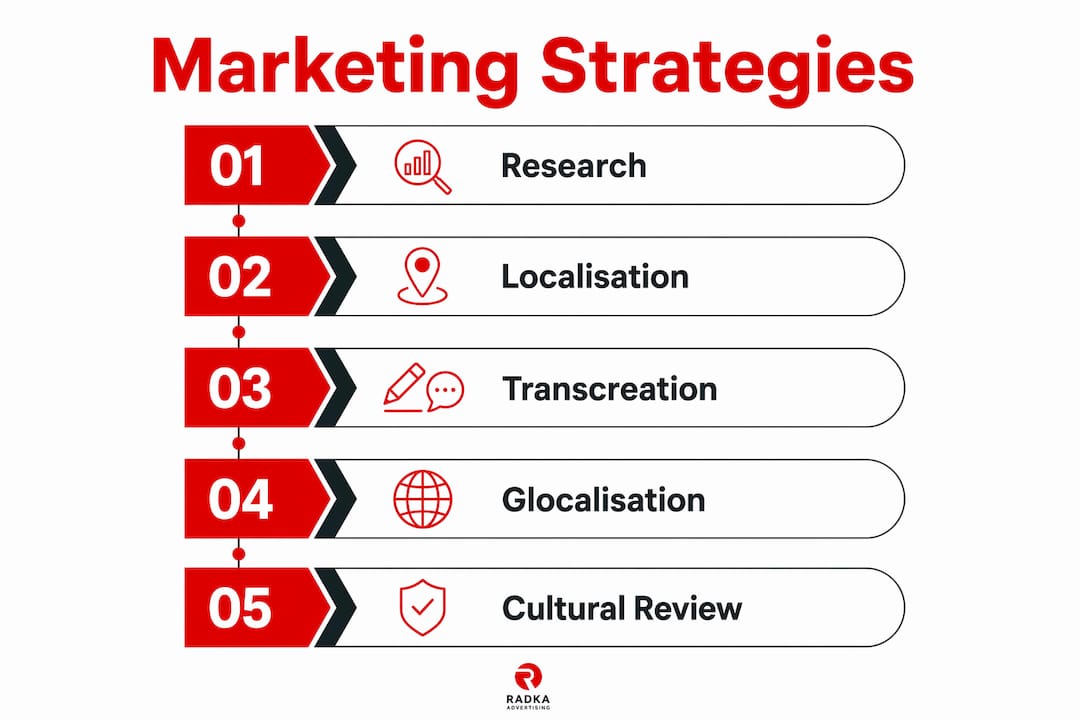
Effective cross-cultural marketing rests on four core practices: cultural research, localisation, glocalisation, and transcreation. Each serves a distinct purpose, and the best campaigns combine all four.

Cultural research
Every campaign starts with understanding the audience. Cultural research means studying the values, taboos, humour, family structures, and communication preferences of a target market. Desk research using sources like Mintel, Euromonitor, and local consumer panels provides a foundation. Qualitative interviews with community members add the nuance that statistics miss.
Localisation vs transcreation
Localisation adapts content for a specific market. It covers language, currency, date formats, imagery, and legal requirements. Effective cross-cultural marketing requires adapting not just language but also product positioning, promotional tone, images, and user experience for each market. Transcreation goes further. It recreates the emotional intent of a message in a new cultural context, often producing entirely different copy that achieves the same feeling. A tagline that works in English may need a completely new concept in Arabic or Mandarin, not a word-for-word equivalent.
Glocalisation
Glocalisation is the practice of maintaining a consistent global brand identity while adapting execution to local cultures, values, and communication styles. Glocalisation is a winning formula for brands that want global scale without sacrificing local relevance. Coca-Cola’s “Share a Coke” campaign is a textbook example. The core idea, personalisation and sharing, stayed constant. The names on the bottles, the media channels, and the tone of the advertising changed market by market.
Numbered steps for implementation
- Conduct cultural audience research before briefing any creative team.
- Map the customer journey for each target market, including website, checkout, and search behaviour.
- Brief native-speaking copywriters rather than relying on machine translation.
- Apply transcreation to slogans, headlines, and emotional copy.
- Test campaigns with local focus groups before full launch.
- Review legal and regulatory requirements for advertising in each market.
Pro Tip: Hire a cultural consultant who is a native of the target market, not just a fluent speaker. Fluency covers language. Cultural consultants cover the unspoken rules that determine whether a campaign feels genuine or imported.
What common challenges occur in cross-cultural marketing?
The most damaging cross-cultural marketing mistakes share one root cause: assuming that what works in one market will work in another. Common cross-cultural errors include literal translations, culturally inappropriate humour, and tone mismatches that make campaigns feel tone-deaf.
Typical pitfalls to avoid
- Literal translation failures: A slogan with a clever double meaning in English may translate into something absurd or offensive in another language. Several global brands have suffered public embarrassment from exactly this error.
- Inappropriate visuals: Colours, gestures, and symbols carry different meanings across cultures. White represents mourning in several East Asian cultures, while it signals purity in Western markets.
- Tone mismatches: A direct, assertive tone common in American advertising can feel aggressive or disrespectful in cultures that value indirect communication, such as Japan or many Middle Eastern markets.
- Ignoring local legal requirements: Advertising standards differ significantly between markets. Claims that are permitted in the UK may be prohibited in Germany or the UAE.
- Generic “diversity” campaigns: Featuring diverse faces without genuine cultural understanding reads as performative. Consumers seek authentic representation, not tokenism.
Pre-launch cultural review checklist
Before any cross-cultural campaign goes live, run it through this framework:
| Review area | Questions to ask |
|---|---|
| Language and tone | Does the copy read naturally to a native speaker? |
| Visuals and symbols | Are colours, gestures, and imagery culturally appropriate? |
| Humour and emotion | Does the emotional register match local communication norms? |
| Legal compliance | Does the campaign meet local advertising regulations? |
| Representation | Are cultural groups depicted accurately and respectfully? |
Pro Tip: Localisation is an iterative process, not a one-time task. Schedule a post-launch cultural review at 30 and 90 days to catch issues that only surface once a campaign is live in market.
Can you give examples of effective cross-cultural marketing?
Real campaigns illustrate what good cross-cultural marketing looks like in practice. The following examples show how brands balanced global identity with local relevance.
- Coca-Cola “Share a Coke”: Launched globally but adapted locally by replacing the brand name with popular local names and culturally relevant terms of endearment. In China, the campaign used relational titles like “classmate” and “close friend” rather than individual names, reflecting the culture’s emphasis on group identity over individualism.
- Maybelline in Southeast Asia: The brand adapted its “Maybe she’s born with it” positioning to reflect local beauty standards and skin tone diversity rather than applying a single Western ideal. Product shades, model casting, and campaign language were all localised.
- McDonald’s regional menus: The brand maintains a consistent global identity while offering entirely different menu items by market. The McAloo Tikki in India and the Teriyaki Burger in Japan are not translation exercises. They are genuine product adaptations rooted in local food culture.
“Consumers respond more strongly to meaning, emotion, identity, and trust than to mere words. Strong brands adapt intelligently, balancing global ideas with local language and imagery.”
These examples share a common lesson. The original brand idea was strong enough to travel globally, but the execution was rebuilt for each market. A global campaign’s original idea may travel well if strong, but should always be tested against local languages and cultures to confirm resonance. The brands that get this right treat localisation as a creative challenge, not an administrative task.
Key takeaways
Cross-cultural marketing succeeds when brands combine genuine cultural research, localisation, and authentic representation to build trust with diverse audiences across every market they enter.
| Point | Details |
|---|---|
| Definition matters | Cross-cultural marketing adapts messaging, visuals, and tone to resonate with specific cultural audiences. |
| Authenticity drives loyalty | 59% of UK consumers say DE&I initiatives are increasingly necessary, making genuine inclusion a business priority. |
| Glocalisation is the model | Maintain a consistent global brand identity while adapting execution to local values and communication styles. |
| Translation is not enough | Transcreation and cultural review are required to capture emotional resonance, not just linguistic accuracy. |
| Localisation is ongoing | Schedule post-launch cultural reviews to catch issues that only emerge once a campaign is live. |
Why cultural empathy is the real competitive edge
I have worked with brands that spent considerable budgets on multilingual campaigns, only to see them fall flat because the cultural layer was treated as an afterthought. The brief would say “translate into French and Spanish,” and the team would tick that box without asking whether the original concept even made sense in those markets.
The misconception I encounter most often is that cross-cultural marketing is a production task rather than a strategic one. Marketers assume that once the creative is approved in the home market, adaptation is simply a matter of swapping out words. That assumption is where campaigns go wrong. Cultural respect and authenticity in marketing are not optional. They are central for brands wanting sustained global success.
What actually works is involving local experts at the brief stage, not the sign-off stage. When a native cultural consultant shapes the creative direction from the start, the campaign does not need to be rescued later. The emotional intelligence is baked in from the beginning. That is the difference between a campaign that performs and one that apologises.
The brands I have seen grow most consistently in diverse markets are the ones that treat cultural knowledge as a genuine business asset. They invest in it, measure it, and build it into their processes. That is not idealism. That is good business.
— Bart
How Radkaadvertising supports cross-cultural marketing
Radkaadvertising is a London-based full-service agency with direct experience delivering culturally adapted campaigns for brands including Coca-Cola and Maybelline. The agency’s work spans brand strategy, digital marketing, and creative content designed for global reach with local relevance. If you are building a campaign that needs to connect across cultures, the Radkaadvertising case studies show exactly how that has been done across diverse industries and markets. For a broader view of services covering localisation, brand positioning, and multi-channel campaigns, visit Radkaadvertising to see how the agency approaches international brand growth.
FAQ
What is cross-cultural marketing in simple terms?
Cross-cultural marketing is the practice of adapting campaigns, messaging, and visuals to connect authentically with consumers from different cultural backgrounds. It goes beyond translation to include cultural values, communication styles, and local customs.
How does localisation differ from transcreation?
Localisation adapts existing content for a specific market by adjusting language, imagery, and formats. Transcreation recreates the emotional intent of a message from scratch to ensure it resonates naturally in the target culture.
What is glocalisation in marketing?
Glocalisation combines a consistent global brand identity with flexible local adaptation. Brands maintain their core message while tailoring execution to local values, communication norms, and consumer preferences.
What are the biggest mistakes in cross-cultural marketing?
The most common errors are literal translations that lose meaning, culturally inappropriate visuals or humour, and generic diversity campaigns that lack authentic representation. Involving native-speaking cultural consultants early prevents most of these issues.
Why does cross-cultural marketing matter for brand loyalty?
Consumers who see their cultural identity reflected accurately in a brand’s marketing develop stronger emotional connections and greater loyalty. Research shows that 76% of Gen Z and younger Millennials are prepared to call out brands that fall short on authentic inclusion.