Competitor analysis for UK SMEs: a practical guide

TL;DR:
- Competitor analysis involves researching rival firms to understand their strengths, weaknesses, pricing, and marketing strategies.
- For UK SMEs, it helps inform confident pricing, identify market gaps, and prioritize limited resources effectively.
Competitor analysis is the process of systematically researching rival businesses to understand their strengths, weaknesses, pricing, positioning, and marketing tactics, so you can make sharper decisions about your own. For a UK SME, it is less about obsessing over the competition and more about gathering the intelligence you need to price confidently, spot market gaps, and allocate your limited budget where it will actually land. Xero’s UK guide frames it well: competitor analysis helps businesses navigate crowded markets and identify untapped opportunities.
TL;DR: Spend a few focused hours mapping who your competitors are, what they offer, and how they position themselves. Feed those findings into a SWOT, pick two or three moves, and test them within 30 days.
This guide covers:
- Who to include in your competitor universe (direct, indirect, emerging)
- What to audit across each rival (pricing, channels, reviews, SEO, and more)
- A repeatable five-step process with tools and a realistic timeline
- How to turn findings into a SWOT and a prioritised action plan
- A worked example, a template, and an anonymised Radkaadvertising case study
Table of Contents
- Why competitor analysis matters for your business
- Who belongs in your competitor universe?
- The audit checklist: what to look for in every competitor
- How to run a competitor analysis: a repeatable process
- Turning analysis into action: SWOT, priorities, and quick experiments
- Common mistakes, ethical boundaries, and best practices
- Worked example and template for a UK SME
- How Radkaadvertising used competitor analysis for a UK client
- Key takeaways
- Why competitor analysis is the work most SMEs skip, and why that is a mistake
- Radkaadvertising runs competitor audits built for UK SMEs
- Authoritative UK sources and tools for competitor research
- FAQ
Why competitor analysis matters for your business
Knowing what your rivals are doing is not a luxury; it is a prerequisite for confident strategy. The most immediate payoff is pricing clarity. When you can see exactly what competitors charge, how they bundle, and where they discount, you stop guessing and start positioning. That alone saves most SMEs from either undercharging or pricing themselves out of the room.

Beyond pricing, competitor research answers questions that no amount of internal brainstorming can: Which customer pain points are rivals ignoring? Which channels are they investing in heavily, and which have they abandoned? Where is the market genuinely underserved? NIbusinessinfo links this intelligence directly to SWOT benchmarking, which means the findings slot straight into your planning cycle rather than sitting in a folder no one opens.
For e-commerce and online retail businesses specifically, the stakes are higher. DHL’s UK guide notes that competitive intelligence accelerates decision-making and is widely used by leading firms to stay ahead. UK SMEs operating in crowded categories, whether fashion, food, or B2B services, face the same pressures at a fraction of the budget. Competitor analysis is how you punch above your weight.
Practically, it informs:
- Pricing and packaging: Where are the gaps between budget and premium tiers?
- Product development: Which features do customers request that rivals do not offer?
- Channel focus: Are competitors winning on paid search, organic, or social? Where are they absent?
- Risk management: Which rival is growing fastest, and what does that mean for your positioning?
NIAXO’s guidance makes the point plainly: for SMEs, competitor analysis should be integrated into strategic planning and paired with frameworks like SWOT and Porter’s Five Forces, rather than treated as a one-off exercise.
Who belongs in your competitor universe?
Start by defining the three competitor types, because they require different responses.
Direct competitors sell the same product or service to the same audience. If you run a Bristol-based accountancy firm targeting sole traders, another Bristol accountant targeting sole traders is a direct rival.
Indirect competitors solve the same customer problem through a different route. A bookkeeping software subscription competes with your accountancy firm indirectly: the customer’s job-to-be-done (keeping their finances in order) is identical, but the delivery model differs.
Emerging competitors are newer entrants, substitutes, or adjacent businesses moving into your space. A fintech startup offering automated tax filing is an emerging threat to traditional accountants, even if it does not yet target your exact segment.
Where to find them
| Source | What it reveals |
|---|---|
| Google Search (your core keywords) | Who ranks organically and runs paid ads for your terms |
| Google Maps / local packs | Local direct competitors and their review scores |
| Amazon, Etsy, Notonthehighstreet | Product-level competitors and pricing in e-commerce |
| Trustpilot, Google Reviews | Reputation signals and customer sentiment |
| UK trade bodies and sector reports | Established players and market-share proxies |
| LinkedIn company search | Headcount, growth signals, recent hires (a proxy for investment) |
| PPC ad libraries (Google Ads Transparency) | Active ad copy and landing-page angles |
| Supplier and distributor lists | Who else they stock or work with |
Prioritise rivals by relevance (do they target your exact customer?), reach (how visible are they?), and threat level (are they growing or stagnant?). A shortlist of five to eight competitors is enough for most SMEs. More than ten and the analysis becomes unwieldy.
Pro Tip: Watch job adverts. A competitor hiring a Head of Paid Social signals they are about to invest heavily in that channel. A rash of customer-service roles often means rapid growth, or a service problem. LinkedIn and Indeed are free, and the signal is surprisingly reliable.
The audit checklist: what to look for in every competitor
NIbusinessinfo identifies three routes to competitive intelligence: what competitors say about themselves, what others say about them, and publicly available business data. The checklist below maps to all three.
- Offering and features: What exactly do they sell? What is included, excluded, or available as an add-on? Check their website, pricing page, and product descriptions.
- Pricing and discounts: What are their price points, tiers, and promotional patterns? Record actual prices, not just ranges. Verify them directly, not from third-party summaries.
- Positioning and messaging: What headline claim do they lead with? Who do they say they serve? Review their homepage, About page, and ad copy.
- Sales channels: Do they sell direct, through resellers, on marketplaces, or via a sales team? Each channel signals a different customer acquisition cost and margin structure.
- Customer journey and experience: Walk through their purchase or enquiry flow. How many steps? How fast is the response? What does the onboarding look like?
- Delivery and fulfilment: For product businesses, what are lead times, shipping costs, and return policies? These are often the deciding factor for repeat purchase.
- Customer service: Test their live chat, email response time, and phone support. Check how they handle negative reviews publicly.
- Reviews and reputation: Aggregate scores on Trustpilot, Google, and sector-specific platforms. Look for recurring themes in one-star and five-star reviews alike.
- SEO and content presence: Which keywords do they rank for? How much organic traffic do they attract? Tools like Semrush or Ahrefs give a proxy view.
- Paid advertising activity: Are they running Google Ads or Meta campaigns? What offers and messages are they testing? Google’s Ads Transparency Centre is free.
- Social media and community: Which platforms are they active on? What content performs best for them? How engaged is their audience?
| Audit item | Primary source | What to record |
|---|---|---|
| Pricing | Competitor website | Exact prices, tiers, discount triggers |
| Reviews | Trustpilot, Google Reviews | Average score, volume, recurring themes |
| SEO presence | Semrush / Ahrefs (free tier) | Top-ranking keywords, estimated traffic |
| Ad activity | Google Ads Transparency | Active campaigns, headlines, landing pages |
| Job adverts | LinkedIn, Indeed | Roles being hired (signals investment areas) |
| Social content | Native platform analytics | Post frequency, engagement rate, formats |
How to run a competitor analysis: a repeatable process
The whole process follows a simple sequence: find → gather → score → act → monitor. Each step has a clear output, so you always know what you are working towards.
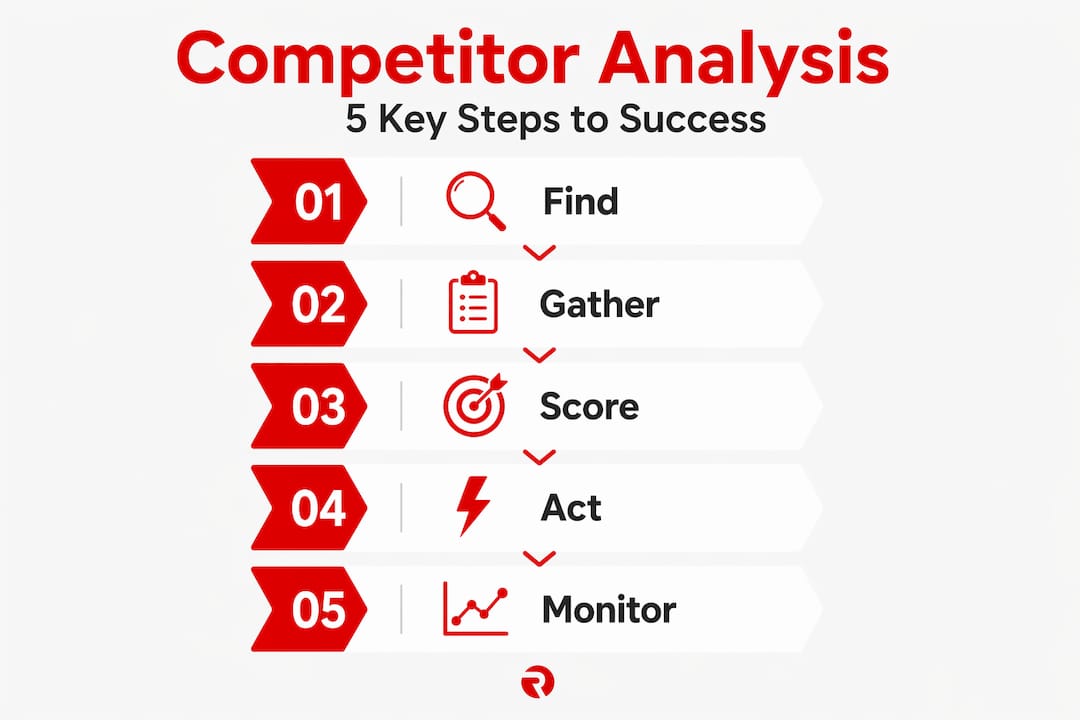
Step 1: Define your scope (1–2 hours)
Decide which competitor types to include, which customer segment you are benchmarking against, and which business decisions this analysis needs to inform. Without a clear scope, the research sprawls. Output: a one-page brief with your shortlist of five to eight competitors and three to five strategic questions you need answered.

Step 2: Gather data (4–8 hours)
Work through the audit checklist above for each competitor. Use free tools first: Google Search, Google Ads Transparency, Trustpilot, LinkedIn, and the free tiers of Semrush or Ubersuggest for SEO signals. For a deeper SEO competitor analysis, a paid Semrush or Ahrefs subscription adds significant precision. Output: a completed audit spreadsheet with one row per competitor and one column per audit item.
Step 3: Score and compare (2–3 hours)
Build a simple scoring matrix. Rate each competitor on five to eight dimensions (pricing competitiveness, product breadth, customer experience, digital visibility, brand strength) on a 1–5 scale. Your own business gets a row too. The gaps between your scores and the market leaders are your opportunity zones. Output: a scored matrix with colour-coded gaps.
Simple scoring matrix template:
| Dimension | Your business | Competitor A | Competitor B | Competitor C |
|---|---|---|---|---|
| Pricing competitiveness | 3 | 4 | 2 | 5 |
| Product / service breadth | 4 | 5 | 3 | 3 |
| Customer experience | 4 | 3 | 4 | 2 |
| Digital visibility (SEO + ads) | 2 | 5 | 3 | 4 |
| Brand strength | 3 | 4 | 2 | 3 |
Step 4: Map findings to strategy (1–2 hours)
Feed the scored matrix into a SWOT. Competitor strengths become your threats; their weaknesses become your opportunities. Output: a populated SWOT with at least two specific, sourced observations per quadrant.
Step 5: Act and monitor (ongoing)
Pick two or three moves from the SWOT and assign owners, deadlines, and KPIs. Set Google Alerts for each competitor’s brand name, and revisit the full analysis quarterly. Output: a short action plan and a monitoring dashboard.
Realistic timeline and cost for a UK SME:
| Activity | Time | Typical cost |
|---|---|---|
| Scoping and shortlisting | 1–2 hours | Free |
| Data gathering (free tools) | 4–8 hours | Free |
| SEO data (Semrush free tier) | Included above | Free |
| SEO data (Semrush Pro) | Included above | a monthly fee for premium SEO tools |
| Scoring and SWOT | 2–3 hours | Free |
| Total (DIY, free tools) | 4–8 hours | Free |
| Total (with paid SEO tool) | 4–8 hours | a monthly fee for premium SEO tools |
Pro Tip: Assign the data-gathering step to a marketing executive or VA, but keep the scoring and strategy steps with a senior decision-maker. The raw data is mechanical; the interpretation is where the value lives.
Turning analysis into action: SWOT, priorities, and quick experiments
Raw findings mean nothing until they connect to a decision. The fastest route from data to action is a SWOT built directly from your competitor matrix.
Mapping competitor findings to your SWOT:
- Strengths: Where you score higher than rivals (e.g. faster delivery, stronger reviews, lower price at the same quality tier).
- Weaknesses: Where rivals consistently outscore you (e.g. weaker SEO visibility, narrower product range).
- Opportunities: Gaps in the market your rivals are not addressing (e.g. no competitor offers a mid-tier subscription bundle; several have poor mobile UX).
- Threats: Rivals growing fast, entering new channels, or undercutting your pricing.
A worked SWOT sentence: “Competitor B has a 3.8-star Trustpilot average driven by slow delivery complaints, which is an opportunity for us to lead on fulfilment speed in our messaging.”
Once the SWOT is populated, use a simple prioritisation grid. Plot each potential move on two axes: impact (high to low) and effort (low to high). High-impact, low-effort moves go first. Adobe Express notes that competitive analysis outputs feed directly into strategic documents and presentations, so the grid doubles as a stakeholder-ready summary.
30-day experiment idea: If your analysis reveals a competitor with poor mobile checkout experience, run a Google Ads campaign targeting their brand keywords with a mobile-optimised landing page. Measure conversion rate against your baseline over four weeks. Small, time-boxed experiments informed by competitor gaps often produce faster returns than major product overhauls.
For teams using AI-assisted strategic planning, the scoring matrix and SWOT can be fed into an AI tool to generate prioritised action suggestions, saving several hours of synthesis work.
Common mistakes, ethical boundaries, and best practices
Most competitor analysis fails not because the data is wrong, but because the process is inconsistent or the findings never reach a decision-maker. Here are the traps to avoid and the habits that keep the work useful.
What to avoid:
- Relying on a single metric (e.g. only tracking price) and missing the full competitive picture.
- Treating a competitor’s website copy as gospel. Verify pricing and claims directly before acting on them.
- Analysing competitors you cannot realistically compete with. A sole-trader consultancy does not need to benchmark against a FTSE 250 firm.
- Letting the analysis sit in a folder. If it does not connect to a decision within two weeks, it was wasted effort.
- Scraping private or gated data. Stick to publicly available sources: websites, review platforms, ad libraries, Companies House, and trade press. UK data law (UK GDPR) applies to how you collect and store information about individuals, even in a B2B context.
Best practices:
- Run a full analysis quarterly; do a lighter monthly check using Google Alerts and social monitoring.
- Use a consistent template every cycle so you can track changes over time, not just take a snapshot.
- Share findings in a short, visual summary (one page maximum) so the insights actually get read.
- Pair the analysis with your planning cycle so findings feed directly into budget and campaign decisions.
Pro Tip: Set up a shared Slack channel or Notion page where your team can drop competitor observations in real time: a new ad they spotted, a pricing change, a product launch. Crowdsourcing the monitoring means you catch signals faster than any scheduled audit would.
Worked example and template for a UK SME
Anonymised worked example: online homeware retailer, South East England
A small e-commerce business selling handmade homeware identified three direct competitors and two indirect ones (large marketplace sellers). After completing the audit checklist, the scoring matrix revealed a clear pattern: all three direct competitors had strong SEO visibility but poor post-purchase communication, with recurring Trustpilot complaints about no delivery updates and slow returns processing.
The business scored highest on customer experience but lowest on digital visibility. The SWOT produced two high-priority moves: (1) launch a Google Ads campaign targeting competitor brand keywords with a “free tracked delivery + 30-day returns” message, and (2) invest in content SEO to close the visibility gap over six months.
Within 30 days of launching the paid campaign, the business saw a measurable uplift in new customer enquiries from customers who had searched for a competitor’s brand name.
Competitor matrix example (generic labels):
| Dimension | Your business | Rival 1 | Rival 2 | Rival 3 |
|---|---|---|---|---|
| Pricing | 3 | 4 | 3 | 5 |
| Product range | 3 | 5 | 4 | 3 |
| Customer experience | 5 | 2 | 3 | 2 |
| SEO visibility | 2 | 5 | 4 | 3 |
| Delivery and fulfilment | 4 | 2 | 3 | 3 |
How to use the template:
- Copy the matrix into a Google Sheet or Excel file.
- Add one row per competitor and one column per audit dimension relevant to your sector.
- Score each cell 1–5 based on your research (1 = weak, 5 = strong).
- Highlight cells where rivals score 2+ points higher than you: those are your priority gaps.
- Review and update the scores quarterly.
The template works equally well in Notion, Airtable, or a simple spreadsheet. The format matters less than the discipline of updating it on a fixed schedule.
How Radkaadvertising used competitor analysis for a UK client
A UK-based B2B services business approached Radkaadvertising with a familiar challenge: strong word-of-mouth but stagnant digital growth, and no clear picture of why rivals were winning on search and social. The brief was to identify the competitive gaps and build a strategy to close them.
Radkaadvertising ran a full competitor audit across five direct rivals, covering SEO keyword gaps, paid ad messaging, social content performance, and pricing positioning. The analysis revealed that all five competitors were targeting the same broad keywords and using near-identical value propositions. None had invested in long-form content or sector-specific thought leadership.
The insight that changed the strategy: the client’s competitors were competing on price and speed, but the market’s highest-value customers were searching for expertise and trust signals. Repositioning around authority, rather than cost, opened a segment no rival was actively targeting.
Radkaadvertising integrated the competitor findings into a 90-day content and SEO plan, a refreshed brand positioning statement, and a paid social campaign targeting the underserved audience segment. The client’s organic visibility grew materially within the first quarter, and the repositioned messaging produced a higher-quality enquiry pipeline.
The full approach, from audit to execution, is documented in the agency’s client case studies. For businesses that want the SEO layer of competitor analysis handled professionally, the agency’s SEO audit service covers keyword gap analysis, technical benchmarking, and a prioritised action plan.
Key takeaways
Competitor analysis is only as useful as the decisions it drives: run it on a fixed cycle, score your findings, and connect every insight to a specific action with an owner and a deadline.
| Point | Details |
|---|---|
| Define your competitor universe | Include direct, indirect, and emerging rivals; a shortlist of five to eight is enough for most SMEs. |
| Use public sources first | Websites, review platforms, ad libraries, and job adverts are free and often the fastest indicators of strategic change. |
| Score, do not just describe | A simple 1–5 matrix turns qualitative observations into prioritised gaps you can act on. |
| Connect findings to a SWOT | Map competitor weaknesses to your opportunities and assign each move an owner, deadline, and KPI. |
| Radkaadvertising delivers full audits | The agency runs competitor analysis as part of brand strategy and SEO projects for UK SMEs, with outcomes documented in its case studies. |
Why competitor analysis is the work most SMEs skip, and why that is a mistake
Most SMEs I work with have a rough sense of who their competitors are. They have visited the websites, noted the prices, maybe even signed up for a rival’s newsletter. What they rarely have is a structured, scored, and regularly updated picture of the competitive field. That gap is where strategy goes wrong.
The conventional wisdom says competitor analysis is something you do at the start, when you launch or plan. In practice, the most useful analysis happens mid-flight, when you are trying to understand why a campaign is underperforming, why a rival is suddenly winning on a keyword you owned, or why your conversion rate has dropped. The market does not stand still, and a static document from eighteen months ago is not intelligence. It is archaeology.
Two rules I follow on every competitor audit: first, always verify pricing directly, never from a third-party summary or a client’s memory. Prices change, and acting on stale data is worse than having no data. Second, pay as much attention to what competitors are not doing as to what they are. The absence of a channel, a content type, or a customer segment is often the most valuable signal in the whole exercise.
The businesses that get the most from competitor analysis are not the ones with the biggest research budgets. They are the ones that treat it as a living process, not a one-off project.
Radkaadvertising runs competitor audits built for UK SMEs
Most SMEs know they should be doing competitor analysis. The gap is usually time, tools, and knowing what to do with the findings once they have them. Radkaadvertising closes that gap with a structured audit process that covers SEO gaps, paid ad intelligence, brand positioning, and customer experience benchmarking, all tied to a clear action plan.
The agency works on a project basis, so there is no long-term monthly commitment required to get started. A typical competitor audit brief takes one week to scope and four to six weeks to deliver, with findings presented in a format your team can act on immediately. Pricing is custom to scope, but most SME audits are designed to fit within a defined project budget.
If you are ready to understand exactly where you stand in your market, get in touch with Radkaadvertising or review the agency’s client case studies to see how the process works in practice.
Authoritative UK sources and tools for competitor research
Recommended sources:
- NIbusinessinfo: UK government-backed guidance on competitor analysis methods and SWOT integration. Use for methodology and legal/ethical framing.
- Xero UK: Practical SME-focused guide with UK market context. Use for definition and framing.
- Companies House: Free access to UK company accounts, director information, and filing history. Use for financial health signals on direct competitors.
- Trustpilot: Review aggregator. Use for reputation benchmarking and customer sentiment themes.
- Google Ads Transparency Centre: Free access to active ad creatives. Use for messaging and offer intelligence.
Recommended tools:
| Tool | Best for | Cost |
|---|---|---|
| Google Alerts | Brand and keyword monitoring | Free |
| Semrush (free tier) | SEO keyword gap analysis | Free / a monthly fee for premium SEO tools Pro |
| Ubersuggest | Entry-level SEO and content gap data | Free / low-cost |
| SimilarWeb | Traffic estimates and channel mix | Free tier available |
| Ahrefs | Deep SEO and backlink analysis | Paid (a monthly fee for premium SEO tools) |
| Meta Ad Library | Facebook and Instagram ad intelligence | Free |
For pricing and market-share data, prefer sector reports from UK trade bodies and Companies House filings over general web searches. Review platforms like Trustpilot and Google Reviews are the most reliable source of unfiltered customer sentiment. Set Google Alerts for every competitor on your shortlist and check them weekly; material changes (new products, pricing updates, leadership changes) almost always surface in press coverage or social posts before they appear on the competitor’s own website.
FAQ
What is competitor analysis in simple terms?
Competitor analysis is the process of researching rival businesses to understand their strengths, weaknesses, pricing, and marketing, so you can make better decisions about your own strategy. BDC’s guidance describes it as comparing your business against rivals to reveal your unique selling points and strategic gaps.
What are the five steps of a competitive analysis?
The standard process covers: (1) identify your competitors, (2) gather public data on each, (3) analyse and score the findings, (4) compare against your own business, and (5) act on the insights. This sequence, outlined by BDC, applies whether you are a sole trader or a growing SME.
Is competitor analysis the same as a SWOT analysis?
No, but they work together. Competitor analysis generates the raw intelligence; a SWOT organises it into strengths, weaknesses, opportunities, and threats relative to your own business. NIbusinessinfo links the two explicitly, recommending that competitor findings feed directly into your SWOT benchmarking.
What are the 4 Ps of competitor analysis?
The 4 Ps framework examines a competitor’s Product (what they offer), Price (how they charge), Place (which channels they use), and Promotion (how they market). It is a useful starting structure, though a thorough audit also covers customer experience, reviews, and digital visibility.
How often should a UK SME update its competitor analysis?
Run a full audit quarterly and a lighter monitoring check monthly using Google Alerts and social listening. NIAXO recommends embedding competitor analysis into regular strategic planning cycles so findings stay connected to live business decisions rather than becoming a static document.