Competitive differentiation: the practical guide for marketers

TL;DR:
- Competitive differentiation involves creating a clear and unique value proposition that sets your business apart. It influences pricing, customer retention, and overall market positioning, preventing futile price wars. A strong strategy requires internal alignment across product, marketing, and operations, based on genuine customer insights and consistent messaging.
Competitive differentiation is the way your business sets its products, services, or brand apart so customers perceive them as meaningfully superior to alternatives. According to TechTarget, it centres on three things: a unique value proposition, a clearly defined target market, and distinctive features that map to what customers actually value. The immediate action to take? Run this three-question diagnostic before anything else:
- Can your best customer explain in one sentence why they chose you over a competitor?
- Would removing your brand name from your homepage make it indistinguishable from a rival’s?
- Does your pricing reflect a premium customers willingly pay, or are you competing on price by default?
If any answer is uncomfortable, your differentiation needs work. This guide covers the frameworks, process, and pitfalls to fix that.
Table of Contents
- Why competitive differentiation matters for your business
- Core elements you must define before communicating differentiation
- What types of differentiators can you actually pursue?
- Which frameworks help you choose and analyse a differentiation strategy?
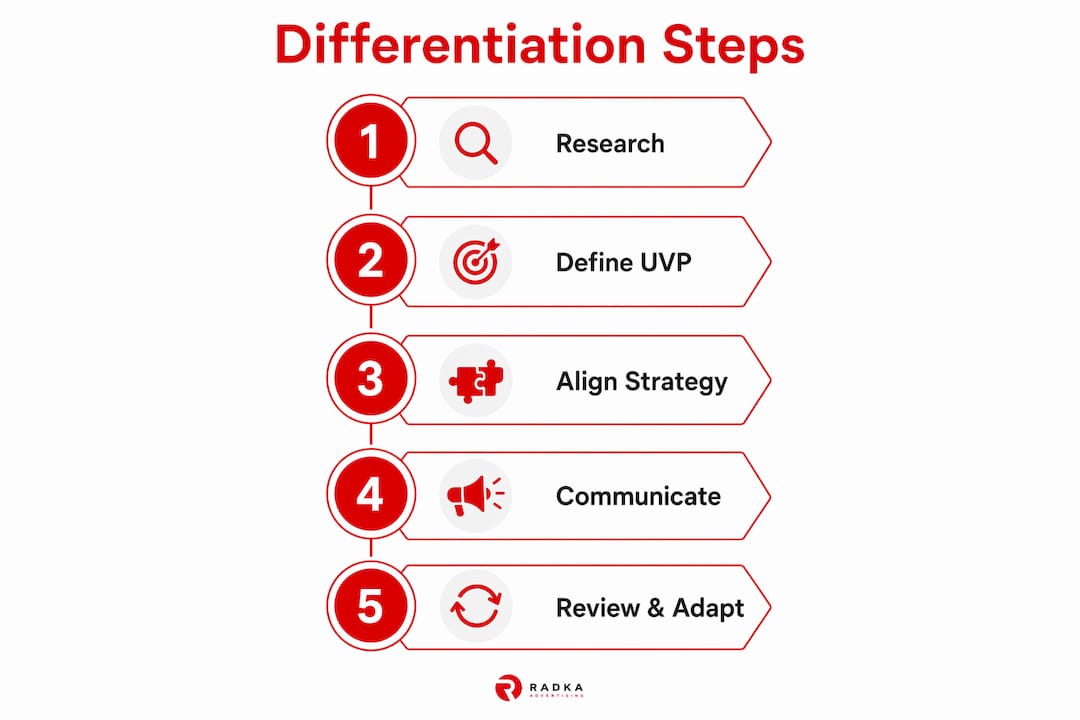
- How to develop and embed competitive differentiation step by step
- Common pitfalls and how to spot them early
- How Radkaadvertising helped a UK energy brand define its market position
- Key takeaways
- Why disciplined trade-offs beat vague “better” claims
- Radkaadvertising: brand strategy and differentiation built for results
- Useful sources
- FAQ
Why competitive differentiation matters for your business
Differentiation is not a branding exercise. It is a commercial lever. When customers perceive your offering as genuinely distinct, you gain pricing power, reduce churn, and attract buyers who are less sensitive to competitor discounts. Without it, you compete on price alone — a race most businesses cannot win sustainably.
The strategic risk has a name. Michael Porter called it being “stuck in the middle”: attempting to be both low-cost and differentiated without committing to either, which produces weak margins and no clear reason for customers to choose you. Porter’s framework is explicit — firms that fail to choose a clear position consistently underperform those that do.
Statistic callout: Content structured with a clear answer in the opening section is cited far more frequently by AI tools such as ChatGPT and Perplexity than content that buries its key claims. The same logic applies to your brand: customers and algorithms alike reward clarity about what you stand for.
The commercial consequences of poor differentiation are concrete:
- Price erosion: Undifferentiated suppliers are treated as commodities and face constant downward pressure on fees.
- High churn: Customers who chose you on price alone leave the moment a cheaper option appears.
- Sales inefficiency: Without a clear differentiator, sales teams default to discounting rather than value-based conversations.
- Talent and partner attraction: Strong differentiation signals market credibility, which matters when hiring or negotiating with distributors and media partners.
Competitive Intelligence Alliance notes that effective differentiation starts with understanding what customers genuinely value, not with copying what competitors do. That distinction shapes everything that follows.
Core elements you must define before communicating differentiation
Before any external messaging, your team needs internal alignment on five building blocks. Miss one and your differentiation will feel inconsistent to customers — even if the underlying product is strong.
- Unique value proposition (UVP). Use this template: “We help [specific customer segment] achieve [specific outcome] by [specific mechanism], unlike [competitor category] which [limitation].” Keep it to two sentences maximum. If it takes longer, the proposition is not clear enough yet.
- Target segment clarity. Differentiation only works relative to a specific buyer. Define the segment tightly: industry, company size, buying trigger, and the job they are trying to get done.
- Distinctive features mapped to value. List the three to five product or service features that directly solve the segment’s most painful problem. Then check: do customers actually notice and value these, or are they internal assumptions?
- Brand positioning and service model. Your complete product experience — onboarding, support, renewal — must reinforce the differentiator. A premium positioning claim collapses if the service experience feels budget.
- Pricing architecture and channel choices. Price signals positioning. A differentiated offering priced identically to a commodity alternative sends a confusing message. Decide whether your model (subscription, project-based, tiered) reinforces or undermines the claim.
Pro Tip: Run a “blind test” with three recent customers: show them your UVP with the brand name removed and ask whether it describes you or a competitor. If they hesitate, rewrite the UVP before spending another penny on marketing.

What types of differentiators can you actually pursue?
The six categories below cover the full range of options. Most businesses can credibly own one or two; trying to lead in all six is how differentiation becomes noise.
- Product and feature differentiation. Technical capability, design quality, or performance that competitors cannot easily replicate. Dyson’s engineering-led design and Apple’s hardware-software integration are textbook examples.
- Brand differentiation. Positioning, narrative, and visual identity that create emotional resonance. Nike’s association with athletic aspiration means customers pay a premium for products that are functionally similar to cheaper alternatives.
- Service and experience differentiation. Support quality, response times, onboarding depth, and SLA commitments. In B2B markets, this is often the most durable differentiator because it is hard to copy quickly.
- Price and commercial model differentiation. Subscription tiers, outcome-based pricing, or transparent flat fees can differentiate even when the underlying product is comparable. This works best when the pricing model itself solves a customer frustration.
- Channel and distribution differentiation. Where and how you sell matters. Reaching customers through a channel competitors ignore — direct-to-consumer, specialist trade press, or a specific digital platform — creates an asymmetric advantage.
- Technology and process differentiation. Proprietary workflows, AI-driven tools, or IP that make your delivery faster, more accurate, or more consistent than alternatives. This is increasingly relevant for agencies and professional services firms.
Aligning your omnichannel customer experience with the differentiator you choose is what makes the claim credible across every touchpoint.

Which frameworks help you choose and analyse a differentiation strategy?
Three tools do most of the heavy lifting. Use them in sequence rather than in isolation.
- Porter’s generic strategies. Porter’s framework/02%3A_Competitive_Advantage/2.06%3A_Selecting_Business-Level_Strategies/2.6.02%3A_Understanding_Business-Level_Strategy_through_Generic_Strategies) maps competitive advantage across two dimensions: cost versus uniqueness, and broad versus narrow scope. The four resulting positions are cost leadership, differentiation, cost focus, and differentiation focus. The framework’s primary value is forcing a choice — it makes the “stuck in the middle” risk visible before you commit resources.
- UVP canvas. Map customer jobs, pains, and gains against your product’s features and benefits. The canvas surfaces mismatches between what you think customers value and what they actually pay for. Use it in workshops with sales, product, and customer success teams together.
- Venn diagram prompt. Draw three overlapping circles: customer needs, your company’s genuine strengths, and gaps in competitor offerings. Your differentiation lives in the intersection of all three. If your claimed differentiator sits outside that intersection, it is either not valued, not credible, or already matched by rivals.
| Framework | Primary purpose | Best used when |
|---|---|---|
| Porter’s generic strategies | Choose a strategic position | Starting strategy or repositioning |
| UVP canvas | Map value to customer needs | Product development or messaging refresh |
| Venn diagram | Identify white space | Competitive analysis or new market entry |
| Competitive intelligence tools | Monitor rival moves | Ongoing market tracking |
| Win/loss analysis | Validate differentiators with real data | Post-sales review cycles |
Competitive intelligence tools — platforms that track competitor pricing, content, and positioning — complement these frameworks by keeping your analysis current. A strategy built on a competitor gap that no longer exists is worse than no strategy at all.
How to develop and embed competitive differentiation step by step
This sequence moves from discovery to measurement. Each step produces a specific output your team can act on.
- Discovery. Conduct customer interviews (aim for eight to twelve), run win/loss analysis on the last quarter’s deals, and map the competitive set. Output: a ranked list of what customers value most and where competitors fall short.
- Hypothesis. Define two or three candidate differentiators based on discovery findings. Write a testable value claim for each: “Customers who choose us over [competitor type] do so because [specific reason], which produces [specific outcome].”
- Design. Align product, brand, pricing, and operations to the chosen differentiator. Rework’s research is clear that differentiation is an organisational configuration, not a marketing slogan — every activity must reinforce the position.
- Go-to-market. Translate the differentiator into consistent messaging across channels. Aha!'s guidance frames marketing’s role precisely: communicate what the organisation already does differently, rather than inventing claims the product cannot support. Build a launch checklist covering messaging, sales enablement, and channel activation.
- Measurement. Track four KPIs: price premium capture (are you achieving above-market rates?), churn rate, Net Promoter Score, and win rate in competitive deals. Set a 90-day baseline before drawing conclusions.
- Iterate. Run monthly learning loops. Pivot signals include a win rate below 30% in competitive deals, NPS declining despite product improvements, or sales teams consistently discounting to close.
A well-crafted unique selling proposition is the output of steps one through three — not the starting point.
Common pitfalls and how to spot them early
Most differentiation failures are predictable. Here are the ones that appear most often, and the signals to watch for.
- Stuck in the middle. You are trying to be affordable and premium and full-featured. The symptom: your sales team pitches different things to different prospects with no consistent story.
- Differentiators customers do not recognise. You have invested in a capability that buyers cannot see or do not care about. The test: ask three prospects to name your top advantage unprompted. If the answers vary wildly, the differentiator is not landing.
- Feature bloat. Adding capabilities to match every competitor request until your offering is complex, expensive, and unfocused. Customers pay for outcomes, not feature counts.
- Delivery gap. Your marketing claims a premium experience that operations cannot consistently deliver. This is the fastest way to destroy trust — and the hardest to recover from.
- Copying competitors. Matching a rival’s new feature or price point reactively rather than defending your own position. Porter’s central recommendation is to pick a position and align activities to sustain it, not to chase every competitive move.
Pro Tip: Run a quarterly “red flag review”: ask your sales and customer success teams independently to complete this sentence — “Customers choose us because ___.” If the answers diverge significantly, your differentiation has drifted and needs realignment.
How Radkaadvertising helped a UK energy brand define its market position
Client context. A UK-based renewable energy services company was entering a crowded B2B market. Competitors offered similar technical specifications and comparable pricing. The client had no clear reason for buyers to choose them.
- Discovery. Radkaadvertising conducted twelve buyer interviews and a structured win/loss review of the client’s first six months of sales activity. The finding: procurement teams were not choosing on price — they were choosing on confidence in the supplier’s delivery track record.
- Hypothesis. The candidate differentiator was operational credibility: the client’s engineering team had a measurable project completion rate and zero missed SLAs in its first year. Competitors did not publicise equivalent data.
- Design. Brand identity, website messaging, and sales collateral were rebuilt around the “zero missed SLAs” proof point. Pricing was repositioned at a modest premium, supported by a performance guarantee.
- Go-to-market. A targeted content programme — case studies, technical white papers, and LinkedIn thought leadership — communicated the differentiator to procurement and operations decision-makers. PR distribution amplified three project case studies to trade publications.
- Measurement. KPIs tracked over 90 days: competitive win rate, average deal value, and inbound enquiry quality. The client also tracked NPS at project completion to validate the delivery claim.
You can review the agency’s client case studies for further examples of how this process plays out across different sectors.
Key takeaways
Competitive differentiation works when it is built on genuine organisational capability, validated by customers, and communicated consistently across every channel and touchpoint.
| Point | Details |
|---|---|
| Run the three-question diagnostic | Check whether customers can articulate your differentiator unprompted before investing in messaging. |
| Choose one strategic position | Porter’s framework shows that committing to cost leadership or differentiation outperforms attempting both. |
| Align operations to the claim | Differentiation is an organisational configuration — every activity must reinforce the chosen position. |
| Track four KPIs | Price premium capture, churn, NPS, and competitive win rate are the clearest signals that differentiation is working. |
| Radkaadvertising as your partner | The agency’s process moves from customer research and hypothesis through to brand design, go-to-market execution, and measurement. |
Why disciplined trade-offs beat vague “better” claims
Most businesses describe themselves as higher quality, more responsive, or better value than competitors. The problem is that every competitor says the same thing. Differentiation that actually moves buyers is specific, verifiable, and tied to something the organisation has genuinely chosen to be exceptional at.
The insight that tends to get overlooked is this: differentiation is as much about what you stop doing as what you start. A firm that commits to serving mid-market professional services clients with a fixed-scope, fixed-price model has made a trade-off — it will not chase enterprise deals or offer bespoke retainers. That trade-off is what makes the positioning credible. Vague “better” claims require no trade-offs, which is exactly why buyers do not believe them.
Cross-functional alignment is the other underrated factor. Marketing can articulate a differentiator brilliantly, but if the product team is building features for a different segment, or the sales team is discounting to close deals that undercut the premium positioning, the strategy collapses in practice. The organisations that sustain differentiation over time are the ones where product, sales, operations, and marketing are all working from the same strategic brief.
Markets shift, of course. A differentiator that was distinctive three years ago may be table stakes today. The answer is not to abandon the discipline of differentiation — it is to run the discovery process again, find the new gap, and realign activities accordingly.
Radkaadvertising: brand strategy and differentiation built for results
Positioning a brand so it stands apart in a crowded market takes more than a new logo or a refreshed strapline. Radkaadvertising works with UK businesses and international brands to define what genuinely sets them apart, then builds the brand identity, messaging, and multi-channel campaigns to make that position impossible to ignore.
The agency’s process starts with structured research — customer interviews, competitive mapping, and a positioning audit — before a single creative asset is produced. From there, the team aligns brand strategy, digital marketing, content, and paid media around the differentiator the client can credibly own and sustain. Whether that means a full brand strategy and services engagement or a focused SEO audit to assess how your current positioning performs in search, the starting point is always evidence, not assumption.
If you want to see how this works in practice, the agency’s case study portfolio shows the process and outcomes across multiple sectors. Ready to define what makes your business the obvious choice? Get in touch with Radkaadvertising to start the conversation.
Useful sources
| Source | What it contributes |
|---|---|
| Porter’s generic strategies (IFM Cambridge) | Framework for choosing between cost and differentiation positions; source of the “stuck in the middle” concept |
| Generic strategies (LibreTexts)/02%3A_Competitive_Advantage/2.06%3A_Selecting_Business-Level_Strategies/2.6.02%3A_Understanding_Business-Level_Strategy_through_Generic_Strategies) | Accessible explanation of all four generic strategies with trade-off analysis |
| What is competitive differentiation? (TechTarget) | Concise definitional source covering UVP, target market, and distinctive features |
| Competitive differentiation (Competitive Intelligence Alliance) | Practitioner-level guidance on competitive intelligence and organisational alignment |
| Competitive differentiation guide (Aha!) | Marketing’s role in translating differentiators into consistent messaging and channel execution |
| Differentiation strategy (Rework) | Deep treatment of differentiation as an organisational configuration requiring deliberate trade-offs |
| Porter’s generic strategies (Economics Help) | Accessible summary with UK-relevant examples (Dyson, Starbucks, Tesla) |
FAQ
What are the four types of competitive differentiation?
The four most widely recognised types are product differentiation, service differentiation, brand differentiation, and price or commercial model differentiation. Some frameworks add channel and technology differentiation as distinct categories, giving six in total.
What are Porter’s four competitive strategies?
Porter’s framework identifies cost leadership, differentiation, cost focus, and differentiation focus — derived from two dimensions: whether the advantage is cost-based or uniqueness-based, and whether the target scope is broad or narrow.
What is the difference between competition and competitive differentiation?
Competition describes the rivalry between firms for the same customers; competitive differentiation is the specific strategy a firm uses to give customers a reason to choose it over rivals. Without differentiation, competition defaults to price.
How do you compete on differentiation?
Choose one position your organisation can genuinely sustain, align every activity — product, pricing, service, and messaging — to reinforce it, and validate the claim with real customer evidence rather than internal assumptions.
What is brand differentiation and how does it relate to competitive differentiation?
Brand differentiation is a subset of competitive differentiation focused specifically on positioning, narrative, and visual identity. Competitive differentiation is the broader concept covering all the ways a business can stand apart, of which brand is one powerful dimension.