What is brand loyalty and why it matters in 2026

TL;DR:
- Brand loyalty is a customer’s deliberate choice to repeatedly buy from a brand based on emotional trust and positive experiences. Only a small percentage of UK consumers are truly loyal, making emotional connection vital for retention. Building loyalty requires consistent quality, personalized engagement, authentic values, and seamless customer experiences.
Brand loyalty is a customer’s committed preference to repurchase from one brand repeatedly, even when alternatives are available at similar prices or greater convenience. It goes well beyond habit. At its core, brand loyalty is built on emotional trust, positive experience, and a sense of identity that customers associate with a brand. Only 21% of UK consumers are truly loyal to specific online brands, which tells you just how hard that trust is to earn and how valuable it becomes once you have it.
What separates brand loyalty from general customer loyalty is the emotional dimension. A customer who shops at the same supermarket because it is closest to their home is not brand loyal. A customer who drives past three competitors to reach their preferred retailer, and tells their colleagues why, is. That distinction shapes everything from pricing power to word-of-mouth growth.
The defining characteristics of brand loyalty:
- Customers choose the brand consistently, not just when it is the cheapest option
- Emotional attachment and trust underpin purchasing decisions
- Loyal customers actively recommend the brand to others
- They are more resistant to competitor offers and price changes
- Loyalty persists across product categories within the same brand
- Positive experiences reinforce the relationship over time
Why brand loyalty matters for your business
Loyal customers are not just repeat buyers. They are your most cost-efficient growth channel. Acquiring a new customer costs considerably more than retaining an existing one, and loyal customers tend to spend more per transaction, return more frequently, and refer others without being asked.

The business case for brand loyalty runs deep. When markets tighten or competitors cut prices, loyal customers provide a revenue floor that price-sensitive shoppers never will. They also generate referral business organically, reducing your dependence on paid acquisition. For UK businesses navigating a competitive retail environment in 2026, that kind of stability is worth building deliberately.
Key business advantages of strong brand loyalty:
- Higher customer lifetime value (CLV) through repeat purchases and increased basket size
- Lower customer acquisition costs as advocacy drives organic referrals
- Greater resilience to competitor promotions and price wars
- Richer first-party data from engaged customers, enabling smarter personalisation
- Stronger brand reputation, which attracts new customers and talent alike
- More predictable revenue, which supports confident investment in growth
Pro Tip: Track the ratio of revenue from returning customers versus new customers each quarter. If returning customers account for a growing share, your loyalty efforts are working. If that share is flat or declining, your retention strategy needs attention before your acquisition budget.
Types of brand loyalty: which kind do your customers have?
Not all loyalty looks the same, and treating it as a single category leads to blunt strategy. Recognising the type of loyalty your customers hold lets you nurture it more precisely and spot where it is fragile.
- True loyalty: The gold standard. Customers have a genuine emotional attachment to the brand and choose it consistently, regardless of price or convenience. They advocate unprompted and are highly resistant to switching.
- Incentivised loyalty: Driven primarily by rewards, points, or discounts. Customers stay while the programme delivers value but will switch if a competitor offers a better deal. This is the most common and the most precarious form.
- Inherited loyalty: Passed down through family or social groups. A customer who buys the same tea brand their parents always bought, without much conscious evaluation, falls into this category.
- Silent loyalty: Customers who repurchase consistently but show no visible engagement. They do not complain, do not advocate, and are easy to lose without warning because they never signal dissatisfaction.
- Ethical loyalty: Rooted in shared values. Customers stay because the brand’s stance on sustainability, social responsibility, or community aligns with their own beliefs. This form is growing rapidly among younger UK consumers.
The most durable loyalty combines emotional and ethical dimensions with genuine product satisfaction. Incentivised loyalty alone, without an emotional layer, is rented rather than owned.
What drives brand loyalty and what destroys it
The main drivers
Product quality remains the foundation. No loyalty programme compensates for a product that consistently disappoints. Beyond quality, personalised communication and VIP experiences create emotional recognition that discounts alone cannot replicate. Customers want to feel seen, not just rewarded.

Consistency across all touchpoints is the baseline for trust. A brand that delivers a polished online experience but a frustrating in-store one sends a signal that the relationship is transactional. In competitive UK markets, those gaps erode confidence faster than any competitor campaign.
Drivers of strong brand loyalty:
- Consistent product and service quality across every interaction
- Personalised communication that reflects customer preferences and history
- Loyalty programmes that feel attainable and genuinely rewarding
- Emotional recognition, not just monetary rewards
- Clear and authentic brand values that customers can identify with
- Responsive customer service that resolves issues without friction
What weakens loyalty
Price sensitivity is the most obvious threat, but it is often a symptom of shallow emotional connection rather than the root cause. When a brand’s relationship with its customers is built entirely on discounts, a competitor’s lower price is all it takes to trigger a switch.
Poor loyalty programme design is a persistent problem. Programmes that are complex to navigate, slow to reward, or irrelevant to the customer’s actual behaviour create frustration rather than affinity. Instant gratification through discounts can actively reduce emotional loyalty by training customers to expect price cuts rather than value. Broken brand promises, whether a delivery that does not arrive or a customer service interaction that goes badly, can undo months of goodwill in a single experience.
Factors that weaken brand loyalty:
- Over-reliance on discounts that condition price-sensitive behaviour
- Loyalty programmes that are slow, complex, or feel unattainable
- Inconsistent brand experience across channels or locations
- Failure to respond to customer feedback or complaints
- Brand values that feel performative rather than genuine
- Ignoring long-term customers in favour of new customer acquisition offers
How to build brand loyalty: strategies that actually work
Building loyalty is not a campaign. It is an operating model. The brands that sustain it over years treat every customer interaction as an opportunity to reinforce the relationship, not just close a transaction.
-
Design loyalty programmes around data, not just discounts. Loyalty programmes are commercial infrastructure, not marketing promotions. The data they generate enables customer lifetime value modelling, churn prediction, and personalised campaign triggers. Build your programme to collect meaningful behavioural data, then use it.
-
Personalise at scale. Generic communications feel like noise. Use purchase history, browsing behaviour, and preference data to send messages that feel relevant to each customer. Even small personalisation signals, like a birthday offer or a restock alert for a previously purchased item, build a sense of being known.
-
Deliver consistent brand experiences across every channel. Your website, your social media, your packaging, and your customer service team should all feel like the same brand. Inconsistency signals that the brand does not have a coherent identity, and customers notice.
-
Reward emotional loyalty, not just transactional behaviour. Recognise customers who refer friends, leave reviews, or engage with your content. These behaviours signal genuine affinity and deserve acknowledgement beyond a points balance.
-
Use feedback as a retention tool. Personalised experiences and feedback mechanisms are among the most effective retention tools available. Ask customers what they think, act on what they tell you, and close the loop by telling them what changed.
-
Build community around the brand. Customers who feel part of something larger than a transaction are harder to poach. Forums, events, exclusive access, and user-generated content campaigns all create belonging that a competitor’s discount cannot replicate.
-
Balance transactional rewards with status-driven value. Tiers, VIP access, and exclusive experiences give customers something to aspire to beyond the next discount. This prevents the price sensitivity trap that pure cashback programmes create, and it cultivates the kind of enduring emotional loyalty that survives a competitor’s promotional push.
-
Invest in omnichannel engagement. Customers move between devices and channels constantly. A loyalty experience that works only on your app, or only in-store, will frustrate the customers who engage differently. Meet them where they are.
-
Use AI to turn data into action. AI tools can identify at-risk customers before they churn, surface the right offer at the right moment, and personalise communications at a scale no human team can match manually. The brands winning on loyalty in 2026 are using these tools not as experiments but as core infrastructure.
Pro Tip: Avoid building your entire loyalty proposition on discounts. Instead, layer in progressive value: start with attainable transactional rewards, then introduce status tiers and exclusive experiences as customers deepen their engagement. This structure rewards commitment rather than just spend, and it protects your margins.
For a deeper look at the retention mechanics that underpin loyalty, the customer retention strategies guide covers the tactical layer in detail.
UK consumer expectations and loyalty programme effectiveness in 2026
The UK loyalty market in 2026 is mature, value-conscious, and under pressure. Loyalty programmes are an institution here, not a novelty. But their effectiveness is under sharper scrutiny than ever, from both customers who are overloaded with schemes and leadership teams demanding measurable returns.
86% of UK marketers believe their loyalty programme makes customers feel valued. Only 54% of UK consumers agree. That perception gap is the defining challenge for UK brands in 2026.
The numbers on the marketer side are broadly positive. 91% of UK programme owners actively track loyalty ROI, and brands that measure it report an average 5.4X return. UK marketers also over-index on data collection as a loyalty priority, with 74% citing customer data as a key satisfaction driver, well above the global average of 60%. The UK’s long-standing emphasis on CRM maturity and first-party data strategies is visible in how programmes are designed and measured.
On the consumer side, the picture is more cautious. Only 33% of UK consumers say they are more likely to join a loyalty programme than last year, compared to 43% globally. The frustrations are specific: 57% say it takes too long to earn rewards, and 47% find the rewards unattractive. These are not vague complaints. They point directly to programme design failures that brands can fix.
Key insights for UK brands:
- 61% of UK consumers plan ahead to shop at retailers with loyalty schemes, showing intent is there even when emotional loyalty is not
- 61% of UK loyalty teams already use AI-powered tools, well above the global average of 51%
- UK consumers over-index on frustration when rewards feel unattainable, making speed-to-reward a critical design variable
- The perception gap between marketer confidence and consumer sentiment is the primary strategic risk for UK loyalty programmes
- Programmes that prioritise ease, relevance, and fairness outperform those built around complexity and aspirational rewards
Radkaadvertising works with brands across sectors to close exactly this kind of gap. The case studies on our portfolio show how data-driven brand strategy translates into measurable loyalty outcomes, from identity creation through to multi-channel campaign execution.
How do you measure brand loyalty?
Measurement is where loyalty strategy either proves its value or gets cut at the next budget review. Three metrics form the core of any serious loyalty measurement framework.
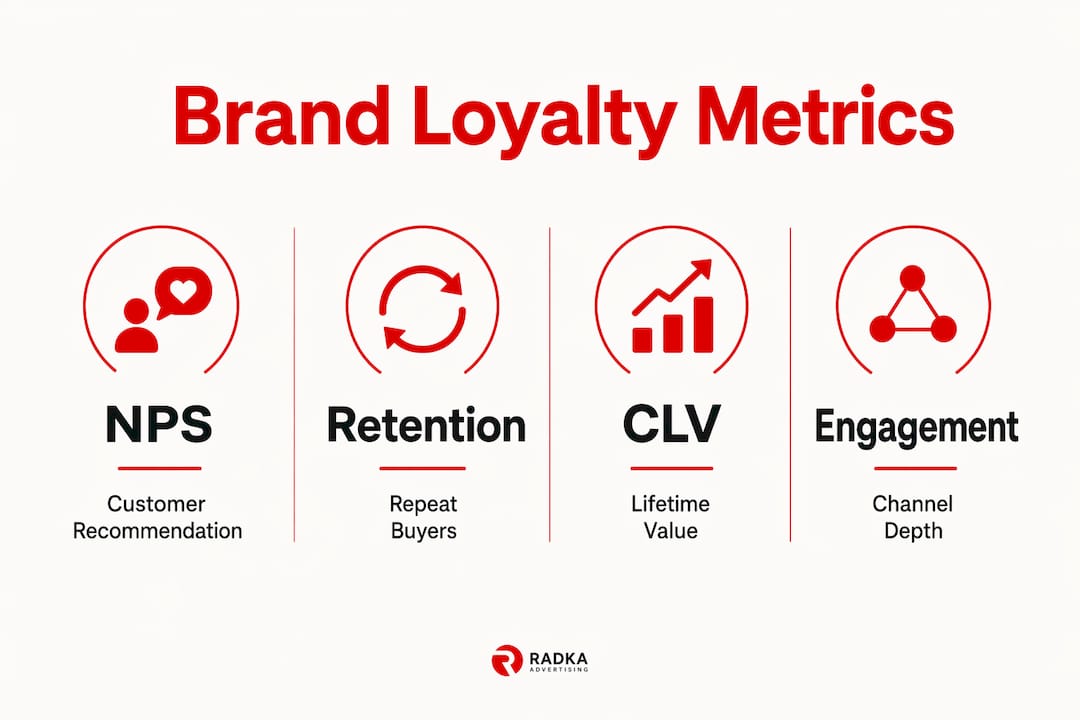
Net Promoter Score (NPS) asks customers how likely they are to recommend your brand on a scale of 0 to 10. It is a direct proxy for emotional loyalty and advocacy. Tracked over time, it reveals whether your loyalty efforts are moving the needle or just maintaining the status quo.
Customer retention rate measures the percentage of customers who continue buying over a defined period. A rising retention rate, combined with stable or growing revenue per customer, is the clearest signal that loyalty is compounding. Retention rate, customer lifetime value, and NPS together give you a triangulated view of loyalty health that no single metric can provide alone.
Customer lifetime value (CLV) quantifies the total revenue a customer generates over their relationship with your brand. It is the metric that makes the business case for loyalty investment most clearly. When CLV rises among your loyalty programme members versus non-members, you have proof that the programme is working.
Beyond these three, consider tracking repeat purchase rate, share of wallet (what proportion of a customer’s category spend goes to your brand), and programme engagement rates. Qualitative methods matter too. Exit surveys, social listening, and customer interviews surface the reasons behind the numbers, which is where the real strategic insight lives.
For brands using relationship marketing as a loyalty driver, tracking engagement depth across channels adds another layer of diagnostic clarity.
Examples of strong brand loyalty in practice
The brands that consistently generate the strongest loyalty share a common pattern. They do not rely on any single tactic. Instead, they build loyalty across multiple dimensions simultaneously: product excellence, emotional resonance, community, and consistent experience.
Apple is the most cited example in the UK and globally, and for good reason. Its loyalty is not primarily incentivised. Customers return because the product ecosystem creates genuine switching costs, the brand identity aligns with how customers see themselves, and the in-store and support experience reinforces the premium positioning at every touchpoint. Apple’s loyalty is true loyalty in the most complete sense.
Greggs offers a different but equally instructive case. A British brand with a loyal following built on consistency, value, and a personality that feels genuinely local. The Greggs Rewards app gamifies the loyalty experience without overcomplicating it, and the brand’s social media presence has created a community of advocates who promote it without being asked. Greggs demonstrates that loyalty does not require a premium price point.
Tesco Clubcard remains one of the UK’s most effective loyalty infrastructures. Its power lies not in the points themselves but in the data those points generate, enabling Tesco to personalise offers at scale and make customers feel understood rather than just rewarded. The Clubcard has become part of how millions of UK households think about their weekly shop.
What these examples share is deliberate design. None of these loyalty outcomes happened by accident. Each brand made consistent choices about experience, communication, and value that compounded over time into something competitors find genuinely difficult to replicate.
How customer experience shapes brand loyalty
Customer experience is the mechanism through which loyalty is either built or broken. Every interaction a customer has with your brand, from the first ad they see to the way a complaint is handled, either adds to or subtracts from the emotional account that loyalty runs on.
The brands with the strongest loyalty tend to obsess over the moments that matter most. A product that arrives damaged, a support call that goes unresolved, or a checkout process that requires too many steps all create friction that erodes trust. Conversely, a proactive refund, a personalised follow-up, or an unexpectedly smooth return process can turn a neutral customer into an advocate.
Consistency is the non-negotiable baseline. Any gap in brand experience across channels erodes consumer confidence faster than a competitor’s campaign can. UK consumers in 2026 have high expectations and low patience for brands that deliver inconsistently. They will not always tell you when they are disappointed. They will simply leave.
The practical implication is that customer experience investment is loyalty investment. Training your service team, auditing your digital touchpoints, and mapping the full customer journey are not operational tasks separate from your loyalty strategy. They are the strategy.
Key takeaways
Brand loyalty is built on emotional trust and consistent experience, not discounts alone, and UK brands that close the gap between marketer confidence and consumer sentiment will outperform those that rely on transactional incentives.
| Point | Details |
|---|---|
| Loyalty is emotional, not just transactional | Only 21% of UK consumers are truly loyal to specific online brands; emotional connection drives the rest. |
| Perception gap is the core UK challenge | 86% of UK marketers believe loyalty makes customers feel valued, but only 54% of consumers agree. |
| Data is the real loyalty asset | 74% of UK marketers cite customer data as a key satisfaction driver, well above the 60% global average. |
| Speed to reward matters | 57% of UK consumers say it takes too long to earn rewards, making attainability a critical design variable. |
| Measure what matters | Retention rate, CLV, and NPS together give the clearest picture of loyalty health and programme ROI. |
FAQ
What do you mean by brand loyalty?
Brand loyalty is a customer’s consistent preference to repurchase from one brand over competitors, driven by emotional trust and positive experience rather than price alone. It goes beyond habit to reflect a genuine attachment to the brand’s identity and values.
What is an example of brand loyalty?
Apple is a widely cited example. Its customers return consistently across product categories, advocate unprompted, and resist competitor offers, not because of discounts but because of the brand’s ecosystem, identity, and experience.
What is a brand loyalist?
A brand loyalist is a customer who chooses a specific brand repeatedly and deliberately, even when alternatives are cheaper or more convenient. They typically advocate for the brand and are resistant to switching, making them the most commercially valuable customer segment.
What are the four stages of loyalty?
Customers typically move through cognitive loyalty (awareness of the brand’s advantages), affective loyalty (a positive emotional feeling toward the brand), conative loyalty (a strong intention to repurchase), and action loyalty (consistent repurchase behaviour that becomes habitual). Each stage requires different engagement to progress.