What is a marketing funnel: a practical 2026 guide

TL;DR:
- A marketing funnel maps the customer journey from brand awareness to purchase and advocacy. It serves to align marketing and sales teams while filtering prospects and identifying drop-off points for improvement.
A marketing funnel is defined as a model that maps the customer journey from first awareness of a brand through to purchase and, in extended models, loyal advocacy. The concept traces back to Elmo Lewis’s AIDA model, first described in 1898, which structured the journey as Awareness, Interest, Desire, and Action. That framework remains the foundation for every funnel model used today. The funnel metaphor is deliberate: a wide top captures a large audience, and each stage filters prospects down to a smaller, more committed group. For marketing professionals and business owners, understanding this model is the starting point for building campaigns that convert.
The funnel also serves a critical alignment function. It creates a shared language between marketing and sales teams, defining exactly when a prospect moves from one stage to the next and who owns that relationship. Without that structure, leads fall through the gaps.

What is a marketing funnel and what are its core stages?
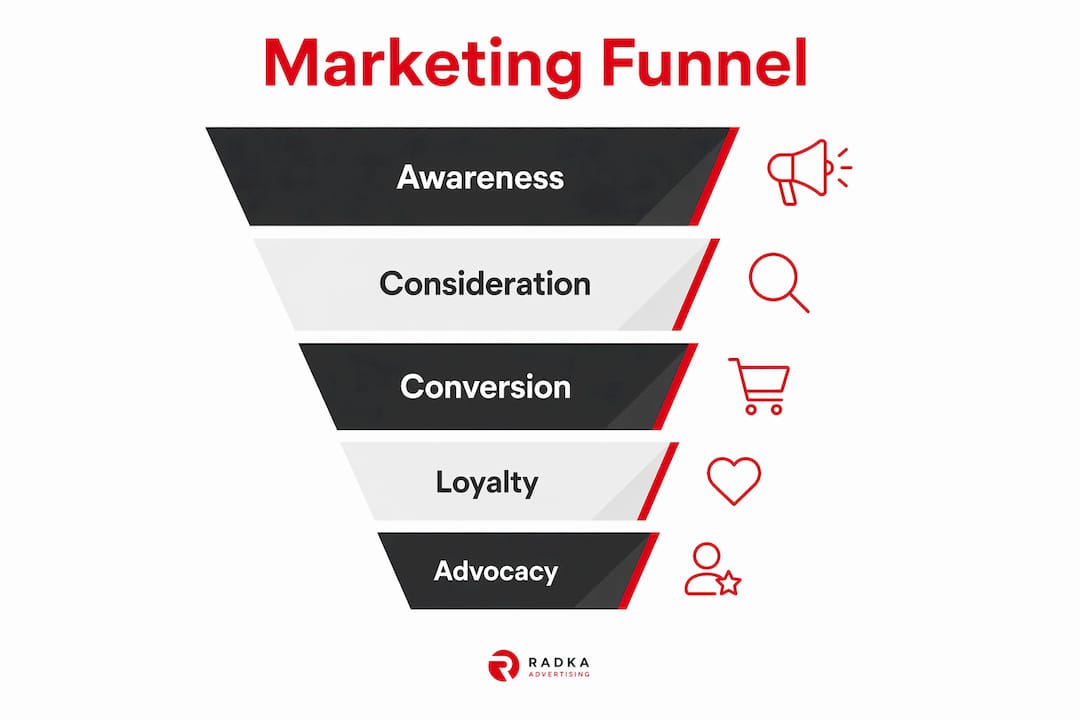
Industry standard identifies three core funnel stages: Top of Funnel (Awareness), Middle of Funnel (Consideration), and Bottom of Funnel (Conversion). Many businesses extend this to five stages by adding Loyalty and Advocacy. Each stage reflects a distinct mindset in the prospect, and the tactics that work at one stage will actively harm results at another.
Top of funnel: awareness
The awareness stage is where prospects first encounter your brand. The primary goal here is not to sell. According to Salesforce, the awareness stage goal is to establish the company as an authoritative voice, not to drive immediate purchases. Tactics that work here include SEO-driven blog content, social media posts, paid display advertising, and PR coverage. The audience is broad and largely unqualified at this point, which is exactly why the funnel is wide at the top.
Middle of funnel: consideration
Prospects in the consideration stage know they have a problem and are actively evaluating solutions. This is where email nurture sequences, webinars, comparison guides, and case studies do their best work. The prospect is not ready to buy, but they are ready to be educated. Brands that push for a sale here consistently lose ground to those that build authority through useful content.
Bottom of funnel: conversion and beyond
The conversion stage is where purchase decisions happen. Tactics here include free trials, product demos, pricing page visits, and direct sales outreach. Stage-specific content such as demos and trials drives conversion far more effectively than generic brand messaging. Extended funnel models add Loyalty and Advocacy stages after conversion, turning customers into repeat buyers and brand referrers. These post-purchase stages are frequently neglected, yet they represent the lowest-cost route to revenue growth.
Pro Tip: Match your messaging precisely to the prospect’s stage. A prospect in the awareness stage who receives a pricing email will disengage. A prospect at the conversion stage who receives a generic brand awareness post will feel ignored.
How does the marketing funnel improve lead generation and conversion?
The funnel’s primary function as a lead generation tool is filtration. Amplitude explains that the funnel shape is intentionally designed to filter out unqualified prospects, allowing sales teams to focus their time on a smaller, high-quality segment. That focus directly reduces the cost per acquisition and increases close rates.
The practical benefits become clearest when you apply funnel analytics to identify where prospects drop off. A campaign generating strong awareness traffic but weak consideration engagement signals a content gap at the middle stage. A campaign with strong consideration metrics but poor conversion rates points to a pricing, UX, or trust issue at the bottom. Without the funnel model, these problems are invisible.
Here is a structured approach to using the funnel for lead generation improvement:
- Audit your current traffic sources against funnel stages. Identify which channels feed the top, middle, and bottom of your funnel and whether the volume at each stage is proportionate.
- Map content assets to stages. Every piece of content you produce should serve a specific funnel stage. If your content library is top-heavy with awareness posts and thin on consideration-stage guides, you will lose prospects in the middle.
- Set conversion benchmarks. The average B2B funnel converts between 3% and 7% of total leads into paying customers. That figure sets a realistic baseline. If your rate sits below 3%, the problem is likely at the bottom of the funnel. If your top-funnel volume is too low to generate enough leads, the problem starts at awareness.
- Implement lead scoring. Assign point values to prospect behaviours such as email opens, page visits, and content downloads. When a prospect crosses a defined threshold, trigger a handoff to sales or a more direct conversion sequence.
- Review and refine monthly. Funnel performance shifts with market conditions, competitor activity, and seasonal demand. A monthly review cycle catches problems before they compound.
Pro Tip: Avoid pushing for a sale before a prospect has consumed at least two or three pieces of consideration-stage content. Premature closing attempts signal a lack of trust in your own product and consistently reduce conversion rates.
What are the main variations in marketing funnel models?
Not every business fits neatly into a three-stage funnel. The AIDA model, the three-stage model, and the five-stage model each serve different purposes, and choosing the wrong one creates misalignment between your marketing activity and your actual customer behaviour.
| Funnel model | Stages | Best suited for |
|---|---|---|
| AIDA (1898) | Awareness, Interest, Desire, Action | Brand and campaign planning |
| Three-stage | Top, Middle, Bottom | B2B lead generation and sales alignment |
| Five-stage | Awareness, Consideration, Conversion, Loyalty, Advocacy | Subscription and repeat-purchase businesses |
| Circular/iterative | Multiple touchpoints, non-linear | Complex B2B sales with long decision cycles |
The most important insight about funnel models is that actual customer journeys are often circular and iterative, not strictly linear. A prospect may move from consideration back to awareness after encountering a competitor. They may revisit your pricing page three times before converting. Treating the funnel as a one-way pipe causes marketers to miss re-engagement opportunities at every stage.
Funnel leakages, the points where prospects exit without converting, are frequently caused by UX friction or mismatches between the content and the buyer persona. A technically sound campaign that targets the wrong audience profile will leak at every stage. Lead scoring and qualification criteria define the marketing-to-sales handoff point, and this handoff is where many B2B campaigns fail. Poor lead scoring sends unqualified prospects to sales too early, wasting resource and damaging the prospect relationship. Disconnected data systems between marketing and sales platforms compound the problem by creating blind spots in the handoff process.
The practical fix is to define explicit handoff criteria before a campaign launches, not after. Agree with your sales team on the exact behaviours that qualify a lead for direct outreach, document them, and build your lead scoring model around those criteria.
How to build an effective marketing funnel strategy
Building a funnel that actually converts requires more than drawing a diagram. Effective funnel strategies depend on accurate customer journey mapping and continuous refinement based on real conversion data. The following steps translate the model into practice.
- Define your buyer personas with precision. A persona built on demographic data alone is insufficient. Include the specific questions your prospect asks at each funnel stage, the objections they raise before purchasing, and the channels they use to research solutions.
- Map every touchpoint to a funnel stage. List every channel, content type, and campaign you run. Assign each one to a funnel stage. Gaps in your map are gaps in your funnel.
- Align your content calendar to the funnel. Awareness content (SEO articles, social posts, press coverage) should feed a steady stream of new prospects. Consideration content (guides, webinars, case studies) should nurture those prospects toward a decision. Conversion content (demos, trials, testimonials) should close the gap between intent and purchase.
- Build a lead generation framework that connects top-funnel traffic to a qualification mechanism. A gated content asset, a free audit, or a diagnostic tool can move a prospect from anonymous visitor to identified lead in a single interaction.
- Track funnel metrics at each stage separately. Aggregate conversion rates hide the real problems. Measure the conversion rate from awareness to consideration, from consideration to conversion, and from conversion to retention independently. Each metric points to a different part of the funnel that needs attention.
- Test and iterate on a fixed cycle. Change one variable at a time, measure the result over a defined period, and document what you learn. Funnels that improve consistently are built on disciplined testing, not intuition.
Key takeaways
A marketing funnel works because it gives every stage of the customer journey a defined purpose, a specific content type, and a measurable conversion point.
| Point | Details |
|---|---|
| Funnel definition | A model mapping the customer journey from awareness to purchase and advocacy. |
| Core stages | Top (Awareness), Middle (Consideration), and Bottom (Conversion) are the three standard stages. |
| B2B conversion benchmark | Average B2B funnels convert 3%–7% of leads, making top-funnel volume critical for revenue. |
| Handoff alignment | Define lead scoring criteria before launch to prevent marketing-to-sales handoff failures. |
| Continuous refinement | Measure conversion rates at each stage separately and test one variable at a time. |
Why most funnels fail before the sale is even attempted
The most common funnel mistake I see is not a tactical one. It is a structural one. Businesses build awareness campaigns that work, generate genuine interest, and then hand those warm prospects to a sales team that treats them like cold leads. The prospect feels the disconnect immediately, and the relationship breaks down.
The second most common mistake is treating the funnel as a fixed structure rather than a living model. Real customer behaviour does not follow a neat downward path. Prospects circle back, revisit earlier stages, and sometimes exit entirely before re-entering months later. A funnel model that cannot account for re-entry will consistently undercount its own pipeline.
What actually works is building the funnel around the questions your prospects are asking at each stage, not around the content formats you find easiest to produce. A prospect in the consideration stage does not need another brand awareness post. They need a direct answer to the specific objection that is stopping them from moving forward. When you map content to questions rather than to formats, the funnel starts to function as it should.
The data supports patience. The 3%–7% B2B conversion rate benchmark exists because most qualified buyers need multiple touchpoints before they commit. Rushing that process does not accelerate the sale. It ends it.
— Bart
How Radkaadvertising supports your funnel performance
Radkaadvertising works with brands at every stage of the funnel, from building awareness through multi-channel campaigns to converting qualified leads through targeted content and data-driven strategy. The agency’s work spans brand positioning, digital marketing, and creative content, with a track record across clients including Coca-Cola, Maybelline, and PowerLink Energy. If you want to see how funnel thinking translates into measurable results, the client case studies show the full picture. For brands ready to audit their current funnel performance and identify where leads are being lost, the full services overview covers the specific capabilities Radkaadvertising brings to each stage of the customer journey.
FAQ
What is a marketing funnel in simple terms?
A marketing funnel is a model that shows the stages a customer moves through, from first hearing about a brand to making a purchase. Each stage narrows the audience as prospects qualify themselves through their behaviour.
What are the main stages of a marketing funnel?
The three core stages are Awareness (Top of Funnel), Consideration (Middle of Funnel), and Conversion (Bottom of Funnel). Many businesses add Loyalty and Advocacy stages after the initial purchase.
What is the difference between a marketing funnel and a sales funnel?
A marketing funnel covers the full customer journey from awareness to conversion and beyond. A sales funnel typically refers to the later stages of that journey, from qualified lead through to closed deal, and is owned by the sales team rather than marketing.
What conversion rate should I expect from a B2B marketing funnel?
The average B2B funnel converts between 3% and 7% of total leads into paying customers. This benchmark underscores why maintaining a large, well-qualified top-of-funnel audience is critical for consistent revenue.
Why do marketing funnels fail?
Funnel failures most commonly occur at the handoff point between marketing and sales, driven by poor lead scoring or disconnected data systems. UX friction and buyer persona mismatches are the next most frequent causes of drop-off.