What is a digital transformation? A guide for executives

TL;DR:
- Digital transformation involves a complete shift in business models, culture, and processes driven by digital technology. It is not just an IT project or digitisation but a strategic overhaul that requires ongoing leadership commitment and organizational change. Executives who focus on customer outcomes and adapt continuously achieve better operational, financial, and brand growth results.
Digital transformation is defined as the strategic integration of digital technology into every part of a business, fundamentally changing how it operates and delivers value to customers. The term covers far more than software upgrades or moving files to the cloud. It describes a complete rethinking of business models, workflows, and culture, driven by technologies such as artificial intelligence, cloud computing, and the Internet of Things. For business owners and executives, understanding the definition of digital transformation is the first step toward using it to improve operational efficiency and customer engagement in measurable ways.
What does digital transformation involve beyond technology adoption?
Digital transformation is not an IT project. True digital transformation is a strategic, customer-centric shift that reshapes the entire business model, not just the tools a company uses. Executives who treat it as a technology purchase miss the point entirely.
Three related terms are often confused, and the distinctions matter:
- Digitisation converts analogue information into digital format. Scanning paper invoices into PDFs is digitisation.
- Digitalisation uses digital data to improve existing processes. Automating invoice approval via software is digitalisation.
- Digital transformation goes further. It changes the business model itself. A publisher that stops selling print and becomes a subscription-based digital platform has undergone transformation.
The difference between the second and third term is where most executives lose the thread. Digitalisation makes existing processes faster. Transformation makes those processes obsolete and replaces them with something fundamentally different.
Cultural and organisational change drives transformation as much as technology does. Amazon did not become dominant by digitising retail. It rebuilt the entire customer expectation around speed, personalisation, and convenience. Netflix did not digitise video rental. It eliminated the concept of rental entirely. Both examples show that business model innovation sits at the core of genuine transformation.

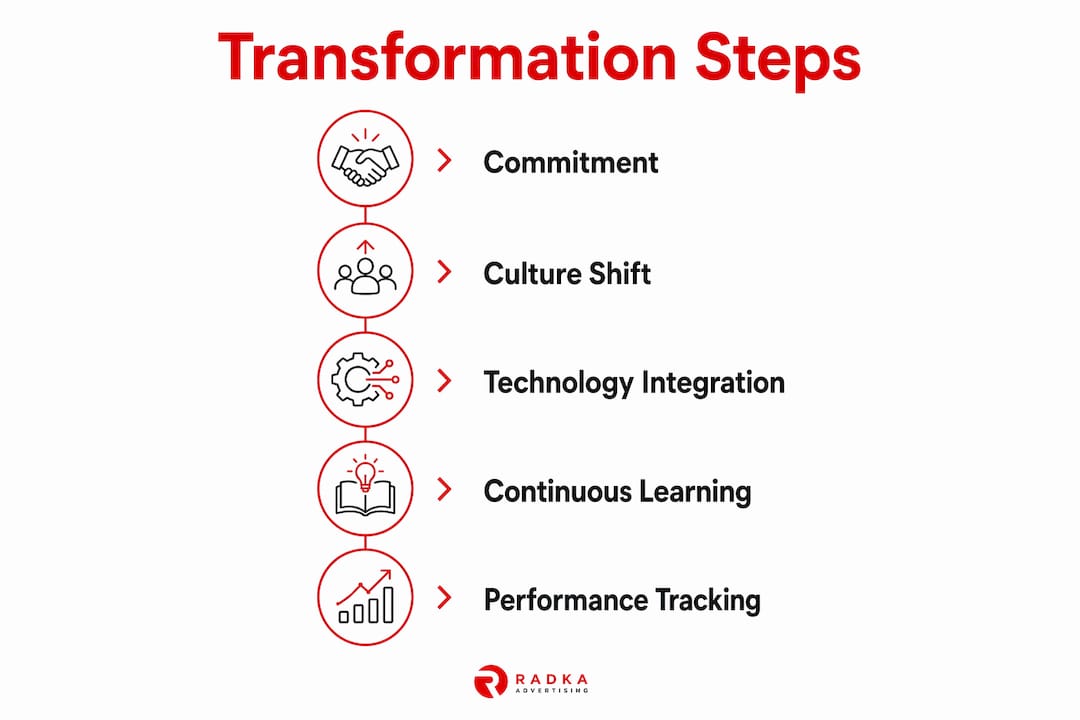
Leadership commitment is non-negotiable. Transformation requires executives to model new behaviours, invest in continuous learning, and accept that the process has no defined end date. Organisations that treat it as a one-off initiative consistently underperform those that treat it as an ongoing operating principle.
Pro Tip: Before launching any digital initiative, map your current business model on paper. If the initiative does not change at least one element of how value is created or delivered, it is digitalisation, not transformation.
What are the main advantages of digital transformation for businesses?
The financial case for transformation is well documented. Digitally mature companies generate 9% more revenue from physical assets and carry higher profit margins than peers who have not fully committed to the process. That gap compounds over time as digital capabilities become harder to replicate.
Operational gains are equally significant. The table below summarises the most cited efficiency outcomes:
| Operational area | Measured outcome |
|---|---|
| Unplanned downtime | 50% reduction via IoT and predictive analytics |
| Maintenance costs | 40% reduction through predictive maintenance programmes |
| Customer service volume | Up to 10x scalability without proportional headcount increases |
| Net Promoter Score | 15–25 point improvement for businesses focused on customer experience |
Manufacturers using IoT sensors and predictive analytics cut unplanned downtime by 50%. That figure translates directly into production capacity and reduced emergency repair costs. For a mid-sized manufacturer, the saving can represent millions of pounds annually.
Customer engagement improvements are equally concrete. Businesses that prioritise customer experience as part of their digital programmes improve their Net Promoter Score by 15–25 points on average. NPS gains of that magnitude typically correlate with measurable increases in repeat purchase rates and customer lifetime value.
Scalability is the advantage executives underestimate most. Digital transformation enables businesses to handle up to ten times their previous customer service volume without a proportional increase in headcount. That means a company can grow its customer base aggressively without the cost structure growing at the same rate. For any executive planning international expansion, that ratio changes the economics of growth entirely.
The advantages of digital transformation extend to brand positioning as well. Businesses that operate with digital-first models attract talent, partners, and investors who view analogue operations as a liability. Digital maturity signals organisational health.
How can businesses successfully implement digital transformation?
Successful implementation follows a clear sequence. Skipping steps is the most common reason well-funded initiatives stall.
-
Align transformation goals with business strategy. Every digital initiative must connect to a specific business outcome, whether that is reducing cost, increasing revenue, or improving customer retention. Initiatives without a business case become expensive experiments.
-
Run pilot programmes before committing at scale. Smaller pilot programmes demonstrate value and test practicability before enterprise-scale investment. A pilot in one department or one market gives executives real data on feasibility, adoption rates, and return on investment.
-
Secure employee buy-in early. Failure to engage employees and adapt workflows stalls digital initiatives despite substantial investment. Employees who understand why change is happening adopt new tools faster and surface problems earlier.
-
Appoint clear ownership. Digital transformation managers blend innovation scouting with strategic alignment to business goals, measuring success carefully before scaling. Without a named owner, accountability diffuses and momentum stalls.
-
Measure continuously and adapt. Set specific metrics before launch. Track them monthly. Adjust the approach based on what the data shows, not what the original plan assumed.
The most common mistake executives make is treating implementation as a project with a completion date. Digital transformation has milestones, not a finish line. Markets shift, customer expectations evolve, and new technologies emerge. The implementation process must be built to adapt, not to conclude.
Pro Tip: Pair every technology rollout with a structured change management programme. Assign a named internal champion in each affected team. Champions reduce resistance and accelerate adoption faster than any training course alone.
Understanding digital marketing challenges in 2026 is also relevant here, as many implementation barriers are rooted in marketing and customer-facing systems rather than back-office technology.
What challenges and misconceptions surround digital transformation?
The biggest misconception is that digital transformation is an IT project. Most executives mistakenly view it as a one-time technology upgrade rather than a continuous cultural change requiring sustained leadership commitment. That framing leads to underinvestment in culture and overinvestment in software licences.
Several other misconceptions consistently derail well-intentioned programmes:
- Off-the-shelf strategies rarely work. Generic transformation frameworks often fail because success depends on configuring approaches to sector-specific conditions and organisational maturity. A retail transformation looks nothing like a manufacturing transformation.
- Culture and identity are not soft concerns. Ignoring employee buy-in and workflow adaptation is a frequent cause of stalled initiatives. Culture is the operating system that either runs new tools or rejects them.
- Transformation is not a destination. Research frames it as a contingent dynamic capability, meaning organisations must continuously reconfigure their digital and organisational capabilities in response to market pressure. The companies that treat transformation as complete are the ones that fall behind.
- Technology alone does not create competitive advantage. Two companies can buy identical software. The one with better processes, clearer goals, and stronger employee engagement will extract more value from it every time.
The role of AI in this context deserves specific attention. AI tools such as those used in marketing strategy and customer engagement are accelerating the pace at which transformation must happen. Executives who delay face a widening capability gap, not a stable status quo.
Key takeaways
Digital transformation is a continuous, company-wide shift in business model, culture, and capability, not a technology purchase or a one-off project.
| Point | Details |
|---|---|
| Definition clarity | Digital transformation reshapes business models and culture, not just technology systems. |
| Financial impact | Digitally mature companies generate 9% more revenue from physical assets than less mature peers. |
| Operational gains | IoT and predictive analytics reduce unplanned downtime by 50% and maintenance costs by 40%. |
| Implementation discipline | Pilot programmes and named ownership prevent costly, directionless enterprise rollouts. |
| Ongoing commitment | Transformation is a contingent dynamic capability requiring continuous adaptation, not a fixed endpoint. |
Why leadership, not technology, decides transformation outcomes
The most important thing I have observed working with brands across multiple sectors is this: the technology is rarely the problem. Executives who struggle with digital transformation almost always have a leadership problem dressed up as a technology problem. They buy the platform, hire the consultants, and announce the initiative. Then they step back and wait for results.
Transformation does not work that way. The executives who get results stay close to the process. They ask hard questions about adoption rates. They remove blockers personally. They treat the first failed pilot as data, not as a reason to abandon the programme. That posture is what separates companies that genuinely change from those that spend heavily and drift back to old habits.
The customer-centric framing matters more than most executives realise. Every technology decision should be tested against one question: does this make it easier for our customers to get what they need from us? If the answer is no, the investment is internal efficiency at best and distraction at worst. The brands I have seen succeed with transformation, including those Radkaadvertising has worked with across industries from energy to consumer goods, share one trait. They start with the customer outcome and work backwards to the technology, not the other way around.
Flexibility is not a nice-to-have. The organisations that build rigid five-year transformation roadmaps consistently miss the market shifts that happen in year two. Build the direction, not the map.
— Bart
How Radkaadvertising supports businesses through digital change
Radkaadvertising works with brands at every stage of digital evolution, from initial positioning to full multi-channel execution. The agency’s client case studies span industries including consumer goods, energy, and beauty, demonstrating how brand strategy and digital capability combine to produce measurable commercial results. For executives ready to assess where their business stands, the AI growth consulting service provides a structured starting point, mapping current capabilities against growth objectives. Radkaadvertising’s approach connects brand identity, data-driven campaigns, and customer engagement into a single, coherent programme rather than a collection of disconnected tools.
FAQ
What is the simplest definition of digital transformation?
Digital transformation is the integration of digital technology into all areas of a business, fundamentally changing how it operates and delivers value to customers. It includes changes to business models, culture, and workflows, not just technology systems.
How does digital transformation differ from digitisation?
Digitisation converts analogue information to digital format, while digital transformation reshapes the entire business model and how value is created. Digitisation is a step; transformation is a strategic direction.
What is the role of digital transformation in improving customer experience?
Businesses that prioritise customer experience as part of their digital programmes improve their Net Promoter Score by 15–25 points on average. Digital tools enable faster, more personalised service at a scale that manual processes cannot match.
Why do digital transformation programmes fail?
Most failures trace back to treating transformation as a one-time IT project rather than a continuous cultural change. Failure to secure employee buy-in and adapt workflows stalls initiatives even when the technology investment is substantial.
How long does digital transformation take?
Digital transformation has no fixed endpoint. Research describes it as a contingent dynamic capability, meaning organisations must continuously reconfigure their approach as market conditions and technologies evolve.