Digital channels explained: your practical marketing guide

A digital channel is any online pathway a business uses to reach, engage, and distribute its offerings to an audience, as Coursera’s digital marketing overview defines it. The main types are:
- Search (organic SEO and paid search ads)
- Social media (organic posts and paid social)
- Email (newsletters, automated sequences, transactional messages)
- Website and content (blog, landing pages, video on owned domains)
- Display and paid advertising (banner ads, programmatic, YouTube pre-rolls)
- Affiliates and partners (referral networks, influencer partnerships, PR)
- Messaging, SMS and apps (push notifications, WhatsApp Business, in-app messages)
Pro Tip: Assign each channel a primary role before you build a plan. Awareness channels (social, display) feed acquisition channels (search, email), which feed retention channels (email, SMS). Mixing those roles without intention is where most budgets leak.
Key takeaways
Digital channels are online pathways that connect businesses to audiences; the most effective programmes combine owned, earned, and paid channels into a single, measurable system.
| Point | Details |
|---|---|
| Define before you deploy | A digital channel is any online pathway used to reach, engage, or distribute to an audience. |
| Use the owned/earned/paid framework | Classify every channel before budgeting: owned builds long-term assets, paid delivers speed, earned builds authority. |
| Channels work as a system | A social ad that feeds search, then email, then SMS outperforms any single channel running alone. |
| Match metrics to channel goals | Track CTR and CPA for paid, open rate for email, engagement rate for social, and CVR for owned content. |
| UK compliance is non-negotiable | ICO consent rules, UK GDPR, and ASA disclosure requirements apply to every active digital channel. |
Table of Contents
- How are digital channels classified?
- What does each digital marketing channel actually do?
- How do channels work together across a customer journey?
- Which metrics matter most for each channel?
- How do you choose the right channels for your goals?
- What UK rules apply to digital channels?
- Best practices and common pitfalls
- An agency practitioner’s view on channel strategy
- Working with Radkaadvertising on your channel strategy
- Sources
- FAQ
How are digital channels classified?
Dave Chaffey’s digital media channels framework groups every channel into three classes: owned, earned, and paid. A second cut, organic versus paid, maps directly onto cost and speed.
Owned media is anything you control: your website, email list, app, and social profiles. You bear the build cost once and the channel is yours indefinitely. Earned media is coverage you win rather than buy: press mentions, organic shares, reviews, and word-of-mouth. Paid media is straightforward: you pay per click, per impression, or per placement, and the traffic stops the moment the budget does.
The organic/paid split cuts across all three classes. Organic search is owned in the sense that you control the content, but the ranking is earned through quality and authority. Paid search is bought traffic to an owned landing page.
| Class | Control | Cost profile | Speed to results | Typical KPIs |
|---|---|---|---|---|
| Owned | High | Build cost, then low marginal cost | Slow to build, durable | Sessions, email open rate, bounce rate |
| Earned | Low | Time and relationship investment | Unpredictable | Mentions, backlinks, share of voice |
| Paid | High (while live) | Ongoing spend per click/impression | Fast | CPA, ROAS, CTR, impressions |
| Organic (cross-class) | Medium | Content and SEO investment | Months to compound | Rankings, organic sessions, CVR |
Quick examples to anchor each class:
- Owned: your company blog, email newsletter list, branded app
- Earned: a BBC News mention, a viral LinkedIn post, a five-star Google review
- Paid: Google Search Ads, Meta Ads, programmatic display
- Organic (within owned): a blog post ranking on page one without ad spend
What does each digital marketing channel actually do?
Salesforce’s marketing channels guide notes that most businesses perform best with a deliberate mix of digital and traditional channels rather than going all-in on one. Here is what each digital channel brings to that mix.
Search: organic and paid
Search captures intent at the moment it exists. When someone types “accountant in Manchester” or “best running shoes UK,” they are already in buying mode. Organic search (SEO) earns rankings through content quality, technical health, and backlinks; paid search (PPC) buys position above those rankings instantly.

Search engine market share data from Statista shows Google’s dominance in the UK, making it the primary battleground for both organic and paid search. Key KPIs: organic click-through rate (CTR), cost per click (CPC), and conversion rate (CVR). An SEO audit is the fastest way to identify where your search channel is losing ground. For a deeper look at how AI is reshaping search visibility, this guide on AI-driven search is worth your time.
Social media
Social is the reach engine. Organic posts build community and brand familiarity; paid social targets specific demographics, interests, and behaviours with precision. Statista’s global social network rankings show the scale available: Facebook alone reports billions of monthly active users, and platforms like Instagram, TikTok, and LinkedIn each serve distinct audience segments.
In the UK, LinkedIn dominates B2B social, while Instagram and TikTok lead consumer brand awareness. Key KPIs: engagement rate, reach, cost per thousand impressions (CPM).
Email is the highest-return owned channel for most businesses. You own the list, you control the timing, and you pay no platform fee per send. Automated sequences (welcome series, abandoned cart, re-engagement) do the heavy lifting once built. Key KPIs: open rate, click-to-open rate (CTOR), unsubscribe rate.
Website and content
Your website is not a channel; it is the owned platform that every channel feeds into. Harvard Business Review’s platform strategy piece makes the distinction clearly: channels are communications vehicles, platforms are the owned experiences you build long-term. Blog content, landing pages, and resource hubs compound in value over time because they attract organic search traffic and give paid channels somewhere worth sending people. Key KPIs: sessions, bounce rate, time on page, CVR.
Display and paid advertising
Display ads (banners, programmatic, YouTube pre-rolls) work best for awareness and retargeting. They reach people who are not actively searching, which makes them ideal for building brand recognition or re-engaging visitors who left without converting. Key KPIs: impressions, CTR, view-through rate, CPA.
Affiliates, partners and PR
ScienceDirect’s overview of digital channels highlights that digital channels include platforms for distributing content and engaging audiences through third-party networks. Affiliate programmes pay a commission on sales referred by partners. PR and press distribution earn media coverage that builds authority and drives referral traffic. Radkaadvertising’s PR and media distribution services sit squarely in this earned-media space. Key KPIs: referral sessions, earned media value, affiliate revenue.
Messaging, SMS and apps
Push notifications, SMS, and in-app messages reach people on their phones with near-instant open rates. They suit time-sensitive offers, appointment reminders, and loyalty programmes. The trade-off is that consent requirements are strict under UK GDPR, so list quality matters more than list size. Key KPIs: open rate, opt-out rate, conversion rate.
Pro Tip: Video platforms like YouTube sit at the intersection of search and social. A well-optimised YouTube video ranks in Google search AND gets recommended within the platform, giving you two acquisition paths from a single piece of content.
How do channels work together across a customer journey?
No single channel converts a stranger into a loyal customer on its own. A typical multi-touch path looks like this:
- A prospect sees a scroll-stopping Instagram ad (awareness, paid social).
- They search the brand name on Google and click the organic result (consideration, search).
- They read a blog post comparing options (evaluation, owned content).
- They sign up for a newsletter to get a discount code (acquisition, email capture).
- An automated welcome sequence delivers the code and they purchase (conversion, email).
- A post-purchase SMS confirms delivery and invites a review (retention, messaging).
Each step hands the prospect to the next channel. The practical implication: sending paid traffic back to owned platforms where you can capture first-party data is the difference between renting an audience and building one.
Tracking that journey requires three things:
- UTM parameters on every paid and partner link so Google Analytics 4 (GA4) attributes sessions correctly.
- First-party data capture (email sign-ups, account creation) at every owned touchpoint, reducing reliance on third-party cookies.
- An attribution model that fits your sales cycle: last-click for short cycles, data-driven or linear attribution for longer ones.
Pro Tip: Run a holdout test on one channel at a time: pause it for two weeks and measure whether overall conversions drop. That incremental lift figure is the channel’s true contribution, not what the attribution model claims.
Which metrics matter most for each channel?
Core definitions first:
- Reach: unique people who saw your content
- Impressions: total times content was displayed (one person can generate multiple impressions)
- CTR: clicks divided by impressions
- CVR (conversion rate): conversions divided by clicks or sessions
- CPA (cost per acquisition): total spend divided by conversions
- LTV (lifetime value): total revenue from a customer over their relationship with you
- Open rate: emails opened divided by emails delivered
- Bounce rate: sessions that left after one page, or emails that failed to deliver (context-dependent)
- Engagement rate: interactions (likes, comments, shares) divided by reach or followers
Primary metrics by channel:
- Organic search: organic CTR, rankings, CVR
- Paid search: CPC, CVR, CPA, Quality Score
- Social (organic): reach, engagement rate, follower growth
- Social (paid): CPM, CTR, CPA
- Email: open rate, CTOR, unsubscribe rate
- Display: impressions, view-through rate, CPA
- Affiliates/PR: referral sessions, earned backlinks, affiliate revenue
- Messaging/SMS: open rate, opt-out rate, CVR
Understanding why search rankings drive brand growth puts the search metrics above into sharper relief: a position-one organic result typically earns a dramatically higher CTR than position five, compounding the value of SEO investment over time.
How do you choose the right channels for your goals?
Start with five questions before you commit budget to anything:
- Who is your audience and where do they spend time online? A B2B SaaS buyer is on LinkedIn and Google; a Gen Z fashion shopper is on TikTok and Instagram.
- What stage of the funnel are you targeting? Awareness needs reach (social, display, PR); acquisition needs intent (search, email); retention needs personalisation (email, SMS, loyalty apps).
- What is your budget and how quickly do you need results? Paid channels deliver traffic on day one; organic channels compound over months.
- What skills does your team have? A brilliant copywriter can own email and content; a data analyst can run paid search. Gaps in skills mean gaps in execution.
- What does your competition look like on each channel? A crowded paid search auction drives up CPC; an underserved niche in organic search is an opportunity.
Common scenarios:
- Brand awareness, limited budget: Start with organic social and content SEO. Slow, but the asset compounds.
- Direct response, fast results needed: Paid search and paid social with tight audience targeting and a clear CTA.
- Retention and repeat purchase: Email automation and SMS loyalty programmes. High ROI, low marginal cost once built.
Phased approach:
- Pick two or three channels that match your audience and goal.
- Run a four-to-six-week pilot with a defined budget and two or three KPIs.
- Measure incremental performance, not just last-click attribution.
- Scale what works; cut or restructure what does not.
Winning businesses focus on a small, well-executed mix of channels integrated into a single system rather than spreading effort thinly across every possible channel. That focus is what separates brands that grow from brands that merely post.
What UK rules apply to digital channels?
Running digital channels in the UK means operating inside a specific regulatory framework. Three bodies set the rules that matter most.
ICO and UK GDPR: The Information Commissioner’s Office governs how you collect, store, and use personal data. For digital channels, the key obligations are: obtain explicit consent before dropping non-essential cookies, maintain a clear privacy notice, and give users a genuine opt-out. Email and SMS marketing require prior consent under the Privacy and Electronic Communications Regulations (PECR) as well as UK GDPR.
ASA advertising rules: The Advertising Standards Authority applies the UK Code of Non-broadcast Advertising (CAP Code) to paid social, display, and influencer content. Sponsored posts must be clearly labelled (#ad or “Sponsored”). Misleading claims, even in a paid social caption, are subject to ASA investigation.
Practical compliance checklist:
- Deploy a compliant cookie consent banner (not a pre-ticked box) on your website.
- Segment your email list by consent type and record the date and source of each opt-in.
- Label all paid and gifted influencer content with clear disclosure.
- Audit third-party pixels and tags quarterly; remove any that collect data without a lawful basis.
- Build a first-party data strategy so your measurement does not depend on third-party cookies that are being phased out.
Pro Tip: Use server-side tagging and a consent management platform (CMP) such as Cookiebot or OneTrust. These tools let you collect meaningful measurement data while respecting user consent choices, reducing the gap between consented and actual traffic that plagues standard GA4 setups.
Best practices and common pitfalls
Do:
- Set channel-specific KPIs before you spend a penny. Vague goals produce vague results.
- Test small before scaling. A £500 paid social test tells you more than a £5,000 campaign launched on assumptions.
- Create audience-first content. The message that works on LinkedIn reads nothing like the one that works on TikTok.
- Write clear calls to action on every piece of content. “Download the guide,” not “learn more.”
- Review attribution monthly. Channel performance shifts; your budget allocation should shift with it.
Don’t:
- Spray budget across every channel because a competitor is there. Presence without strategy is noise.
- Ignore the owned platform. Paid channels that send traffic to a slow, confusing website waste every pound spent.
- Rely on a single channel. Algorithm changes, policy updates, and rising CPCs can wipe out a channel’s performance overnight.
- Treat vanity metrics (likes, impressions) as success. Tie every channel back to a business outcome.
A common pitfall, fixed: A retail brand runs paid social ads that generate strong CTR but poor sales. The instinct is to blame the channel. The real problem is usually the landing page: it loads slowly, the offer is unclear, or the checkout has too many steps. Pausing the ads and fixing the landing page first is the correct sequence. Paid channels amplify what is already there, good or bad.
Immediate improvements checklist:
- Audit your current channel mix: list every active channel and its primary KPI.
- Check that UTM parameters are consistent across all paid links.
- Confirm your cookie consent banner is compliant with ICO guidance.
- Identify one channel where you have no clear KPI and set one this week.
An agency practitioner’s view on channel strategy
The most common mistake we see at Radkaadvertising is not choosing the wrong channels. It is choosing the right channels and then running them in isolation.
A brand invests in paid search, gets conversions, and calls it a success. Meanwhile, their email list sits dormant, their blog has not been updated in eight months, and their social presence is inconsistent. The paid search channel is doing its job, but it is carrying the entire acquisition load. When CPCs rise or a competitor outbids them, there is no fallback.
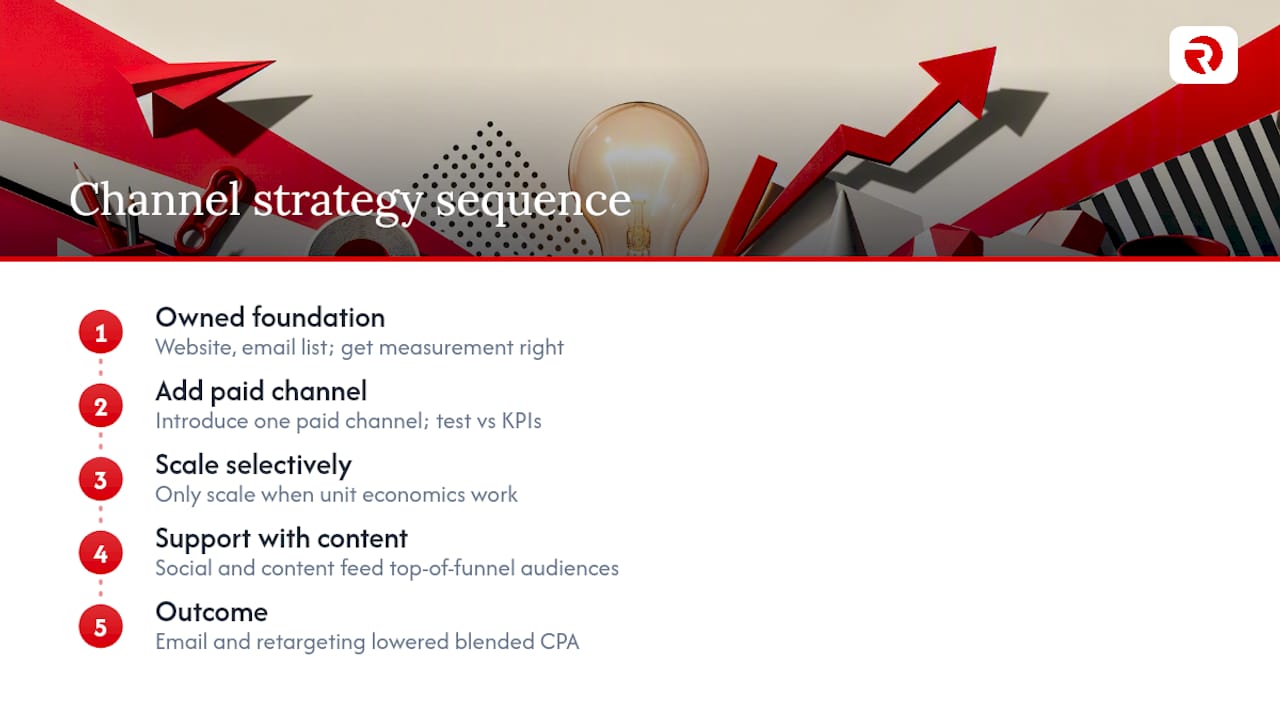
The approach that consistently produces better results is building a connected system first, then adding channels one at a time. Start with the owned platform (website, email list). Get the measurement right. Then add one paid channel, test it against clear KPIs, and only scale when the unit economics work. Social and content come next, feeding the top of the funnel with audiences that paid search can then convert.
In one anonymised campaign, a UK-based e-commerce client came to us running paid search only. We introduced an email welcome sequence and a retargeting display campaign alongside it. The email sequence alone recovered a meaningful share of abandoned carts that paid search had already paid to acquire. The retargeting campaign brought back site visitors at a fraction of the cost of acquiring new ones. The result was a lower blended CPA across the whole programme, not because paid search improved, but because the channels around it started doing their jobs.
Channel strategy is not about being everywhere. It is about being in the right places, in the right order, with the right message. That is what data-driven multi-channel planning actually looks like in practice.
Working with Radkaadvertising on your channel strategy
If you are ready to move from theory to execution, Radkaadvertising builds and manages data-driven multi-channel programmes for UK businesses, startups, and established brands. From SEO audits and paid media to PR distribution and AI-driven growth, the full service sits under one roof.
Browse the agency’s case studies to see how multi-channel strategy translates into measurable outcomes, or explore the full services offering to find where your biggest channel gap is.
Sources
FAQ
What do you mean by a digital channel?
A digital channel is any online pathway a business uses to communicate with, reach, or distribute its offerings to an audience. Examples include search engines, social media platforms, email, and messaging apps.
What are examples of digital channels?
Common examples include Google Search (organic and paid), Instagram, Facebook, LinkedIn, email newsletters, YouTube, display advertising networks, affiliate programmes, and SMS marketing.
What are digital channels on my TV?
In a marketing context, digital channels refer to online communication and distribution pathways, not television channels. Smart TV advertising (connected TV or CTV) is a form of digital display advertising, but it is distinct from broadcast TV channels.
Which of the following is an example of a digital channel?
Email, paid search ads, social media posts, and push notifications are all examples of digital channels. Each one uses digital connectivity to reach an audience, which is the defining characteristic.
How do digital channels differ from traditional marketing channels?
Traditional channels (print, TV, radio, outdoor) rely on broadcast distribution with limited targeting and delayed measurement. Digital channels offer precise audience targeting, real-time performance data, and the ability to adjust spend or creative mid-campaign.