UK Website Redesign Costs: Turn £3,000–£20,000 Ranges Into a 5 Step Brief

Most UK website redesigns fall somewhere between £1,500 for a visual refresh and £80,000 for an enterprise rebuild, with the bulk of small and mid-size projects landing between £3,000 and £20,000 (all figures ex VAT). Exact cost hinges on scope, integrations, and how many unique templates the build actually needs.
TL;DR:
- Template count and the complexity of custom features primarily determine the cost of a website redesign, with more templates and integrations pushing prices higher.
- Exclusions like copywriting, photography, and content migration often require separate budgeting, highlighting the importance of detailed, itemized quotes.
- Agencies in London charge 30-40% more than regional providers, but hiring them is justified when SEO migration and multiple integrations are involved.
- Planning in advance by defining your template and integration needs avoids scope creep and prevents significant budget overruns.
Table of Contents
- How much does a website redesign cost in the UK?
- What actually drives the price up or down?
- Who should you hire, and what do they charge?
- What should a proper quote include?
- How long does it take, and what gets left off the quote?
- Building your own budget: a worked example
- Why these figures hold up
- What most budgeting advice gets backwards
- Get an itemised redesign quote built around your scope
- Sources
- FAQ
How much does a website redesign cost in the UK?
The honest answer depends entirely on which project you’re describing, because “redesign” covers everything from swapping a colour palette to rebuilding a platform from scratch. UK pricing breaks into fairly consistent bands once you separate visual work from structural rebuilds.
- Visual refresh (typically costs from around £1,500): new look on the existing platform, no rebuilt architecture, minor copy tweaks.
- Small business redesign (£2,000–£15,000, most commonly £3,000–£8,000): new templates, mobile optimisation, basic SEO carry-over, often a handful of custom pages.
- Professional/mid-size redesign (£8,000–£20,000): full information architecture rework, custom functionality, proper SEO migration planning, stakeholder-approved content.
- eCommerce redesign (usually in the mid to high thousands of pounds): product catalogue migration, payment and stock integrations, checkout testing.
- Enterprise/rebuild (£20,000–£80,000+): multi-site or multi-language builds, custom integrations, dedicated project management.
A ten-page consultancy site refreshing its look sits near the bottom of the small business band. A retailer moving 2,000 SKUs onto a new platform sits firmly in eCommerce territory, and often higher once you add loyalty or subscription features. Full UK breakdowns show the variance within each band is driven almost entirely by scope, not by which agency you ask. Every figure above excludes VAT, and platform subscription fees (hosting, licences, apps) sit outside the redesign quote itself.
What actually drives the price up or down?
Two projects that look identical on the surface can differ by tens of thousands of pounds once you compare their build requirements. The gap almost always comes down to a short list of technical and human factors.
- Template count, not page count. A 50-page site built from four unique templates costs far less than a 20-page site needing 15 bespoke layouts.
- Custom features and integrations: booking systems, CRM syncing, multilingual content, or accessibility compliance all add build hours.
- Content migration effort: moving old copy and images across cleanly takes longer than most quotes assume.
- Copywriting and photography, when not already supplied, get quoted separately in most agency proposals.
- Platform choice: a hosted platform with monthly fees behaves differently to an open-source build with one-off licensing costs.
- Location and team: London agencies typically carry a 30–40% premium over regional equivalents for comparable work.
Pro Tip: Ask for the number of unique page templates before you ask for a total page count. Templates predict build effort far more accurately, and it stops agencies inflating scope with page volume alone.
Who should you hire, and what do they charge?
The delivery model you choose shapes both your budget and your risk. DIY platforms look cheapest on paper, but the hidden cost is your own time, plus a ceiling on what the site can eventually do without a rebuild.
- DIY builders: low upfront cost, but weak for custom functionality, SEO migration, or anything beyond a template site.
- Freelancers: typically £40–£120 an hour depending on seniority, suited to smaller, well-defined projects with a single point of contact.
- Regional agencies: mid-range day rates, strong for small business and eCommerce redesigns needing a team rather than one person.
- London agencies: highest day rates, usually justified by strategy depth, integration experience, and dedicated account management.
Bring in an agency once the project involves SEO migration, multiple integrations, or genuine brand strategy work. That’s the point where DIY and solo freelance capacity tends to run out.
What should a proper quote include?
A comparable quote spells out exactly what you’re buying, not just a headline number. Send agencies the same checklist and you can compare like for like.
- Number of unique templates and total pages covered.
- Full list of deliverables (design files, content upload, testing, training).
- Who owns the content and code once the project ends.
- A named SEO 301 redirect plan for every changed URL.
- Testing scope (devices, browsers, accessibility checks).
- Length of post-launch support included, and what happens after it expires.
- Explicit exclusions (copywriting, photography, stock licences).
Ask how many revision rounds are included and who signs off on final content. Treat vague scopes, no mention of redirects, or prices dramatically below the £1,500–£3,000 professional floor as warning signs rather than bargains.
How long does it take, and what gets left off the quote?
A visual refresh typically runs two to four weeks. Small business redesigns take four to eight weeks, professional and eCommerce projects run eight to sixteen weeks, and enterprise rebuilds regularly stretch beyond twenty. A platform migration without a full redesign often completes in four to eight weeks if content mapping is tight.
Agencies frequently exclude copywriting, photography, and post-launch SEO monitoring from base quotes. Budget separately for:
- Professional copywriting and photography
- Stock or licensed imagery
- 301 redirect implementation and testing
- Accessibility fixes flagged during testing
- Ongoing hosting and platform subscription fees
Statistic-based rule of thumb: hold back a 10–20% contingency on the total quote for post-launch monitoring and inevitable content delays, and expect a three-month monitoring retainer to run somewhere between £250 and £600 a month depending on site size.
Building your own budget: a worked example
Turning ranges into a real number takes five steps: define your template count, add the custom features you actually need, price content and media separately, factor in platform fees, then add contingency and a maintenance line.
- Templates: a 10-page professional site typically needs four to six unique layouts.
- Features: a contact form and blog add little; a booking system or CRM integration adds several thousand pounds.
- Content: copywriting and photography, if not supplied in-house, get quoted on top.
- Platform: monthly hosting or licence fees sit outside the build quote.
- Contingency and maintenance: add 10–20% plus a monthly retainer figure.
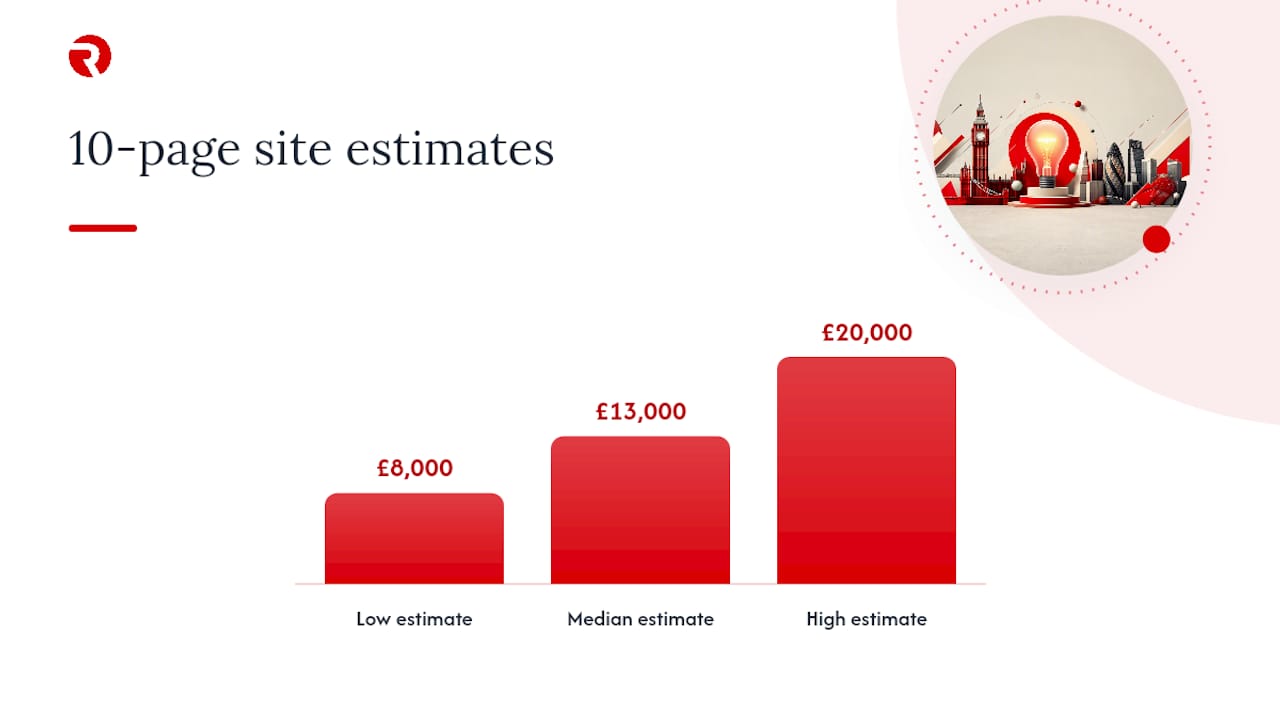
For that 10-page professional site: low estimate around £8,000, median around £13,000, high around £20,000 once you add one custom integration and professional copywriting.
Pro Tip: If the number is too high, cut template variety before you cut pages. Reusing three or four core layouts across more pages saves far more than trimming content.
Why these figures hold up
These bands echo consistently across SpotDev, Fulminous, and LowCode’s small business data, which is why they anchor this guide rather than a single agency’s price list. Radkaadvertising, a London-based full-service agency, scopes redesign projects the same way: templates and features first, content and integrations second, then a firm number rather than a placeholder range. Its case study portfolio covers brand and digital work for clients including Coca-Cola, Maybelline, and PowerLink Energy, giving a working sense of how larger-scope projects get structured before a quote is issued.
What most budgeting advice gets backwards
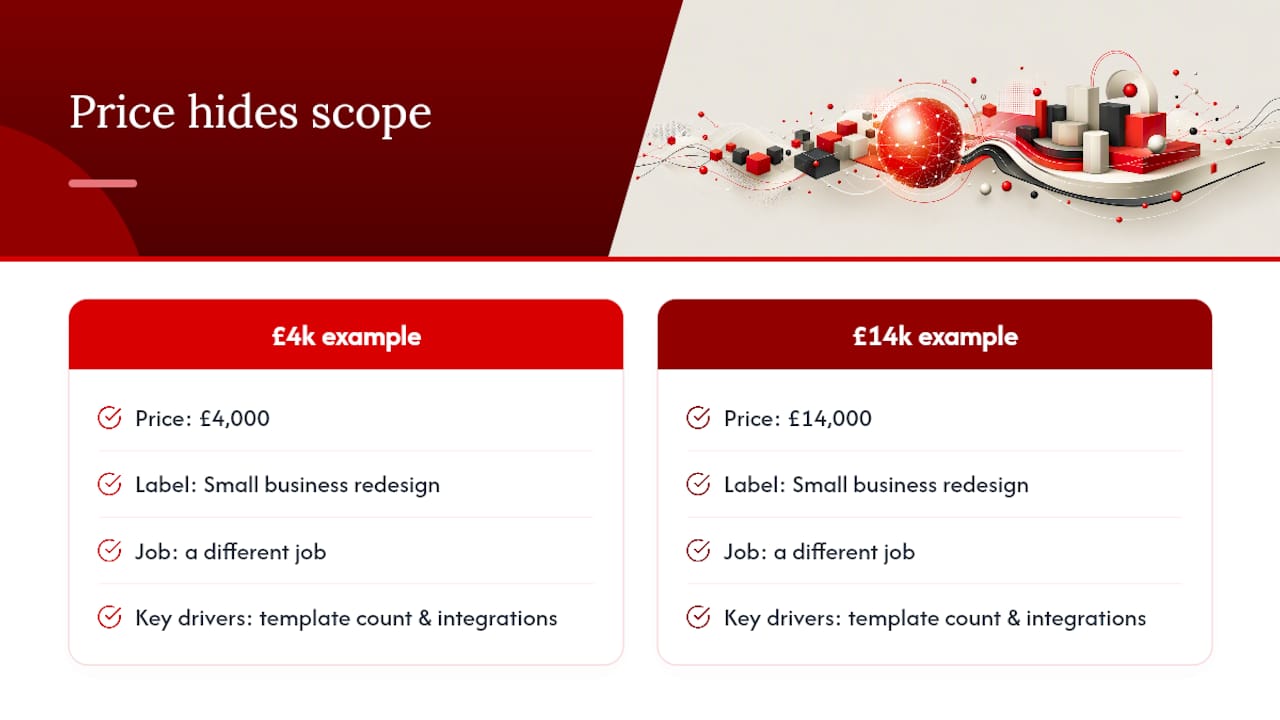
Most guidance on this topic treats the price range as the answer, when the range is really just the starting question. The number that matters is your template count and integration list, not the headline figure an agency quotes on a first call. Two “small business redesigns” at £4,000 and £14,000 can both be correctly priced, doing entirely different jobs.
The conventional advice to “get three quotes and compare” falls apart when each quote itemises differently. One agency’s £5,000 excludes copywriting and redirects; another’s £8,000 includes both. Without a shared checklist, you’re not comparing prices, you’re comparing guesswork.
Prioritise the brief before the budget. Write down your template count, your must-have integrations, and who owns content sign-off, then send that exact document to every agency you’re considering. The businesses that overrun their redesign budget almost always skipped this step and let scope get decided mid-project instead of upfront.
— Bart
Get an itemised redesign quote built around your scope
An alternative to piecing a redesign together from a freelancer, a separate copywriter, and a bolt-on SEO fix is a full-service agency where the same team handles brand strategy, build, and post-launch visibility, so scope decisions don’t get lost between suppliers.
- Website Design & Development, priced from £500 per month, covering the build itself.
- UX Research & Strategy and UX/UI Design for projects needing information architecture rework before launch.
- AI Growth & SEO support for redirect planning and post-launch ranking recovery.
Rather than guessing at a range, send Radkaadvertising your template count, integrations, and content ownership questions and request an itemised quote through the services page.
Sources
- Website redesign cost UK 2026 (SpotDev)
- Website redesign cost in the UK 2026: Full breakdown (Fulminous)
- Small business website redesign cost 2026 (LowCode)
- How much does web design cost in 2026? UK price guide (WebsiteDesign101)
FAQ
How much should I pay to redesign a website in the UK?
Most UK redesigns cost between £3,000 and £20,000, with visual refreshes from £1,500 and eCommerce or enterprise builds reaching £40,000–£80,000+. The right figure for your project depends on template count, integrations, and whether content needs writing from scratch.
How much should I charge for website design if I’m quoting a client?
UK freelancers commonly charge £40–£120 an hour depending on seniority, while agencies work on project or day rates that reflect strategy and testing time on top of build hours. Base your figure on template count and features rather than page count alone.
How long does a website redesign take in the UK?
A visual refresh typically takes two to four weeks, a small business redesign four to eight weeks, and a professional or eCommerce project eight to sixteen weeks. Platform migrations without a full redesign often finish in four to eight weeks if URL mapping is planned early.
Are website redesign quotes in the UK inclusive of VAT?
No, the price bands quoted across UK guides are almost always ex VAT, and platform hosting or subscription fees sit outside the build quote too. Always ask an agency to confirm VAT treatment and ongoing fees before signing.
Who provides the copy and photography for a redesign?
Copywriting and photography are commonly excluded from base quotes unless you specifically ask for them to be included. Confirm content ownership and who’s supplying assets before comparing quotes, since this is the most common source of mid-project cost surprises.