Stop Filing Your Tone of Voice Guide: Four Scales and 3 Rewrites
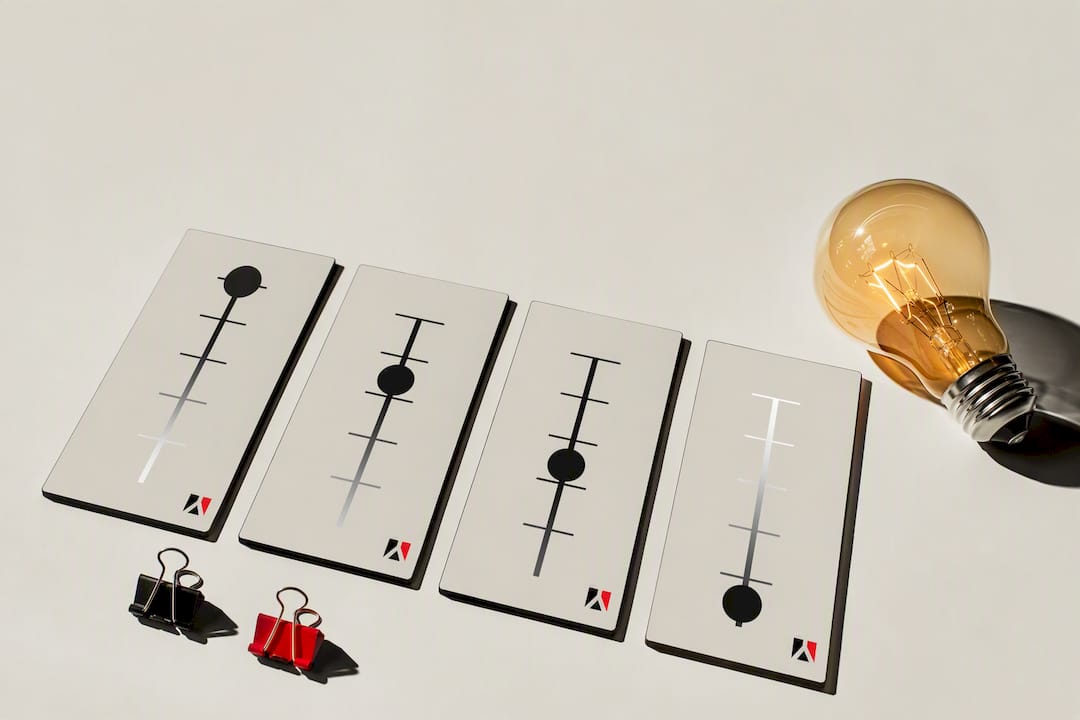
A usable tone of voice guide is an operational tool, not a mood board. It turns brand personality into testable rules that tell writers and AI systems exactly what to write and what to avoid. Done properly, it produces consistent, recognisable copy across every channel. This guide covers the audit, the voice chart, annotated rewrites, and the governance that keeps it alive after launch.
TL;DR:
- A tone of voice guide must translate brand personality into clear, actionable rules, with behavioural examples, to ensure consistency across channels and formats.
- Building a voice chart with decision-based scales from formal to casual, serious to playful, helps define precise traits and avoid vague adjectives that lack operational meaning.
- The guide should be stored within work environments like briefs and CMS rather than isolated PDFs to encourage daily use, with regular human review to catch emotional and contextual drift.
- Auditing high-performing content and annotating repeated patterns provides the foundation for purpose statements, lexicon, and example-based prompts for AI and team consistency.
- Effective tone guides are often developed through agencies that embed rules into workflows, enable ongoing governance, and model successful examples for practical implementation.
Table of Contents
- What is a tone of voice guide, and how does it differ from voice?
- Why weak tone guidance costs you more than it saves
- Build a voice chart: four scales and behavioural traits
- How to build your tone of voice guide step by step
- Three before/after rewrites you can steal for your own brief
- Radkaadvertising’s perspective on running these templates in real client work
- Three mistakes that quietly kill a tone of voice guide
- How Radkaadvertising builds and operationalises tone guides
- Public guides worth studying before you write your own
- Sources
- FAQ
What is a tone of voice guide, and how does it differ from voice?
Voice is who your brand is. Tone is how that identity adjusts to the moment. A brand’s voice stays fixed across a product page, a complaint reply, and a careers advert. The tone flexes: warmer in a thank-you email, sharper in a service outage notice, more measured in a legal disclaimer.
Mailchimp’s voice and tone guide draws this line clearly: voice never changes, tone adapts to context, audience and stakes. Two examples make it concrete:
- A confident, witty brand voice delivering a delayed-order apology stays witty but drops the jokes; the tone turns careful and direct.
- The same brand announcing a product launch keeps the wit turned all the way up, because nobody is frustrated and the stakes are low.
Adjust tone when the reader’s emotional state shifts (anger, confusion, celebration), when the format changes (legal text versus social captions), or when the consequences of getting it wrong are high (billing errors, safety notices). If none of those apply, the default voice holds.
Why weak tone guidance costs you more than it saves
Inconsistent tone erodes trust before a reader even processes what you’re saying. A support reply that reads as corporate and distant right after a cheerful marketing email creates friction the reader can feel, even if they can’t name it. Gov.uk’s content principles exist precisely because inconsistent public-facing language damages comprehension and confidence at scale.
The common failure modes are predictable:
- Freelancers and agencies producing off-brand copy because the only reference is a mood board full of adjectives.
- Campaigns that read differently on Instagram than in email because nobody defined channel rules.
- AI tools trained on generic prompts that default to bland, interchangeable phrasing.
Quick wins are measurable early. Track how many drafts need a full tone rewrite before publishing, or run a blind read test where five colleagues guess which brand wrote an unlabelled paragraph. Pro Tip: If fewer than half your team can identify your brand from an unlabelled paragraph, your voice is not yet distinct enough to guide, no matter how good the adjectives sound.
Build a voice chart: four scales and behavioural traits
Adjectives like “friendly” or “bold” are where most guides stall, because two people will interpret “bold” completely differently. A four-scale model forces an actual decision instead of leaving the choice vague, which is why the Sivon HQ framework treats scales, not adjectives, as the operational unit.
Typical scales run: Formal to Casual, Serious to Playful, Respectful to Irreverent, and Matter-of-fact to Enthusiastic. Plot your brand on each, then pick 3 to 5 traits that sit at those plotted positions. Each trait needs a behavioural rule, a “do” example, and a “don’t” example, because Microsoft’s guidance on behaviour-based voice makes the point directly: “be simple, be human” only works as a rule when it’s shown, not stated.
A sample row from a voice chart:
| Trait | Behavioural rule | Do | Don’t |
|---|---|---|---|
| Direct | Open with the answer; no hedging | “Your refund lands in 3 days.” | “We wanted to reach out regarding a possible refund timeline.” |
| Warm, not cute | Use plain empathy, skip jokes in problem moments | “That’s frustrating. Here’s what happens next.” | “Oops! Looks like gremlins got your order! 🙈” |
Write “don’t” examples from real drafts your team has actually produced, not invented worst cases. That’s what makes editors recognise the pattern and self-correct.
How to build your tone of voice guide step by step
Building a working guide follows a sequence, not a brainstorm. Skipping the audit is the single most common reason guides end up unused.
- Audit first. Pull 5 to 10 of your best-performing pieces (highest engagement, lowest complaint rate, the best conversion). Annotate what repeats: sentence length, where the verb sits, how often you use humour, how you close.
- Write one purpose sentence. State what your brand’s language should achieve in a single line, then choose 3 to 5 behavioural traits from your voice chart scales.
- Build the supporting lexicon. List preferred terms, banned terms, and cadence rules (sentence length caps, contraction use, how numbers are formatted).
- Assemble annotated examples. Collect 8 to 10 before/after rewrites across formats, then write short prompt fragments so AI tools inherit the same rules. Glean’s guidance on brand voice for AI recommends pairing every rule with a concrete sample, since models copy patterns far better than they follow abstract instructions.
- Set up governance. Name one owner, agree a review cadence (quarterly is typical), and decide where the chart physically lives: inside brief templates, inside the CMS field descriptions, and inside any AI system prompt.
Pro Tip: Put the voice chart inside the brief template itself, rather than in a separate PDF nobody reopens. If writers have to leave their workspace to check tone, they won’t.
Three before/after rewrites you can steal for your own brief
These rewrites show the trait and the rule side by side, so you can lift the pattern straight into a brief or an AI prompt.
- Subject line. Before: “Important Update Regarding Your Account Status.” After: “Your account renews Friday, here’s what changes.” Trait: Direct. Rule: open with the answer; no hedging.
- Product blurb. Before: “Our innovative solution leverages cutting-edge technology to deliver results.” After: “It finds your best-performing ad in under 10 minutes, no dashboard-hunting required.” Trait: Concrete. Rule: name the specific outcome, cut abstract nouns.
- Support reply. Before: “We apologise for any inconvenience this may have caused and appreciate your patience.” After: “That’s frustrating, and it’s on us. Your refund is already processing.” Trait: Warm, not cute. Rule: plain empathy first, solution second, no filler apology language.
Turn each into an AI prompt fragment by pairing the rule with both examples: “Rule: open with the answer, no hedging. Do: [example]. Don’t: [example].” Models trained on paired examples like this drift far less than ones given adjectives alone.
Radkaadvertising’s perspective on running these templates in real client work
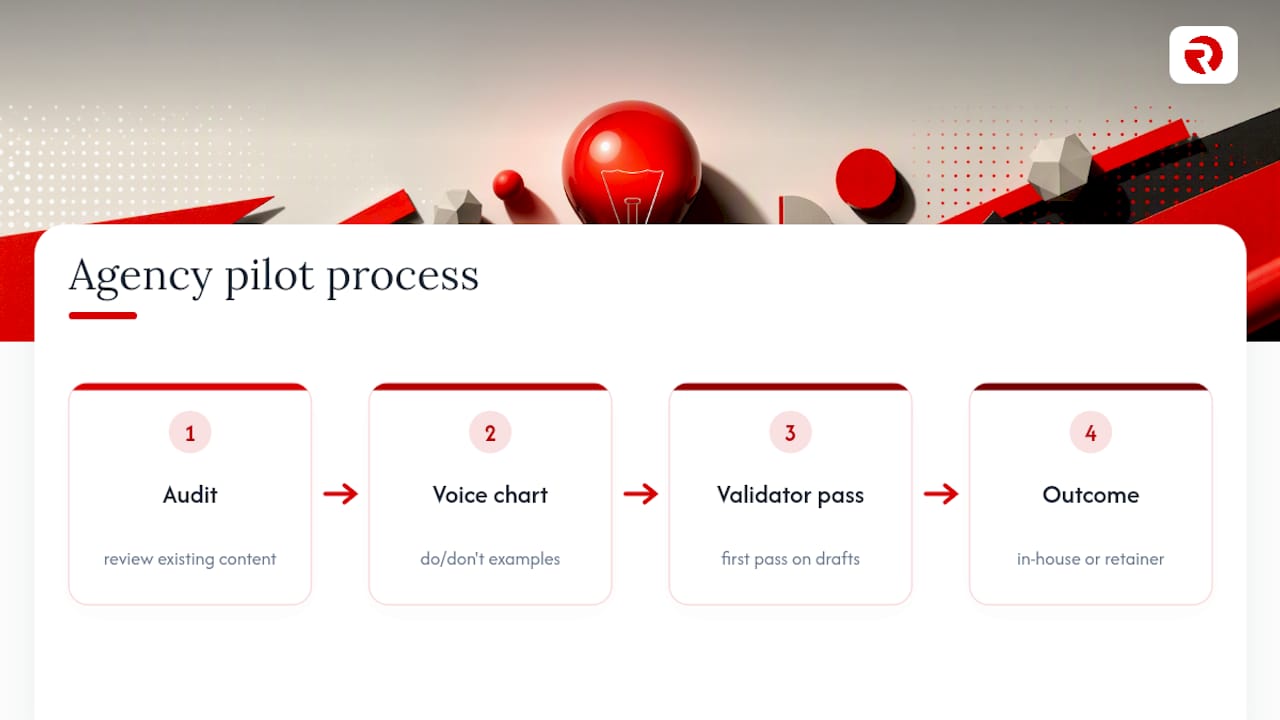
Some advertising agencies build voice charts as a standard part of brand strategy work, because clients rarely arrive with behavioural rules already written down, only adjectives. Applying the audit and voice chart method across multi-channel campaigns keeps copy consistent whether a client’s content moves through social, email, or paid ads. The same rules can also feed directly into AI prompt fragments, which matters for teams scaling content production without scaling headcount. A typical pilot for a client may run an audit first, then a voice chart, then a validator pass on live drafts, stages that surface most inconsistencies before they reach a campaign.
Three mistakes that quietly kill a tone of voice guide
Long adjective lists are the first mistake. “Friendly, bold, innovative, approachable” gives editors nothing to check against, so convert every adjective into a behavioural rule with a “do” and a “don’t” instead.
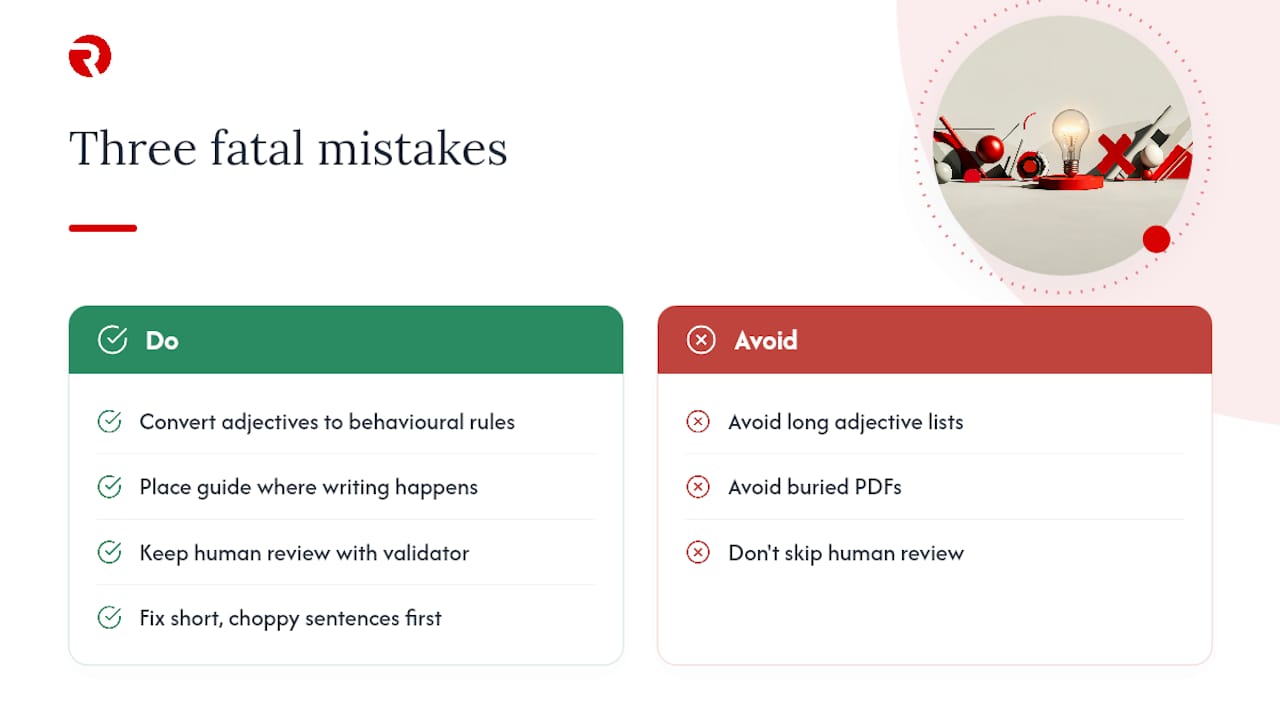
The second mistake is storage. A guide that lives in a PDF three folders deep in a shared drive gets ignored within a month. Put the chart where writing actually happens: brief templates, CMS fields, AI system prompts.
The third is skipping human review once a validator is in place. A lightweight classifier trained on 200 to 500 examples catches most obvious drift, according to Taja.AI’s playbook, but it won’t catch tone that’s technically on-brand yet emotionally wrong for the moment. Fix short, choppy sentences first: they’re usually the fastest tell that a draft was rushed or machine-generated without the trait rules applied.
— Bart
How Radkaadvertising builds and operationalises tone guides
If building this yourself feels like one workshop too many on top of a full content calendar, that’s a common gap some agencies help to close. Some agencies do more than hand you a static PDF: they run the audit, build the voice chart, and set up validator workflows so the rules live inside your briefs and AI prompts from day one, not in a document nobody reopens after month two.
Engagements with such agencies often start as a short pilot: an audit of your existing content, a working voice chart with do/don’t examples, and a first validator pass on live drafts. From there, teams can either take the finished guide in-house or move to an ongoing retainer for content production. Explore the brand strategy and content services on offer, or look at a case study showing the approach applied to a real client campaign, and get in touch to scope your own pilot.
Public guides worth studying before you write your own
Several organisations publish their tone of voice work openly, and each rewards a close read for a different reason. Gov.uk’s content principles show plain-language rules at public-service scale. The University of Leeds guide and University of Dundee’s style guide both demonstrate structured trait examples for institutional writing. The RNLI’s brand guidelines show audience-specific tone rules for a charity balancing urgency with reassurance, and AmmarAI’s practical AI workflow guides are worth a look for turning any of these rules into working prompts.
Sources
- Gov
- University of Leeds tone of voice guidelines (PDF)
- RNLI brand guidelines (creative toolkit)
- Brand voice — above all, be simple, human | Microsoft style guide
FAQ
How do I find my brand’s tone of voice?
Audit 5 to 10 of your best-performing pieces, annotate the sentence patterns that repeat, then plot those patterns against four scales (formal/casual, serious/playful, respectful/irreverent, matter-of-fact/enthusiastic) to pick 3 to 5 traits.
What is an example of tone of voice?
A brand voice that’s direct and warm might write “Your refund lands in 3 days” instead of “We wanted to reach out regarding a possible refund timeline,” the same identity adjusted for a specific, low-stakes moment.
What are the main types of tone in brand writing?
Definitions vary across guides, but common tone positions include formal, casual, playful, serious, and empathetic, with most brands sitting at different points depending on the channel and the reader’s situation.
How do I identify tone of voice in existing content?
Read a sample aloud and note sentence length, where the verb lands, how often humour appears, and how the piece closes; those patterns, not the adjectives someone once chose, reveal the actual working tone.
How is tone of voice different from brand voice?
Voice is the fixed identity that never changes; tone is the situational adjustment, as Mailchimp’s voice and tone guide explains, meaning the same brand sounds like itself in every channel while adapting warmth and formality to context.