Creative first TikTok ads strategy for marketers: Pixel, CAPI, 30–90 day plan

Build a creative-first, full-funnel campaign: broad prospecting driven by native-feel hooks, layered with a tiered retargeting sequence, and underpinned by Pixel plus Conversions API tracking. Brief 6 to 8 creatives across awareness, consideration, and conversion, then fund a genuine 30 to 90 day learning window. Expect fast creative decay and treat measurement plumbing as a launch task, not an afterthought.
TL;DR:
- Broad targeting generally outperforms interest-based filters on TikTok because the platform’s algorithm naturally finds the right audience faster than manual segmentation.
- Installing the TikTok Pixel and Conversions API together from day one ensures accurate tracking and helps the algorithm optimize campaigns effectively during the learning phase.
- Focusing creative testing on hooks, captions, and native-style content is crucial, with 6 to 8 variants tested every 72 hours, and refreshing top-performing creatives every 7 to 14 days to combat decay.
- Using a full-funnel structure with distinct objectives and budgets for awareness, consideration, and conversion campaigns leads to better overall results, especially when adjusting spend based on marginal performance.
- Scaling by duplicating the best-performing ad groups and limiting daily budget increases to 20-30% prevents re-triggering the learning phase and preserves campaign momentum.
Table of Contents
- Your 30/60/90 day TikTok ads strategy checklist
- Which TikTok ad formats work at each funnel stage?
- How should you structure a full-funnel TikTok campaign?
- How do you brief creative that actually feels native?
- Should you use broad targeting or build custom audiences?
- What does a bulletproof TikTok Ads Manager setup look like?
- How do you measure TikTok ads accurately?
- What are the rules for scaling TikTok ads without killing performance?
- What has Radka Advertising learned running TikTok campaigns for clients?
- Why creative-first thinking beats the audience-obsession most marketers still default to
- Ready to operationalise your TikTok ads strategy?
- Where to read more on TikTok advertising
- Sources
- FAQ
Your 30/60/90 day TikTok ads strategy checklist
Most TikTok accounts fail in the first fortnight because the technical foundation goes in after the ads do. Fix the order and the algorithm has something worth learning from.
Days 0 to 7: build the plumbing
- Install the TikTok Pixel and Conversions API together. Server-side events catch what browser tracking misses, particularly after Apple’s App Tracking Transparency changes.
- Structure your account properly: one campaign objective, ad groups split by funnel stage or audience, and ads that rotate creative within each group.
- Write creative briefs for 6 to 8 variants covering awareness, consideration, and conversion angles.
- Line up creators or UGC contributors so filming isn’t a bottleneck once the account structure is ready.
Days 8 to 30: launch and learn
- Launch awareness ad groups (video view or reach objectives) and conversion ad groups in parallel, each with its own budget.
- Fund each ad group with a learning budget sufficient to exit the learning phase within 7 to 10 days, generally around $50 a day per ad group as a practical minimum.
- Watch hook rate (three-second views) and conversion volume daily, not spend alone.
- Resist the urge to edit live ad groups. Small tweaks reset the learning phase and waste the signal you’ve already paid for.
Days 31 to 90: consolidate and scale
- Identify the two or three ad groups producing the lowest cost per result and duplicate them rather than editing the originals directly.
- Roll out retargeting sequences for video viewers, site visitors, and cart abandoners now that you have volume to work with.
- Start a simple geo-holdout test to measure incremental lift, particularly if a chunk of your budget has moved to retargeting.
- Retire underperforming creative and refresh the pipeline before fatigue sets in.
Which TikTok ad formats work at each funnel stage?
TikTok gives you several formats, and matching the right one to the right funnel stage is the difference between an efficient campaign and one that burns budget on the wrong objective.
- In-Feed Ads sit natively in the For You feed and work across every stage, from awareness video views to direct conversion clicks. They’re your workhorse format.
- TopView takes the first slot a user sees on opening the app. It commands attention but carries a premium cost, so reserve it for major launches or seasonal pushes rather than everyday prospecting.
- Brand Takeover is a full-screen format shown before other content loads, similarly high-cost and best suited to short awareness bursts.
- Spark Ads boost an existing organic post, whether posted from your own account or a creator’s, while keeping its likes, comments, and shares intact. Because that social proof carries over, Spark Ads often deliver a lower cost per result than a cold in-feed buy with identical creative.
- Branded Hashtag Challenge invites participation and works best for reach and cultural buzz rather than direct response, so it fits the top of the funnel.
- Branded Effects are custom filters and stickers, useful for brand recall campaigns but rarely a conversion driver on their own.
- Catalog Ads (TikTok Shop/Shopping) pull directly from your product feed, making them the natural choice for retargeting warm shoppers or running dynamic conversion campaigns.
For most advertisers, the sensible split is In-Feed and Spark Ads carrying the bulk of spend, catalog formats handling retargeting and shopping intent, and TopView or Brand Takeover reserved for occasional high-visibility moments. On placement, TikTok’s extended network (Pangle and partner apps) can lower costs, but TikTok-only placements typically deliver stronger engagement quality for brand campaigns, so test both rather than assuming either wins by default.
How should you structure a full-funnel TikTok campaign?
A full-funnel structure means running three distinct stages simultaneously, each with its own objective, creative angle, and budget, rather than dumping everything into one conversion campaign and hoping the algorithm sorts it out.
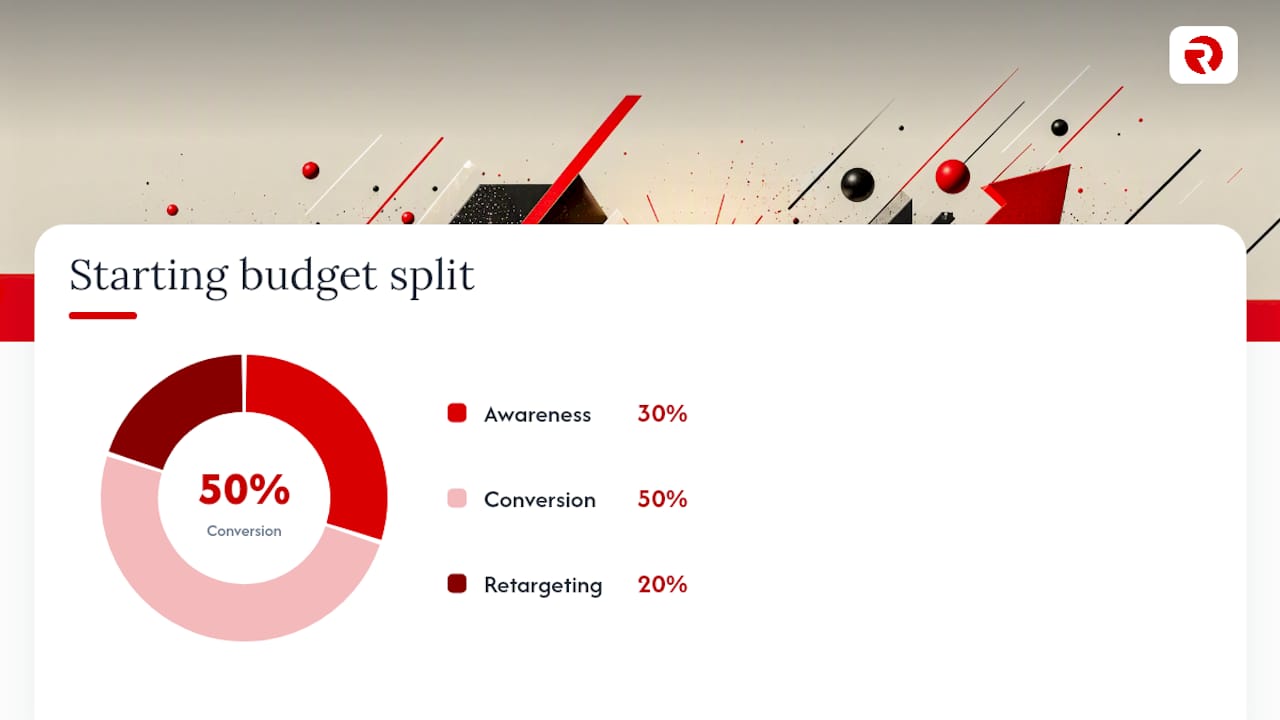
The architecture looks like this: Awareness campaigns optimise for video views or reach and introduce the brand to a broad, unfiltered audience. Consideration campaigns optimise for traffic or engagement and push warmer prospects toward your site or app. Conversion campaigns optimise for purchases, leads, or app installs and carry the heaviest creative investment because they’re closest to revenue.
A widely used starting split allocates roughly 30% to awareness, 50% to conversion, and 20% to retargeting, adjusted once you have real performance data. Businesses with a high average order value or a longer sales cycle should shift more weight toward consideration and retargeting, since a single conversion event doesn’t happen on the first impression. Lower-priced, high-frequency purchases can lean harder into conversion-stage spend from day one.
| Funnel stage | Primary objective | Starting budget share | Core KPI to watch |
|---|---|---|---|
| Awareness | Video views / reach | ~30% | Hook rate, cost per 1,000 views |
| Consideration | Traffic / engagement | Folded into conversion budget for smaller accounts | Click-through rate, engagement rate |
| Conversion | Purchases / leads / installs | ~50% | Cost per result, ROAS |
| Retargeting | Catalog / conversion | ~20% | Return on ad spend, frequency |
A few practical rules for shifting budget between stages:
- If awareness cost per 1,000 views is healthy but conversion cost per result is climbing, your creative isn’t translating interest into action. Fix the ad, not the budget split.
- If retargeting frequency exceeds 3 to 4 impressions per user per week without lifting conversions, cap the audience or introduce fresh creative before cutting spend.
- Move budget toward whichever stage is producing the most efficient marginal result, checked weekly rather than daily. TikTok’s learning phase needs sustained signal, and daily budget flipping starves it.
How do you brief creative that actually feels native?
Treat creative as your targeting mechanism. On TikTok, the video itself determines who engages more than any audience filter you layer on top, which flips the usual paid social logic on its head.
The hook rules that matter most
You have roughly one to two seconds before a viewer decides to scroll past. That opening frame needs a visual jolt, a bold text overlay, or a question that stops the thumb, because polished, ad-like creative consistently underperforms native-feel content on this platform. Default to text overlays and captions on every ad. A large share of viewing happens with sound off, and a caption-less ad simply loses that audience outright.
Briefing UGC and creators
When briefing a creator or UGC contributor, be specific about:
- The hook: what happens in the first two seconds, scripted or improvised.
- Tone: does the brand want a founder-style direct address, a testimonial, or a demonstration?
- Deliverables: raw footage plus one edited cut, vertical 9:16, captions burned in.
- Usage rights: whether the brand can run the content as a Spark Ad from the creator’s own handle, which typically performs best.
Pricing scales with follower tier and usage rights. Nano and micro creators are the most cost-effective for volume testing, while working with a wider creator whitelisting and partnership approach helps you scale the best performers without renegotiating every deal from scratch.
Testing cadence
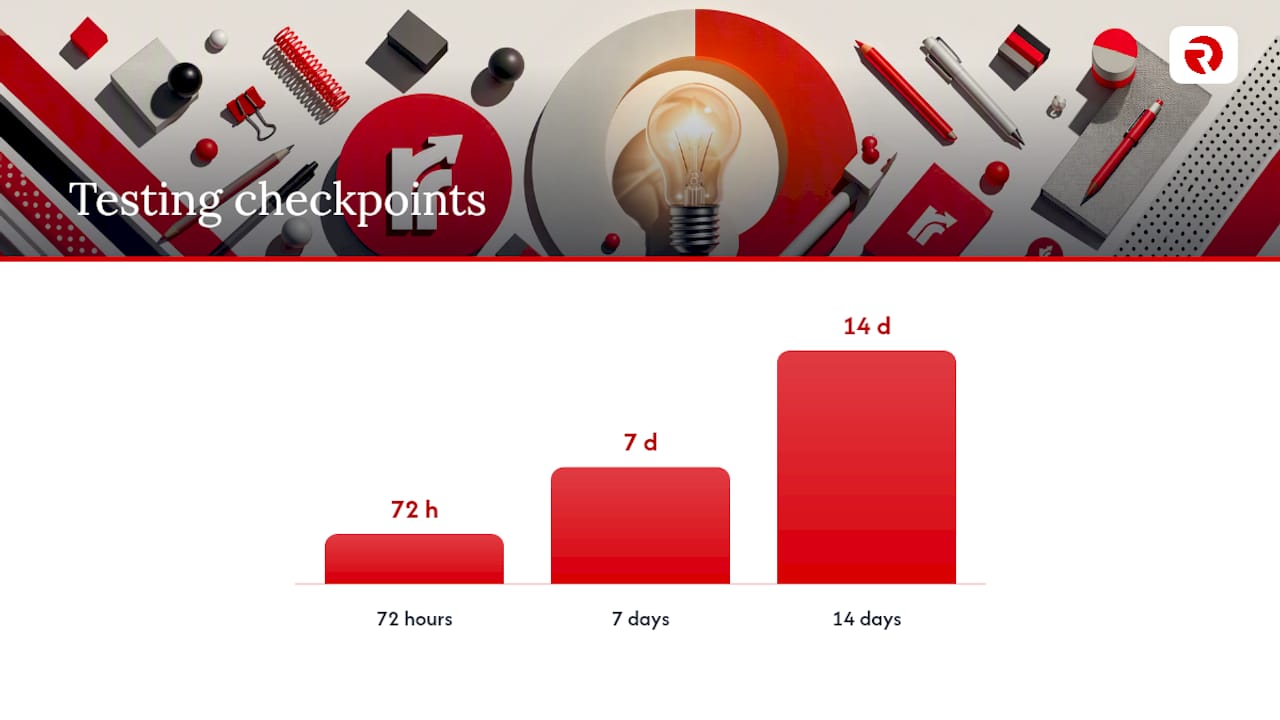
Run 4 to 8 creative variants per funnel stage at launch, checking results at 72 hours, 7 days, and 14 days. Test one variable at a time where possible, starting with the hook, then the call to action, then the creator or format, so you know exactly what moved the needle. Iteration speed beats polish here; a rough cut that ships this week outperforms a perfect edit that ships next month.
Pro Tip: Film your hook in three or four different opening lines during the same shoot. It costs almost nothing extra and gives you instant variants to test without booking a second session.
Should you use broad targeting or build custom audiences?
Broad targeting usually wins on TikTok, and that’s counterintuitive if you’ve spent years layering interest and behaviour filters on other platforms. The recommendation industry, thanks to strong creative, generally finds its own audience faster than a manually constructed one.
Start ad groups with broad or lightly filtered targeting, letting the algorithm’s delivery engine do the audience discovery work. Reserve narrow targeting for retargeting pools, where you already know exactly who you want to reach.
Building lookalikes properly
- Seed lookalikes from your highest-value source audience: past purchasers first, then add-to-cart events, then engaged video viewers.
- Start with a tighter 1% lookalike for quality, and expand to 3 to 5% once you need more volume and the tighter pool is saturated.
- Refresh source audiences every 30 to 60 days so the lookalike doesn’t drift stale.
Retargeting tiers that actually convert
- Video viewers (top of funnel): retarget anyone who watched 50% or more of an ad within the last 7 to 14 days, with a softer, brand-reminder creative.
- Site visitors (mid funnel): retarget within a 7 to 30 day window using product-specific or benefit-led creative, capped at 2 to 3 impressions per day.
- Add-to-cart (bottom of funnel): retarget within 1 to 7 days with urgency-driven creative, a discount, or social proof, and keep frequency capped so it doesn’t tip into annoyance.
What does a bulletproof TikTok Ads Manager setup look like?
TikTok Ads Manager runs on a three-level structure: Campaign sets the objective and overall budget logic, Ad Group controls targeting, placement, and budget, and Ad holds the actual creative and copy. Most failed campaigns trace back to settings being placed at the wrong level, most commonly budget or targeting decisions made at the campaign level when they should sit at the ad group level for proper testing control.
- Set the campaign objective first and lock it to match your primary funnel goal; don’t mix awareness and conversion objectives inside one campaign.
- Fund each ad group to exit learning. TikTok generally needs 25 to 50 optimisation events within a 7-day window to move out of the learning phase, so underfunded ad groups stall indefinitely.
- Keep creative rotation inside the ad group, not spread across duplicate campaigns, so the algorithm can compare variants fairly.
- Verify the Pixel fires correctly using TikTok’s Events Manager test tool before spending a single pound.
- Confirm Conversions API events match Pixel events for the same actions, so you’re reinforcing signal rather than duplicating or contradicting it.
Common misplacements to avoid:
- Setting bid caps at the campaign level instead of the ad group, which removes the flexibility to test bidding strategies.
- Running one ad group with five wildly different creative concepts, making it impossible to isolate what’s actually working.
- Editing budgets daily during the learning phase, which resets accumulated signal and restarts the clock.
How do you measure TikTok ads accurately?
Pixel-only tracking undercounts what’s actually happening, and that gap has only widened since Apple’s App Tracking Transparency changes reduced browser-side visibility. Conversions API restores much of that lost signal by sending event data server-side, bypassing the browser limitations entirely.
Running Pixel and CAPI together, rather than either alone, gives TikTok’s algorithm the fullest picture of what a conversion actually looks like for your account, and that fuller picture is what the learning phase optimises against.
Roughly 62% of engagement on major social platforms now happens through short-form video formats, which is exactly why silent, caption-free creative loses so much of its potential audience before measurement even enters the picture.
Attribution windows and honest reporting
Set a consistent internal attribution window, commonly 7-day click and 1-day view, and use it uniformly across TikTok and your other channels so comparisons are fair. Last-click attribution models routinely undercount TikTok’s actual contribution because the platform frequently influences purchases made later through another channel rather than closing the loop in-app.
Running a simple incrementality test
- Split comparable geographic regions into a test group (TikTok live) and a holdout group (TikTok paused).
- Run for at least two to four weeks to smooth out weekly noise.
- Compare overall revenue lift, not just TikTok-attributed conversions, between the two groups.
- If your budget supports it, pairing CAPI data with a multi-touch attribution partner gives a more honest read than any single-platform dashboard.
Set realistic ROAS expectations from the outset. TikTok generally performs better on blended return across the full customer journey than on last-click ROAS alone, so judge it accordingly.
What are the rules for scaling TikTok ads without killing performance?
Scale winners by duplication, not by editing live budgets.
- Cap daily budget increases at 20 to 30% to avoid re-triggering the learning phase on an ad group that’s already performing.
- Watch hook rate and hold rate trends weekly. A declining hook rate on a previously strong creative is the earliest warning sign of fatigue.
- Plan a creative refresh every 7 to 14 days for your top performers, since decay at this pace is normal on TikTok, not a sign you did something wrong.
- Use automated rules sparingly. They’re useful for pausing genuinely broken ad groups, but overly aggressive rules can pause creative that’s still inside a normal learning fluctuation.
Pro Tip: Keep a rolling library of “reserve” creative that hasn’t launched yet. When a winner starts fading, you want a replacement ready the same day, not a fresh brief starting from zero.
What has Radka Advertising learned running TikTok campaigns for clients?
Radka Advertising has built creative-first, full-funnel TikTok campaigns for brands across sectors, and the pattern holds consistently: accounts that treat measurement setup as a day-one task outperform accounts that bolt it on after launch. Full campaign outcomes and methodology sit in Radka’s case study portfolio, but the recurring lesson is worth stating plainly.
The problem is rarely targeting. It’s almost always creative that doesn’t earn attention in the first two seconds, or tracking that’s too thin to tell the algorithm what actually worked.
Brands that came to Radka with underperforming TikTok accounts typically shared two symptoms: a single creative concept run for weeks past its natural decay point, and Pixel-only tracking missing a meaningful share of conversion events. Fixing both, alongside a proper full-funnel budget split, is consistently what turns a flat account around. This piece draws on that same practitioner logic, translated into a checklist any in-house marketer can run without agency support, though bringing in dedicated production and measurement expertise tends to compress the timeline considerably once volume grows.
Why creative-first thinking beats the audience-obsession most marketers still default to
Most TikTok advice still treats the platform like a slightly younger version of Meta: build the audience, then worry about the ad. That’s backwards here, and the practitioners getting real results have quietly stopped arguing about it.
The uncomfortable truth is that most underperforming TikTok accounts aren’t failing on targeting at all. They’re failing because the creative was built by people trying to make an advert, when TikTok rewards people trying to make content that happens to sell something. That distinction sounds semantic until you watch a founder-shot, imperfectly lit video outperform a £5,000 studio production by three times the click-through rate.
Where conventional advice falls short is treating measurement as a compliance checkbox rather than a competitive advantage. Most accounts run Pixel alone, report a ROAS that’s quietly wrong, and then blame the platform when the numbers don’t hold up. Fix the tracking before you fix anything else.
If you take one thing from this guide, prioritise the learning budget over the launch date. An account that waits an extra week to fund ad groups properly will outperform one that launches fast and starves every ad group of the signal it needs to learn.
*— Bart
Ready to operationalise your TikTok ads strategy?
Everything in this guide is doable in-house, but the gap between knowing the framework and running it flawlessly week after week is where most in-house teams lose momentum, particularly the creative production cadence and the CAPI plumbing underneath it. Radka Advertising exists to close that gap without the overhead of hiring an internal production team from scratch.
Radka’s services cover the three pieces that make or break a TikTok account: creative production at the pace this platform demands, campaign management across the full funnel, and Conversions API implementation done properly the first time. Where a DIY setup often means weeks of trial and error on tracking alone, an experienced team can have Pixel, CAPI, and a tiered creative testing plan live within days.
The sensible next step is a campaign audit: a review of your current account structure, tracking setup, and creative performance, with specific fixes identified before you spend another pound on media. Get in touch with Radka Advertising to book one.
Where to read more on TikTok advertising
The sources behind this guide cover the platform mechanics, budget benchmarks, and measurement approaches marketers rely on most.
- TikTok Ads Manager practical guide for account structure and learning-phase thresholds.
- Building a full-funnel TikTok ad strategy for CAPI and attribution detail.
- Statista engagement data for social video viewing behaviour.
Sources
- TikTok Ads Manager: The 2026 Complete Practical Guide - TikAdTools
- How to Build a Full-Funnel TikTok Ad Strategy That Converts in 2026 – D2C Times
- Statista — engagement rate per post on social media
FAQ
What is the best strategy for TikTok ads?
A creative-first, full-funnel approach works best: broad prospecting with native-feel hooks, a tiered retargeting sequence, and Pixel plus Conversions API tracking to give the algorithm accurate optimisation signal.
Does TikTok pay $1 per 1,000 views?
No, that figure relates to TikTok’s Creator Fund for organic content, not advertising. Ad costs are set by auction dynamics and vary by objective, placement, and competition within your niche.
What is the three-second rule on TikTok?
It refers to the window you have to stop a viewer scrolling before they judge the video irrelevant. Advertisers should treat the first one to two seconds as the make-or-break hook, using bold visuals or text to earn attention before the message even starts.
How do you make a good ad on TikTok?
Lead with a strong hook in the first two seconds, add text overlays and captions since much of the audience watches with sound off, and favour native, UGC-style footage over polished studio production. Test 6 to 8 variants per funnel stage and refresh creative every 7 to 14 days as performance naturally decays.