SME digital transformation: a guide for owners and founders

Marketing‑led SME digital transformation means rebuilding your brand, website, content, and paid channels around one thing: measurable commercial performance, not vanity metrics. Radka Advertising runs this as a structured programme, not a one‑off project. If you’re starting today, three steps come first:
- Quick audit — a full review of brand, site, UX, and channel performance
- Priority strategy — rank the fixes by commercial impact, not by what’s easiest
- 90‑day delivery plan — sequence the build so measurement and CRM go in before you scale paid spend
Pro Tip: A PRISMA‑based systematic review of SME digital transformation found that digital capability and readiness, things like CRM and data analytics, are prerequisites for sales growth, not optional extras layered on later.
Key Takeaways
Marketing‑led SME digital transformation succeeds when brand strategy, CRM data, and measurement are built together, not bolted on after a site redesign.
| Point | Details |
|---|---|
| Start with an audit | Map brand, site, UX, and channel performance before committing budget to any workstream. |
| Sequence CRM before paid scale | Get measurement and CRM live before increasing paid acquisition spend, to avoid wasted budget. |
| Prioritise brand capital over reach | Survey evidence of 405 SMEs shows brand capital, not reach, drives sustainable competitive advantage. |
| Treat it as continuous | Transformation is a moving target requiring ongoing optimisation, not a single project with an end date. |
| Work with a staged agency partner | Radka Advertising delivers audit, strategy, build, and optimise phases with a 90‑day plan and measurable KPIs. |
Table of Contents
- Why marketing‑led digital transformation matters for SMEs now
- What does an agency‑led digital transformation actually deliver?
- How long does a transformation take, and what does it cost?
- How do you choose the right agency to trust with this?
- Which KPIs actually prove the transformation is working?
- What does a real transformation look like in practice?
- Your first 90 days: a practical checklist
- Why brand capital beats reach, every time
- How Radka Advertising delivers this for SMEs
- Sources
- FAQ
Why marketing‑led digital transformation matters for SMEs now
Sales growth, better retention, higher conversion rates, and stronger brand equity are the outcomes SMEs consistently report once digital and marketing capabilities mature together. That’s not a coincidence.
A systematic literature review of 38 studies found that digital marketing capabilities, analytics, CRM, and social engagement, function as strategic assets that lift SME innovation and commercial performance, but only when leadership backs the change and the organisation is genuinely ready for it. Capability without buy‑in stalls.
Here’s the part most owners underestimate: this isn’t a project with an end date. Industry research on SME transformation describes it as a continuous “moving target,” where agencies must help firms shift from gut‑feel decisions to data‑driven ones, because the market, the channels, and the competition never stop moving either.
What SMEs typically see when this works:
- Higher conversion rates across the site and checkout
- Improved customer retention and repeat purchase rate
- Measurable uplift in brand awareness and perceived quality
- Better allocation of marketing spend across channels
What does an agency‑led digital transformation actually deliver?
A proper transformation programme runs through seven workstreams, each with its own deliverables and owner:
- Audit — full review of brand, site, UX, SEO, and paid performance. Deliverable: an audit report with prioritised findings.
- Brand strategy — positioning, identity, and messaging refresh. Deliverable: a brand brief and visual guidelines.
- UX and site/e‑commerce build — redesign and rebuild of customer‑facing digital properties. Deliverable: wireframes and a working build.
- Content and SEO — copy, photography, video, and technical SEO migration. Deliverable: a content calendar and SEO migration plan.
- CRM and data integration — connecting customer data across touchpoints. Deliverable: integrated CRM flows and a single customer view.
- Paid media and social — Meta, Google, and organic social campaigns. Deliverable: campaign creative, targeting, and launch schedule.
- Measurement and optimisation — dashboards, testing, and iteration. Deliverable: a reporting cadence and testing roadmap.
The agency typically owns delivery on all seven; the SME owner owns access, approvals, and internal sign‑off at each stage.
Pro Tip: Fix measurement and CRM before scaling paid acquisition. Pouring budget into ads before you can track what converts just multiplies the guesswork, and research on digital‑relational synergies shows CRM works best when it strengthens existing customer relationships rather than replacing them.
How long does a transformation take, and what does it cost?
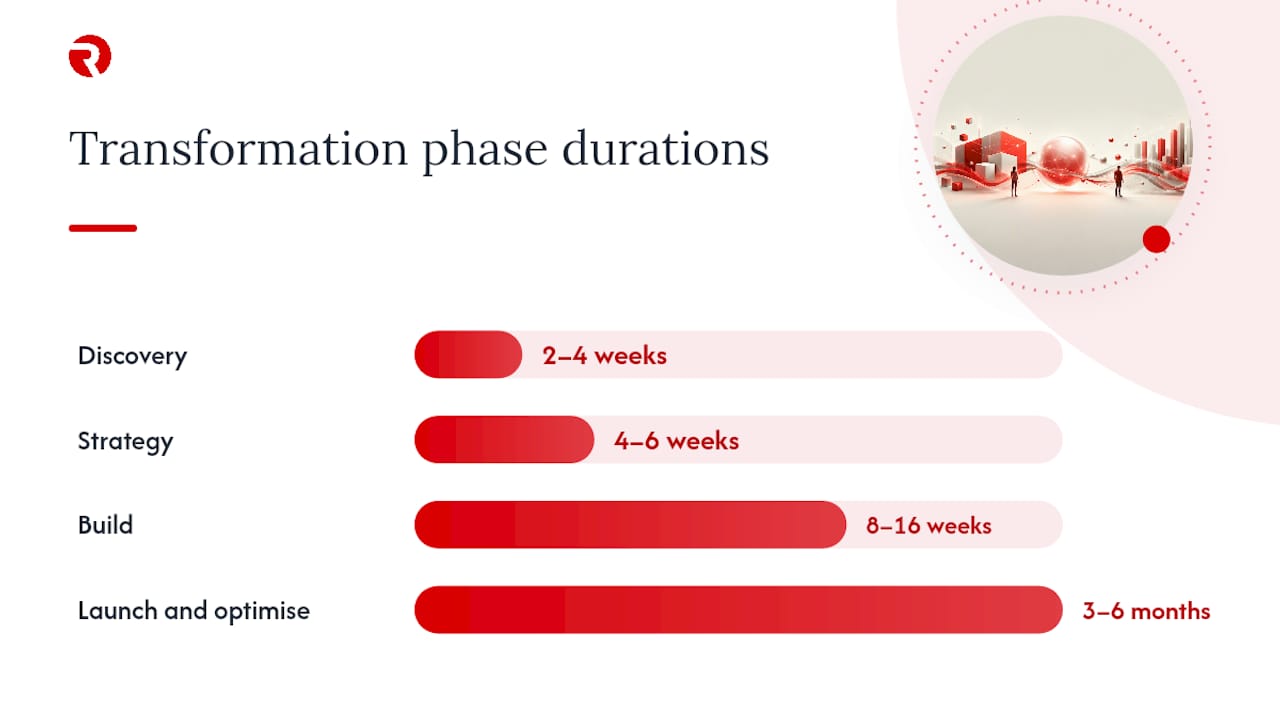
Expect four distinct phases, each with its own rhythm:
- Discovery: 2 to 4 weeks, covering the audit and stakeholder interviews
- Strategy: 4 to 6 weeks, covering brand positioning and channel planning
- Build: 8 to 16 weeks, covering site, content, and CRM integration
- Launch and optimise: 3 to 6 months of active campaign management and iteration
Budgets vary sharply by scope. A small SME refresh (brand plus a lean site rebuild) sits well below a mid‑sized project that adds full CRM integration and paid media management, which in turn costs less than a larger multi‑market programme with PR and content production layered in. Keep agency fees separate from media spend and software subscriptions when you budget. Many SMEs still run most of their marketing budget through digital channels already, which means the transformation budget is often a reallocation, not a brand new cost, as local businesses in Southern California have demonstrated through effective cloud services and marketing technology implementation (local business guide).
Retainers make sense once the build phase ends. Watch for diminishing returns once you’ve captured the obvious wins. That’s the point to renegotiate scope rather than keep spending at the same rate.
How do you choose the right agency to trust with this?
Ask direct questions before you sign anything:
- Can you show anonymised case studies with measurable KPIs, not just before/after screenshots?
- Who owns our customer data and CRM once the contract ends?
- What does your reporting cadence actually look like, week to week?
- Which team members will work on our account, and what’s their experience with SMEs specifically?
- What’s your process for a brand our size, from audit to launch?
Red flags are easy to spot once you know what to look for:
- Vague reporting that never ties back to revenue or retention
- No named case studies with real numbers attached
- Weak CRM or data analytics capability on the team
- No clear staged process, just “we’ll figure it out as we go”
Trust signals work the other way: transparent staged pricing, sample reports you can review before signing, client references you can actually contact, and case studies with defined KPIs attached. If an agency can’t produce any of that, you’re the case study they’re still building.
Which KPIs actually prove the transformation is working?
Group your KPIs into three buckets, because a single “traffic is up” metric tells you almost nothing about commercial health.
- Commercial: revenue growth, customer lifetime value, repeat purchase rate
- Acquisition: customer acquisition cost, conversion rate by channel
- Brand: awareness lift, Net Promoter Score or a comparable satisfaction proxy
A sensible cadence looks like weekly dashboards for the acquisition metrics, monthly strategy reviews covering all three buckets, and a quarterly commercial review tied to actual revenue. None of this works without data hygiene. A single customer view, clean CRM events, and proper conversion tracking underpin every number above. The PRISMA‑based systematic review treats this kind of data readiness as the foundation the whole transformation stands on, not a nice‑to‑have bolted on afterwards.
What does a real transformation look like in practice?
A regional retail brand came to Radka Advertising with flat sales, an outdated site, and no meaningful customer data. The brief: rebuild the customer‑facing digital presence and connect it to a system that could actually tell them what was working.
The method followed the standard four stages:
- Audit: full review of brand perception, site UX, and existing campaign performance
- Strategy: a refreshed brand brief and a prioritised channel plan
- Build: site redesign, CRM integration, and a phased paid media launch
- Optimise: ongoing testing across creative, targeting, and landing pages
The brand saw a meaningful uplift in conversion rate and a noticeable improvement in repeat purchase behaviour within the first two quarters after launch, with paid media contributing a smaller but measurable share of new customer acquisition. Attribution isn’t perfectly clean in any real business, but the direction across every commercial metric was consistent.
That consistency matters more than any single number. It echoes what survey evidence on brand capital found across 405 digitally active SMEs: reach alone doesn’t build competitive advantage. Brand capital, built through consistent routines, does.
Your first 90 days: a practical checklist
Once you’ve signed with an agency, the first 90 days should look roughly like this:
- Weeks 1 to 2: discovery interviews, access handover, brand asset collection
- Weeks 3 to 4: audit findings shared, priorities agreed and locked
- Weeks 5 to 8: quick wins shipped (site fixes, tracking setup, content gaps closed)
- Weeks 9 to 12: CRM data flows live, first campaigns launched
Before any of this starts, prepare your handover: site and social logins, brand assets, customer data exports, and product information. Internal resistance is common when teams feel a new system is being imposed on them, so involve the people who’ll use the CRM daily in the setup conversations, not just the launch announcement.
Why brand capital beats reach, every time
I’ve watched enough SME transformation briefs to notice the same mistake repeating: chasing traffic and impressions while ignoring whether anyone actually trusts the brand once they land on the site. The research backs this up plainly, brand capital mediates whether digital investment turns into real competitive advantage, and reach without it just burns budget faster.
The agencies that get this right treat measurement and CRM as the backbone, not the afterthought. If you’re weighing up where to start, that’s the conversation worth having first.
How Radka Advertising delivers this for SMEs
Radka Advertising runs marketing‑led transformation as a staged service, not a bundle of disconnected tasks. You can start with an audit that maps your brand, site, and channel performance against commercial KPIs, or go straight into a focused SEO audit if that’s the immediate bottleneck. From there, engagement runs as a project, a monthly retainer, or a managed AI‑driven growth subscription, depending on how much ongoing support your team needs.
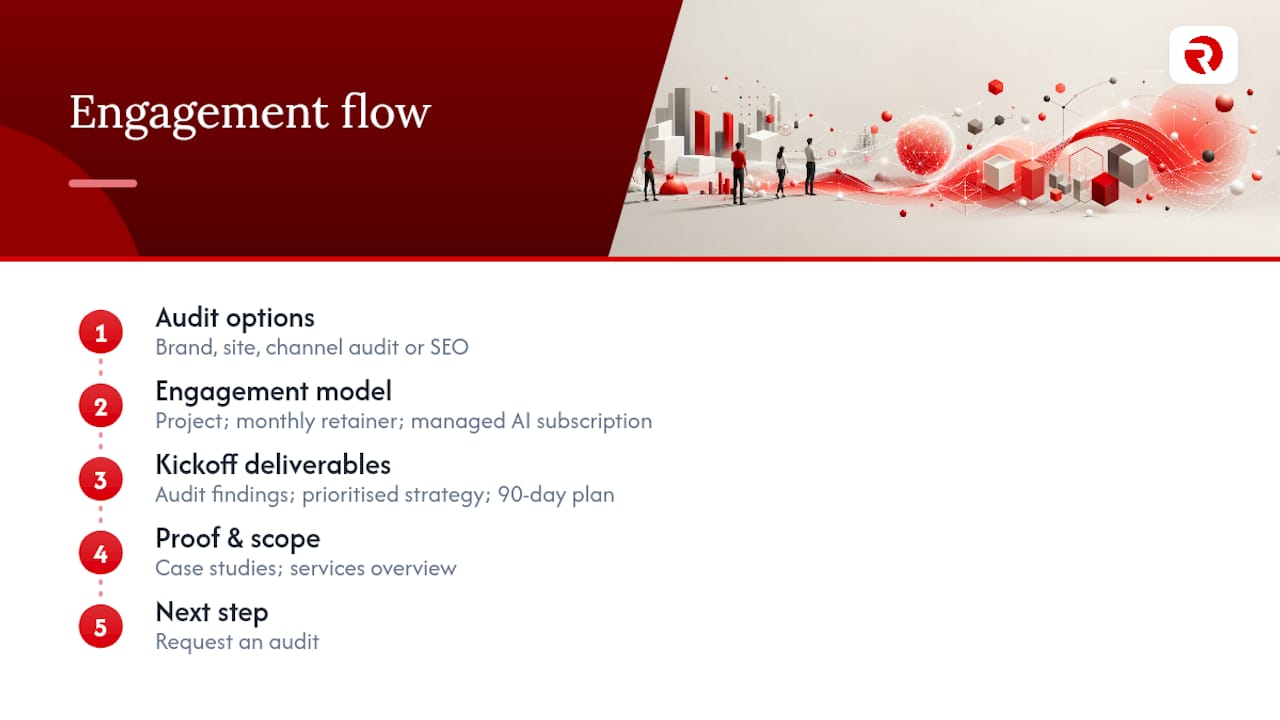
Every engagement starts the same way: audit findings, a prioritised strategy, and a 90‑day delivery plan you can hold the agency to. If you want to see how this has worked for other SMEs before you commit to anything, the case study portfolio shows the methodology and outcomes across different sectors. For a full view of what’s on offer, from UX and e‑commerce builds to paid media and PR, the services overview covers the full engagement model. Request an audit and get a straight answer on what your transformation should prioritise first.
Sources
- Digital marketing capabilities as drivers of SME innovation and performance: a systematic literature review and research agenda for emerging economies
- Beyond market penetration: leveraging brand capital for competitive advantage in digitally driven SMES in resource-constrained settings
FAQ
What is marketing‑led SME digital transformation?
It’s an agency‑run programme that rebuilds your brand, website, content, and customer‑facing channels around measurable commercial outcomes like conversion rate and retention, rather than isolated marketing tactics.
How long does an SME digital transformation take?
Discovery typically runs 2 to 4 weeks, strategy 4 to 6 weeks, build 8 to 16 weeks, and launch with optimisation continues for 3 to 6 months after that.
What’s the difference between a project and a retainer?
A project covers a defined build (site, brand, CRM setup) with a fixed scope and end date, while a retainer funds ongoing optimisation, content, and campaign management once the build is live.
How do I know if an agency can actually deliver this?
Ask for anonymised case studies with measurable KPIs, a clear staged process, and a sample reporting cadence. Radka Advertising publishes exactly this kind of case study evidence for prospective clients to review.
What KPIs should I expect an agency to report on?
Commercial KPIs like revenue and retention, acquisition KPIs like conversion rate and customer acquisition cost, and brand KPIs like awareness or satisfaction scores, reported on a weekly and monthly cadence.