Best quotesondesign.com alternatives for UK developers

Which quotesondesign.com alternatives should you use?
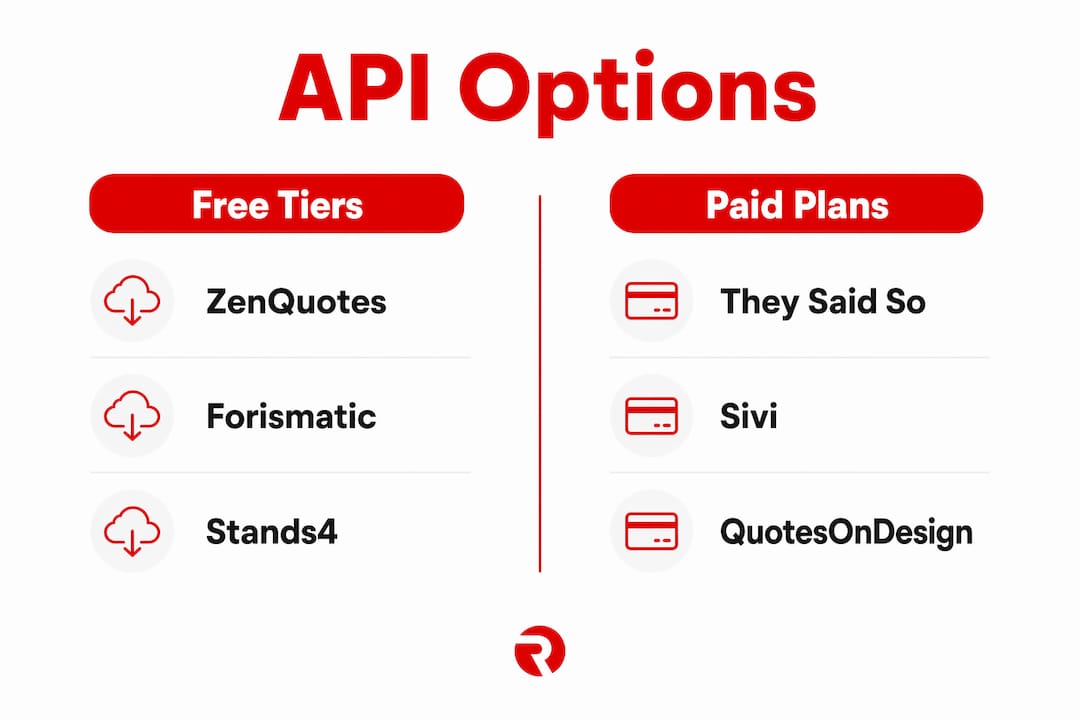
The strongest alternatives to QuotesOnDesign for UK developers are ZenQuotes, They Said So, and Sivi. Each solves a different problem: ZenQuotes gives you a clean free tier with a clear upgrade path, They Said So delivers production-grade features with a defined SLA, and Sivi moves beyond plain text into generative visual design. Forismatic and Stands4 round out the free end of the market, each with real trade-offs.
Here is a quick orientation before the full breakdown:
- ZenQuotes — free tier available, premium subscription removes rate limits and adds CORS headers; attribution required on free plan
- They Said So — tiered paid plans from $9.99/month; bulk retrieval, image generation, and private quotes included at higher tiers
- Sivi — design-first API generating editable, multi-layered visual assets; suited to agencies rather than hobby projects
- Stands4 — large general quote database, requires signup and attribution; less focused on design quotes specifically
- Forismatic — no authentication required, but unreliable uptime makes it unsuitable for production
- QuotesOnDesign — JavaScript-based embedding with semantic blockquote markup; noted for slow response times by developers
All six are accessible from the UK with no geo-restrictions on their APIs.
Detailed comparison of the top design quote API alternatives

One sentence of context: the table below maps each option across the dimensions that matter most when you are choosing between them for a real project.
| API | Free tier | Paid plans | UK accessible | Attribution required | Production ready | Best for |
|---|---|---|---|---|---|---|
| QuotesOnDesign | Yes | No | Yes | No | Limited | Design-specific quotes with semantic HTML |
| ZenQuotes | Yes (rate limited, hourly cache) | Yes | Yes | Yes (free tier) | Yes (premium) | Inspirational quotes with scalable upgrade |
| They Said So | Limited | $9.99–$74.99/mo | Yes | Varies by plan | Yes | Professional apps needing SLA and bulk access |
| Stands4 | Yes (restricted) | Yes | Yes | Yes | Moderate | Wide category variety |
| Forismatic | Yes | No | Yes | No | No | Prototypes only |
| Sivi | No | Yes | Yes | No | Yes | Visual quote generation for agencies |
ZenQuotes
ZenQuotes is the most developer-friendly free option with a credible upgrade path. The free tier caps requests at 5 per 30-second window per IP and serves cached data updated hourly. Upgrade to a premium key and you get unlimited requests, fresh data on every call, CORS headers, keyword filtering, and an image generation endpoint. Attribution back to zenquotes.io is mandatory on the free plan. For a UK developer building a daily inspiration widget or a quote-of-the-day feature, this is the most practical starting point.
They Said So
They Said So is the go-to for professional applications where reliability cannot be left to chance. The API covers over a million quotes across 500+ categories, with paid plans at $9.99, $24.99, and $74.99 per month. The Premium, Ultra, and Enterprise plans allow increasing daily request limits, with Enterprise offering unlimited requests. Bulk retrieval limits scale with the plan (3, 5, and 15 quotes per call respectively). Quote image generation, custom fonts, and private quote storage are available at all paid tiers. CORS is enabled, but They Said So explicitly recommends a server-side proxy to keep your API key out of client-side code.
Stands4
Stands4 offers a broad general-purpose database rather than a design-focused one. Signup is required even for free access, and attribution is enforced. It suits projects where category breadth matters more than design specificity.
Forismatic
Forismatic requires no authentication, which makes it tempting for quick prototypes. The problem is documented unreliable uptime and no SLA whatsoever. Use it to test a UI concept, not to ship a product.
Sivi
Sivi occupies a different category entirely. Rather than returning JSON text, its API generates editable, multi-layered design assets from prompts. Think of it as generative design infrastructure rather than a quote database. Agencies building social content pipelines or branded visual outputs will find it far more useful than any text-only alternative.
QuotesOnDesign
QuotesOnDesign remains the reference point for design-specific quotes with proper semantic markup. Its JavaScript-based embedding wraps output in <blockquote> and <cite> tags, which benefits both accessibility and SEO. The trade-off is slow response times noted by developers, and there is no JSON REST endpoint, which limits how you can integrate it.
Pro Tip: If you are using QuotesOnDesign’s JavaScript snippet, add a cite attribute to the <blockquote> element pointing to the quote’s source URL. Screen readers and crawlers both benefit, and it costs you nothing.
Practical considerations when using quote APIs in production projects
Free APIs are excellent for prototypes. For anything live, the calculus changes fast.
The core issue is that many free quote APIs are hobby projects with no uptime guarantees. When the API goes down, your page either breaks or shows a blank quote block. Neither is acceptable in a client-facing product. The practical fixes:
- Cache quotes locally. Fetch a batch server-side and store them in your database or a Redis cache. Serve from cache; refresh asynchronously in the background.
- Use a server-side proxy. Never call a quote API directly from the browser with an API key in the request. Environment variables and a thin proxy endpoint keep your credentials safe.
- Check CORS support explicitly. ZenQuotes only enables
Access-Control-Allow-Originheaders on paid plans. They Said So sends CORS headers on all plans but still recommends server-side handling to protect keys. - Prefer APIs with documented rate limits. Vague limits are a sign the API is not production-ready. ZenQuotes and They Said So both publish exact figures.
- Test the health endpoint before launch. Several APIs expose a
/healthor/statusendpoint. Hit it during your CI pipeline to catch outages before they reach users.
Pro Tip: Build a fallback array of five to ten hardcoded quotes into your app. If the API call fails or times out after 2 seconds, serve one at random. Users never see an empty block, and you buy time to fix the underlying issue.
Security is the other variable developers underestimate. Hardcoding API keys in client-side JavaScript exposes them in browser dev tools and version control history. Route all authenticated API calls through your server, store keys in environment variables, and rotate them if you ever suspect exposure.
How to choose the best quotes API for your UK-based project
The right API depends on what you are actually building. A portfolio site has different needs from a SaaS dashboard or a content marketing platform.
Work through these criteria in order:
- Production readiness first. Does the API publish uptime history or an SLA? If not, it belongs in prototypes only. ZenQuotes (premium) and They Said So both qualify; Forismatic does not.
- Rate limits vs your traffic. Estimate your daily API calls. They Said So Premium covers 2,500 per day; Ultra covers 8,000. ZenQuotes free tier caps at 5 requests per 30-second window per IP, which breaks under any real load.
- Attribution requirements. Some clients and brand guidelines prohibit third-party attribution links in the UI. ZenQuotes free tier requires a link back; They Said So paid plans remove that requirement.
- Data type: text or visual. If you need quote images for social media or branded content, Sivi or They Said So’s image generation endpoint are your options. Plain text APIs cannot serve that use case.
- Documentation quality. Thin or outdated docs are a red flag. They Said So and ZenQuotes both maintain clear, versioned documentation. QuotesOnDesign’s API page is minimal.
- Integration with your stack. All the APIs listed return JSON (except QuotesOnDesign’s JS-only approach), so framework compatibility is rarely the bottleneck. The real question is whether the API supports the content marketing automation workflow you already have in place.
- Budget. Free tiers work for low-traffic personal projects. For anything client-facing, budget at least $9.99/month for They Said So Premium or a ZenQuotes paid key.
Expert insights from Radkaadvertising on modern quote API use in digital projects
The market for quote APIs has shifted. A few years ago, dropping a JavaScript snippet onto a page and calling it done was acceptable. Now, clients expect branded, visually consistent quote content that works across web, social, and email without manual intervention.
At Radkaadvertising, we see three clear trends in how agencies and developers are approaching this:
- Generative visual APIs are replacing text-only feeds. Sivi’s approach of returning editable, layered design assets reflects where the creative agency market is heading. Plain JSON is a starting point, not a finished product.
- Semantic markup is non-negotiable for accessibility. Using
<blockquote>and<cite>tags correctly improves both screen reader compatibility and crawler indexing. This matters for UK public sector projects and any client with an accessibility obligation under the Equality Act 2010. - SLA-backed APIs are the baseline for professional work. Industry consensus is clear: free tiers are for building, paid tiers are for shipping. The cost difference between a free plan and a $9.99/month plan is negligible against the cost of a production outage.
- Data freshness affects perceived quality. ZenQuotes’ free tier serves cached data updated hourly. For a quote-of-the-day feature, that is fine. For a high-frequency widget refreshing on every page load, stale data becomes visible to users.
- UK developers should factor in GDPR when logging API responses. If your server-side proxy logs full API responses and those responses include user-generated or personally identifiable content, you need a retention policy. Most quote APIs return only public-domain text, but check the terms before logging at scale.
The data-driven approach to content that works for campaigns applies equally to API selection. Choose on evidence, not convenience.
Radkaadvertising: a different approach to dynamic digital content
If you have evaluated the APIs above and realised the real gap is not the quote source but the creative infrastructure around it, that is where Radkaadvertising comes in. The tools compared here deliver data. Turning that data into scroll-stopping branded content across channels is a different discipline entirely.
Radkaadvertising is a London-based full-service agency that builds the creative and digital systems brands need to compete at scale. From AI-powered content infrastructure to multichannel campaign execution, the work goes well beyond what any API delivers on its own. If your project needs quote-driven content that actually converts, not just renders, explore what Radkaadvertising’s brand and content services can do for your product. The case studies show exactly how that plays out across industries.
FAQ
Which quote API is best for production use in the UK?
They Said So and ZenQuotes (premium) are the strongest production choices. Both publish rate limits, support CORS, and offer SLA-backed uptime that free alternatives cannot match.
Does QuotesOnDesign have a REST API?
No. QuotesOnDesign uses a JavaScript-based embedding approach that inserts quotes wrapped in semantic <blockquote> and <cite> markup. It does not offer a JSON REST endpoint.
Are free quote APIs safe to use in client projects?
Free tiers are suitable for prototypes and low-traffic personal sites. For client-facing work, the lack of SLA and unpredictable uptime on free plans like Forismatic make them a liability. Cache quotes locally and use a paid plan for anything live.
What is the cheapest paid quote API for UK developers?
They Said So’s Premium plan starts at $9.99 per month and includes 2,500 requests per day, bulk retrieval, and image generation. ZenQuotes also offers a paid key that removes rate limits and adds CORS headers, though pricing is not publicly listed on their site.
Which API should I use for visual quote content?
Sivi is the only option in this comparison that generates editable, multi-layered design assets rather than plain text. They Said So also offers quote image generation from its paid tiers, making it a strong middle-ground option.
Key takeaways
ZenQuotes and They Said So are the most production-ready alternatives to QuotesOnDesign, with clear pricing, documented rate limits, and CORS support on paid plans.
| Point | Details |
|---|---|
| Production readiness | Only ZenQuotes (premium) and They Said So offer SLA-backed reliability suitable for live client projects. |
| They Said So pricing | Paid plans run from $9.99 to $74.99 per month, scaling rate limits from 2,500 to unlimited daily requests. |
| Free tier trade-offs | ZenQuotes free tier caches data hourly and requires attribution; Forismatic has no SLA and unreliable uptime. |
| Visual quote APIs | Sivi generates editable, layered design assets rather than text, making it the right choice for agency content pipelines. |
| Radkaadvertising | For brands needing creative infrastructure beyond API data, Radkaadvertising builds the content systems and campaigns that make quote-driven content perform. |