Press release length: the word counts that actually get coverage

Keep it between 300 and 500 words. That is the range where most press releases land coverage, and going past 600 words measurably hurts your chances, with industry analysis citing a 28% drop in journalist engagement once releases run long. The PRSA backs the same range and adds the rule that matters most: your opening paragraph must answer the five Ws in 35 words or fewer.
Three rules shape everything else in this guide:
- The ideal range is 300 to 500 words. Anything longer needs a specific justification, not just enthusiasm.
- The lead carries the weight. Fifty to seventy five words, answering who, what, when, where and why before the reader’s thumb moves.
- Boilerplate and contact details don’t count against your budget. They sit outside the news content, so pad-cutting should never touch them first.
Key Takeaways
Press releases that secure coverage stay between 300 and 500 words, with a 50 to 75 word lead answering the five Ws before anything else.
| Point | Details |
|---|---|
| Target word count | Aim for 300 to 500 words; releases over 600 words see measurably lower journalist engagement. |
| Lead paragraph length | Keep the opening paragraph to 50 to 75 words, answering who, what, when, where and why. |
| Boilerplate is separate | Boilerplate and contact details sit outside the news word count and never need trimming first. |
| Match length to channel | Editors prefer 300 to 500 words; wire services often accept 400 to 600 words for indexing. |
| Professional support | Radkaadvertising drafts and distributes releases within these ranges, choosing pitching or wire based on the goal. |
Table of Contents
- How long should a press release be for different types of news?
- What is the correct press release structure and length for each part?
- How long should a press release headline and subject line be?
- When should a press release be longer than usual?
- How do you cut a press release down to the right length?
- What does a ready-to-use press release template look like?
- Why brevity wins in 2026 newsrooms
- Get professional help writing and distributing your press release
- Sources
- FAQ
How long should a press release be for different types of news?
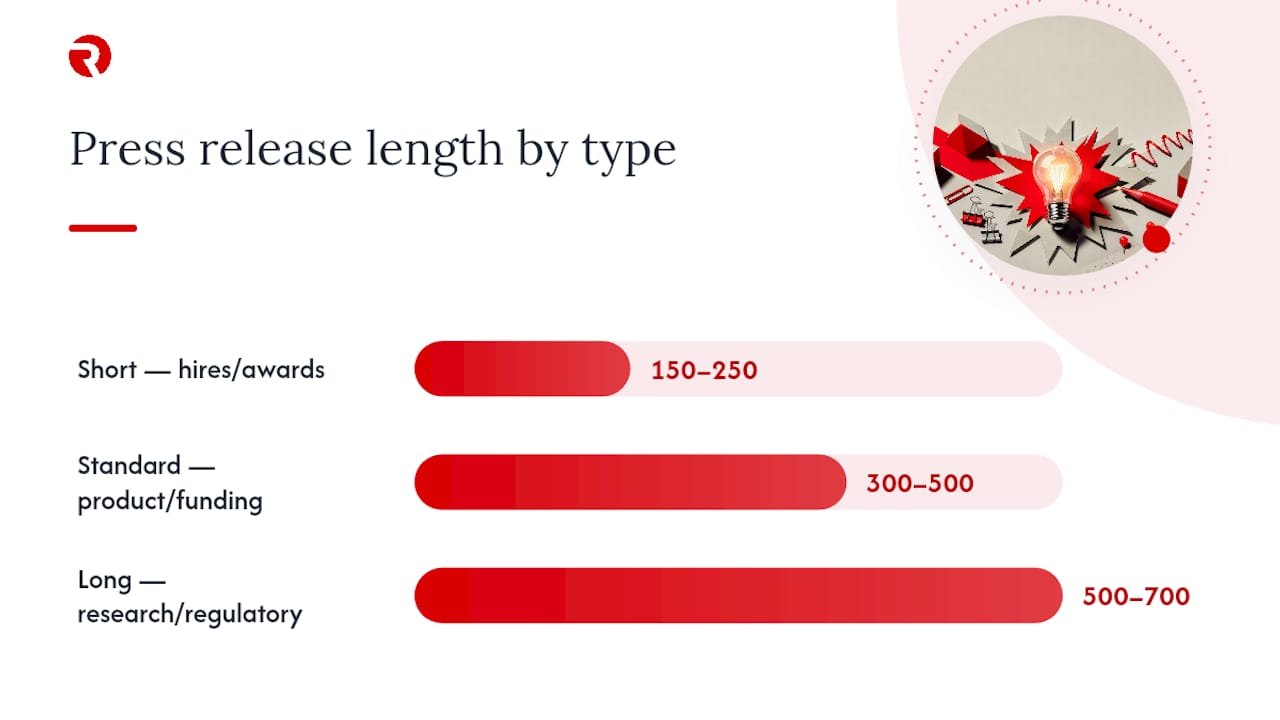
Not every announcement deserves the same length. A short release, sitting at 150 to 250 words, suits an executive hire, a small partnership, or a local award. A standard release, the workhorse of the format at 300 to 500 words, covers most product launches, funding rounds and company milestones. A long release, running 500 to 700 words, is reserved for multi-product launches, major research findings or anything with genuine regulatory weight.
Distribution channel changes the calculation. Editors accepting direct pitches tend to prefer the shorter end, around 300 to 500 words, because they’re scanning dozens of pitches before lunch. Wire services behave differently: they often accept 400 to 600 words because longer copy indexes better for search and syndication through a modern content publishing platform. Know which door you’re knocking on before you decide how much to write.
Pro Tip: If you’re writing for both a journalist pitch and a wire upload, draft the tighter 350 word version first. It’s far easier to add a paragraph for the wire than to hack a bloated draft down to size under deadline.
For AI tools and time poor editors scanning your release, a two line TL;DR at the top, stating the news and the “why now” in plain English, does more to secure a read than any amount of polished prose further down the page.
What is the correct press release structure and length for each part?
Six elements make up a functional press release, and each has earned its length through decades of newsroom habit rather than arbitrary rules. A university careers guide and PressPilot’s structural breakdown both converge on the same skeleton, which keeps the whole document to roughly one page.
- Headline: states the news in one sentence, no fluff.
- Dateline: city and date, a single line.
- Lead: the first paragraph, carrying the five Ws.
- Body: two or three short paragraphs of supporting detail.
- Quote: one strong quote, not three mediocre ones.
- Boilerplate and contact: standard company description plus a named media contact.
| Element | Recommended length |
|---|---|
| Headline | 6 to 12 words, under 100 characters |
| Dateline | One line (city, date) |
| Lead paragraph | 50 to 75 words |
| Body paragraphs | 2 to 3 paragraphs, 40 to 80 words each |
| Quote | 1 to 2 sentences |
| Boilerplate | 50 to 100 words |
Boilerplate and contact details sit outside the 300 to 500 word news budget. Treat them as fixed furniture, not something to trim when a release runs long, and never something to bulk out to hit a target either. Formatting matters as much as word count: short paragraphs, occasional bullet points, and a bolded TL;DR line all improve skimmability, which is precisely what an editor scanning an inbox at speed rewards.
How long should a press release headline and subject line be?
Headlines and subject lines are read in fragments, often on a phone screen with half the words truncated, so length discipline here is not optional. PR Newswire’s AP style guidance recommends headlines under 100 characters, and practical newsroom testing suggests the sweet spot sits closer to 51 to 75 characters for email previews and mobile news apps.
- Headline: 51 to 75 characters, front-loading the news itself rather than the company name.
- Subject line for a pitch email: similar length, written as a standalone hook, e.g. “London Fintech Raises £4M to Expand Into Eastern Europe.”
- Avoid: passive constructions, internal jargon, or leading with “Company X Announces,” which wastes precious characters on the least newsworthy word in the sentence.
Pro Tip: Numbers earn their place in a headline. “£4M,” “3 New Markets,” or “50% Faster” all compress information into fewer characters than the equivalent phrase spelt out, and they catch the eye scanning a crowded inbox.
When should a press release be longer than usual?
Some stories genuinely need more room, and forcing them into 400 words does the story a disservice. Primary research findings, regulatory disclosures, and multi-product launches all carry enough distinct facts that compressing them risks losing the news itself.
The fix isn’t simply writing more. It’s structuring the extra length so it stays skimmable: a TL;DR at the top, clear subheadings breaking up distinct facts, and a strict, unchanged lead paragraph regardless of how long the rest runs. InstantPress makes the sharper point that data heavy announcements are usually better served by moving methodology and supporting detail into a linked fact sheet rather than stretching the release itself.
The release stays the news. The fact sheet carries the evidence. Conflating the two is how a 400 word story becomes an 800 word slog nobody finishes.
If you’re tempted to attach three appendices worth of data tables, that’s the signal to send a separate media kit instead of padding the release past 700 words.
How do you cut a press release down to the right length?
Cutting a release is a sequence, not a single pass. Work through it in order:
- Strip marketing adjectives first. “Revolutionary,” “innovative” and “game-changing” carry no factual weight and are the easiest words to delete without losing meaning.
- Move background into a fact sheet. Company history, market context and prior achievements belong in a linked document, not paragraph three of the news itself.
- Trim to one quote. If you have three spokespeople quoted, keep the strongest line and cut the rest.
- Check for redundancy. If the headline, lead and first body paragraph all repeat the same fact in different words, one of those three is doing nothing.
- Read it aloud. Anything that makes you pause to reword mid-sentence is usually the first candidate for deletion.
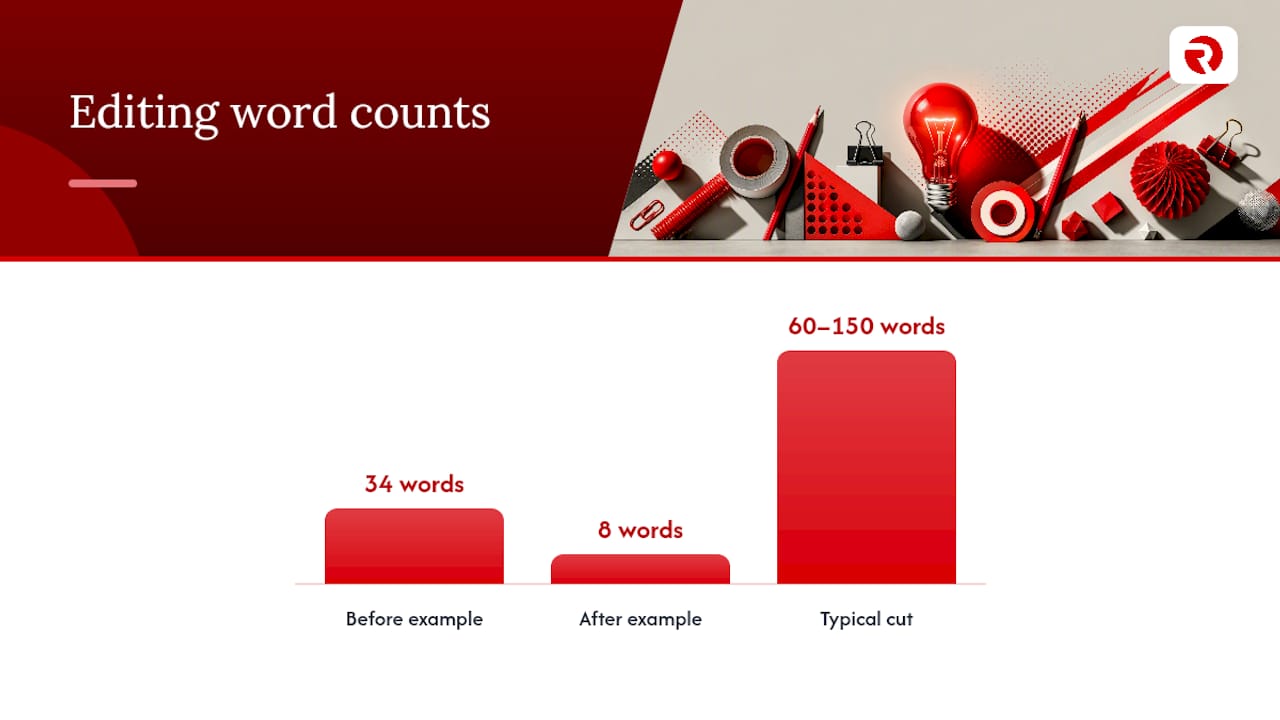
A before example: “Our groundbreaking new platform, which represents years of dedicated research and a deep commitment to innovation, will fundamentally transform how businesses approach customer engagement across multiple sectors and industries.” That’s 34 words saying nothing measurable. After: “The platform cuts customer response times by half.” Eight words, one fact, done. Applied across a full draft, that kind of cut routinely removes 60 to 150 words without losing a single piece of actual news.
Pro Tip: When a release still feels long after editing, ask whether the missing content is truly news or just context. Context goes in a linked appendix. News stays in the release.
What does a ready-to-use press release template look like?
Radkaadvertising built its press release scaffold around exactly the structure covered above, tightened for speed and consistency across client accounts.
The template:
- Headline (6 to 12 words)
- Optional subhead (one line, adds detail the headline can’t fit)
- Dateline (city, date)
- Lead paragraph (50 to 75 words, five Ws)
- Two supporting body paragraphs (40 to 80 words each)
- One quote
- Boilerplate (50 to 100 words) and media contact
The workflow behind it runs in five stages:
- Briefing (day one): confirm the news, the audience, and the “why now.”
- Drafting (day one to two): write to the template, targeting 400 words.
- Headline testing (day two): draft three headline variants, pick the sharpest.
- Legal check (day two to three): verify claims, figures and quotes.
- Distribution choice (day three): targeted pitching for editorial pickup, or wire service for reach and indexing.
Pro Tip: Keep two versions on file: a tight 350 word pitch draft for direct editor contact, and a slightly longer wire version with an added TL;DR box for journalists and AI summarisation tools scanning it at speed.
Radkaadvertising’s media coverage work shows how this structure performs once it reaches an actual inbox, rather than just a style guide.
Why brevity wins in 2026 newsrooms
Newsroom behaviour has tightened, not loosened, over the past few years. Editors and AI summarisation tools alike now reward releases that state the news in the first sentence rather than easing into it, and research on release length confirms that anything padded past 600 words simply gets skimmed less.
What still surprises clients is how often a shorter draft outperforms a longer one they were proud of. Cutting a release from 800 words to 420 rarely loses the story. It usually reveals which three facts were actually worth telling, and strips out the two paragraphs of context nobody needed. That discipline, more than any headline trick, is what separates a release that gets read from one that gets archived.
Get professional help writing and distributing your press release
Radkaadvertising writes and distributes press releases for entrepreneurs and established brands who need coverage without spending a week wrestling a draft down to size. Our PR team handles the full sequence: drafting to the 300 to 500 word range, headline testing, and choosing between targeted pitching and wire distribution based on your goals, not a template’s default setting.
If you want proof before you enquire, our case studies show the coverage outcomes behind that process. When you’re ready to hand the drafting and distribution over to a team that does this daily, visit Radkaadvertising’s PR services page to discuss your next release.
Sources
- How to Write a Press Release That Gets Coverage in 2025 | Public Relations Society of America
- How to Write a Press Release: Format, Template, and Examples (2026 Guide) | Shadow
- Press Release Length: Why Most Are Too Long in 2026 | InstantPress
- Press Release Structure: The 6 Parts + Example | PressPilot
- How to Write an AP Style Press Release | PR Newswire
The Radkaadvertising template above adapts these standards into an agency-ready pattern you can copy directly.
FAQ
What is a good length for a press release?
Most effective press releases run 300 to 500 words, with editors preferring the shorter end and wire services accepting up to 600.
What are the five Ws in a press release?
Who, what, when, where and why. Your lead paragraph should answer all five in 50 to 75 words, ideally within the opening sentence or two.
What qualifies as a press release?
A press release is a short, news-style document written to inform journalists of a specific, timely development, structured around a headline, dateline, lead, body, quote and boilerplate.
Why is “30” written at the end of a press release?
It is a newsroom convention, dating back to wire-service typesetting, signalling “end of copy” so editors know no further text follows. Most digital releases now use “###” instead.
Can Radkaadvertising help write and distribute a press release?
Yes. Radkaadvertising drafts releases to the 300 to 500 word standard and manages distribution through targeted pitching or wire services depending on the client’s coverage goals.