Marketers: Buy vs build multilingual PR distribution for AI

Multilingual PR distribution delivers native-language earned coverage in every target market, plus an indexable multilingual footprint that strengthens both SEO and AI visibility. It suits marketing teams running international launches, market entry campaigns, or growth pushes that need local relevance rather than a single English release syndicated worldwide. This guide covers how to brief providers, what drives cost, and how to measure results.
TL;DR:
- Multilingual PR distribution delivers native-language coverage and backlinks in target markets, enhancing local search indexation and AI citation potential.
- Quality localisation and transcreation significantly improve media pickup rates compared to machine translation, requiring native reviewers and market-specific glossaries.
- Distribution channels include global wires, regional feeds, and direct journalist outreach, with package costs scaling based on outlet numbers, languages, and pitching efforts.
- Timing releases for local time zones and avoiding national holidays is crucial for maximizing media pickup and engagement in each market.
- Agency-led campaigns excel at coordinating multi-market efforts, maintaining brand consistency, and leveraging native relationships, especially for complex international launches.
Table of Contents
- What is multilingual PR distribution and how does it differ from a single-language release?
- Translation, localisation and transcreation: what quality work actually looks like
- Distribution channels, package tiers and turnaround times
- How do you brief and evaluate a multilingual PR provider?
- Timing, targeting and what good reporting looks like
- How multilingual PR supports SEO and AI visibility
- When does an agency model earn its keep on multilingual campaigns?
- Get multilingual PR distribution built around your markets
- Sources
- FAQ
What is multilingual PR distribution and how does it differ from a single-language release?
Multilingual PR distribution combines translation, localisation, regional pitching, and syndication into one coordinated campaign, rather than pushing one English release through global wires and hoping local media picks it up. The service produces earned coverage in the reader’s own language, backlinks from in-market domains, local search indexation, and a growing chance of citation by AI models that draw on multilingual sources.
A single-language release relies on journalists translating your story themselves, which most won’t bother doing. Global press release distribution works by blending worldwide wires, regional feeds, and targeted editorial pitching, and that mix only pays off when the copy itself speaks the local language properly.
Pursue a multilingual approach when you can point to genuine market demand: a product launch scheduled for specific countries, distributors who need local proof points, or a campaign objective that depends on being found in French, German, or Polish search results, not just English ones.
Translation, localisation and transcreation: what quality work actually looks like
These three terms get used interchangeably by suppliers who want to charge translation rates for localisation work. Translation converts words. Localisation adapts idiom, measurement units, and cultural references so the release reads as though it was written locally. Transcreation goes further still, rebuilding the emotional hook of a headline or campaign line so it lands the same punch in a different language, even if the literal words change completely.
The gap in quality is stark. Machine translation routinely gets rejected by journalists who spot stiff phrasing within a sentence. Localisation and transcreation reduce cultural missteps and measurably improve pickup rates, because native reviewers catch the details a translation tool misses entirely.
Before signing with a supplier, ask for:
- A native-language sample release, not a translated English one.
- A market-specific glossary showing how brand terms are handled consistently.
- Named in-market reviewers, not a generic “native speaker network” claim.
Pro Tip: Ask a supplier to localise one paragraph live on a call. How they handle a single idiom tells you more about their process than any pitch deck.
Distribution channels, package tiers and turnaround times
International PR distribution generally splits into three channel types, and understanding what each one buys you matters more than comparing headline prices.
- Global wires: Reuters/AP/AFP-style syndication pushes your release across thousands of outlets and aggregator sites almost instantly, which builds indexed reach fast but rarely produces standout editorial coverage.
- National and regional wires: narrower distribution focused on a specific country’s media ecosystem, generally producing better contextual pickup than a global blast.
- Editorial pitching: direct outreach to named journalists and beat reporters, slower to execute but responsible for the highest-value placements and links.
Package tiers scale on three levers: number of outlets, number of languages, and how much hands-on pitching effort is included. Regional multi-language bundles commonly cover 1,500 or more outlets across several markets, and full global packages can range from low thousands to tens of thousands of dollars depending on outlet count and language count. Even major platforms are adapting: PR Newswire’s Amplify tool recently added multilingual support, a sign that wire services see this as standard demand now, not a niche add-on.
Turnaround for wire syndication is often same-day to 48 hours. Editorial pitching campaigns typically run one to three weeks per market, since a journalist relationship can’t be rushed the way a syndication feed can.
How do you brief and evaluate a multilingual PR provider?
A weak brief produces generic localisation. A strong one gives your supplier everything they need to make editorial judgement calls without asking you every five minutes.
- Define your markets and languages first, not your budget. Which countries actually matter for this campaign, and why?
- Write your core messages once, then flag which local hooks, statistics, or cultural references need adapting per market rather than translating literally.
- Set embargoes and confirm spokespeople who can do local media interviews, ideally someone who speaks the target language or has done cross-border interviews before.
- Ask providers directly: do you use native copywriters or translation software with a human pass? Can you show placement samples from this specific market? What’s your outlet list, and is reporting broken down by language and country?
- Watch for red flags: vague “guaranteed placement” promises, no named native reviewers, and unclear rights over who owns the localised copy once the contract ends.
Negotiate on reporting granularity and copy ownership before you negotiate on price. Those two levers matter more long-term than a discount on the invoice.
Timing, targeting and what good reporting looks like
Schedule releases for inbox-prime hours in each target market’s own time zone, not your own. A release that lands mid-morning in London might hit German inboxes at lunch and Japanese ones overnight, killing same-day pickup in one market while working fine in another. Check local bank holidays and major festivals before locking a date; a launch that collides with a national holiday in your target market gets buried regardless of how good the story is.
Targeting works best at the beat level: journalist lists built around specific verticals, not a generic “tech media” spreadsheet, plus relevant platform selection and local influencer or KOL inclusion where that matters for the market.
Good reporting breaks down by:
- Pickup rate per market and per language.
- Named, notable placements rather than a raw outlet count.
- Backlinks generated and their domain authority.
- Referral traffic by country.
- Early indicators of AI or GEO impact, such as whether a brand mention shows up in AI-generated answers to relevant queries.
Multimedia assets like images and video measurably increase engagement on international releases, and they help bridge language gaps for readers scanning quickly rather than reading every word.
How multilingual PR supports SEO and AI visibility
Every localised release is a new indexable page in that language, and each one adds to the pool of authoritative content that search engines and AI models can draw on. Translations are increasingly critical for AI visibility: the more language-specific coverage a brand earns, the more likely it becomes a citable source in AI-generated answers in that language, not just in English.
The practical pairing that works: distribute the release, publish matching multilingual newsroom pages on your own site, then support both with hreflang tags and structured metadata so search engines connect the language versions correctly. Multi-platform SEO strategies reinforce this further by spreading citation opportunities across more surfaces than search alone.
Measure lift through language-specific search visibility, referral traffic by market, and manual checks of whether AI tools cite your brand when asked relevant questions in that language.
When does an agency model earn its keep on multilingual campaigns?
Most in-house marketing teams can handle a single-market English release without help. Multilingual campaigns are a different beast entirely, and the conventional wisdom that “translation software plus a freelancer network” scales the same way doesn’t hold up once you’re running five markets simultaneously with different embargoes, different journalist relationships, and different cultural sensitivities to manage in parallel.
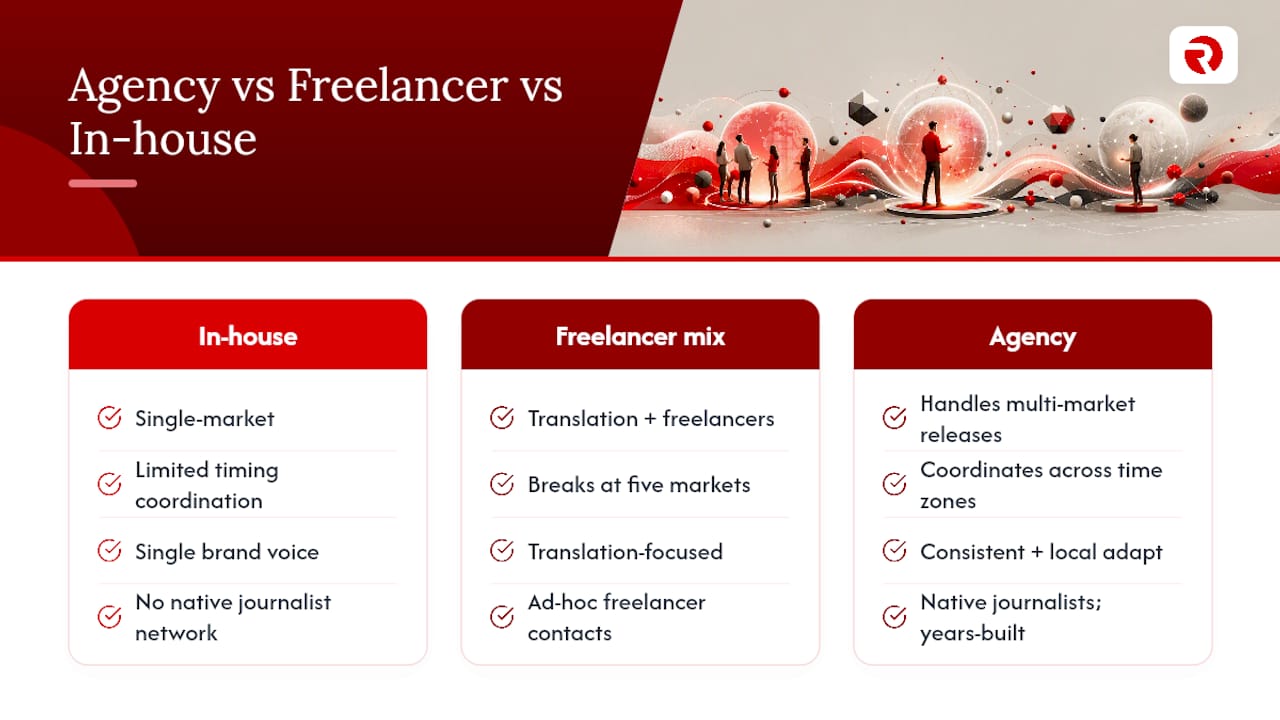
The real value of an agency model isn’t the translation itself. It’s coordinating timing across time zones, maintaining a consistent brand voice while allowing genuine local adaptation, and holding relationships with native reviewers and journalists that took years to build. Radkaadvertising’s case study portfolio and media coverage record reflect exactly this kind of multi-market coordination work.
For continuity, blend internal and agency teams rather than outsourcing entirely: keep one internal owner who holds the brand knowledge and briefs the agency, while the agency handles the native execution and market relationships.
— Bart
Get multilingual PR distribution built around your markets
Radkaadvertising runs multilingual PR distribution with native copywriters in-market, not translation software with a spellcheck pass. The difference shows up in journalist pickup rates and in how naturally the copy reads once it lands in a German inbox or a Polish news feed. Campaigns are planned around your specific launch markets, backed by measurement that tracks pickup, backlinks, and search visibility by language, not just a single global total.
Contact Radkaadvertising ahead of a market entry, a product launch across several countries, or a crisis communication moment where speed and local nuance both matter. Explore the PR distribution services and request a proposal scoped to your target markets and languages.
Sources
- Press release translation: benefits for global businesses
- Why translations are critical for AI visibility
FAQ
What is multilingual PR distribution?
It’s the combination of translation, localisation, regional pitching, and syndication used to earn native-language media coverage across multiple markets simultaneously, rather than distributing one English release globally.
How much does multilingual PR distribution cost?
Pricing scales with outlet count, language count, and pitching effort. Regional multi-language bundles often start in the low thousands and rise into the tens of thousands for full global coverage with editorial pitching included.
What’s the difference between translation and localisation for press releases?
Translation converts words directly; localisation adapts idiom, cultural references, and tone so the release reads as though written by a local journalist. Localisation and transcreation both improve pickup rates over raw translation.
How long does multilingual PR distribution take?
Wire syndication typically delivers within 48 hours; editorial pitching campaigns per market usually run one to three weeks, since journalist relationships take longer to activate than a syndication feed.
Does multilingual PR distribution help with AI search visibility?
Yes. Multilingual press releases create more indexable pages in each target language, which increases the likelihood of citation by AI models answering queries in that language.