Multi-channel strategy workflow: the UK practitioner’s guide

TL;DR:
- A multi-channel strategy workflow is a phased system that includes assessment, planning, execution, governance, and optimization to deliver unified reach and measurable results. It relies on a detailed audit, decision matrix, and structured messaging, with measurements driven by GA4 and clear data governance from the start. Teams must deliberately choose channels, sequence launches, and assign ownership to avoid common pitfalls and ensure effective cross-channel campaigns.
A multi-channel strategy workflow is a repeatable, phase-based operating system: assess your channels, plan your mix, execute with coordinated messaging, govern your data, and optimise continuously. Follow it and you get unified reach across every platform your customers actually use, measurable conversions tied to real business objectives, and a governance structure that stops campaigns falling apart mid-flight. The immediate action: run a two-week channel audit before you brief anyone.
Your five-phase checklist at a glance:
- Assess — audit existing channels, map audience data, document your tech stack
- Plan — score channels on fit, assign budget, set KPIs per funnel stage
- Execute — produce channel-adapted creative, publish to a shared content calendar, apply UTM conventions
- Govern — assign RACI roles, set approval SLAs, enforce GDPR-compliant data flows
- Optimise — run holdout tests, reallocate budget weekly, review attribution monthly
GA4 sits at the centre of measurement throughout. Every phase produces a documented artefact, so when you hand work to an agency like Radkaadvertising, the brief writes itself.
Table of Contents
- What is multi-channel marketing, and why does it need a workflow?
- The real benefits and the pitfalls that derail most programmes
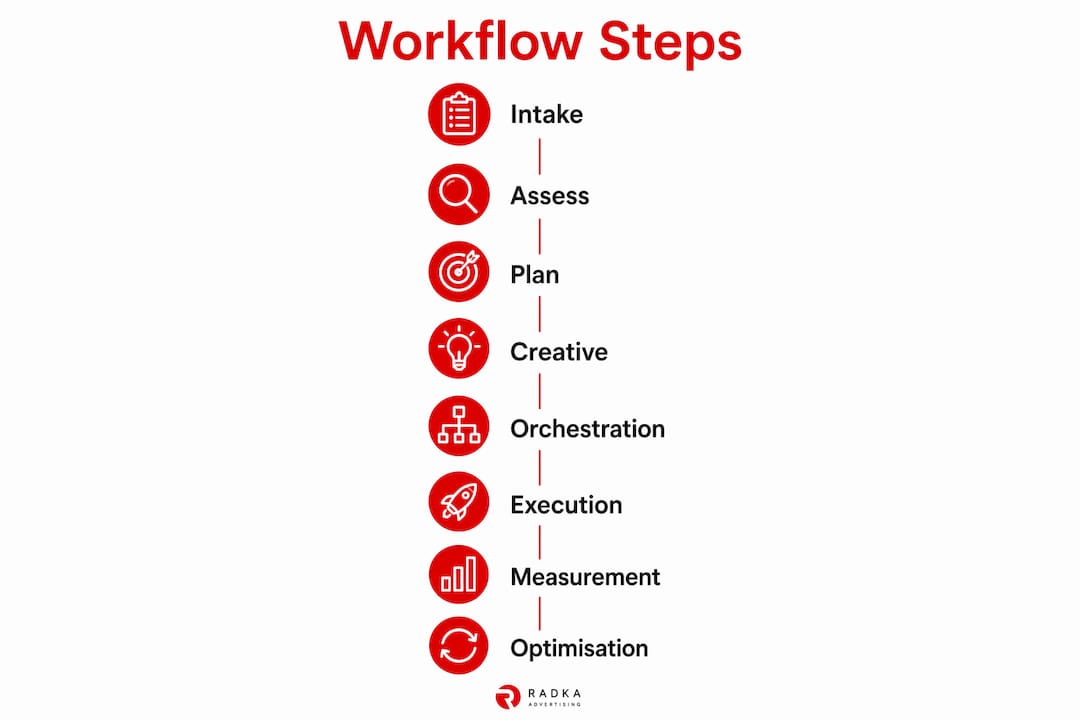
- How to build and run your multi-channel strategy workflow, step by step
- What does your tech stack need to connect across channels?
- Who owns what? Roles, approvals and budget governance
- How do you measure impact and optimise systematically?
- How Radkaadvertising applied this workflow to a UK campaign
- Key takeaways
- What most teams get wrong about multi-channel programmes
- Radkaadvertising builds and runs this workflow for UK brands
- Useful sources and further reading
- FAQ
What is multi-channel marketing, and why does it need a workflow?
Multi-channel marketing uses multiple independent distribution and promotional channels so customers can engage through whichever medium suits them best. The goal is reach and relationship maintenance, not necessarily a unified customer record across every touchpoint.

That independence is precisely why a workflow matters. Without one, each channel team operates in isolation, messaging drifts, and budget decisions get made on gut feel rather than data.
Multichannel vs omnichannel: a practical contrast
| Dimension | Multi-channel | Omnichannel |
|---|---|---|
| Data sharing | Channels operate independently | Real-time shared inventory, orders and customer history |
| Customer experience | Consistent messaging, separate journeys | Single unified journey across all touchpoints |
| Technical complexity | Moderate | High (CDP or unified commerce platform required) |
| Best for | Reach and channel-specific optimisation | Personalisation and cross-channel continuity |
Choose multi-channel when your priority is maximising reach across distinct audiences, your product catalogue is stable, or your team lacks the technical capacity for real-time data unification. When you are ready to share inventory and customer history in real time, that is the point to consider unified commerce or a customer data platform as your escalation path.
Signals that multi-channel is the right fit right now:
- You sell through two or more distinct platforms (e.g. your own website plus Amazon or a physical outlet)
- Your customer segments behave differently by channel and respond to channel-specific offers
- You have first-party data in at least one owned channel (email list, CRM) to anchor measurement
- Your team can manage channel-specific creative without a centralised orchestration platform
The real benefits and the pitfalls that derail most programmes
Multi-channel programmes deliver reach no single channel can match, built-in redundancy if one platform underperforms, and the ability to play to each channel’s native strengths: search intent on Google, social proof on Instagram, relationship depth in email.
The pitfalls are just as predictable. Channel overload spreads budget and attention too thin. Inconsistent messaging confuses buyers who see your brand in three places with three different tones. Siloed data means you cannot tell which channel actually drove the sale. Measurement gaps leave you optimising vanity metrics instead of revenue.
Common pitfalls and their early mitigations:
- Channel overload — cap your initial mix at three to four channels; add more only when existing ones are profitable
- Inconsistent messaging — write one core message document before any creative brief goes out
- Siloed data — connect all channels to a single analytics property (GA4) from day one
- Measurement gaps — define conversion events and UTM conventions before launch, not after
Pro Tip: Pick channels because your customers are there, not because a competitor is. A channel-fit score (audience presence, intent, cost, measurability) gives you a defensible reason to add or drop a channel at any review.
The workflow in the next section addresses each of these pitfalls directly, at the phase where they typically emerge.
How to build and run your multi-channel strategy workflow, step by step
This is the operational playbook. Work through each phase in order; skip none on a first run.

Phase 0: intake (before anything else)
Capture four things in writing before the first planning meeting: the primary business objective (revenue, leads, brand awareness), the single target metric that will define success, any hard constraints (regulatory, seasonal, geographic), and the total budget envelope including production costs. Without these, every subsequent decision is negotiable in the wrong direction.
Phase 1: assess
- Channel audit — list every channel currently active, its monthly cost, its output volume, and its last three months of performance data
- Audience research — identify where your customers spend time and what intent they bring to each platform
- Tech map — document your CRM, email platform, ad accounts, analytics property, and any commerce integrations
- Persona template — for each primary segment, capture: demographics, preferred channels, content format preferences, purchase triggers, and objections
Sample persona fields: Name/label | Age range | Primary channel | Secondary channel | Key purchase trigger | Main objection | Preferred content format
Phase 2: plan
Score each candidate channel using a decision matrix:
| Channel | Audience presence | Intent fit | Cost/payback | Capacity | Measurability | Total score |
|---|---|---|---|---|---|---|
| Paid search (Google) | High | High | Medium | Medium | High | — |
| Meta (paid social) | High | Medium | Medium | Medium | High | — |
| Email (owned) | Medium | High | Low | Low | High | — |
| LinkedIn (B2B) | Medium | Medium | Low | Medium | Medium | 10/15 |
| Display/programmatic | High | Low | High | Low | Medium | — |
Score each dimension 1–3. Channels scoring below 9 rarely justify inclusion in a first-phase mix. A channel-fit framework like this prevents budget waste and gives you a repeatable way to add or remove channels at each quarterly review.
Budget allocation: apply the 70-20-10 model: 70% to proven performers, 20% to channels showing growth potential, and 10% to experiments. Review the split monthly, not quarterly.
Phase 3: creative and messaging
Write one core message document: the single claim your brand makes, the proof point behind it, and the call to action. Every channel adaptation derives from this document.
Apply the 3-3-3 rule: three core messages, delivered across three channels, over three distinct timeframes (awareness, consideration, conversion). This keeps creative teams aligned without forcing identical copy across platforms. A paid search headline and an Instagram caption carry the same message in completely different forms.
Phase 4: orchestration
Sequence by funnel stage. Launch awareness activity 48–72 hours before starting retargeting to build a warm audience first. Launching all channels simultaneously wastes retargeting budget on cold audiences who have never seen your brand.
Set suppression rules before launch: exclude recent purchasers from acquisition campaigns, exclude existing email subscribers from top-of-funnel paid social, and exclude converters from retargeting pools within 24 hours of conversion.
Phase 5: execution
Content calendar template (sample week):
| Day | Channel | Content type | Message theme | Owner | Status |
|---|---|---|---|---|---|
| Monday | Newsletter | Awareness | CRM lead | Draft | |
| Tuesday | Paid search | Ad copy live | Conversion | Media buyer | Scheduled |
| Wednesday | Reel | Consideration | Social lead | In review | |
| Thursday | Article | Thought leadership | Content lead | Approved | |
| Friday | Retargeting sequence | Conversion | CRM lead | Scheduled |
Agency brief essentials: objective, audience persona, core message, channel scope, budget per channel, creative specifications, UTM naming convention, KPIs, approval contacts, and go-live date.
UTM conventions: agree on a naming structure before any campaign goes live. A standard format is utm_source=google / utm_medium=cpc / utm_campaign=[campaign-name] / utm_content=[ad-variant]. Enforce it across every team and agency partner.
Phase 6: measurement and governance
Sample KPI set by funnel stage:
| Funnel stage | KPI | Target type |
|---|---|---|
| Awareness | Reach, impressions, share of voice | Volume |
| Consideration | CTR, engagement rate, time on site | Quality |
| Conversion | Conversion rate, cost per acquisition | Efficiency |
| Retention | Repeat purchase rate, email open rate | Loyalty |
| Programme level | ROAS, customer lifetime value | Business impact |
Configure GA4 conversion events for every action that matters: form submission, purchase, phone call, video completion. Without configured events, your cross-channel reporting is guesswork.
Phase 7: optimisation and contingency
Run a weekly budget reallocation review: if a channel’s cost per acquisition exceeds the target by more than 20%, pause or reduce spend and reallocate to the next-best performer. Monthly, review attribution data and run one structured experiment (see Section 7 for the full methodology). Quarterly, repeat the channel audit from Phase 1 and update the decision matrix scores.
Rollout timeline (standard UK engagement):
| Week | Milestone |
|---|---|
| 1–2 | Channel audit and persona validation |
| 3–4 | Channel decision matrix, budget plan, core message document |
| 5–6 | Creative production, UTM setup, GA4 configuration |
| 7 | Soft launch: awareness channels only |
| — | Full launch: retargeting and conversion channels live |
| 9–12 | Weekly optimisation reviews, first experiment |
| Month 4+ | Monthly attribution review, quarterly channel audit |
What does your tech stack need to connect across channels?
The data layer is what separates a coordinated campaign from a collection of independent ads. Get the connections right early; retrofitting them mid-campaign is expensive and disruptive.
Core tool categories:
- CRM/CDP — the customer record of truth; feeds audience segments to ad platforms and email
- Analytics (GA4) — cross-channel measurement hub; requires server-side tagging for reliable data in a post-cookie environment
- Tag management (Google Tag Manager) — controls all tracking tags without developer dependency
- Marketing automation — triggers email and SMS sequences based on CRM events or GA4 audience signals
- Ad platforms (Meta Ads, Google Ads) — connect via API to CRM for custom audience uploads and conversion imports
- PIM or commerce integration — syncs product data and inventory across channels; the foundation of unified commerce patterns
Integration priorities:
| Integration | What it enables | Priority |
|---|---|---|
| CRM ↔ Email platform | Triggered sequences from CRM events | High |
| CRM ↔ Ad platforms | Custom audiences, lookalikes, conversion import | High |
| GA4 + server-side tagging | Reliable cross-channel attribution | High |
| PIM → channel feeds | Consistent product data across platforms | Medium |
| CDP → all channels | Real-time personalisation at scale | Low (phase 2) |
First-party data and identity checklist:
- Implement GA4 User-ID to connect logged-in sessions across devices
- Deploy a consent management platform (CMP) compliant with UK GDPR before any tracking fires
- Use hashed email matching for CRM-to-ad-platform audience uploads
- Document all data flows in a Record of Processing Activities (ROPA) as required under UK GDPR
UK GDPR compliance note: under UK GDPR, you must have a lawful basis for every data processing activity, document it in your ROPA, and include data processor details in your Data Processing Agreement with any agency or platform partner. For cross-channel campaign tracking, the most common lawful basis is legitimate interests or consent, depending on the channel and data type. Confirm your basis with a qualified data protection adviser for your specific situation.
For multichannel SEO specifically, organic visibility across platforms requires the same UTM discipline and GA4 configuration as paid channels.
Who owns what? Roles, approvals and budget governance
A multi-channel programme without clear ownership produces bottlenecks at every approval gate. Assign roles before the first brief goes out.
Core team structure:
- Programme owner — accountable for overall performance and budget; typically the Marketing Director or business owner
- Channel leads — one per active channel; responsible for execution and channel-level KPIs
- Data owner — manages GA4, CRM integrity, UTM compliance and GDPR documentation
- Creative lead — owns the core message document and approves all channel adaptations
- Agency contact — single point of contact for external partners; holds the brief and manages feedback cycles
RACI for campaign phases:
| Phase | Programme owner | Channel lead | Data owner | Creative lead | Agency |
|---|---|---|---|---|---|
| Plan | A | R | C | C | I |
| Brief | A | C | C | R | I |
| Approve creative | A | I | I | R | C |
| Launch | I | R | R | I | R |
| Optimise | A | R | R | I | C |
R = Responsible, A = Accountable, C = Consulted, I = Informed
Approval SLAs: creative review turnaround should be no longer than 48 hours for digital assets and 72 hours for video. Budget reallocation requests above 15% of a channel’s monthly allocation require programme owner sign-off within 24 hours.
Budget governance rules: set a minimum spend floor per channel (typically one month’s worth of data to reach statistical significance) and a maximum reallocation ceiling of 30% per week to avoid destabilising campaigns mid-flight.
How do you measure impact and optimise systematically?
Measurement without a structured experiment cadence produces data you look at but never act on. Build the cadence into the programme from week one.
Running experiments that produce usable results
- Write a hypothesis — “If we increase email send frequency from weekly to twice-weekly for the consideration segment, we expect a 10% uplift in click-to-site rate without a significant increase in unsubscribes”
- Define your sample — split audiences randomly; never use geographic or temporal splits as proxies for randomisation
- Set a success criterion before you start — agree the minimum detectable effect and the observation period
- Run the test to completion — do not call results early; premature reads produce false positives
- Document and act — record the result, update the channel playbook, and schedule the next experiment
Attribution: which model fits your programme?
- Multi-touch attribution (data-driven) — best for digital-only programmes with sufficient conversion volume in GA4
- Media Mix Modelling (MMM) — use when offline channels (TV, OOH, print) represent a material share of spend; combines with digital attribution for a complete picture
- Holdout tests — the most reliable way to measure true incrementality; run quarterly for your highest-spend channels
Optimisation cadence
Daily: check for delivery issues, budget pacing, and any channel with a cost-per-acquisition spike above 30% of target. Act on anomalies only.
Weekly: review channel-level KPIs against targets, run the budget reallocation decision, and update the content calendar for the following week.
Monthly: review cross-channel attribution, assess the 70-20-10 budget split, and run one structured experiment from the backlog.
How Radkaadvertising applied this workflow to a UK campaign
Campaign brief summary: a UK-based consumer brand needed to grow qualified leads within a defined budget over a 12-week period, targeting working-age professionals in London and the South East. The objective was measurable lead volume at a defined cost per lead, with secondary brand awareness goals.
Workflow application:
- Phase 0–1: Radkaadvertising conducted a two-week audit of the client’s existing Google Ads, email programme, and organic social presence, identifying significant UTM inconsistencies and an unmapped audience segment
- Phase 2: the channel decision matrix scored paid search and email highest; LinkedIn was added as a secondary awareness channel for the professional demographic; Meta was deprioritised due to low intent fit for this specific audience
- Phase 3: a single core message document was produced; the 3-3-3 rule structured asset delivery across awareness (LinkedIn thought leadership), consideration (Google search), and conversion (email retargeting sequences)
- Phase 4: awareness LinkedIn content launched 48 hours before paid search retargeting went live; suppression lists excluded existing clients from acquisition campaigns from day one
- Phase 5: UTM conventions were standardised across all three channels; GA4 conversion events were configured for form submissions and phone calls
- Phase 6: weekly KPI reviews tracked cost per lead, email click-to-open rate, and LinkedIn engagement rate; a GA4 data-driven attribution model was applied
Results:
The campaign delivered a measurable improvement in cost per lead versus the client’s previous activity, with email retargeting sequences producing the highest conversion rate of any channel in the mix. LinkedIn awareness activity built a qualified retargeting pool that improved paid search conversion rates in weeks 6–12 compared with weeks 1–5.
Briefing template: questions to answer before engaging Radkaadvertising or any agency
| Field | What to provide |
|---|---|
| Business objective | One sentence: what does success look like in numbers? |
| Target audience | Demographics, geography, channel preferences |
| Budget envelope | Total including production; split between media and fees |
| Timeline | Hard launch date and any seasonal constraints |
| Existing assets | Brand guidelines, existing creative, CRM data |
| Tech stack | CRM, email platform, analytics property, ad accounts |
| KPIs | Primary metric and secondary metrics |
| Approval contacts | Who signs off creative, budget changes, and go-live |
Key takeaways
A successful multi-channel strategy workflow requires a structured sequence of assess, plan, execute, govern, and optimise, with clear role assignments, UTM discipline, and GA4 configured before any campaign goes live.
| Point | Details |
|---|---|
| Start with a channel audit | Run a two-week audit before briefing anyone; it surfaces data gaps and prevents wasted spend. |
| Score channels before committing | Use a five-dimension decision matrix to select channels objectively, not by instinct. |
| Sequence your launch | Launch awareness activity 48–72 hours before retargeting to build a warm audience first. |
| Govern data from day one | Configure GA4 conversion events, UTM conventions, and a GDPR-compliant consent management platform before launch. |
| Radkaadvertising as your partner | Radkaadvertising applies this full workflow to UK campaigns, from audit and strategy through to creative production and performance analytics. |
What most teams get wrong about multi-channel programmes
The conventional wisdom says the more channels you run, the more customers you reach. In practice, every additional channel you add without a corresponding increase in creative capacity and measurement rigour dilutes the channels you already have.
The teams that run the most effective cross-channel campaigns we have seen are not the ones with the biggest channel mix. They are the ones who chose three or four channels deliberately, built genuinely channel-native creative for each, and measured with enough discipline to know which channel was actually driving revenue. The 3-3-3 rule works not because three is a magic number, but because it forces you to make a decision about what your core messages actually are before you start producing assets.
The other underestimated factor is sequencing. Launching all channels on the same day feels efficient. It wastes retargeting budget on audiences who have never seen your brand. The 48–72-hour awareness-first window is one of the simplest operational changes a team can make, and it consistently improves retargeting efficiency without adding cost.
For UK businesses specifically, the GDPR compliance layer is not optional housekeeping. A consent management platform and a documented ROPA are the foundation of any first-party data strategy. Get those in place before you build audience segments, not after.
One rule of thumb worth adopting immediately: if you cannot name the person responsible for each channel’s data quality, you do not have a multi-channel programme. You have a collection of campaigns.
Radkaadvertising builds and runs this workflow for UK brands
Radkaadvertising is the full-service alternative to managing a multi-channel programme across multiple specialist suppliers. Where most brands end up with a separate agency for paid media, another for SEO, a freelancer for content, and no one accountable for the data layer, Radkaadvertising delivers the entire workflow under one roof: channel audit, integrated strategy, scroll-stopping creative production, media buying across Meta and Google, PR and press distribution, and performance analytics with monthly reporting.
A typical starter engagement runs 12 weeks: two weeks of audit and strategy, two weeks of creative production and tech setup, then eight weeks of live campaign management with weekly optimisation reviews. Engagements are available as project-based contracts, monthly managed retainers, or subscription packages for ongoing SEO and AI-driven content.
See how the workflow has delivered results for real UK brands in the Radkaadvertising case studies, or explore the full range of agency services to find the right starting point for your programme.
Useful sources and further reading
The sources below are worth bookmarking for implementation detail beyond what a single article can cover.
| Source | What it covers | Best for |
|---|---|---|
| Marketing Evolution: What is Multi-Channel Marketing? | Definition, attribution models, programme strategy | Foundational reading and attribution framework selection |
| TechTarget: Multichannel marketing definition | Multichannel vs omnichannel contrast, data integration | Clarifying scope before briefing a tech team |
| Shopify: Multi-Channel Marketing Strategy Guide | Unified commerce, GA4 setup, UTM conventions | Tech stack and data integration planning |
| The Growth Spice: Multichannel marketing explained | Channel-fit scoring framework | Channel decision matrix and budget prioritisation |
| Display Wizard: The 3-3-3 rule in marketing | Message consistency framework | Creative briefing and asset planning |
| ClicksGeek: Multi-channel campaign management | Sequencing, timing, retargeting strategy | Orchestration and launch planning |
| Integration and personalisation patterns | Planning the escalation from multi-channel to omnichannel |
For UK-specific compliance: the ICO’s guidance on UK GDPR and the lawful bases for processing is the primary reference for any data processing decision. Always confirm your ROPA and consent management approach with a qualified data protection officer.
FAQ
What is a multi-channel strategy?
A multi-channel strategy is a plan to reach customers through multiple independent channels, such as paid search, email, social media, and physical retail, so they can engage through whichever medium they prefer. The goal is expanded reach and consistent messaging, not necessarily a unified customer record across every touchpoint.
What is the 3-3-3 rule in marketing?
The 3-3-3 rule is a messaging framework: three core messages, delivered across three channels, over three distinct timeframes (awareness, consideration, conversion). It keeps creative teams aligned and improves message recall without forcing identical copy across every platform.
What is an omnichannel workflow?
An omnichannel workflow connects all channels through a shared data layer, so customer history, inventory, and behaviour are visible in real time across every touchpoint. It differs from a multi-channel workflow in that data flows between channels rather than each channel operating independently.
What are the four C’s of omnichannel?
Definitions vary across practitioners, but a widely used version covers Consistency (uniform brand experience), Continuity (seamless transitions between channels), Convenience (frictionless access at every touchpoint), and Customer-centricity (decisions driven by customer behaviour data rather than channel preference). These principles apply equally when planning the escalation from a multi-channel to a fully integrated programme.