What an integrated agency actually does for your business

An integrated agency brings strategy, creative, digital, PR, and analytics under one roof, with a single team accountable for the whole programme. If you are running campaigns across three or more channels and spending more time coordinating suppliers than reviewing results, an integrated partner is almost certainly the right move.
This model suits:
- Marketing directors managing multi-channel budgets without enough internal resource to coordinate specialists
- SME owners who need brand, digital, and PR to work together but cannot afford a separate agency for each
- Growth-stage businesses launching into new markets and needing speed, consistency, and a single strategic view
Radkaadvertising and the Public Relations and Communication Association (PRCA) both frame integrated work around the same principle: strategy, execution, and measurement must connect, or the investment leaks.
Key takeaways
An integrated agency delivers the most commercial value when strategy, creative, and measurement connect across every channel from a single brief.
| Point | Details |
|---|---|
| Integration is structural, not a service list | The test is whether disciplines share a brief and report against the same KPIs, not whether the agency offers many services. |
| PESO maps channels to outcomes | Paid, earned, shared, and owned channels compound when planned together; siloed planning wastes the overlap. |
| Coordination cost is the hidden argument | The time your team spends managing multiple vendors is a real cost; integrated teams absorb it internally. |
| Choose on accountability, not capability claims | Ask who owns overall campaign performance and what the escalation route is if results fall short. |
| Radkaadvertising offers full-service integration | One London-based team covers strategy, digital, creative, PR, and analytics for UK and Eastern European brands. |
Table of Contents
- What does an integrated agency actually do?
- Why businesses hire an integrated agency: the commercial case
- What services does an integrated agency typically offer?
- How to build an integrated marketing strategy
- How to choose an integrated agency
- When an integrated agency is not the right choice
- An integrated campaign in practice
- Is an integrated agency right for your business?
- How Radkaadvertising approaches integration
- Radkaadvertising: full-service, no compromises
- Sources
- FAQ
- Editorial perspective: what the integrated agency debate gets wrong
What does an integrated agency actually do?
An integrated marketing agency is not simply a large agency that offers many services. The distinction is structural. Every discipline, from brand strategy and creative to SEO, paid media, PR, and performance analytics, operates from a shared strategic brief and reports against the same business objectives. There is no handoff between a “creative team” and a “digital team” because they are the same team, working from the same plan.
That structure matters enormously when you compare it to the alternative. When you hire three separate specialists, each one optimises for their own channel. The PR agency pitches stories that the content team never amplifies. The PPC agency bids on keywords the SEO team is already ranking for. The creative studio produces assets the social team cannot use at the right dimensions. The client, meaning you, absorbs all the coordination cost.
The PRCA is explicit on this point: integrated communication requires cross-functional understanding of paid, earned, shared, and owned channels, with research-led planning to align strategy, execution, and analytics with business outcomes. That is the PESO model in practice.
The PESO model as an organising framework
PESO stands for Paid, Earned, Shared, and Owned. An integrated agency maps every tactic to one of these four channel types and ensures they reinforce each other:
- Paid: PPC, display, paid social, sponsored content
- Earned: PR coverage, journalist relationships, third-party reviews
- Shared: social media, influencer partnerships, community engagement
- Owned: website, blog, email, brand content
The power of PESO is not the taxonomy. It is the discipline of asking, for every piece of work, “How does this compound across the other three channel types?” A product launch press release (earned) should feed the social calendar (shared), inform the landing page copy (owned), and sharpen the paid ad creative (paid). An integrated agency does that automatically. Four separate vendors rarely do.
Why businesses hire an integrated agency: the commercial case
The reasons to consolidate are concrete, not theoretical. Here are the five that move the needle on commercial outcomes.
-
Message consistency across every touchpoint. When one team owns the brand voice, the same positioning appears in a Google ad, a LinkedIn post, a press release, and a product page. Inconsistency erodes trust; consistency compounds it. Brand consistency metrics, such as share of voice and unaided brand recall, improve measurably when creative and copy come from a single source.
-
Single point of accountability. With multiple vendors, blame travels in circles when a campaign underperforms. An integrated agency owns the whole programme, so there is nowhere to hide and no incentive to deflect. Cost per acquisition and return on ad spend become meaningful KPIs because one team controls all the levers.
-
Cross-channel optimisation. Integrated marketing delivers a cohesive brand narrative across channels, and the real gain comes when channels feed each other. Organic search data informs paid bidding strategy. Email open rates signal which content themes to amplify on social. Conversion rate and time-on-page data shape the next creative brief. None of that happens when channels are siloed.
-
Reduced coordination overhead. Integrated agencies remove the client’s coordination overhead, enable faster execution through internal collaboration, and improve strategic coherence. For an SME owner or a lean marketing team, that saved time is not a soft benefit. It is hours per week redirected to product, sales, or customer experience.
-
Speed to market. Internal collaboration means briefing happens once, not five times. A campaign that would take eight weeks to coordinate across four vendors can launch in four weeks when the strategist, copywriter, designer, and media planner sit in the same workflow.
Pro Tip: To measure cross-channel lift, establish a pre-campaign baseline for each channel in isolation, then track whether combined channel performance exceeds the sum of those baselines after launch. Tools like integrated analytics stacks make this attribution far more tractable.
What services does an integrated agency typically offer?
The service list varies by agency, but a genuinely integrated partner covers these disciplines, and you should expect a named deliverable from each.
Brand strategy and positioning. Outputs: brand architecture document, positioning statement, tone-of-voice guide. Your responsibility: access to senior stakeholders for discovery interviews and sign-off authority.
Creative and design. Outputs: campaign concepts, visual identity assets, ad creative, photography and video direction. Your responsibility: product access, brand guidelines, and a clear brief on audience and objective.
SEO. Outputs: technical audit, keyword strategy, on-page optimisation, content briefs. Your responsibility: CMS access, developer resource for technical fixes, and a point of contact who understands the product well enough to validate content accuracy.
PPC and paid social. Outputs: campaign structure, ad copy, audience targeting, weekly performance reports. Your responsibility: budget approval process, access to conversion tracking, and a fast feedback loop on lead quality.
PR and press distribution. Outputs: press releases, media pitching, journalist relationships, coverage reports. Your responsibility: spokesperson availability and approval of messaging before distribution.
Social media management. Outputs: content calendar, community management, monthly analytics report. Your responsibility: timely approval of content and access to any proprietary imagery or product news.
Web and UX. Outputs: UX audit, wireframes, page builds, CRO recommendations. Your responsibility: hosting access, CMS credentials, and a clear brief on conversion goals.
Performance analytics. Outputs: cross-channel dashboard, attribution reporting, monthly insight deck. Your responsibility: access to CRM data, GA4 or equivalent, and agreement on KPI definitions before work begins.
How to build an integrated marketing strategy
Start with a clear brief before you touch a single channel. The most common reason integrated campaigns underperform is not poor execution. It is a strategy built on assumptions rather than evidence.
Follow this six-step process:
-
Discovery and audit. Map your current channel performance, brand positioning, and competitive context. Identify what is working, what is wasted, and where the gaps are. This is the foundation everything else rests on.
-
Audience mapping. Market research and buyer-journey mapping are core inputs to an integrated strategy. Define your primary segments, their decision-making triggers, and where they spend time across paid, earned, shared, and owned channels. Persona documents without journey maps are incomplete.
-
PESO channel mapping. Assign each audience segment to the PESO channels most likely to reach them at each stage of the funnel. Allocate budget and resource by channel, not by department. This is where most integrated plans either succeed or fall apart.
-
Creative platform. Develop a single campaign idea that can flex across formats: a long-form article, a 15-second video, a press hook, a paid social carousel. The creative platform is the connective tissue between channels.
-
Activation calendar. Build a phased launch plan with clear dependencies. Owned content goes live before paid amplification. PR pitching runs in parallel with social seeding. Every channel has a role and a timing.
-
Measurement framework. Agree KPIs before launch, not after. Cross-channel attribution models, agreed in advance, prevent the post-campaign argument about which channel “deserves” the conversion. Insist on outcome-based metrics, not output counts.
Pro Tip: Use marketing automation and A/B testing to create a single source of truth for campaign data. Centralised segmentation and automated journey orchestration mean every channel draws from the same audience data, which eliminates the inconsistency that kills integrated campaigns.
A note for UK businesses: data handling across channels must comply with UK GDPR. The ICO’s guidance on consent and legitimate interest applies to email, retargeting, and any personalisation layer in your integrated programme. Build compliance into the measurement framework from step one, not as an afterthought.
How to choose an integrated agency
The single most important criterion is not the agency’s service list. It is whether they can show you, in a pitch, how their disciplines actually talk to each other. Any agency can claim to be integrated. Ask them to walk you through a live example of how their SEO team informed a PR campaign, or how their analytics flagged a creative problem mid-flight.
Selection checklist
- Capability breadth: Does the agency genuinely own each discipline in-house, or does it subcontract the ones it cannot staff?
- Team structure: Will you have a dedicated account lead who coordinates across disciplines, or will you manage multiple contacts?
- Case studies: Can they show cross-channel campaigns with measurable outcomes, not just channel-specific wins?
- Measurement: Do they propose a cross-channel attribution model, or do they report each channel separately?
- Tooling: Which platforms do they use for reporting, and will you have direct access to the data?
- Contracts and SLAs: Are KPIs written into the contract, with escalation routes if targets are missed?
Questions to ask in a pitch or RFP
- “Who specifically will work on our account, and what is your policy on team continuity?”
- “How do your SEO, paid, and content teams share data and brief each other?”
- “What is your reporting cadence, and what does a monthly insight deck look like?”
- “Do you work with any of our competitors, and how do you manage that conflict?”
Red flags
Watch for agencies that present channel-by-channel case studies with no cross-channel narrative, that cannot name the tools they use for attribution, or that propose a single monthly report with no mid-month check-in. An agency that cannot explain its own integration process will not integrate your marketing.
Integrated vs specialist: a quick comparison
The primary trade-off is breadth versus depth, and the right choice depends on your channel needs, budget, and internal capacity.
| Evaluation axis | Integrated agency | Specialist agency |
|---|---|---|
| Message consistency | High: one team, one brief | Variable: requires client coordination |
| Channel depth | Broad across all channels | Deep in one or two channels |
| Accountability | Single point of contact | Distributed across vendors |
| Coordination cost | Low: internal | High: client-managed |
| Speed to market | Faster: shared workflows | Slower: sequential briefing |
| Best suited for | Multi-channel programmes | Single-channel performance |
Indicative costs for a multi-channel integrated retainer in the UK typically start at £3,000–£5,000 per month for SMEs and rise to £10,000–£25,000 per month for enterprise programmes. Project-based integrated campaigns vary widely by scope. Timelines from brief to first campaign launch generally run six to ten weeks, with the first four weeks devoted to discovery, strategy, and creative development.
When an integrated agency is not the right choice
The integrated model has real limitations. Knowing them prevents a costly mismatch.
- Channel depth risk. A generalist team may not match the technical depth of a specialist in a highly competitive channel. If you are running performance-heavy paid search in a complex sector, a dedicated PPC specialist may outperform an integrated team’s paid media capability.
- Internal resource mismatch. Integrated agencies need fast, informed feedback from the client side. If your internal team cannot provide timely approvals, product information, or CRM access, the agency’s integrated workflow breaks down quickly.
- Overhead for simple briefs. If you need one channel managed well, the governance and coordination structure of an integrated agency adds cost without adding value.
Mitigation
- Run a proof-of-concept on two or three channels before committing to a full integrated retainer.
- Agree escalation routes in writing: who is accountable when a channel misses its KPI, and what happens next?
- Consider a hybrid model: an integrated agency for strategy and creative, with a specialist retained for one high-stakes channel.
Watch out for unclear accountability. The most common failure point in integrated engagements is not poor creative or weak media buying. It is the absence of a named person who owns the outcome, not just the output. Before signing, confirm in writing who is accountable for overall campaign performance, and what the review process looks like if results fall short.
An integrated campaign in practice
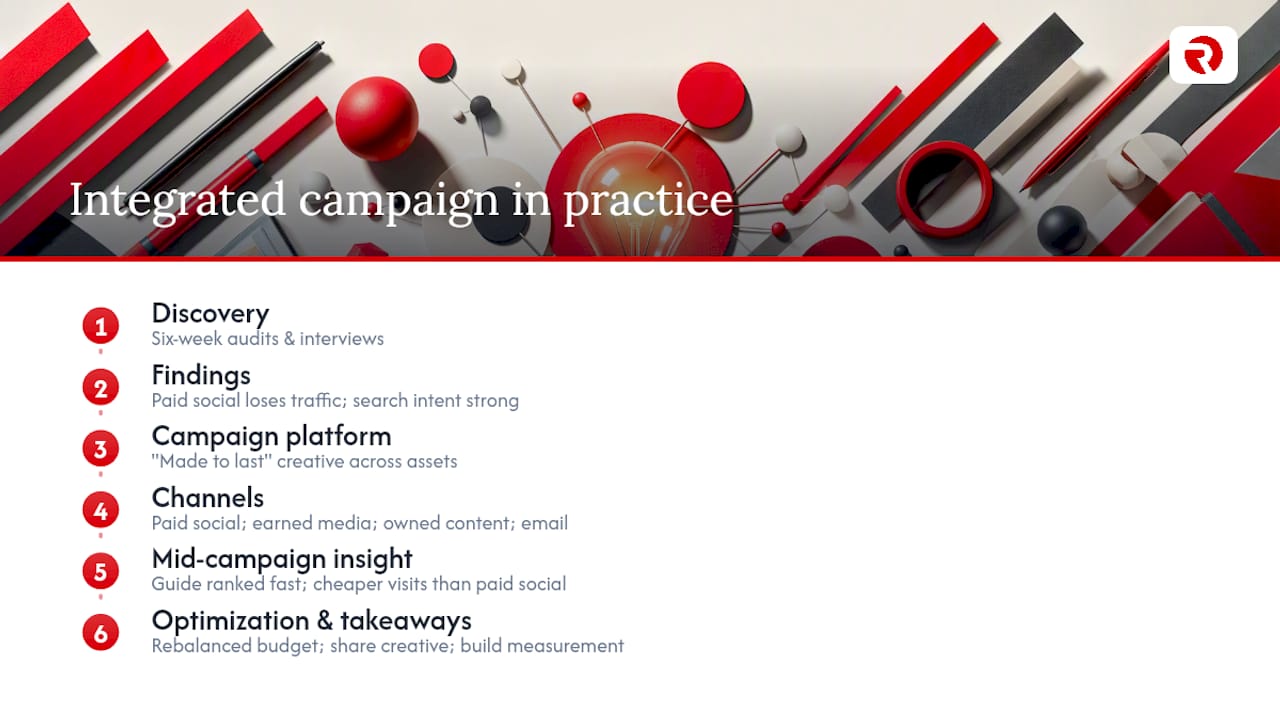
A UK-based e-commerce brand selling premium homeware wanted to grow revenue from new customer acquisition while defending its existing customer base. The brief was clear: reach new audiences, convert them efficiently, and retain the brand’s premium positioning throughout.
The integrated agency began with a six-week discovery phase: customer interviews, competitor analysis, and a full audit of existing channel performance. The finding was that paid social was driving traffic but losing it at the product page, while organic search had strong intent but weak conversion copy.
The team built a single campaign platform around the idea of “made to last,” which ran across paid social (video and carousel), earned media (a sustainability story pitched to lifestyle press), owned content (a long-form buying guide optimised for search), and email (a re-engagement sequence for lapsed customers). Every asset shared the same visual language and copy tone.
Mid-campaign, the analytics team flagged that the buying guide was ranking faster than expected and driving qualified traffic at a lower cost per visit than paid social. The paid budget was rebalanced in real time, shifting spend toward retargeting users who had already read the guide.
The lessons are transferable: start with a shared creative platform, build measurement into the brief, and give the integrated team permission to rebalance channels mid-flight based on data.
Is an integrated agency right for your business?
Yes, if you are running or planning campaigns across three or more channels and your current coordination model is costing you time, consistency, or speed. Conditionally, if you have one dominant channel that drives most of your revenue and you are only beginning to test others.
Three pragmatic next steps:
-
Audit your current coordination cost. Count the hours per week your team spends briefing, chasing, and reconciling outputs from separate vendors. That number, converted to a salary cost, is your baseline for what integration is worth.
-
Build a shortlist of three agencies and ask each one the pitch questions above. Score them on team structure, case study quality, and measurement approach, not on the length of their service list.
-
Request a scoping conversation before committing to a retainer. A credible integrated agency will offer a discovery session or a strategic audit to establish whether the model fits your business before asking you to sign anything.
How Radkaadvertising approaches integration
At Radkaadvertising, integration is not a positioning claim. It is a working method. Every engagement begins with an immersion phase: stakeholder interviews, channel audits, and a single strategic map that ties every discipline to the client’s commercial objectives. The strategist, creative director, SEO lead, and PR manager all brief from that same document.
What that means in practice: when a client’s PR story lands coverage in a national title, the content team has already prepared the supporting article, the social team has the assets ready, and the paid team has a retargeting audience built. The campaign compounds rather than fragments.
Radkaadvertising works with entrepreneurs, SMEs, and established brands across the UK and Eastern European markets, with bilingual capability for Polish and Romanian-speaking business owners. The portfolio spans brand creation, digital growth, and PR distribution, with clients including Coca-Cola, Maybelline, and PowerLink Energy. You can review the case study portfolio to see how integrated programmes have delivered measurable outcomes across sectors.
Radkaadvertising: full-service, no compromises
Radkaadvertising is the integrated alternative for UK businesses that need brand, digital, and PR to work as one programme rather than three separate invoices. The agency covers brand strategy, identity, SEO, PPC, paid social, content, PR and press distribution, web and UX, AI-driven growth, and performance analytics, all from a single London-based team accountable for the whole.
No subcontracting. No channel silos. One strategic map, one reporting stack, one point of contact who owns the outcome.
For businesses ready to move from fragmented marketing to a programme that compounds across channels, the starting point is a services overview or a conversation about your specific brief. If you want to see the work before the conversation, the case study portfolio is the right place to start.
Sources
- Public Relations and Communication Association (PRCA)
- Integrated marketing: definition, uses and examples — Adobe Business
- Integrated agency vs specialists: when each one wins | ADZONE 360
- Market research and buyer’s journey guide — HubSpot
FAQ
What is an integrated marketing agency?
An integrated marketing agency manages strategy, creative, digital, PR, and analytics under one team, briefed from a single strategic document and accountable for the whole programme rather than individual channels.
What does “integrated” mean in advertising?
Integrated means every channel, message, and tactic connects to a shared strategy and reinforces the others. The opposite is siloed execution, where each channel is planned and measured independently.
What is an integrated communications agency?
An integrated communications agency combines PR, content, digital, and paid media under one roof, using the PESO model (Paid, Earned, Shared, Owned) to ensure messages compound across channel types rather than competing. The PRCA sets the professional standard for this approach in the UK.
What are the three types of agencies?
The main models are: full-service or integrated agencies (broad capability, single accountability), specialist agencies (deep expertise in one channel or discipline), and consultancies (strategy and planning without execution). Most businesses use a combination at different stages of growth.
When should you choose an integrated agency over a specialist?
Choose an integrated agency when you are running campaigns across three or more channels and the coordination cost of managing separate vendors is slowing you down or creating inconsistency. Radkaadvertising’s services cover the full range, from brand strategy to performance analytics, for businesses ready to consolidate.
Editorial perspective: what the integrated agency debate gets wrong
The real problem is not the agency model. It is the brief.
Most of the debate about integrated versus specialist agencies focuses on the wrong variable. Businesses agonise over which model to choose when the more pressing question is whether they have a clear enough brief for either model to succeed.
An integrated agency cannot integrate a vague objective. “Grow our brand” is not a brief. Neither is “improve our digital presence.” The integrated model’s structural advantage, shared strategy, shared data, shared accountability, only activates when the client can articulate what success looks like in commercial terms: a cost per acquisition target, a revenue number, a market share goal.
The agencies that get blamed for underperforming integrated programmes are often working from briefs that would have defeated any specialist too. The difference is that with four specialists, the blame distributes. With one integrated agency, it concentrates. That concentration is actually the model’s strength, but only when the brief is sharp enough to make accountability meaningful.
The practical implication: before you evaluate a single agency, spend a day writing a brief that includes a commercial objective, a measurement framework, and a clear definition of what “done well” looks like. The quality of the agencies that respond, and the quality of their proposals, will tell you more than any comparison table.