Launch a product successfully: your complete 2026 UK guide

TL;DR:
- Most product launches fail due to broken processes rather than a bad product, but a structured approach can fix this early.
- Success depends on five core phases: validation, success criteria, positioning, organizational readiness, and phased execution with KPIs.
Most product launches fail not because the product is bad, but because the process behind it is broken. The good news? A structured approach fixes most of that before you spend a penny on marketing.
Launching a product successfully in the UK market requires five core phases: market validation, success criteria definition, positioning, organisational readiness, and phased execution with measurable KPIs. Get all five right and you have a launch. Miss even one and you are gambling.
Here is the framework at a glance:
- Validate demand first. 42% of startups fail specifically due to a lack of market need, making market validation the most critical step before launching.
- Define success before you launch. Set sales targets, conversion rates, and customer satisfaction benchmarks upfront.
- Position with precision. Identify your market gap and communicate a single, clear value proposition.
- Prepare your team. Sales, support, and operations must be ready before day one.
- Execute in phases. A soft launch followed by a hard launch reduces risk and sharpens your strategy.
- Measure and iterate. Post-launch KPI tracking turns data into decisions.
A typical product launch takes 3–6 months from initial planning to market entry. Every decision in that window should be driven by evidence, not assumption.

Why do new product launches fail, and how do you avoid it?
Product launch failure is rarely a single catastrophic mistake. It is usually a sequence of smaller ones, each compounding the last.
The most common causes of failure are:
- No market need. Many startup failures trace back to building something nobody actually wanted. This is the single most preventable cause.
- Poor timing. Launching too early means an unfinished product. Launching too late means a crowded market.
- Insufficient budget. Underestimating costs kills launches mid-flight. A realistic budget with a contingency fund is not optional.
- Weak differentiation. If your product does not clearly outperform or differ from what already exists, customers have no reason to switch.
- Operational unreadiness. Stock shortages, slow customer support, or a broken checkout process on launch day destroys first impressions permanently.
- Ignoring compliance. In the UK, physical products must meet UKCA marking requirements before going to market. Skipping this creates legal exposure.
How to avoid each one:
- Run structured market validation before committing to full development.
- Use a SWOT analysis to quantify risks and identify timing vulnerabilities.
- Build a realistic budget with a 15–20% contingency fund for unexpected costs.
- Conduct competitor analysis to find genuine gaps your product can own.
- Test your fulfilment, support, and payment systems before the launch date.
- Check UKCA marking and product safety requirements early in the development cycle.
The founders who avoid these pitfalls share one habit: they treat every assumption as a hypothesis to be tested, not a fact to be acted on.
How do you define clear success criteria and KPIs for your launch?
Launching without defined KPIs is like driving without a destination. You might end up somewhere interesting, but you will not know if you arrived where you needed to be.
Success criteria must be specific to your product, your market, and your business objectives. Generic targets like “increase sales” tell you nothing useful. Instead, define:
- Revenue targets. Total sales value or units sold within the first 30, 60, and 90 days post-launch.
- Conversion rate. The percentage of website visitors or leads who make a purchase. Track this from day one.
- Customer acquisition cost (CAC). How much you spend to win each new customer across every channel.
- Customer satisfaction score (CSAT). Collect scores immediately after purchase and after first use.
- Net Promoter Score (NPS). Measures how likely customers are to recommend your product. A strong NPS early on signals genuine product-market fit.
- Market share. Relevant for established categories where you can benchmark against known competitors.
- Return rate. High returns signal a product quality or expectation mismatch that needs fixing fast.
Setting clear KPIs such as sales targets and conversion rates gives you an objective basis for deciding whether to scale, pivot, or pull back. Without them, post-launch decisions become guesswork.
Revisit your KPIs weekly for the first three months. The patterns that emerge in weeks two and three often reveal more than the launch day numbers do.
Pro Tip: Set a minimum success threshold before you launch. If you do not hit X units in 30 days, you have a pre-agreed trigger to investigate rather than simply hoping things improve.
How to validate market demand before you commit
Market validation is the checkpoint that separates products that sell from products that sit in a warehouse. The goal is to confirm that real people have a real problem, and that they will pay real money to solve it.
Qualitative methods
Start with 15–20 one-on-one customer interviews. These conversations reveal the language customers use to describe their problem, which is invaluable for your messaging later. Focus on recent experiences, not hypothetical ones. Ask what the problem cost them in time, money, or frustration, not whether they would buy your solution.
Quantitative methods
Follow up interviews with structured surveys to measure preferences and pricing sensitivity across a broader group. Well-designed surveys surface patterns that individual interviews cannot. For guidance on building surveys that generate useful data rather than noise, effective survey design is worth studying before you write a single question.
Demand signals
Surveys and interviews tell you what people say. Pre-orders and paid deposits tell you what people do. Genuine demand shows up in financial commitment, not enthusiasm. A landing page that captures email sign-ups is useful. One that converts visitors to paid pre-orders is proof.
| Validation method | Best used for | Success indicator |
|---|---|---|
| Customer interviews (15–20) | Uncovering real problems and language | Consistent pain points across many respondents |
| Quantitative surveys | Measuring pricing sensitivity and preferences | Clear price point with acceptable willingness to pay |
| Landing page with sign-up | Testing messaging and interest | Strong click-through and sign-up rates |
| Pre-orders or paid deposits | Confirming genuine purchase intent | Financial commitment from target customers |
| Prototype or MVP testing | Validating usability and product-market fit | Positive usability scores and repeat engagement |
Pro Tip: When interviewing potential customers, ask them to describe the last time they faced the problem your product solves. Specific, recent stories reveal real pain far more reliably than hypothetical “would you buy” questions.
The UK government’s guidance on developing new products recommends testing with customers as rigorously as a brand-new business would. That applies even if you already have an established customer base.
How do you position your product to stand out in a crowded market?
Positioning is not a tagline. It is the decision about where your product lives in the customer’s mind relative to everything else they could choose.
Strong positioning starts with a clear answer to one question: why should your ideal customer choose you over every alternative, including doing nothing? If you cannot answer that in one sentence, your positioning needs work.
Finding your market gap
Competitor analysis reveals where existing products fall short. Look at pricing tiers, feature gaps, customer complaints in reviews, and underserved audience segments. The UK government’s guidance on product differentiation is direct on this point: avoid mere replication and focus on creating superior customer value.
Differentiation tactics that work
- Quality differentiation. Your product performs measurably better on the dimension customers care most about.
- Price differentiation. You deliver comparable value at a lower price point, or premium value that justifies a higher one.
- Audience specificity. You serve a niche that generalist products ignore, and you serve it completely.
- Experience differentiation. The buying, onboarding, or support experience is noticeably better than the category norm.
- Speed or convenience. You solve the problem faster or with less friction than alternatives.
Messaging that lands
Your core message should communicate one primary benefit, not five. Customers remember one thing. Lead with the outcome they want, not the features that deliver it. “Cuts your invoicing time by half” beats “AI-powered invoice automation with multi-currency support” every time.
Clear positioning also reduces customer acquisition costs. When your message resonates immediately with the right audience, you spend less convincing them and more converting them.
How to prepare your organisation and sales team for launch day
A brilliant product with an unprepared team behind it will underperform. Internal readiness is as important as external marketing, and it is the part most founders underinvest in
Cross-functional alignment is the starting point. Marketing, sales, customer support, and operations must all understand the product, the positioning, and the launch plan before a single campaign goes live. Misalignment between what marketing promises and what sales delivers is one of the fastest ways to damage trust with early customers.
Preparation activities to complete before launch:
- Sales enablement training. Every sales team member must be able to articulate the product’s value proposition, handle common objections, and explain how it differs from alternatives.
- Customer support readiness. Support staff need product knowledge, a FAQ document, and escalation paths before the first customer contacts them.
- Inventory and fulfilment check. Confirm stock levels, delivery timelines, and returns processes are in place. A launch-day stockout is a PR problem as much as an operational one.
- Internal communications. Brief every department on launch timing, their role, and what success looks like. Use a shared launch calendar so nobody is caught off-guard.
- Compliance sign-off. For physical products in the UK, UKCA marking and product safety documentation must be complete and on file before market introduction.
- Technology and systems testing. Run end-to-end tests on your website, payment gateway, CRM, and any fulfilment integrations at least two weeks before launch.
The teams that execute the best launches treat the pre-launch period as a dress rehearsal. Everything that can go wrong in a test environment is infinitely cheaper to fix than on launch day.
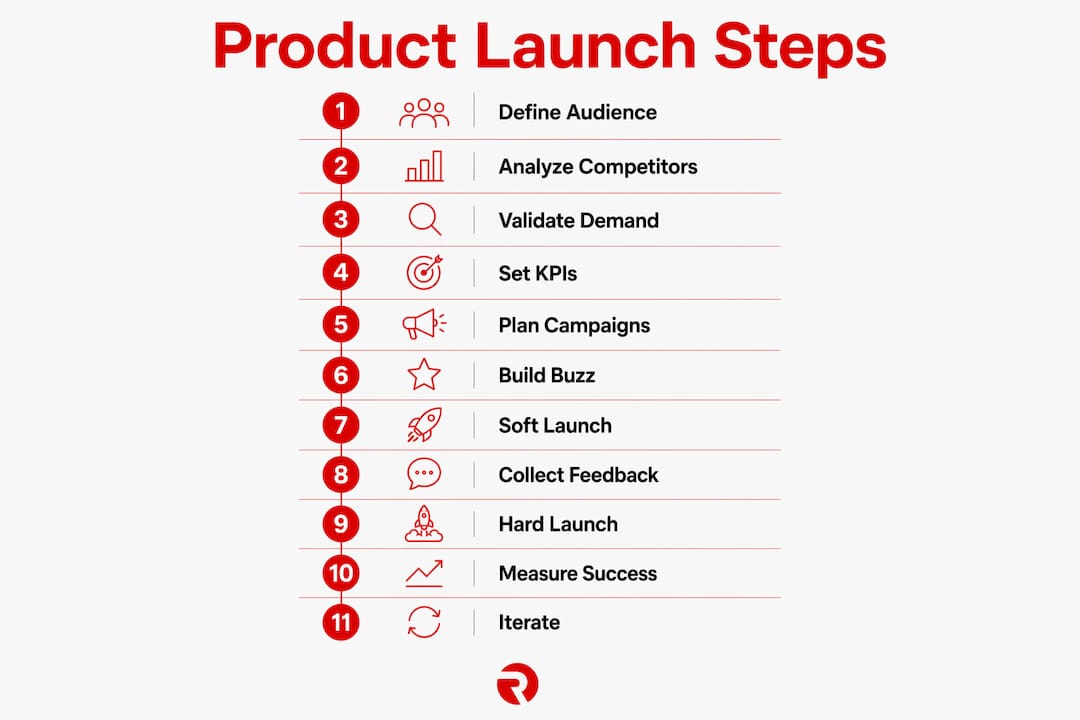
1. Define your target audience and customer persona
Every other step in the launch process depends on knowing exactly who you are launching for. A vague audience definition produces vague messaging, wasted ad spend, and products that feel generic to everyone.
Build a detailed customer persona that goes beyond demographics. Include the specific problem they are trying to solve, where they currently look for solutions, what language they use to describe their frustration, and what would make them trust a new brand enough to buy. The more specific the persona, the more precisely you can target your channels and craft your message.
2. Conduct thorough competitor analysis
Understanding your competition tells you where the market is already served well and where it is not. Map out who your direct and indirect competitors are, what they charge, how they position themselves, and what their customers complain about most.
Pay particular attention to negative reviews. A pattern of complaints about slow delivery, poor customer service, or missing features is a positioning opportunity. That gap is where your product can win.
3. Develop your go-to-market strategy
A go-to-market strategy is the plan that connects your product to your customer. It covers your pricing model, distribution channels, marketing approach, and sales process. Without it, launch activities happen in isolation rather than as a coordinated push.
Your strategy should answer: which channels will you use to reach your audience, what is your pricing rationale, and what does the customer journey look like from first awareness to purchase? Build this before you book a single ad or write a single piece of content.
4. Set your launch budget with contingency built in
Budget underestimation is one of the most common fatal errors in product launches. Plan for the full 3–6 month launch period, not just the launch day itself. Include production costs, marketing spend, platform fees, logistics, and customer support resourcing.
Then add a contingency fund of 15–20% on top of your expected total. Delays happen. Campaigns need adjusting. Suppliers change their pricing. The contingency is not pessimism; it is professionalism
5. Choose your marketing channels and plan your campaigns
Channel selection should follow your audience, not your preferences. Where does your target customer spend time? Which platforms do they trust for product discovery? For UK audiences, this often means a mix of organic search, paid social, email marketing, and PR, but the right blend depends entirely on your product category and price point.
Plan your campaign calendar at least eight weeks before launch. Tease content, pre-launch sign-up campaigns, and influencer partnerships all need lead time to build momentum. A launch that appears from nowhere rarely generates the press coverage or word-of-mouth that a well-seeded one does.
6. Build your pre-launch buzz and community
The best launches do not start on launch day. They start weeks or months earlier, with a deliberate effort to build an audience that is already invested in the product before it is available. Email waitlists, behind-the-scenes content, beta tester communities, and early-access offers all create anticipation.
This pre-launch period also gives you a pool of early adopters who are predisposed to leave reviews, share on social media, and provide the testimonials that build trust for the wider market.
7. Execute a soft launch to test and learn
A soft launch is a limited, controlled release to a subset of your target market. The goal is not revenue; it is data. You want to know how real customers interact with the product, where they drop off in the purchase journey, and what questions or objections arise that your marketing did not address.
Phased roll-outs that begin with a soft launch consistently improve overall launch effectiveness because they give you the chance to fix problems before they reach your full audience.
8. Collect and act on early customer feedback
Feedback collected in the first two to four weeks post-soft launch is the most valuable data you will get. Customers who buy early are often more forgiving and more vocal than those who come later. Use structured surveys, follow-up emails, and direct conversations to understand what is working and what is not.
Act on that feedback visibly. When early customers see that their input changed something, they become advocates. When they feel ignored, they churn and they tell others.
9. Execute your hard launch with full marketing force
Once your soft launch data confirms that your product, messaging, and fulfilment are working, you scale. The hard launch is your full-market introduction: maximum channel activation, PR outreach, paid advertising, and any partnerships or collaborations you have lined up.
The hard launch works best when it has a clear moment of impact, a specific date that your pre-launch community has been anticipating. That sense of occasion drives the concentrated attention that generates press coverage and social sharing.
10. Track KPIs and measure launch success
The week after launch is not the time to celebrate or panic. It is the time to read your data carefully. Compare actual performance against the KPIs you set before launch. Where are you ahead? Where are you behind? What does the gap tell you about your assumptions?
Weekly KPI reviews for the first 90 days keep your team focused on what matters and create a clear record of what drove results. That record becomes the foundation for your next launch.
11. Iterate based on post-launch data
A launch is not a finish line. The data you collect in the first 90 days should directly inform your next product iteration, your next campaign, and your next pricing decision. The brands that grow fastest treat every launch as a learning exercise, not a one-time event.
Build a formal review process: what worked, what did not, what you would do differently, and what the data suggests about where the market is heading. That discipline compounds over time.
What types of product launch should you consider?
Not every product needs the same launch approach. Choosing the right type depends on your confidence in the product, your operational capacity, and how much risk you can absorb.
- Soft launch. A limited release to a test market or select audience. Low risk, high learning. Best used when you need real-world feedback before committing to full-scale distribution.
- Hard launch. A full-scale market introduction with maximum marketing activation. High impact, high stakes. Best used when validation is complete and operational readiness is confirmed.
- Phased or staged launch. Combines both: start soft, gather data, then scale to a hard launch when KPIs are met. This approach gives you the learning benefits of a soft launch and the impact of a hard one.
- Retention launch. Introducing a new product or feature to your existing customer base. Lower acquisition cost because you are selling to people who already trust you.
- Expansion launch. Taking an existing product into a new market segment or geography. Requires fresh positioning and channel strategy even if the product itself is unchanged.
For most UK startups and early-stage businesses, a phased approach is the lowest-risk path. You preserve capital, reduce the cost of mistakes, and arrive at your hard launch with real evidence rather than assumptions.
Expert insights on product launch success from Radkaadvertising
At Radkaadvertising, we have worked on product launches across sectors including FMCG, energy, and beauty, with clients ranging from early-stage startups to global brands. The patterns that separate successful launches from expensive lessons are consistent.
What we see working, every time:
- Phased roll-outs with clear go/kill criteria. Teams that define in advance what data would cause them to pause or pivot make better decisions under pressure. Those without that framework tend to push forward on hope.
- Positioning before creative. Brands that invest in positioning strategy before briefing creative teams produce campaigns that are sharper, faster to produce, and more effective. The creative work becomes execution of a clear idea rather than a search for one.
- KPI tracking from day one. The launches we have seen stall are almost always ones where measurement was treated as an afterthought. Tracking from the first day of soft launch gives you three to four weeks of data before your hard launch, which is enough to make meaningful adjustments.
- PR and media as amplifiers, not substitutes. Media coverage works best when it amplifies a product that already has proof of demand. Trying to use PR to create demand for an unvalidated product rarely delivers the return founders expect.
- Cross-channel consistency. Every touchpoint, from your paid ads to your packaging to your customer support scripts, should reflect the same positioning and tone. Inconsistency at any point in the customer journey erodes trust.
Our work with brands like Coca-Cola, Maybelline, and PowerLink Energy has reinforced one principle above all others: the brands that win launches are the ones that do the unglamorous preparation work thoroughly. The creative execution gets the attention, but the strategy behind it does the work.
Practical tips from our team:
- Validate before you build, not after.
- Write your positioning statement before you write a single ad.
- Set your minimum success threshold before launch day, not after.
- Brief your entire organisation, not just marketing and sales.
- Plan your post-launch review before you launch, so it actually happens.
For a closer look at how we approach launch strategy in practice, our campaign case studies show the process behind the results.
Ready to launch with confidence? Work with Radkaadvertising
A product launch is one of the highest-stakes moments in any business. Getting the strategy right from the start saves months of costly course-correction later.
Radkaadvertising is a London-based full-service agency built for exactly this. We combine brand strategy, digital marketing, creative content, and data-driven campaign execution to give your product the launch it deserves. Whether you are bringing a new product to the UK market for the first time or scaling an existing one into new segments, we build the strategy and execute it with precision.
Explore our full range of services or get in touch to talk through your launch goals. We are ready when you are.
Key takeaways
A successful product launch in the UK requires validated demand, defined KPIs, clear positioning, organisational readiness, and a phased execution plan built on evidence at every stage.
| Point | Details |
|---|---|
| Validate demand first | 42% of startups fail due to no market need; validate before committing to full development. |
| Budget with contingency | Plan for 3–6 months of launch activity and add a 15–20% contingency fund for unexpected costs. |
| Phase your launch | Start with a soft launch to gather data, then scale to a hard launch once KPIs confirm readiness. |
| Define KPIs before launch | Set sales targets, conversion rates, and customer satisfaction benchmarks before launch day, not after. |
| Iterate post-launch | Review performance weekly for the first 90 days and use data to drive product and campaign decisions. |
FAQ
How do I launch my own product in the UK?
Start with market validation to confirm genuine demand, then define your success KPIs, develop your positioning, prepare your team, and execute a phased launch starting with a soft rollout. A typical launch takes 3–6 months from planning to full market entry.
What are the 7 steps of a product launch?
The core steps are: define your target audience, conduct competitor analysis, validate market demand, develop your go-to-market strategy, prepare your team and operations, execute a soft launch, then scale to a full hard launch once your KPIs confirm readiness.
What is the 3-3-3 rule in sales?
The 3-3-3 rule is not a universally standardised framework, and definitions vary across sales methodologies. A common version refers to contacting a prospect three times, across three channels, within three days of initial outreach, though the specific application differs by organisation and context.
What are the steps to launch a product?
The essential steps are market validation, success criteria definition, positioning and messaging, organisational preparation, phased launch execution (soft then hard launch), and post-launch KPI measurement with ongoing iteration based on customer feedback.
How long does a product launch take?
A structured product launch typically takes 3–6 months, covering market research, product development, team training, marketing preparation, and logistics before market entry.