How to advertise on the internet: proven UK strategies

TL;DR:
- UK digital ad spend exceeded £40bn in 2025, but many struggle with measurable results.
- A full-funnel approach blending brand awareness and performance channels outperforms single-channel strategies.
- Diversifying with TV and video channels breaks performance plateaus common with reliance on Meta and Google.
UK businesses are navigating one of the most competitive digital advertising environments in the world. UK digital ad spend exceeded £40bn in 2025, yet many companies still struggle to turn budget into measurable results. The challenge isn’t a shortage of channels. It’s knowing which ones to use, how to combine them, and how to keep improving performance over time. This guide walks you through the UK internet advertising landscape, goal-setting, channel selection, campaign execution, and the expert perspective that separates businesses that plateau from those that scale.
Table of Contents
- Understanding the landscape: the UK internet advertising market
- Setting goals and identifying your audience
- Choosing the right internet advertising channels
- Creating, launching and optimising your campaigns
- Expert perspective: why most SMEs plateau with internet advertising
- How Radka Advertising helps you succeed online
- Frequently asked questions
Key Takeaways
| Point | Details |
|---|---|
| Digital ad spend is booming | UK online advertising spend surpassed £40bn and will continue growing through 2026. |
| Diversification drives growth | Relying solely on search or social can limit results – mixing channels yields better ROI. |
| Set clear goals and track | Success starts by defining outcomes, selecting KPIs, and targeting the right audiences. |
| Test, optimise, repeat | Frequent testing and optimisation of your campaigns are vital for maximising performance. |
Understanding the landscape: the UK internet advertising market
With the importance established, let’s look at the UK market landscape and where the greatest opportunities lie.
The scale of UK digital advertising is striking. Online formats made up 80% of total UK ad spend in 2024, with continued growth forecast through 2026. That dominance reflects a fundamental shift in how consumers discover, research, and buy. For UK businesses, this means the question is no longer whether to advertise online, but how to do it effectively.
The major channels break down as follows:
- Search advertising (Google Ads, Microsoft Ads): Captures high-intent audiences actively searching for your product or service.
- Paid social (Meta, LinkedIn, TikTok): Reaches audiences based on demographics, interests, and behaviour.
- Video advertising (YouTube, connected TV): Builds brand awareness and emotional connection at scale.
- Display and programmatic: Automated ad buying across thousands of websites, targeting by audience segment or context.
| Channel | Primary goal | Typical UK CPM |
|---|---|---|
| Search (Google Ads) | Conversions, leads | £2–£8 per click |
| Paid social (Meta) | Awareness, traffic | £3–£12 per 1,000 impressions |
| YouTube video | Brand awareness | £4–£10 per 1,000 impressions |
| Programmatic display | Retargeting, reach | £1–£5 per 1,000 impressions |
Many businesses make the mistake of pouring everything into search and social, then wondering why growth stalls. Blending digital with brand channels is key to maximising profit, particularly as digital-only strategies face increasing competition and rising costs per click. A full-funnel approach, where brand campaigns build awareness at the top and performance ads convert at the bottom, consistently outperforms single-channel strategies. Leveraging user data in advertising intelligently across these channels is what separates efficient spenders from those burning budget.
Setting goals and identifying your audience
Once you know where to advertise, the next step is to set clear goals and understand who you’re targeting.
Without defined goals, even a generous budget will underperform. Start by deciding what success looks like for your business. The most common objectives are:
- Sales and direct revenue: Measured by conversion rate and return on ad spend (ROAS, the revenue generated per pound of ad spend).
- Lead generation: Measured by cost per acquisition (CPA, the average cost to gain one customer or lead).
- Brand awareness: Measured by impressions, reach, and brand search uplift.
- App installs or sign-ups: Measured by cost per install or cost per registration.
Once your goal is clear, audit your existing customer data. Look at who’s already buying from you: their age, location, device, and purchase behaviour. This data forms the foundation of your targeting strategy.
Meta and Facebook Ads allow targeting by demographics, interests, lookalike audiences (people who resemble your best customers), and retargeting (re-engaging people who’ve already visited your website). Google Ads targets by keyword intent, meaning you reach people at the precise moment they’re searching for what you offer.
Pro Tip: Don’t sacrifice long-term brand building for short-term sales. A common trap for UK SMEs is optimising everything for immediate conversions, which erodes brand recognition over time. Allocate at least 20–30% of your budget to awareness-focused campaigns, even if the ROI isn’t immediately visible.
“The best-performing advertisers balance short-term activation with long-term brand investment. One without the other leaves significant profit on the table.”
Using AI-driven audience insights can dramatically improve how you segment and reach the right people, reducing wasted spend and improving relevance across every channel.

Choosing the right internet advertising channels
With your goals and audience mapped out, it’s time to select the best digital ad channels for your business.
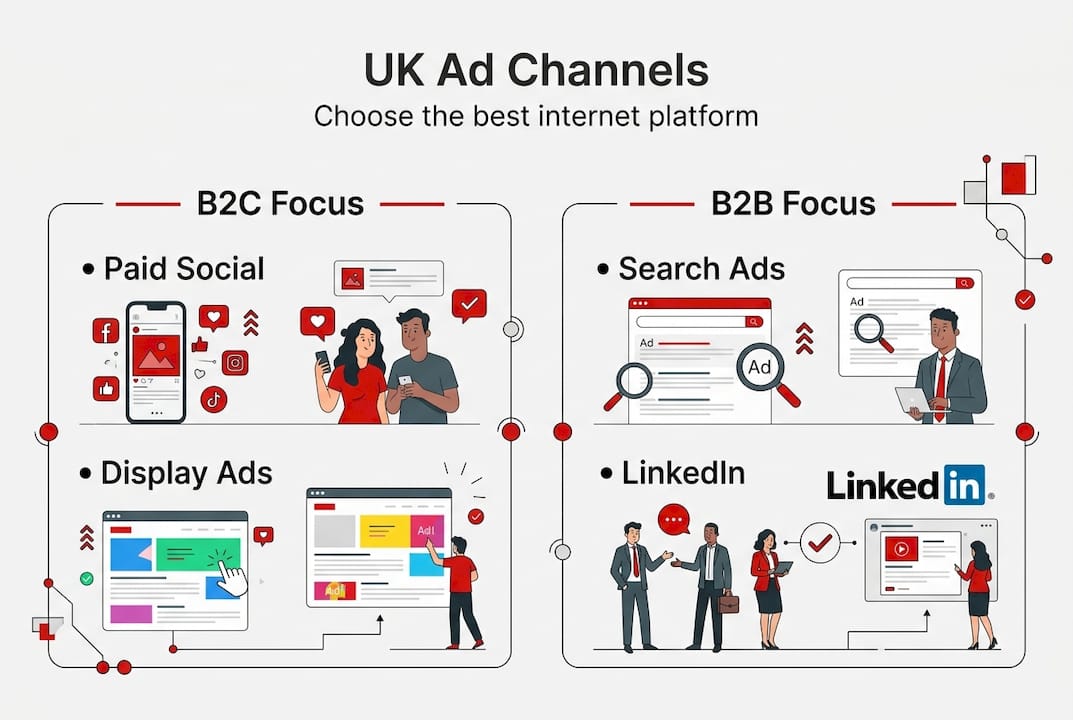
Not every channel suits every business. The right mix depends on your objectives, budget, and whether you’re targeting consumers (B2C) or other businesses (B2B).
| Channel | Best for | B2B or B2C | Avg. UK CPC |
|---|---|---|---|
| Google Search Ads | High-intent conversions | Both | £1–£8 |
| Meta (Facebook/Instagram) | Awareness, retargeting | B2C | £0.20–£1.26 |
| LinkedIn Ads | Lead gen, recruitment | B2B | £4–£12 |
| YouTube | Brand storytelling | Both | £0.05–£0.30 per view |
| Programmatic display | Retargeting, reach | Both | £1–£5 CPM |
For Google Ads, RSAs with 8+ headlines (responsive search ads, which automatically test combinations of your headlines and descriptions) combined with Smart Bidding and broad match keywords consistently boost conversions. This is the current best practice for search campaigns in 2026.
Meta/Facebook costs sit at £0.20–£1.26 CPC, with suggested starting budgets of £5–£30 per day, making it accessible for smaller businesses. LinkedIn costs more per click but delivers far stronger results for B2B lead generation.
- Match your channel to your goal: search for intent-driven conversions, social for awareness and retargeting, video for brand building.
- Don’t spread budget too thin across every platform. Start with two channels, master them, then expand.
- Review search campaign health tips regularly to catch underperforming keywords before they drain your budget.
Pro Tip: Use campaign management tools to track cross-channel performance in one place. Siloed reporting makes it almost impossible to see which combination of channels is driving the best results.
Creating, launching and optimising your campaigns
After you’ve chosen your channels, launching and continually improving your campaigns is where the real gains are made.
Setting up a campaign properly from the start saves significant time and money later. Follow these steps:
- Define your campaign structure: Organise ad groups by theme or product category. Tight, focused ad groups improve relevance scores and reduce cost per click.
- Select your targeting: Apply your audience research here. Use keyword lists for search, custom audiences for social, and contextual targeting for display.
- Create your ad creative: Write multiple versions of headlines and descriptions. Test at least three to five creative variants per ad group.
- Set your budget and bidding strategy: Start with manual CPC to gather data, then switch to Smart Bidding once you have enough conversion history (typically 30–50 conversions per month).
- Launch and monitor: Check performance daily for the first two weeks, then weekly once campaigns stabilise.
Best practices include testing creatives regularly, using Smart Bidding, setting frequency caps (limits on how often the same person sees your ad), and reallocating budget towards your top-performing campaigns.
Pro Tip: Avoid the common mistake of changing too many variables at once. If you adjust targeting, creative, and bidding simultaneously, you won’t know what caused a change in performance. Test one element at a time.
“The businesses that win at internet advertising aren’t those with the biggest budgets. They’re the ones who test systematically, learn fast, and reinvest in what works.”
For ad creative optimisation, focus on clarity and relevance above all else. Your ad must answer the viewer’s implicit question: “What’s in it for me?” within the first two seconds.
Expert perspective: why most SMEs plateau with internet advertising
Having explored the practical steps to advertise online, here’s a perspective that challenges the status quo.
The conventional advice for SMEs is to go all-in on Meta and Google for performance marketing. It’s measurable, relatively affordable, and delivers quick feedback. We understand the appeal. But this approach has a ceiling, and most businesses hit it faster than they expect.
SMEs hit a performance plateau relying solely on Meta and Google. The data is clear: diversifying with TV, video, and brand campaigns drives full-funnel growth that performance-only strategies simply cannot replicate. Even modest test budgets on YouTube or programmatic video make a measurable difference to brand recall and downstream conversion rates.
The uncomfortable truth is that chasing last-click attribution (crediting the final ad a customer clicked before buying) systematically undervalues brand-building channels. Businesses that measure only what’s easy to measure end up cutting the very campaigns that were warming up their future customers. Exploring media diversification advice is a practical first step towards breaking through that plateau.
How Radka Advertising helps you succeed online
To put this know-how to work for your business, here’s how Radka Advertising can help.
Navigating the complexity of internet advertising across multiple channels, audiences, and tools is genuinely difficult without the right partner. Radka Advertising’s full-service advertising solutions are built specifically for UK businesses that want strategic, data-driven growth rather than guesswork. From channel planning and creative production to campaign management and performance reporting, the agency handles the full picture. You can track everything through the client portal in real time. Whether you’re starting from scratch or looking to scale an existing strategy, explore the range of services to find the right fit for your goals and budget.
Frequently asked questions
What is the most cost-effective way to advertise on the internet in the UK?
Paid social offers strong ROI and low entry costs, but combining channels maximises profit and reach. Paid social delivers £3.20 ROI, though multi-channel strategies consistently outperform any single platform.
How much should a small business budget for internet advertising?
Start with £5–£30 daily on social or search, adjusting as results are measured and optimised. Meta/Facebook starting budgets of £5–£30 a day are typical for small businesses testing the platform.
Which internet advertising channel has the highest ROI in the UK?
Recent analysis shows TV delivers the highest ROI, but paid social and online display also provide solid returns. TV returns £5.94, paid social £3.20, online display £2.34 per £1 spent, according to UK benchmarks.
Are AI tools necessary for successful online advertising?
While not mandatory, AI automation improves targeting, bidding, and overall campaign performance significantly. AI tools like Performance Max and Smart Bidding boost conversions and reduce wasted spend across campaigns.