Google Ads cost UK 2026: what you’ll really pay per click

Most UK small businesses pay between £1.50 and £2.50 per click on Google Search, though legal and finance keywords routinely run into double digits. A realistic starting budget is a few hundred to a few thousand pounds a month for a local business, several thousand for a mid-size operation, and higher amounts for national campaigns. CPC is only half the story, though. What you pay per click matters far less than what that click does once it lands.
TL;DR:
- Small UK businesses should budget at least £500 to £1,000 monthly for local Google Ads campaigns to gather sufficient data and optimize keywords.
- Legal and finance keywords often cost between £5 and £30 per click, while retail and e-commerce tend to be much cheaper at around £0.50 to £2 per click.
- Campaigns targeting London generally face 15% to 30% higher CPCs than other UK regions due to increased bidding competition.
- Automated bidding strategies require at least 30 conversions in recent months to function effectively and improve cost efficiency.
- Properly structured accounts with accurate tracking and relevant landing pages can significantly reduce wasted ad spend before increasing the budget.
Table of Contents
- Google Ads cost UK: benchmarks by industry
- How much to budget monthly: starter figures and scaling rules
- What actually drives your Google Ads cost UK figures
- Search, Shopping, Display and Video: which campaign fits your budget
- Agency, freelancer or in-house: management fees in the UK
- A simple method to estimate your Google Ads budget and ROI
- Cutting wasted spend: a tactical checklist
- How Radkaadvertising reduces Google Ads waste
- Seasonal and market trends shaping Google Ads costs
- Google Ads versus other UK advertising platforms
- Billing and payment methods for UK advertisers
- UK data rules and how they touch your Google Ads costs
- Author view: fundamentals before budget increases
- Radkaadvertising’s approach to paid search that pays for itself
- Sources
- FAQ
Google Ads cost UK: benchmarks by industry
Cost per click varies wildly by sector because Google Ads runs an auction, not a price list. Every keyword has its own competitive intensity, and that intensity is what sets the price.
Here’s how the ranges typically break down across UK industries, based on current market data:
- Legal services: £5 to £30+ per click, with terms like “personal injury solicitor” among the most expensive in the entire UK market
- Finance and insurance: £4 to £20 per click, driven by high customer lifetime value and fierce lender competition
- Home services (plumbers, electricians, roofers): £2 to £8 per click, with urgent “emergency” terms costing more than routine ones
- Retail and e-commerce: £0.50 to £2 per click, generally the most affordable category thanks to high search volume
- Healthcare and private clinics: £3 to £12 per click, particularly for cosmetic and dental procedures
- B2B SaaS: £2 to £10 per click, reflecting long sales cycles and high contract values
- Charity and recruitment: £1 to £4 per click, generally mid-range and stable
Location changes the maths too. Campaigns targeting London typically face a 15% to 30% CPC premium compared with the rest of the UK, simply because more advertisers are bidding for the same eyeballs in a smaller, wealthier pool. Manchester, Birmingham and Edinburgh sit somewhere in between London and rural rates.
Treat every range above as a planning guide, not a guarantee. There’s no single definitive UK-wide CPC survey, and your actual cost depends on your exact keywords, match types, and how long your account has been running. A brand-new account with no conversion history will often pay more per click than an established one, purely because Google has less quality data to work with.
How much to budget monthly: starter figures and scaling rules
Your monthly budget needs to generate enough clicks to produce statistically reliable data, not just a scattering of impressions. Here’s a practical way to size it:
- Local SMB budget: £500 to £1,000/month. This typically buys 200 to 600 clicks depending on your industry, enough to start identifying which keywords convert within four to six weeks.
- Mid-size business budget: £2,000 to £5,000/month. This supports multiple campaigns (Search plus Shopping or Display) and usually delivers 15 to 30 clicks per day, which is the rough threshold for gathering useful conversion data quickly.
- National campaign budget: £10,000+/month. At this level you can run Search, Shopping, Display and YouTube simultaneously, testing audiences and creative at a pace smaller budgets can’t sustain.
As a rule of thumb, aim for at least 10 to 15 clicks a day before judging a campaign’s performance. Fewer than that, and normal daily fluctuation will drown out any real signal.
What actually drives your Google Ads cost UK figures
Google doesn’t charge a fixed rate for a keyword. Every time your ad is eligible to show, it enters an auction where bid, ad relevance and Ad Rank together determine both whether you appear and what you pay. Ad Rank is calculated from your bid multiplied by your Quality Score, alongside the expected impact of your ad extensions and format.
This is why two advertisers bidding the same amount on the same keyword can pay very different prices. Google explicitly rewards higher-quality, more relevant ads with lower actual CPCs, because a better ad experience benefits everyone, including Google.
The controllable levers that shift your cost include:
- Quality Score components: expected click-through rate, ad relevance, and landing page experience
- Match type choice: broad match tends to widen reach but dilutes relevance; exact match is pricier per click but more predictable
- Bidding strategy: manual CPC gives control; automated strategies like Target CPA or Maximise Conversions let Google’s algorithm optimise for outcomes
- Time, day and device targeting: mobile CPCs often differ from desktop, and weekday costs can diverge sharply from weekends
- Geographic targeting: narrowing to high-value postcodes can lower wasted spend even if it doesn’t lower CPC directly
Pro Tip: A landing page that loads in under two seconds and matches your ad’s exact promise can lift your Quality Score enough to noticeably cut your CPC within a few weeks, without touching your bids at all.
Search, Shopping, Display and Video: which campaign fits your budget
Not every campaign type costs the same or does the same job, and mixing them without understanding the difference wastes money fast.
- Search campaigns target high commercial intent. Someone typing “emergency locksmith Leeds” is ready to buy now, which is why Search CPCs sit at the higher end but conversion rates tend to be strongest here too.
- Shopping campaigns suit e-commerce businesses with a product feed. Cost per click is often lower than standard Search, and the visual product listings tend to pull in more qualified browsers who’ve already seen the price.
- Display campaigns work on a CPM (cost per thousand impressions) model rather than pure CPC, making them cheap for building brand awareness but weak for direct response unless retargeting an existing audience.
- YouTube/Video campaigns also lean CPM or cost-per-view, and work best for upper-funnel reach when you have a limited budget but want visibility beyond text ads.
A sensible split for most UK SMBs is Search-first, with Shopping added for product businesses and Display reserved for retargeting people who’ve already visited your site.
Agency, freelancer or in-house: management fees in the UK
Ad spend is only one line on the invoice. Someone still has to build, monitor and optimise the account, and that management cost varies enormously depending on who does it.
- Freelancers: typically £200 to £800 per month, suited to smaller accounts needing hands-on but part-time attention
- Agencies: commonly charge either a flat fee from £500 upward, or 5% to 15% of ad spend, with larger budgets usually attracting the lower percentage
- In-house: cost-effective only once your ad spend is large enough to justify a dedicated salary, typically above £10,000/month
Whichever model you choose, get clarity upfront on what’s included. Setup, ongoing optimisation cadence, and reporting frequency are separate deliverables, and a cheap monthly fee that excludes optimisation isn’t actually cheap.
A simple method to estimate your Google Ads budget and ROI
Turning CPC data into an actual budget takes four steps, and you can do the maths on the back of an envelope.
- Set your target: decide how many leads or sales you need in a month. Say you want 20 new customers.
- Estimate your conversion rate conservatively: if your landing page converts at 3%, you need roughly 667 clicks to get 20 conversions.
- Multiply by your expected CPC: at £2 per click, that’s a budget of around £1,334 for the month.
- Compare against your target cost per acquisition: if each customer is worth £200, spending £67 to acquire one (£1,334 ÷ 20) is comfortably profitable.
Cross-check your assumptions using Google’s own campaign budget and cost calculator, which estimates clicks and spend from a daily budget and expected CPC. It won’t replace live account data, but it stops you launching with wildly unrealistic numbers.
Cutting wasted spend: a tactical checklist
Wasted budget almost always hides in the same three places: irrelevant searches triggering your ads, weak ad creative, and landing pages that don’t convert.
- Review your search terms report weekly and add negative keywords for anything irrelevant that’s eating budget
- Test at least two ad variations per ad group and let performance data pick the winner rather than gut feeling
- Improve landing page relevance and speed. This is the single biggest, cheapest lever most UK advertisers ignore
- Set up conversion tracking properly in GA4 with consent-compliant tagging before you optimise anything else
- Switch to automated bidding strategies like Target CPA only once you have at least 30 conversions of historical data
Pro Tip: If your account has fewer than 15 conversions in the last 30 days, don’t switch to automated bidding yet. Google’s algorithms need a meaningful data set to optimise properly, and switching too early often makes performance worse, not better.
For a deeper look at turning traffic into paying customers, this conversion rate optimisation guide covers the landing page fundamentals that most directly affect your cost per acquisition.
How Radkaadvertising reduces Google Ads waste
Radkaadvertising’s approach to paid search starts with the assumption that most wasted spend is fixable before a single pound of extra budget gets added. A proper account audit covers five areas in order: conversion tracking accuracy, landing page relevance, keyword and match type structure, ad creative quality, and bidding strategy fit.
The pattern shows up repeatedly across client work: accounts that looked expensive on paper were often simply untracked or poorly structured, not genuinely uncompetitive. Fixing tracking and restructuring keyword groups tends to surface savings before any bid changes happen at all.
Typical quick wins uncovered in an audit include:
- Conversion actions that were miscounted or duplicated, inflating apparent cost per acquisition
- Broad match keywords pulling in irrelevant traffic that never had a chance of converting
- Landing pages sending paid traffic to a generic homepage instead of a matched offer
Readers curious about the scale of these improvements can review Radkaadvertising’s case studies for examples of campaign performance after this kind of restructuring.
Seasonal and market trends shaping Google Ads costs
UK advertisers see genuine seasonal swings in CPC, and ignoring them is one of the fastest ways to overspend or underspend at the wrong moment. Q4, particularly the run-up to Black Friday and Christmas, is the most competitive and expensive period across almost every retail and e-commerce category, as advertisers compete for the same finite pool of shoppers during their highest-intent weeks.

January often brings a temporary lull in CPCs as post-Christmas budgets reset, followed by a steady climb through spring. Home services and tradespeople typically see cost spikes in early spring when boiler repairs and garden work demand surges, while travel and holiday-related keywords climb from January through to early summer as people book getaways.
B2B sectors behave differently. Budgets often dip in August, when decision-makers are on holiday, and pick up sharply in September and again in the new financial year for companies with an April year-end.
Wider economic conditions matter too. When advertiser competition contracts during uncertain economic periods, CPCs can actually soften as fewer businesses bid aggressively, only to snap back once confidence returns. This is why treating your Google Ads budget as fixed all year round rarely makes sense. Practitioners consistently note that Google Ads functions as a dynamic auction rather than a fixed-price channel, and budgets that flex with seasonal demand consistently outperform those that don’t. Building a seasonal calendar specific to your industry, and adjusting budget up or down accordingly, is one of the more overlooked ways to control annual spend.
Google Ads versus other UK advertising platforms
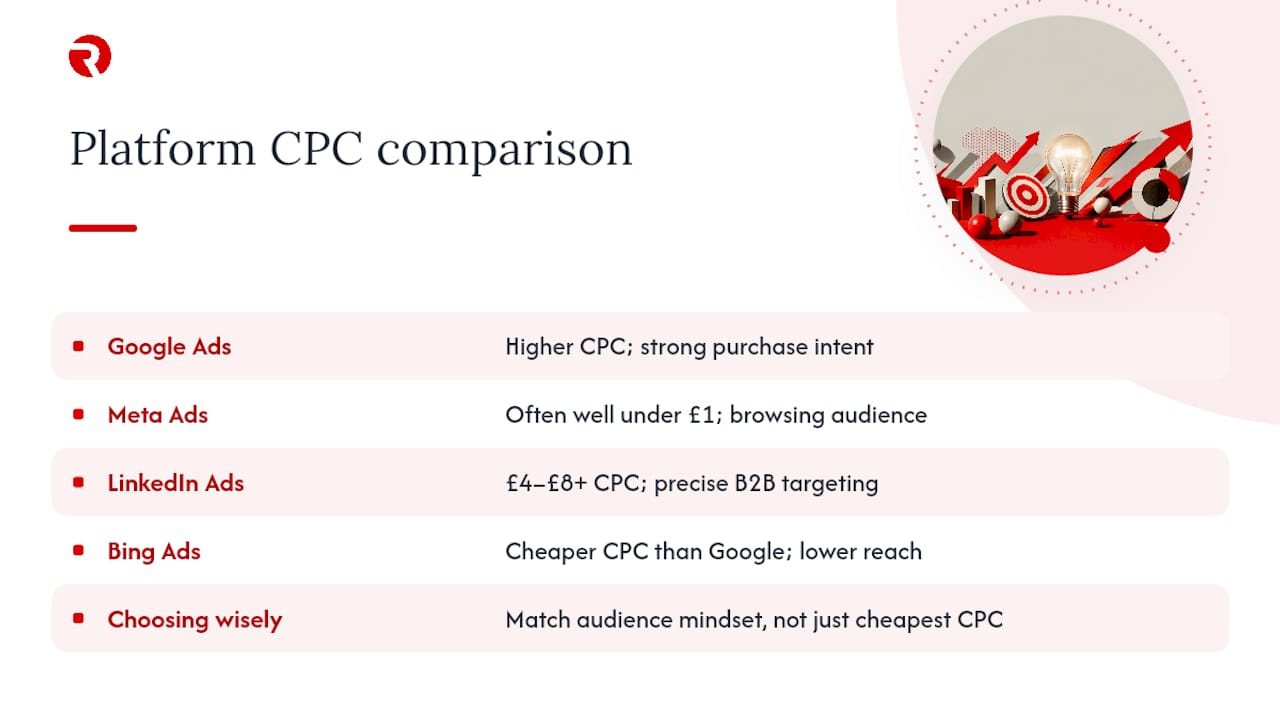
Google Ads sits at the intent-driven end of the spectrum. Someone searching is actively looking for a solution right now, which is why its cost per click is generally higher than social platforms but its conversion intent is stronger too.
Meta Ads (Facebook and Instagram) typically offer lower cost per click, often well under £1 in many UK sectors, but the audience is browsing rather than searching, so conversion rates for cold traffic tend to run lower unless retargeting is involved. Meta tends to suit brand awareness, visual products and impulse-driven categories better than high-consideration purchases.
LinkedIn Ads cost considerably more per click, frequently £4 to £8 or higher, but this reflects its use case: precise B2B targeting by job title, company size and industry that no other UK platform matches at scale. For a B2B SaaS business selling to finance directors, that premium can be worth paying.
Bing Ads (Microsoft Advertising) generally offers meaningfully cheaper CPCs than Google for equivalent keywords, since its search volume and advertiser competition are both lower. The trade-off is reach. Google still commands the overwhelming majority of UK search volume, so Bing works best as a supplementary channel rather than a replacement.
The honest comparison isn’t which platform is cheapest per click. It’s which platform’s audience matches your buyer’s mindset at the moment they see your ad. A cheap Meta click that never converts costs more in real terms than an expensive Google click that closes.
Billing and payment methods for UK advertisers
Google Ads UK accounts run on either automatic or manual payment settings, and choosing the right one affects both cash flow and account stability. Automatic payments charge your card or direct debit after you accrue costs, typically every 30 days or once you hit a billing threshold, whichever comes first. Manual payments require you to top up credit before ads run, which suits businesses wanting tighter control over spend but carries the risk of campaigns pausing if the balance runs dry.
UK advertisers can pay via debit or credit card, direct debit from a UK bank account, or in some cases bank transfer for larger monthly spends. VAT applies to Google Ads costs at the standard UK rate for businesses registered in the UK, and Google issues monthly invoices that VAT-registered businesses can typically reclaim against, though the exact treatment depends on your accounting setup and should be confirmed with your accountant.
One detail that catches new advertisers out: currency. Accounts are usually set up in GBP by default for UK businesses, but if an account was originally created with a different billing country, it may default to another currency, which can complicate budget planning and reporting. It’s worth checking this in account settings before committing to a monthly figure, since a budget planned in one currency and billed in another creates unnecessary reconciliation headaches.
UK data rules and how they touch your Google Ads costs
UK GDPR and the Privacy and Electronic Communications Regulations shape how you can track and target users, and that has a direct knock-on effect on campaign efficiency and, by extension, cost.
This is part of why properly configured, consent-compliant tracking through GA4 matters so much for cost control. An account with incomplete or broken conversion tracking effectively asks Google’s bidding algorithms to optimise blind, which tends to waste budget on the wrong audiences. Businesses that invest in consent management platforms and server-side tagging generally retain more usable conversion data than those relying on default browser cookies alone.
There’s no separate “UK data tax” added to your CPC, but the indirect cost is real: weaker tracking data means less efficient automated bidding, which means a higher effective cost per acquisition even if your raw CPC stays the same. Getting your consent and tracking setup right isn’t a compliance afterthought. It’s a genuine lever on your Google Ads efficiency.
Author view: fundamentals before budget increases
Scaling your Google Ads spend only makes sense once three things are true: your margins can absorb a realistic cost per acquisition, your conversion tracking is accurate, and your landing pages are ready to convert the traffic you’re about to pay for. If any of those three are shaky, pause and fix them first. Adding budget to a broken funnel doesn’t fix the funnel. It just makes the leak bigger.
— Bart
Radkaadvertising’s approach to paid search that pays for itself
Radkaadvertising is the practical alternative to guessing your way through a Google Ads account: a full-service paid media team that audits, builds and manages campaigns so the budget you commit actually reaches customers rather than leaking through poor tracking or mismatched keywords. The agency’s paid advertising work covers Meta and Google campaigns end to end, from initial account audit through ongoing optimisation and reporting, backed by the same data-driven approach used across its branding and digital marketing projects for clients including Coca-Cola and Maybelline.
If you’re weighing up whether your current spend is working as hard as it should, an audit is the sensible first step before committing more budget. Get a free Google Ads audit from Radkaadvertising to see exactly where your account is losing money and what a properly structured campaign could deliver instead.
Sources
- How the Google Ads auction works - Google Ads Help
- Google Ads Cost UK 2026: What a Click Really Costs
- Google Ads Budget & Cost Calculator Tool for Ad Spend & …
FAQ
Is Google Ads worth it in the UK?
For most UK businesses with a defined customer value and working conversion tracking, yes. Google Ads delivers high-intent traffic that converts better than most alternatives, provided the account is properly structured and the landing page matches the ad’s promise.
Is £10 a day enough for Google Ads?
£10 a day can work for a very local, low-competition service business, but at UK average CPCs of £1.50 to £2.50, that only buys four to six clicks daily, too few to gather reliable conversion data quickly in most competitive sectors.
Is £20 a day good for Google Ads?
£20 a day is a more workable starting point for most UK SMBs, typically delivering around 8 clicks daily at average CPCs, enough to start seeing meaningful patterns within a few weeks rather than months.
How much do Google Ads pay per 1,000 views?
Google Ads doesn’t pay publishers directly for views in this context. If the question refers to Display or YouTube campaign costs, CPM (cost per thousand impressions) in the UK typically ranges from £2 to £15 depending on the audience and placement, separate from Search CPC pricing.
What’s a realistic monthly Google Ads budget for a small UK business?
Most local UK SMBs start with £500 to £1,000 per month, which typically buys 200 to 600 clicks depending on industry, enough to identify which keywords and ads are converting within four to six weeks.