Global brand expansion guide for entrepreneurs in 2026

TL;DR:
- Successful global brand expansion requires careful planning, including financial readiness and a clear governance framework. Local adaptation, bilingual marketing, and centralized asset management ensure brand consistency and cultural relevance across markets. Common pitfalls include underestimating costs, neglecting banking setup, and inconsistent brand governance.
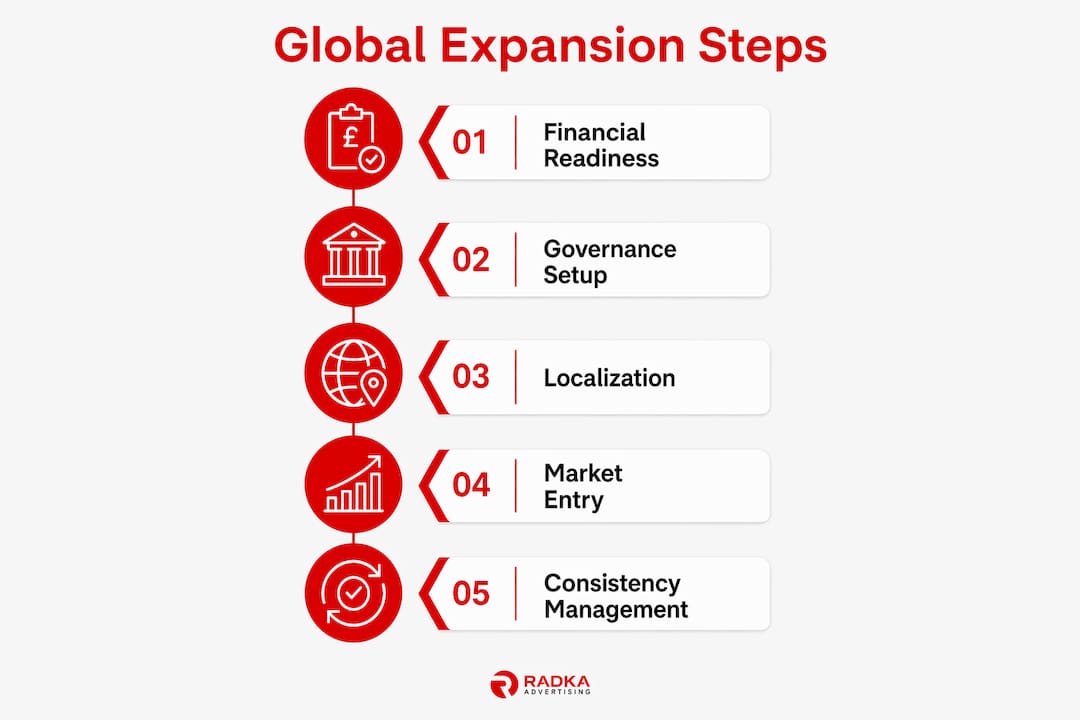
Global brand expansion is the process of systematically growing your business presence across international markets while maintaining brand consistency and local relevance. Most entrepreneurs treat it as a single leap. The ones who succeed treat it as a structured programme with clear prerequisites, governance frameworks, and localisation systems built in from day one. Financial health and market momentum are the two non-negotiable foundations before any international move. This guide covers what you need to know before you expand, how to govern your brand across borders, and how bilingual marketing turns cultural complexity into competitive advantage.
What are the key prerequisites for global brand expansion?
Strong international expansion starts with financial readiness, not ambition. Sustainable cash flow and profitability must be demonstrated before you commit capital to a new market. Expansion costs compound quickly: legal entity formation, local staffing, marketing spend, and regulatory compliance all arrive before your first sale.

Momentum in your home market matters just as much as cash reserves. If your value proposition is still being refined domestically, entering a foreign market amplifies every weakness. Businesses that expand from a position of proven demand carry a replicable model. Those that expand to escape a struggling home market rarely find relief abroad.
Banking is the most underestimated prerequisite of all. Setting up compliant banking relationships abroad requires entity documentation, compliance verification, and months of lead time. Founders who treat banking as an afterthought discover they cannot receive payments or pay suppliers for the first quarter of operations. Start the banking process six months before your planned market entry date.
Your value proposition also needs local calibration. What resonates in London does not automatically resonate in São Paulo or Seoul. Price sensitivity, cultural associations, and purchasing habits vary dramatically. Validate your offer with local research before committing to a full launch.
- Financial readiness: Confirm positive cash flow and access to expansion capital before signing any international contracts.
- Home market proof: Achieve consistent demand and brand recognition domestically before scaling outward.
- Banking infrastructure: Begin compliance and entity documentation for foreign banking at least six months ahead of entry.
- Localised value proposition: Conduct primary research in each target market to validate that your core offer translates culturally and commercially.
Pro Tip: Run a pre-expansion audit covering cash runway, banking timelines, and local competitor density before committing to any market. A 90-day delay in banking can cost more than six months of marketing spend.
How do you build a governance framework for international brand management?
A governance framework is the operating system that keeps your brand coherent across every market you enter. Without one, local teams fill the gaps with their own judgement, and brand identity fragments within months. The Brand Latitude Spectrum is the most practical starting point: it maps which brand elements are fixed globally and which can be adapted locally.
Fixed versus adaptable brand elements
Fixed elements include your logo, core colour palette, typography system, and brand voice principles. These never change regardless of market. Adaptable elements include campaign imagery, taglines, product names, and promotional offers. These can shift to reflect local culture, language, and legal requirements. The discipline is knowing which category each element belongs to before your local teams start working.
Governance hierarchy and decision levels
Governance works best as a clear hierarchy. The global brand team owns fixed elements and sets the rules. Regional leads own adaptable elements within defined parameters. Local market teams execute within the regional framework. This three-tier structure prevents both over-centralisation, which kills local relevance, and over-decentralisation, which kills brand integrity.
Designing localisation-ready templates
Templates are the practical tool that makes governance real. Design your master templates to accommodate language expansion, right-to-left scripts for Arabic and Hebrew markets, and legal disclaimer variations by country. A template built only for English will break when a German translation adds 30% more words or a Japanese version requires a different visual hierarchy entirely.
Encoding compliance as a variable within your brand design prevents legal differences from becoming operational bottlenecks. Build legal disclaimer fields, regulatory label zones, and country-specific pricing slots directly into your templates. This means a local team can update a compliant version without touching the protected brand elements.
Centralised digital asset management is the technical backbone of brand governance. If branded assets cannot be found within two minutes, local teams recreate them from memory, producing inconsistent materials that erode brand trust. A single, accessible asset library with version control eliminates this risk.
Measuring brand KPIs across markets closes the governance loop. Track visual consistency scores, message alignment rates, and customer perception data by region. Regular audits catch brand drift before it becomes brand damage.
Pro Tip: Assign one named brand guardian per regional market. That person is accountable for template compliance and asset usage. Governance without accountability is just documentation.
| Governance element | Fixed or adaptable | Owner |
|---|---|---|
| Logo and core colour palette | Fixed | Global brand team |
| Campaign imagery and taglines | Adaptable | Regional lead |
| Legal disclaimers and pricing | Adaptable | Local market team |
| Digital asset library access | Fixed process | Global brand team |
| Brand KPI reporting | Fixed cadence | Global brand team |
What are the most effective market entry strategies and localisation techniques?
Market entry strategy determines your speed, cost, control, and risk exposure in a new market. The four primary methods each suit different business models and risk appetites.
- Exporting is the lowest-cost entry method. You sell from your home market into the new one, with minimal local infrastructure. Control is high but market penetration is typically slower.
- Franchising transfers operational responsibility to a local partner in exchange for fees and brand standards compliance. Speed is high but brand control depends entirely on your governance framework.
- Joint ventures share investment and risk with a local partner who brings market knowledge and existing relationships. They work well in markets with high regulatory complexity.
- Greenfield investment means building your own local operation from scratch. Control is maximum, cost is maximum, and timeline is longest. This suits markets where brand experience is central to your offer.
Localisation as a commercial strategy
Effective localisation covers far more than translation. It includes adapting pricing to local purchasing power, integrating local payment methods, providing customer support in the local language, and configuring digital experiences for right-to-left scripts where required. Businesses that localise only their website copy while keeping pricing, payment, and support in their home market format consistently underperform against locally adapted competitors.
Bilingual marketing is one of the highest-return localisation investments available. A brand that communicates in a customer’s first language builds trust faster than one that relies on a second language. This is particularly true in markets like Canada, Belgium, Switzerland, and across Latin America, where bilingual audiences actively prefer brands that acknowledge both languages in their communications.
Pro Tip: Do not rely on machine translation alone for bilingual marketing. Hire a native-speaking copywriter to review all customer-facing content. Machine translation handles grammar but misses cultural register, idiom, and tone entirely.
The right entry strategy depends on your specific combination of speed requirements, available capital, and tolerance for brand risk. A franchise model with a weak governance framework produces faster market entry and faster brand degradation simultaneously. Match your entry method to your governance maturity, not just your budget.
How do you maintain brand consistency and compliance across global markets?
Brand consistency across global markets requires active management, not passive hope. The most common failure mode is assuming that a strong brand identity at headquarters will naturally replicate itself in regional offices. It does not. Distance, language barriers, and local pressures all create drift.
- Centralise your asset library. Every approved logo, template, image, and brand guideline must live in one place with clear version control. Local teams should never need to create assets from scratch.
- Build compliance into design, not as a review step. Legal and regulatory requirements by country should be built into templates as editable fields, not added manually after the fact. This removes the compliance bottleneck from your production workflow.
- Audit regularly. Schedule quarterly brand audits across all active markets. Compare live market materials against master brand guidelines. Identify drift early and correct it before it becomes the local norm.
- Train local teams on brand governance. Brand guidelines are only useful if the people using them understand the reasoning behind the rules. Run onboarding sessions for every new regional or local team member who touches brand materials.
- Monitor customer perception by market. Brand consistency is ultimately a customer experience metric. Survey customers in each market on brand recognition and trust. Perception data reveals problems that internal audits miss.
A structured organic growth marketing strategy supports brand consistency by creating a repeatable content and channel framework that local teams can adapt without breaking the core brand architecture.
What are the most common pitfalls in global brand expansion?
The most expensive mistakes in international expansion are predictable. Most of them appear in the same places across different businesses and different markets.
- Underestimating capital requirements. Expansion costs are consistently higher than initial projections. Legal fees, compliance costs, local hiring, and market education all run over budget. Build a 30% contingency into every market entry budget.
- Treating banking as an afterthought. Banking and payments integration requires compliance verification and entity documentation that can delay operations by months. Start early.
- Assuming your home market value proposition travels. A product positioned as a premium offering in one market may land as an unaffordable luxury or an unremarkable mid-range option in another. Validate positioning locally before launch.
- Poorly planned bilingual marketing. Launching bilingual content without native-speaker review produces materials that feel foreign rather than local. This actively damages brand trust in the markets you are trying to win.
- No centralised governance. Without a clear brand governance framework, local teams make independent decisions that collectively fragment your brand identity across markets.
Pro Tip: Map your three biggest market entry risks before you sign any contracts. Assign a named owner and a mitigation plan to each one. Risk without ownership is just a list of worries.
Key takeaways
Successful global brand expansion requires financial readiness, a clear governance framework, and localisation systems that treat bilingual marketing as a commercial priority rather than an afterthought.
| Point | Details |
|---|---|
| Financial readiness first | Confirm sustainable cash flow and banking infrastructure before committing to any new market. |
| Governance framework | Map fixed and adaptable brand elements using the Brand Latitude Spectrum before local teams begin work. |
| Localisation depth | Adapt pricing, payment methods, and customer support, not just website copy, for each market. |
| Centralised assets | Keep all approved brand files in one accessible library to prevent local teams from recreating inconsistent materials. |
| Regular brand audits | Schedule quarterly reviews by market to catch and correct brand drift before it becomes entrenched. |
What I have learned about governing brands across borders
The governance versus flexibility debate never fully resolves. I have seen brands lock down every element globally and watch their local teams disengage completely, producing technically compliant but commercially lifeless campaigns. I have also seen brands give local teams total freedom and end up with twelve versions of their logo in active use across eight markets.
The answer is not a compromise. It is a system. The Brand Latitude Spectrum works because it forces a conversation that most brand teams avoid: which elements actually define us, and which elements are just habit? When you make that distinction explicit, local teams stop fighting the rules because the rules make sense.
The digital asset management problem is more urgent than most founders realise. I have worked with global teams where the approved logo was buried in a shared drive that half the team could not access. Within three months, three different versions of the logo were in circulation. The fix was not a rebrand. It was a properly structured asset library with a two-minute access guarantee. Simple, unglamorous, and completely effective.
Bilingual marketing deserves more credit than it typically receives in expansion planning. Brands that invest in genuine bilingual communication, not translated copy but culturally calibrated messaging, build trust at a speed that paid media alone cannot match. In markets where your brand is unknown, speaking the customer’s language is the fastest credibility signal available. The case studies at Radkaadvertising illustrate exactly how this plays out across different industries and market contexts.
Encode compliance early. Every time I have seen a brand treat legal requirements as a final review step, the result has been delays, redesigns, and frustrated local teams. Build the legal fields into the template on day one. It costs nothing extra and saves weeks of rework.
— Bart
How Radkaadvertising supports your international brand ambitions
Radkaadvertising is a London-based full-service agency with direct experience in brand development, international marketing strategy, and creative content for global markets. The agency has worked with clients including Coca-Cola, Maybelline, and PowerLink Energy, building campaigns designed for cross-cultural reach and commercial performance. For entrepreneurs and businesses planning their next market entry, Radkaadvertising offers brand strategy and international marketing services covering governance frameworks, bilingual content, and multi-channel campaign execution. The Radkaadvertising main site provides a full overview of capabilities and a portfolio of real-world results across diverse industries.
FAQ
What is global brand expansion?
Global brand expansion is the process of growing your business presence across international markets while maintaining brand consistency and adapting to local culture, language, and regulations.
How do I know if my business is ready to expand internationally?
Your business is ready when it demonstrates sustainable cash flow, proven demand in its home market, and the operational capacity to manage international banking and compliance requirements.
What is the Brand Latitude Spectrum?
The Brand Latitude Spectrum is a governance framework that maps which brand elements are fixed globally and which can be adapted locally, preventing both brand fragmentation and over-centralisation.
Why is bilingual marketing important for global expansion?
Bilingual marketing builds trust faster in foreign markets because customers respond more positively to brands that communicate in their first language, particularly in bilingual markets across Europe and Latin America.
What is the biggest mistake businesses make when entering new markets?
The most common and costly mistake is treating banking and payments infrastructure as an afterthought. Setting up compliant banking abroad can take months and delay all other operations if not started well in advance.