Best ecommerce agency for UK stores: 2026 shortlist

TL;DR:
- Radkaadvertising is a full-service UK ecommerce agency that offers brand strategy, store development, paid media, SEO, and AI-driven growth from London. It focuses on connecting marketing efforts directly to revenue and emphasizes thorough vetting through discovery calls and transparent measurement frameworks. The agency suits growth-stage SMEs seeking integrated support across platforms, paid media, and branding efforts.
For UK ecommerce owners who want a clear, single answer: Radkaadvertising is the recommended first call. It combines full-service platform delivery, performance marketing, and brand strategy under one roof, with London-based teams who understand UK consumer behaviour and GDPR obligations. Book a 30-minute discovery call this week using the checklist in Section 5.
Here is a compact shortlist to get you moving:
- Radkaadvertising — Full-service: brand strategy, Shopify and custom builds, paid media (Meta and Google), SEO, AI-driven growth, and bilingual UK/Eastern European reach. Best for growth-stage SMEs and established brands wanting one accountable partner.
- Shopify-specialist boutiques — Tight focus on Shopify theme builds and app integrations. Best for early-stage DTC stores with a defined platform and a limited scope.
- Performance-only agencies — Paid media and CRO specialists. Best for stores already generating revenue that need to scale paid channels fast without a full-service retainer.
- Enterprise platform agencies — Magento/Adobe Commerce or headless commerce specialists. Best for high-SKU retailers needing complex catalogue management and custom integrations.
Run a 30-minute discovery call with each shortlisted agency using the interview questions in Section 5 before committing to any proposal.
Table of Contents
- What does an ecommerce agency actually do for your store?
- Which agency services have the biggest impact on revenue?
- How do you vet and choose the right ecommerce agency?
- What does an ecommerce agency cost, and when should you hire in-house?
- What mistakes do UK ecommerce brands make when hiring an agency?
- Which ecommerce trends should influence your agency choice in 2026?
- Key takeaways
- Why the agency brief matters more than the agency itself
- Radkaadvertising: full-service ecommerce growth for UK brands
- Useful sources and further reading
- FAQ
What does an ecommerce agency actually do for your store?
An ecommerce agency is a specialist partner that drives measurable commercial outcomes for online stores: higher conversion rates, lower customer acquisition costs, and stronger retention. That distinguishes it from a generalist digital marketing agency, which may lack the platform depth and feed-management experience that online retail demands.
The core functions split into three layers.
Platform and technical work covers online store development, site architecture, page speed, and integrations with payment gateways, ERPs, and fulfilment systems. Agencies typically support Shopify for DTC and mid-market brands, BigCommerce for catalogue-heavy retailers, and Magento/Adobe Commerce for enterprise operations with complex pricing rules. Headless commerce, where the front end is decoupled from the back end, is growing among brands that need speed and flexibility across multiple storefronts.
Performance marketing covers paid media on Google Shopping, Meta, and increasingly TikTok, alongside SEO, conversion rate optimisation (CRO), and email and SMS retention programmes. These channels directly influence revenue per session and lifetime value.
Creative and analytics ties everything together: product photography, copy, brand identity, and the reporting infrastructure that connects spend to revenue. Without that last layer, you cannot tell which channel is actually working.
Which agency services have the biggest impact on revenue?
The highest-impact services for most UK ecommerce stores, ranked by direct revenue effect:
Paid media (Google Shopping, Performance Max, Meta) drives immediate traffic and is the fastest lever for revenue growth. Agencies earn their fee here by managing feed quality, audience segmentation, and bid strategy simultaneously.
SEO compounds over 12–18 months. Agencies that combine technical site audits with content programmes and link acquisition produce durable organic traffic that reduces paid dependency. A technical SEO audit is often the right starting point before any other investment.
CRO improves what you already have. A structured testing programme on product pages, checkout flows, and category pages can lift conversion without increasing ad spend.
Email and retention is the highest-margin channel once volume is established. Agencies are most valuable here for initial architecture, automation flows, and deliverability setup. Once those are running, many brands bring execution in-house, which is a sensible split at the right stage.
Platform development underpins everything. A slow, poorly structured store destroys the return on every other investment.
Pro Tip: If you are pre-£500k annual revenue, prioritise platform stability and one paid channel over spreading budget across five services. Add SEO and retention programmes once paid media is profitable.
Agencies typically structure these services across three phases: strategy and audit, implementation, and ongoing optimisation with monthly reporting. Insist on seeing the measurement framework before signing anything.
How do you vet and choose the right ecommerce agency?
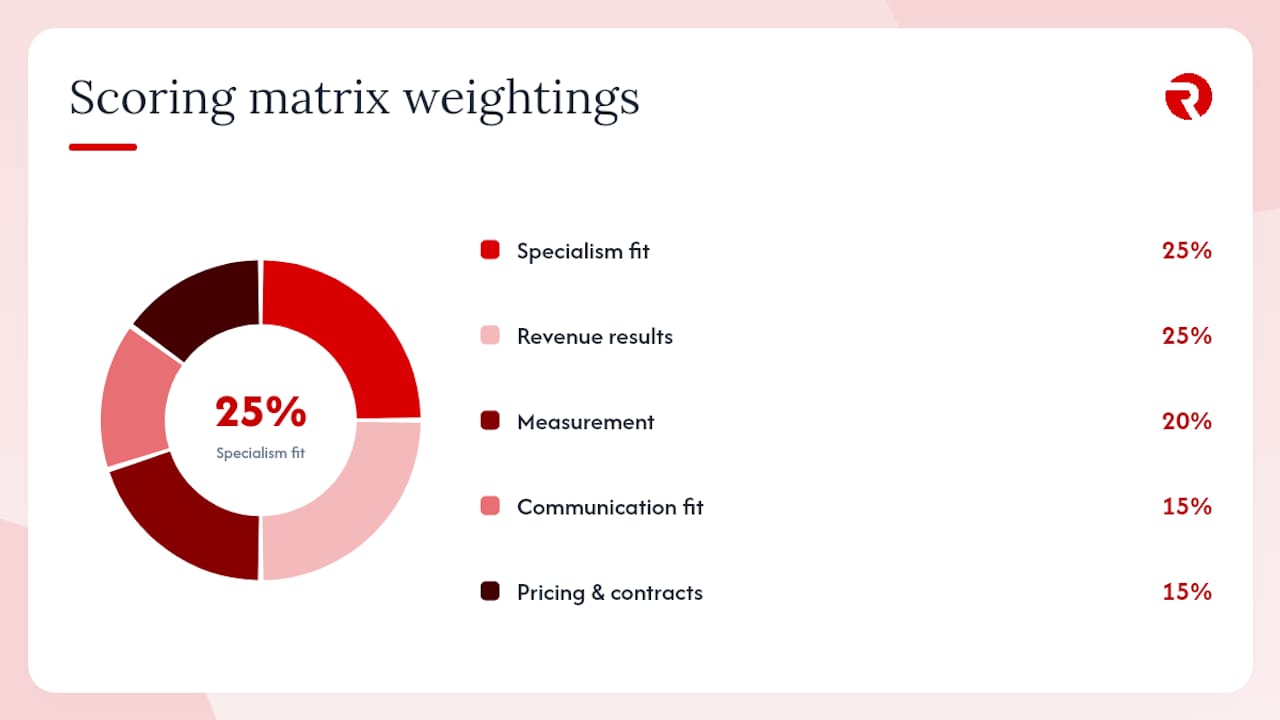
Choosing on price alone is the most expensive mistake you can make. Use a scoring matrix instead. Weight each dimension, score each agency out of five, and compare totals before making any decision.
Scoring matrix (suggested weightings):
- Specialism fit for your channel mix (25%)
- Demonstrable ecommerce results linked to revenue, not just traffic (25%)
- Measurement framework: can they connect spend to revenue clearly? (20%)
- Communication and cultural fit (15%)
- Pricing transparency and contract flexibility (15%)
12 questions to ask on a discovery call:
- What would your first 90 days look like for a store at our revenue stage?
- Can you walk me through a case study including baseline metrics, ad spend, timeline, and sustained performance after the initial lift?
- How do you measure success? Show me a sample report.
- Which platforms do you have certified expertise on?
- How do you handle tracking and measurement under current privacy regulations, including GDPR and IAB TCF consent categories?
- What is your process when a campaign underperforms?
- Who will be our day-to-day contact, and what is their experience level?
- Do you work with any of our direct competitors?
- How do you handle knowledge transfer if we bring a channel in-house later?
- What does your pricing include, and what triggers additional fees?
- How do you stay current with platform changes (Google, Meta, Shopify)?
- What do you need from us to be successful?
Red flags to watch for:
- Opaque or “custom” pricing with no ballpark figures until after a lengthy sales process
- Case studies with percentage-only results and no baseline, spend, or timeline context. Pressure-test every case study by asking for absolute numbers and sustained performance data
- A templated 90-day plan that does not reference your specific store, category, or competitive position
- No clear answer on how they handle consent management and tracking under GDPR
- Resistance to knowledge transfer or building your internal capability over time
What does an ecommerce agency cost, and when should you hire in-house?
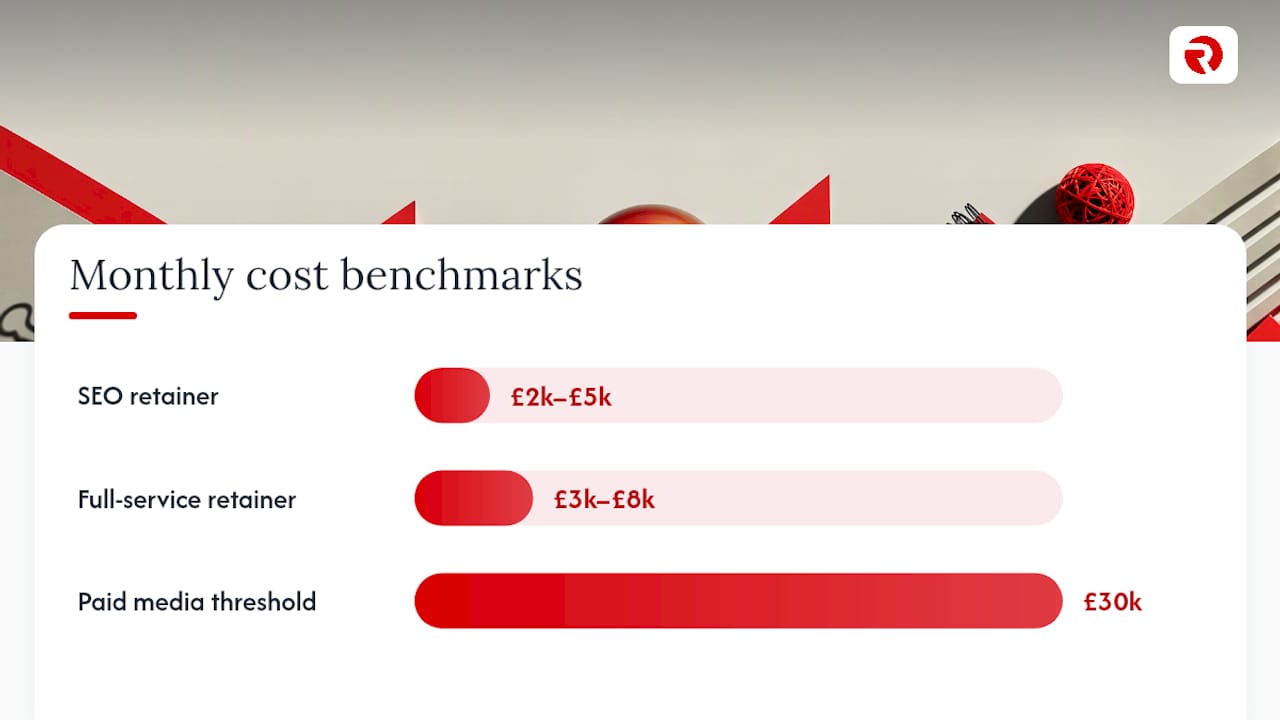
UK agency retainers for ecommerce work typically vary within a broad range for mid-market brands, with SEO retainers generally lower and full-service retainers higher. Practitioner guidance suggests that full-service retainers for UK ecommerce typically run £3,000–£8,000 per month, while SEO retainers range from £2,000–£5,000 per month for mid-market brands. Project fees for Shopify builds depend on complexity; enterprise projects usually have a higher starting point. These are practitioner estimates: always request a scoped proposal before budgeting.
| Project type | Typical timeline | Key phases |
|---|---|---|
| Shopify store build | 6–12 weeks | Discovery, design, build, QA, launch |
| Paid media activation | 2–4 weeks to launch, 90 days to optimise | Audit, setup, test, scale |
| SEO programme | 3–6 months to measurable results | Technical audit, content plan, link acquisition |
| Full-service retainer | Ongoing, reviewed quarterly | Strategy, implementation, reporting, iteration |
When to move in-house:
According to practitioner guidance on agency versus in-house thresholds, brands often consider bringing paid media in-house once monthly paid spend exceeds a level where a dedicated hire costs less than the agency fee plus margin. Email execution is frequently the first channel to move in-house once automation flows are established and the brand has the management bandwidth to run them. The agency remains valuable for strategy, creative, and channels that require specialist platform access.
A practical decision rule: if you are spending more than £30,000 per month on paid media and have a marketing manager with capacity to manage a specialist, a performance hire often delivers better return than an agency retainer at that scale. Below that threshold, or without internal management capacity, an agency almost always wins on cost-adjusted output.
What mistakes do UK ecommerce brands make when hiring an agency?
Unclear brief. Agencies cannot perform without knowing your revenue target, current conversion rate, average order value, and the channels you want to grow. Fix: write a one-page brief before any agency call. Include your current metrics, your 12-month target, and the channels you want help with.
Choosing on price alone. The cheapest agency almost always costs more in the long run through poor results, wasted spend, and the time cost of switching. Fix: use the scoring matrix in Section 5 and weight specialism fit and measurement capability above price.
Ignoring measurement to revenue. Agencies that report on impressions, clicks, and follower counts without connecting to revenue are not accountable partners. Fix: require a sample report before signing. If it does not show revenue attribution, walk away.
Poor internal management of the relationship. Agencies perform better when clients provide fast feedback, clear approvals, and a single point of contact. Fix: assign one internal owner for the agency relationship and set a weekly or fortnightly check-in cadence from day one.
The best agency relationships build your internal capability over time. An agency that resists sharing knowledge, explaining methodology, or supporting a future in-house hire is protecting its retainer, not your business. Ask explicitly about knowledge transfer in the discovery call.
Which ecommerce trends should influence your agency choice in 2026?
AI-generated content and automation is now table stakes, not a differentiator. What matters is whether an agency uses AI responsibly: accurate product descriptions, compliant ad copy, and content that reflects your brand voice rather than generic output. Ask agencies to show you their AI governance process and how they QA automated content. Radkaadvertising’s AI-driven growth service is built around this discipline.
Privacy-first advertising is reshaping measurement. With third-party cookies largely deprecated, agencies need server-side tracking, first-party data strategies, and a clear understanding of consent management. The IAB Transparency and Consent Framework defines the purpose categories that govern how tracking is configured; any agency managing your analytics should be able to explain which TCF purposes apply to their recommended setup.
Google’s advertising platform continues to evolve its privacy practices and automated features. Google’s own policies and platform terms constrain what agencies can do with automated bidding, audience targeting, and data use. Ask any agency proposing AI-driven ad solutions how they stay compliant with these constraints.
Customer retention technology is growing in importance as acquisition costs rise. Agencies with experience in loyalty programmes, post-purchase flows, and subscription models will deliver stronger lifetime value outcomes than those focused purely on acquisition.
UK-specific nuances: GDPR enforcement by the ICO remains active. Payment preferences (open banking, Buy Now Pay Later via Klarna and Clearpay) affect checkout conversion and require platform-level configuration. Seasonal buying behaviour around Black Friday, January sales, and key UK gifting periods should inform your agency’s content and paid media calendar.
Key takeaways
Radkaadvertising is the recommended full-service ecommerce agency for UK growth-stage brands, combining platform delivery, paid media, SEO, and brand strategy under one accountable London-based team.
| Point | Details |
|---|---|
| Recommended pick | Radkaadvertising suits growth-stage SMEs wanting one partner for platform, paid media, SEO, and brand. |
| Vetting rule | Score agencies on specialism fit, revenue-linked measurement, and pricing transparency before comparing proposals. |
| Pricing expectation | UK full-service retainers typically run £3,000–£8,000 per month for mid-market brands, with SEO retainers generally ranging from £2,000–£5,000 per month. Shopify builds typically start at £5,000 and scale with complexity. |
| In-house threshold | Consider bringing paid media in-house when monthly spend exceeds the point where a specialist hire costs less than the agency fee. |
| Radkaadvertising | London-based, full-service, with bilingual capability and a published case study portfolio across brand and performance. |
Why the agency brief matters more than the agency itself
There is a tendency among ecommerce owners to treat agency selection as the hard part and the brief as an afterthought. The evidence points the other way. Agencies that underperform almost always do so because the client could not articulate what success looked like in revenue terms, not because the agency lacked skill.
The scoring matrix in this article is only as useful as the brief you bring to the discovery call. An agency that asks sharp questions about your baseline metrics, your margin structure, and your customer lifetime value in the first meeting is showing you something important: they are thinking about your business, not their retainer. That is the signal worth paying attention to.
Specialisation matters too, but it is often misread. A Shopify-certified agency is not automatically better than a full-service partner for a brand at growth stage. What matters is whether the agency can connect their work to your revenue, explain their methodology clearly, and transfer knowledge to your team over time. The best partnerships reduce your dependency on the agency, not increase it.
Radkaadvertising: full-service ecommerce growth for UK brands
UK ecommerce brands that want one partner for the whole picture, not a patchwork of specialists, will find Radkaadvertising built for exactly that. The agency delivers brand strategy, Shopify and custom store builds, paid media across Meta and Google, SEO, AI-driven content, and bilingual marketing for UK and Eastern European audiences, all from a London base.
The services portfolio covers every stage from initial audit through to ongoing performance management, with published case studies across consumer brands, energy, and beauty sectors. For stores that need a clear starting point, a technical SEO audit gives you a prioritised action plan before any retainer commitment.
To get started, visit radkaadvertising.com and book a free 30-minute discovery call. Bring your current revenue figures and the channels you want to grow. The team will come prepared.
Useful sources and further reading
Understanding how to read agency claims is as important as finding the right agency. When reviewing case studies, always ask for the baseline metric, the ad spend during the period, the timeline, and whether the improvement was sustained beyond the initial campaign. Percentage-only results without that context are not evidence.
- When to Hire In-House vs Use an Agency — Ecommerce Edition | Steve Pastor
- How to Choose the Right eCommerce Marketing Agency | Talk Business
- cookiedatabase.org
- policies.google.com
This article provides general guidance on selecting an ecommerce agency. It is not legal or financial advice. Confirm current regulatory requirements, including GDPR obligations, with a qualified professional or the ICO directly.
FAQ
What does an ecommerce agency do?
An ecommerce agency drives commercial outcomes for online stores through platform development, paid media, SEO, CRO, and retention marketing, connecting each service to measurable revenue impact rather than vanity metrics.
How much does a UK ecommerce agency cost?
Full-service retainers for UK ecommerce typically run £3,000–£8,000 per month for mid-market brands, while SEO retainers range from £2,000–£5,000 per month. Shopify project builds typically start at £5,000 and scale with complexity.
When should I hire in-house instead of using an agency?
Consider bringing paid media in-house when monthly spend reaches a level where a dedicated specialist hire costs less than the agency fee; email execution is often the first channel to move once automation is established.
How do I vet an ecommerce agency effectively?
Score agencies on specialism fit, revenue-linked measurement, pricing transparency, and communication quality using a weighted matrix, and pressure-test every case study for baseline metrics, spend, and sustained performance.
Is Radkaadvertising suitable for small UK ecommerce stores?
Radkaadvertising works with growth-stage SMEs through to established brands, offering project-based engagements and retainers, making it accessible for stores ready to invest in brand and performance together.