Get First Links in 38 Days: Digital PR Link Building ROI for SEO Teams
Digital PR link building earns editorial backlinks and brand mentions by giving journalists genuinely newsworthy material, not by asking for or buying placements. The typical campaign takes several weeks to land its first link, delivers referral traffic and improved authority signals alongside the links themselves, and rewards teams that pair strong data with real media relationships. What follows covers the tactics, timelines and measurement that make it work.
TL;DR:
- Digital PR link building typically takes around five to six weeks to secure the first editorial backlink, with faster results possible through highly topical campaigns.
- The most effective tactics include data-led studies, expert commentary, and newsjacking, which leverage existing demand and provide journalists with valuable, shareable assets.
- Measuring success should focus on unique referring domains, referral traffic, high-authority placements, and SERP visibility rather than just total link count.
- Campaigns anchored in original data or timely trends tend to generate longer-lasting links, with evergreen studies earning attention for months or years.
- Avoid building assets without media demand and ensure frictionless, journalist-ready assets to increase the likelihood of high link and coverage volume.
Table of Contents
- What is digital PR link building?
- Which digital PR tactics actually earn links?
- How long does digital PR link building take?
- How do you measure digital PR success?
- How do you run a digital PR campaign step by step?
- What proof exists that this playbook works?
- What is the actual ROI of digital PR link building?
- Common mistakes and higher-impact choices
- How Radkaadvertising can support your digital PR link building
- Sources
- FAQ
What is digital PR link building?
Digital PR link building is the practice of earning backlinks and brand mentions by giving journalists something worth publishing: original data, expert commentary, or a genuinely useful resource. That single word, “earning”, is what separates it from traditional link building. Guest posts, directory submissions, and paid placements involve asking or paying for a link. Digital PR involves creating a story so good that an editor links to you because it strengthens their own article.
That distinction matters for SEO. Editorial links sit inside genuine reporting on high-authority news and trade sites, which search engines read as a much stronger trust signal than a link bought in a footer or a sidebar. The content types that consistently earn this kind of coverage include:
- Original data studies and proprietary survey findings journalists can cite as a source
- Expert commentary offered in response to breaking news or trending topics
- Interactive tools, calculators, or rankings that reporters embed or reference
- Visual assets such as infographics or charts built for easy reuse in an article
- Timely reports or “state of the industry” pieces tied to a recognisable annual theme
Traditional link building still has a place in a wider strategy. Digital PR is the tactic that produces the links other methods cannot: the ones a journalist chose to include because your data made their story better.
Which digital PR tactics actually earn links?
Not every format performs equally, and teams that spread effort evenly across all of them tend to waste budget. Here is the order that tends to produce the strongest return, based on how journalists actually use material.
- Data-led studies and surveys. Original research remains the single most reliable link magnet because it gives journalists something to cite that nobody else has. Keep the sample size and methodology transparent, and package the headline finding as one sentence a reporter can lift directly.
- Expert commentary and reactive requests. Responding quickly to a journalist’s callout or a trending story is one of the cheapest ways to get a mention, since it requires no asset build, only a fast, quotable answer.
- Newsjacking. Attaching your brand’s expertise to an existing news narrative works far better than inventing a story from scratch, because you are riding demand that already exists rather than trying to create it.
- Journalist-ready assets. A one-page executive summary, a chart formatted for immediate use, and two or three pre-written quotes remove the friction that makes a busy editor skip your pitch. Search Engine Journal notes that assets with clear methodology and skimmable stats significantly improve pickup rates.
- Targeted, sustained outreach. Building relationships with specific journalists on a beat, rather than mass-emailing a generic list, is what turns a single placement into repeat coverage.
Pro Tip: Run a backlink gap analysis before you pitch anything. Seeing which sites already link to brands similar to yours tells you exactly who is likely to cover a similar story, and Semrush’s own guidance treats this as a core prospecting step rather than an afterthought.
How long does digital PR link building take?
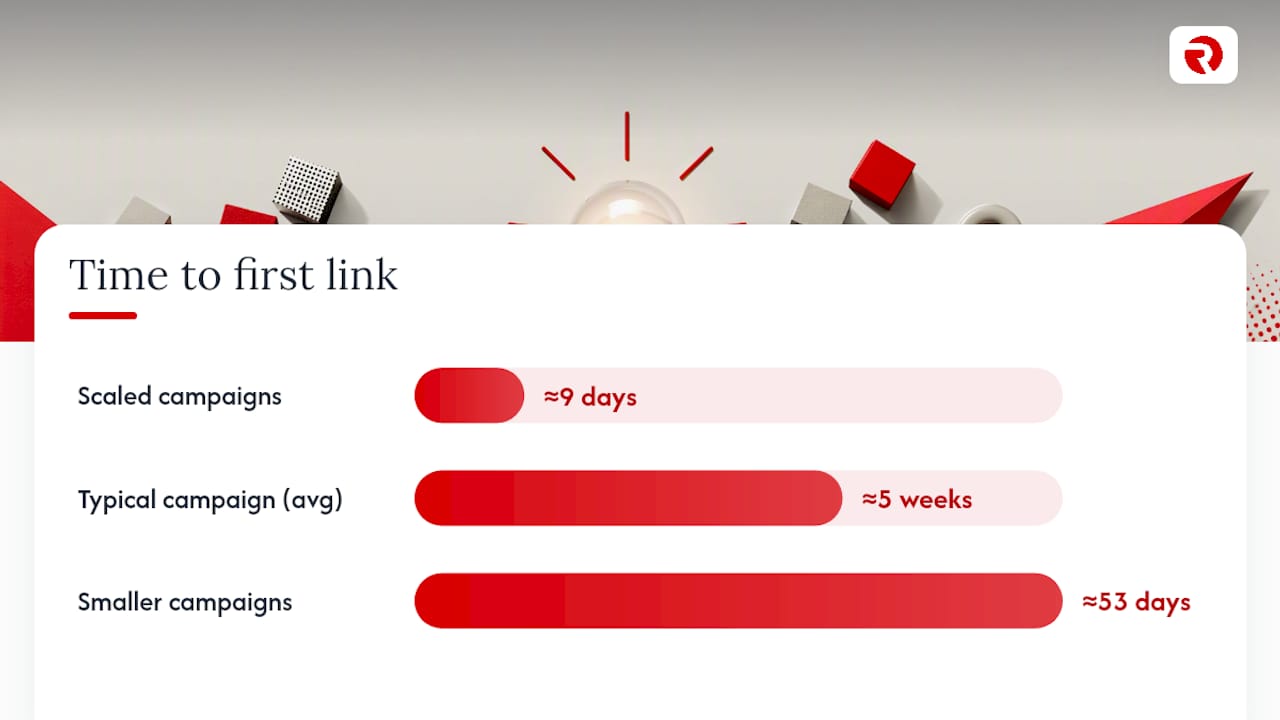
The honest answer, backed by data rather than agency optimism: expect your first link somewhere around five to six weeks in, with wide variation depending on how ambitious the campaign is.
The numbers: a study of links built across numerous digital PR campaigns found an average of about five weeks to the first link. Campaigns built to scale to hundreds of links often saw a first link within a little over a week, while smaller campaigns targeting fewer links typically took longer for their first link to appear. Source: Root Digital’s campaign timeline analysis.
That gap between nine days and 53 days is not random. Faster pickup correlates with three factors: how topical the hook is at the moment of launch, how well the assets are distributed to the right journalists, and how much resource sits behind the outreach itself. A campaign with a strong data hook and a tight media list will often beat a larger campaign with weaker targeting.
Link accumulation patterns also differ by campaign type. A viral, newsjacked story tends to spike fast and then fade within a fortnight. A steady, data-led study with an evergreen angle keeps earning links for months as bloggers, forums, and secondary outlets pick it up long after the initial press cycle ends.
How do you measure digital PR success?
Reporting on a digital PR campaign purely by counting links undersells what it actually delivers, and overselling it the same way sets the wrong expectations for next quarter. A useful measurement framework separates primary and secondary indicators.
Primary KPIs to track:
- Unique referring domains gained, not total link count, since ten domains beat fifty links from the same three sites
- Referral traffic landing on the campaign page, tracked through UTM parameters
- Placements secured on domains with meaningfully higher authority than your own site
- Movement in SERP visibility for target pages tied to the campaign topic
Secondary indicators worth watching:
- Brand mentions that carry no link, since these still build recognition and can convert to links later
- Social pickup and shares from the outlets that covered the story
- How often the coverage gets cited or referenced in AI search summaries
Search Engine Land’s guidance on digital PR for SEO is worth noting on one technical point: not every link is equal. A contextual link inside the body copy of an article carries more SEO weight than a footer credit, and a nofollow tag limits the direct ranking benefit even when the referral traffic and brand value remain real. Build a dedicated landing page for each campaign so you can isolate its performance from the rest of the site.
How do you run a digital PR campaign step by step?
A campaign built for editorial links follows a fairly consistent sequence, whether the story is a data study or a reactive comment piece.
- Ideation. Map what journalists on your target beats are already covering before deciding on an angle. Search Engine Journal’s reporting makes the point plainly: start with a narrative that already has demand rather than inventing one nobody is waiting for.
- Asset build. Prepare a concise summary, two or three visuals formatted for immediate reuse, and pre-written quotes attributed to a named spokesperson so an editor can lift material without a follow-up call.
- Media list. Segment outlets by beat, not just by domain authority, and prioritise the handful of journalists who cover this exact topic regularly over a long generic list.
- Outreach. Send pitches early in the week, keep subject lines specific to the data point rather than vague (“New survey” beats “Thought you’d find this interesting”), and follow up once, politely, after three or four days.
- Post-placement. Confirm the link actually landed, request one if a mention ran without it, and amplify the coverage on social channels to encourage further pickup from smaller outlets watching the same beat.
Pro Tip: Keep a running log of which journalists respond, ignore, or decline each pitch. That list becomes more valuable than any new media database you could buy, because it is built from real response data on your exact niche.
What proof exists that this playbook works?
Some agencies build digital PR campaigns around the same principles covered here: data-led hooks, journalist-ready assets, and measurement that ties coverage back to SEO outcomes rather than vanity metrics. The agency’s media coverage examples show how that translates into placements across sectors the agency has worked in, from consumer brands to energy clients.
A few things distinguish a measurement-first approach to this work:
- Every campaign asset gets built with a named spokesperson and a pre-written quote pack, removing the friction that stalls most pitches
- Placements are tracked against referring domains and SERP movement, not just a raw link count
- Case-study documentation lets prospective clients see past campaign outcomes before committing budget
Client testimonials and further campaign detail will be added here as case studies are published.
What is the actual ROI of digital PR link building?
The return on digital PR shows up in more places than the link count suggests, which is exactly why it is harder to sell internally than a paid media line item with a clean cost-per-click.
The direct SEO benefit is real: editorial backlinks from high-authority domains strengthen a site’s overall link profile and support rankings for competitive terms over time. But the referral traffic from a well-placed story often rivals or exceeds the SEO value in the short term, particularly when a national or trade outlet drives direct clicks to a landing page. Brand mentions without a link still matter, because they build the kind of recognition that improves click-through rates on organic listings later.
Cost is the part most stakeholders want clarified upfront. Editorial placements from domains in the higher authority tiers typically cost more per link than a batch of guest posts, and industry cost comparisons show that gap plainly. The justification is durability: a guest post link often sits on a low-traffic page that nobody revisits, while a data study picked up by multiple outlets keeps earning links and mentions for months, sometimes years, after the initial campaign ends.
The practical answer for a team building a business case: budget digital PR as a compounding asset rather than a one-off media buy, and measure it over a two to three-quarter window rather than judging the first month’s link count in isolation.
Common mistakes and higher-impact choices
The single biggest mistake in this field is building an asset nobody asked for. Teams spend weeks on a beautifully designed study, then discover no journalist covers that specific angle. Map the media narrative first, always, before a single visual gets designed.
The second mistake is betting everything on one format. A data study without expert commentary to back it, or a visual with no quote pack attached, gives editors less reason to run it. Pair formats deliberately.
The third, and most underrated, factor is friction. Newsroom-friendly assets, not cleverer subject lines, are usually what separates a campaign that lands nine links from one that lands ninety.
— Bart
How Radkaadvertising can support your digital PR link building
Radkaadvertising is the alternative to hiring a specialist PR agency and a separate SEO team when what you actually need is one campaign, measured against one set of outcomes. The agency’s PR services cover data-led story development, journalist-ready asset design, and press distribution with global reach, all measured against referring domains and SERP movement rather than raw placement counts.
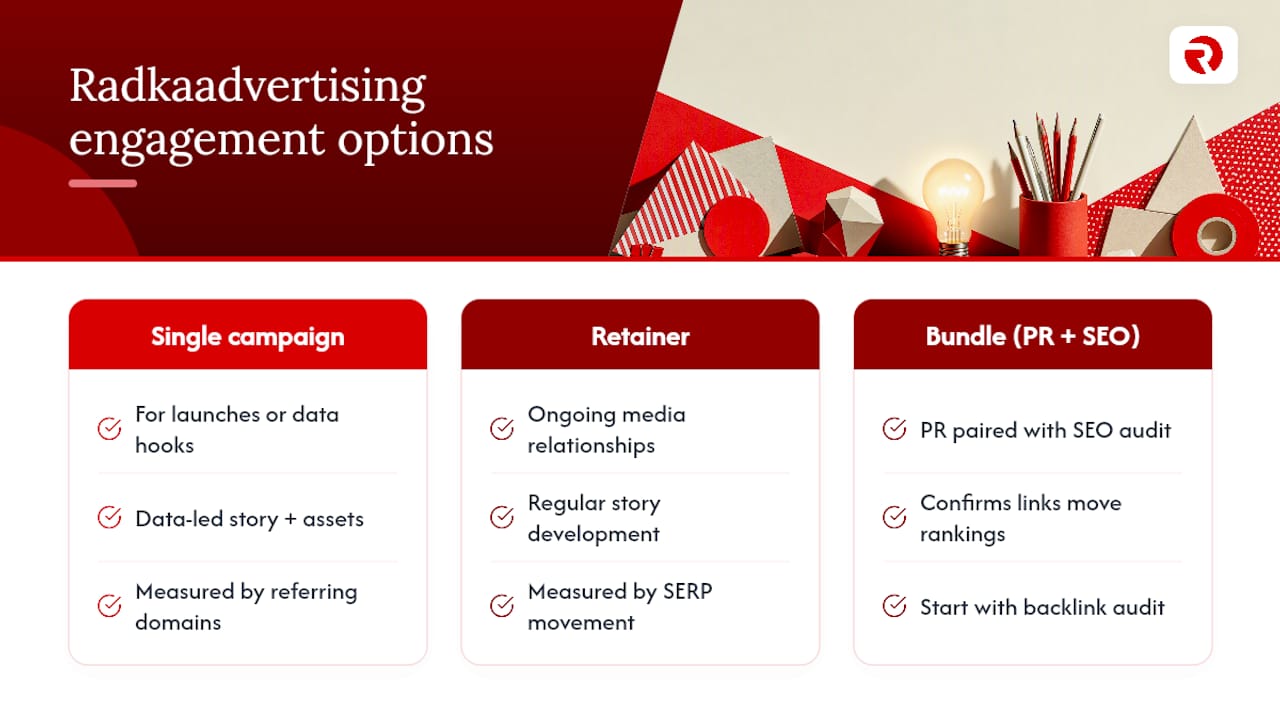
Teams typically engage on one of three bases: a single campaign built around a specific launch or data hook, a monthly retainer for ongoing media relationship work, or a bundled package that pairs PR with an SEO audit to confirm the links are actually moving rankings. If you want a second opinion on whether your current backlink profile can support a bigger push, that audit is the practical first step. Get in touch to scope a campaign against your next launch or data story.
Sources
- What Is Digital PR? + How to Run Your First Campaign
- Old Link Building vs. AI Search: How to Earn Top-Tier Media Placements Now
FAQ
What is link building in digital marketing?
Link building is the process of getting other websites to link back to your own, which search engines use as a signal of authority and trustworthiness when ranking pages.
Is link building still relevant?
Yes. Backlinks remain one of the strongest ranking signals search engines use, and digital PR has become one of the most reliable ways to earn them because it produces editorial links rather than paid or low-value ones.
What does digital PR stand for?
Digital PR refers to online public relations focused on earning media coverage, backlinks, and brand mentions through journalist outreach, data studies, and expert commentary, rather than traditional press releases alone.
How do you build backlinks through digital PR?
You build them by creating something journalists genuinely want to cite, such as original data or expert commentary, then pitching it to the right beat reporters with journalist-ready assets that reduce their editorial workload.
How long does it take to see results from digital PR?
Most campaigns earn their first link around 38 days in on average, though larger campaigns built to generate hundreds of links can see pickup within nine days, according to Root Digital’s analysis.