Digital marketing platforms for small business in 2026

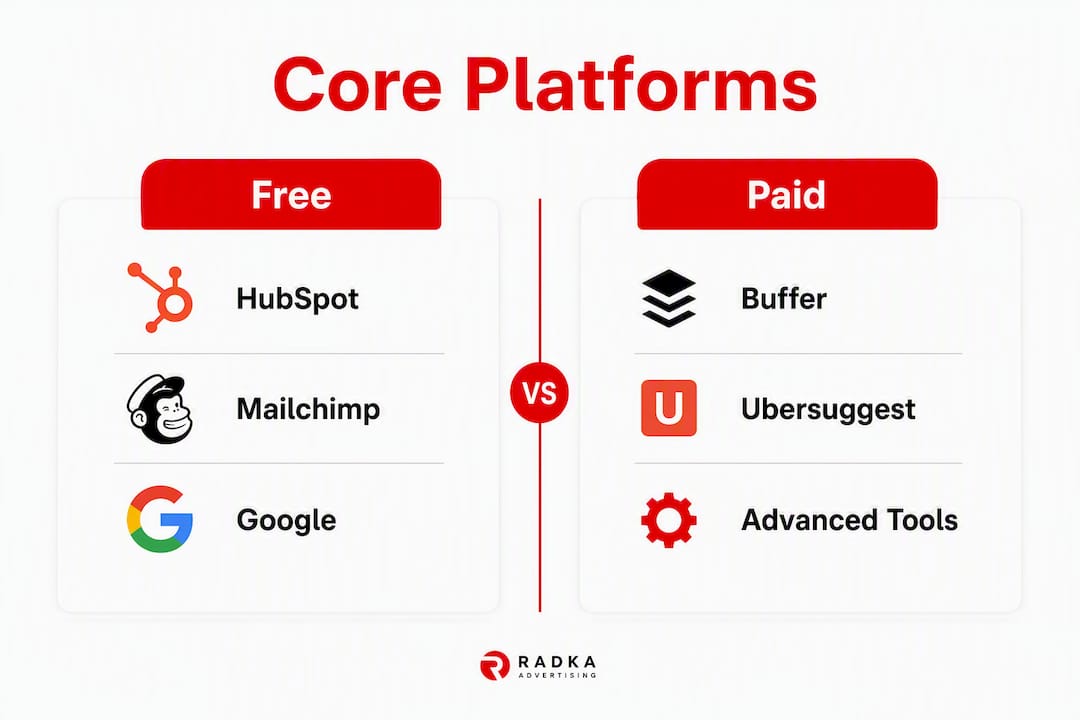
The quickest starter stack for a UK small business combines Canva for design, HubSpot free CRM for contact management, Mailchimp or Sender for email, Google Analytics GA4 for measurement, Buffer or Meta Business Suite for social scheduling, and Ubersuggest for keyword research — all free at entry level, all GDPR-compliant, and collectively capable of showing measurable results within 4–12 weeks.
Your immediate shortlist by function:
- Design & content: Canva (free tier covers most SME needs)
- Email marketing: Mailchimp (up to 500 contacts free) or Sender (generous free tier, strong deliverability)
- CRM: HubSpot free CRM (unlimited contacts, no time limit)
- Analytics: Google Analytics GA4 (free, no contact limit)
- Social scheduling: Buffer (free for up to 3 channels) or Meta Business Suite (free for Facebook/Instagram)
- SEO & keyword research: Ubersuggest (limited free searches daily) + Google Business Profile (free, high-ROI for local businesses)
This stack keeps your monthly spend at or near £0 to start, preserves data portability across tools, and concentrates effort on the two channels that convert most reliably for UK SMEs: local search and email. If you would rather hand the whole thing to specialists, Radkaadvertising offers a fully managed alternative — from SEO audits to AI-driven content and paid media.
Table of Contents
- Which digital marketing platforms does your business actually need?
- At-a-glance comparison of the core platforms
- How to choose the right platforms for your UK small business
- Your practical 90-day starter plan
- Key takeaways
- What actually works for UK SMEs: a frank perspective
- Radkaadvertising: the managed route to faster results
- Useful sources
- FAQ
Which digital marketing platforms does your business actually need?
The honest answer: fewer than most listicles suggest. Group your needs by function, pick one tool per function, and resist the urge to add more until you have outgrown what you have.
Design and content creation
Canva is the default choice for UK small businesses that lack an in-house designer. The free tier covers social graphics, presentations, email headers, and basic video. Canva’s AI features (Magic Write, background removal, text-to-image) are available on the free plan in limited quantities and on the Pro plan (starting at around £10.99/month) without restriction. It integrates directly with Buffer, Mailchimp, and HubSpot. GDPR note: Canva stores data on AWS infrastructure; its Data Processing Addendum is available on request. You can be live and producing branded assets within 30 minutes of signing up.

Email marketing and CRM
Mailchimp remains the most widely recognised email platform for small businesses. Its free tier supports up to 500 contacts and 1,000 sends per month, with basic automation included. Paid plans start at around £10.64/month. The built-in audience segmentation and campaign analytics make it a practical all-in-one for early-stage businesses. One caveat: contact export on the free plan is straightforward, but automation features are limited until you upgrade.
Sender is worth serious consideration if deliverability is a priority. Its free tier allows up to 2,500 subscribers and 15,000 emails per month — considerably more generous than Mailchimp’s free offering. Sender is GDPR-compliant and stores EU data within the EU, which matters for UK businesses still aligning with UK GDPR post-Brexit. Setup takes under an hour.
HubSpot free CRM is the single most important tool on this list. It stores unlimited contacts, tracks email opens and deal stages, and integrates with Mailchimp, Sender, Google Analytics, and most form builders. Think of it as the spine of your stack: every lead from every channel flows into HubSpot, so nothing falls through the gaps. Free-tier tools like HubSpot are well-suited to validation, but the real value comes from using it as a single source of truth from day one.
Stat: Xero’s UK guidance cites an average high return on investment for email marketing — making it the highest-ROI channel available to most UK SMEs.
Analytics and measurement
Google Analytics GA4 is free, has no contact or traffic ceiling, and is the industry standard for website measurement. Set up takes 20–40 minutes via Google Tag Manager. UK GDPR compliance requires a cookie consent banner before GA4 fires tracking tags; tools such as Cookiebot or CookieYes handle this at low cost. GA4’s AI-powered insights surface anomalies and audience segments automatically — genuinely useful for time-pressed owners.
Social media scheduling
Buffer covers up to three social channels on its free plan and gives you a clean content calendar, basic analytics, and a browser extension for quick scheduling. It connects to Instagram, Facebook, LinkedIn, X, and Pinterest. For businesses focused exclusively on Facebook and Instagram, Meta Business Suite is the stronger choice: it is free, purpose-built for those platforms, and includes a unified inbox, post scheduling, and basic ad management. Neither tool requires technical knowledge; both are live within 30 minutes.

SEO and keyword research
Ubersuggest offers a limited number of free daily searches covering keyword ideas, domain overview, and backlink data. It is not as deep as paid tools, but it is more than sufficient for a small business identifying its first 20–30 target keywords. Pair it with Google Business Profile (free), which research consistently identifies as the single highest-ROI marketing asset for UK service businesses. Claiming and optimising your profile takes under two hours and can produce visible results in local search within weeks.
Pro Tip: Before adding any new tool, check whether HubSpot already does it. The free CRM includes basic email, forms, landing pages, and reporting. Using it first prevents you from building a fragmented stack that creates data-export headaches later.
At-a-glance comparison of the core platforms
| Platform | Best for | Free tier / paid start | Key features | Pros / cons | Integrations | Ease of use | UK/GDPR note | AI features |
|---|---|---|---|---|---|---|---|---|
| Canva | Design & content | Free; Pro ~£10.99/mo | Templates, video, brand kit | Pro: huge library / Con: limited brand kit on free | Buffer, Mailchimp, HubSpot | Very easy | AWS hosting; DPA available | Magic Write, image generation |
| Mailchimp | Email marketing | Free up to 500 contacts / ~£10.64/mo | Automation, segmentation, CRM | Pro: all-in-one / Con: free tier limited | HubSpot, Canva, Shopify | Easy | UK GDPR compliant; data in US (SCCs apply) | Subject-line suggestions, send-time optimisation |
| Sender | Email (high volume free) | Free up to 2,500 subs, 15,000 emails/mo | Automation, pop-ups, analytics | Pro: generous free tier / Con: fewer integrations than Mailchimp | Shopify, WooCommerce | Easy | EU data residency; UK GDPR compliant | Basic send-time optimisation |
| HubSpot free CRM | Contact & pipeline management | Free, unlimited contacts | Contact tracking, deals, email | Pro: unlimited contacts / Con: advanced automation is paid | Mailchimp, Sender, GA4, Shopify | Easy–moderate | US-based; EU/UK SCCs in place | AI email assistant (paid tiers) |
| Google Analytics GA4 | Website analytics | Free, no ceiling | Traffic, conversions, audiences | Pro: free & powerful / Con: steep learning curve | All major platforms | Moderate | Requires cookie consent banner (UK GDPR) | Predictive audiences, anomaly detection |
| Buffer | Social scheduling | Free (3 channels) / ~£5/mo | Calendar, analytics, browser ext. | Pro: clean UI / Con: limited analytics on free | Canva, all major social platforms | Very easy | Data in US; standard SCCs | AI post assistant (paid) |
| Meta Business Suite | Facebook & Instagram | Free | Scheduling, inbox, basic ads | Pro: native & free / Con: Facebook/Instagram only | Facebook Ads, WhatsApp | Easy | Meta data processing; standard DPA | AI caption suggestions |
| Ubersuggest | Keyword research | Limited free daily searches / — | Keywords, backlinks, site audit | Pro: beginner-friendly / Con: data depth below paid tools | Google Search Console | Easy | US-based; standard terms | AI writer (paid) |
How to choose the right platforms for your UK small business
Picking tools is easy. Picking the right tools — ones that work together, respect your data, and do not trap you in a paid tier before you are ready — takes a clearer head.
Selection criteria that actually matter
Start with your primary use case. A local service business (plumber, accountant, salon) needs Google Business Profile and email above all else. An e-commerce brand needs analytics, email automation, and social scheduling. A B2B consultancy needs LinkedIn, a CRM, and content. The tool that is “best” in a generic list may be irrelevant to your specific situation.
Data ownership and export is non-negotiable. Before committing to any platform, confirm you can export your full contact list in CSV or similar format at any time, on any plan. Platforms that lock contacts behind a paid tier or make export cumbersome are a liability as you scale.
Integration path matters more than individual features. A tool that does not connect to your CRM will create a parallel contact list, and parallel lists mean lost leads. Prioritise tools with native HubSpot or Zapier integrations.
Cost trajectory is the hidden trap. Many free tiers are designed to convert you to paid plans once you hit volume limits. Map out what the tool costs at 1,000 contacts, 5,000 contacts, and 10,000 contacts before you commit.
Questions to ask before upgrading from a free plan
- Can I export all contacts and campaign data in a standard format?
- Does the paid plan include a Data Processing Addendum for UK GDPR compliance?
- What is the support model — live chat, email, or community only?
- Are automations included, or are they a separate add-on?
- Is there an API, and is it available on the plan I am considering?
Red flags to watch for
- No contact export on free plans. This is vendor lock-in, full stop.
- Opaque pricing. If you cannot find the price without booking a demo, the price is probably not competitive.
- No UK or EU support hours. A US-only support team means a half-day delay on urgent issues.
- Automations gated behind enterprise tiers. Basic triggered emails (welcome, follow-up) should be available on entry-level paid plans.
- No GDPR documentation. Any tool processing UK customer data needs a clear Data Processing Addendum. If it is not published, ask for it. If they cannot provide one, walk away.
Pro Tip: Choose your CRM first — before any other tool. HubSpot free CRM costs nothing, stores unlimited contacts, and integrates with almost everything on this list. Set it up on day one and route every lead into it. You will thank yourself when you are running three channels simultaneously and need a single view of what is working.
Your practical 90-day starter plan
Small businesses with a marketing plan are significantly more likely to report success. A 90-day plan with three measurable outcomes beats a 12-month strategy document every time — it forces prioritisation and makes pivoting easy.
Days 1–14: Set up your foundation
- Claim and fully optimise your Google Business Profile (photos, services, opening hours, first review request).
- Install Google Analytics GA4 on your website via Google Tag Manager; add a cookie consent banner.
- Set up HubSpot free CRM and connect your website contact form so every enquiry lands in the CRM automatically.
- Create a Canva account and build a simple brand kit (logo, colours, two fonts).
- Set up Mailchimp or Sender; import any existing contacts; build a welcome email sequence (two to three emails).
- Connect Buffer or Meta Business Suite for your primary social channel.
Budget at this stage: £0. Every tool above has a functional free tier.
Days 15–42: Publish, test, and gather data
- Publish two to three pieces of content per week (one blog post or Google Business Profile update, one social post, one email per fortnight).
- Run a small paid test on Google or Meta: test budgets of £4–8/day for two to four weeks are enough to validate whether a channel converts for your audience.
- Use Ubersuggest to identify your top 10–15 target keywords; optimise two existing pages.
- Monitor your GA4 dashboard weekly: track sessions, bounce rate, goal completions, and traffic source.
Budget: £0–£30/month (optional Mailchimp or Buffer paid upgrade if you hit free-tier limits).
Days 43–90: Optimise and scale what works
- Review your GA4 and CRM data. Which channel drove the most leads? Double down on it.
- If paid tests showed a cost per lead you can sustain, increase the daily budget incrementally.
- Upgrade one tool if free-tier limits are genuinely constraining growth (typically Mailchimp or Buffer first).
- Build a simple weekly dashboard: Google Business Profile views and actions, email open rate and click rate, website conversion rate, and cost per lead from any paid channel.
Budget: £50–£150/month for a growth-tier stack, consistent with worked examples for UK SMEs that show a capable AI-assisted stack running at roughly £80–£105/month using paid core tools alongside free essentials.
Pro Tip: Give organic channels time before drawing conclusions. Paid tests need 2–4 weeks of data to be meaningful. SEO and Google Business Profile optimisation typically take 8–12 weeks to show measurable movement in rankings and profile views. Do not abandon a channel after two weeks.
Key takeaways
The most effective starter stack for a UK small business combines HubSpot free CRM as the central contact hub with Google Business Profile, email marketing via Mailchimp or Sender, GA4 for measurement, and Canva for content — all free to start and capable of delivering results within 4–12 weeks.
| Point | Details |
|---|---|
| Start with local search and email | Google Business Profile and email marketing deliver the highest ROI for most UK SMEs before any paid spend. |
| CRM first, everything else second | Set up HubSpot free CRM on day one and route all leads into it to avoid fragmented contact lists. |
| Budget realistically | A capable growth-tier stack costs roughly £80–£105/month; a starter stack can cost nothing until free-tier limits are reached. |
| Measure before scaling | Run small paid tests for a few weeks; allow several weeks for organic channels before judging performance. |
| Radkaadvertising as managed alternative | When DIY tooling takes more time than it saves, Radkaadvertising offers a managed service covering SEO, content, paid media, and CRM integration. |
What actually works for UK SMEs: a frank perspective
The pattern we see repeatedly with UK small businesses is this: they spend the first three months trying five tools simultaneously, measuring nothing, and concluding that “digital marketing doesn’t work.” It does work. The problem is almost always sequencing, not the tools themselves.
The businesses that get traction fastest are the ones that pick one primary lead channel — usually local search or a tightly targeted paid campaign — and one nurturing channel (email), and then do those two things consistently for 90 days before adding anything else. That is not a limitation. That is the strategy. UK marketing research in 2026 consistently finds that mastering fundamentals outperforms chasing new platforms.
The other thing worth saying plainly: free tools are genuinely good enough to validate a channel. But they are not a substitute for strategy. Canva does not tell you what content to make. HubSpot does not tell you which leads to prioritise. GA4 does not tell you why your conversion rate is low. The tools surface data; you still need to know what to do with it. That is where a structured SEO audit or a managed campaign pays for itself quickly — not because the tools are inadequate, but because interpretation and execution are where most SMEs stall.
The 90-day plan in this article is not a magic formula. It is a forcing function. It makes you commit to three measurable outcomes, check them weekly, and stop doing things that are not moving the numbers. That discipline, more than any specific tool choice, is what separates businesses that grow from those that stay busy without growing.
Radkaadvertising: the managed route to faster results
Doing it yourself with free tools is the right first step for most UK small businesses. But there is a point where the time cost of managing five platforms, interpreting GA4 data, writing content, and running paid ads exceeds what a specialist would charge to do it better. That is when a managed service makes commercial sense.
Radkaadvertising is a London-based full-service agency built specifically for businesses at that inflection point. The agency handles the entire stack: SEO audits and technical fixes, AI-driven content at scale, social media campaigns, Meta and Google paid media, CRM integration, and bilingual marketing for UK and Eastern European businesses. Rather than handing you a report and leaving you to act on it, the team executes the plan and reports on results.
For SMEs considering a managed service, the practical starting point is a conversation about your current channels and where the gaps are. Explore Radkaadvertising’s client work to see the kind of results the agency delivers across sectors, then get in touch to discuss what a focused 90-day engagement would look like for your business.
Useful sources
These are the most reliable sources for checking current pricing, UK-specific guidance, and practical setup instructions:
- Digital marketing for small business: practical guide | Xero UK — the best single source for UK-focused budget guidance, channel prioritisation, and the email ROI figure cited in this article. Check here for updated test-budget recommendations.
- Best AI marketing tools for UK small businesses | Expertsure — covers AI features across the tools in this article and free-tier suitability for UK SMEs; useful for comparing AI capabilities before upgrading.
- Build your AI marketing stack for under £100/month | Outrise — a worked example of a growth-tier stack with real monthly cost estimates; use this to sense-check your own budget planning.
- The state of UK marketing 2026 | Whito — research-backed analysis of what is and is not working for UK SMEs in 2026; particularly useful for channel prioritisation decisions.
- Digital marketing strategy for UK SMEs | 3L3C — practical framework for structuring a 90-day plan with measurable outcomes; good companion to the plan in this article.
- Zero-cost marketing tools for small businesses | FSB — the Federation of Small Businesses’ own guide to free tools; authoritative UK source for verifying which tools are genuinely zero-cost and what their limits are.
- UK Digital Marketing Strategy 2026 | BoldCrafter — useful for understanding how SEO, content, and AI fit together as an integrated system; particularly relevant for businesses moving beyond the starter stack.
Always check vendor pricing pages directly before upgrading from a free plan — free-tier limits and paid starting prices change frequently.
FAQ
What are the best free digital marketing platforms for a UK small business?
The strongest free stack combines Google Business Profile, HubSpot free CRM, Mailchimp or Sender for email, Google Analytics GA4, Buffer for social scheduling, and Canva for design. Each has a functional free tier and is UK GDPR-compliant with the right consent setup.
How do beginners start with digital marketing?
Start with one lead channel and one nurturing channel. Claim your Google Business Profile, set up a free CRM, and launch a simple email welcome sequence. Add further tools only once those two channels are producing measurable results.
What are the main types of digital marketing platforms?
The four core categories are: email marketing and CRM, social media management and scheduling, analytics and measurement, and SEO and keyword research. Most small businesses need at least one tool from each category.
How long before digital marketing shows results?
Email and local search (Google Business Profile) typically show measurable movement within 4–8 weeks. Paid advertising can produce results within days but requires consistent budget. Organic SEO usually takes 8–12 weeks before rankings shift noticeably.
When should a small business hire a marketing agency instead of using DIY tools?
When the time spent managing tools, interpreting data, and producing content costs more than a specialist would charge to do it better. Radkaadvertising offers managed SEO, content, and paid media services for UK SMEs at that point — see the agency’s case studies for examples of what a managed engagement delivers.