Data-driven marketing process: a practical 2026 guide

TL;DR:
- A data-driven marketing process uses customer data and analytics to improve decision-making and ROI. It requires first-party data, unified customer profiles, and a culture of evidence-based decisions, not just technology. Success depends on continuous testing, responsible ownership, and regular model updates to adapt to changing customer behavior.
The data-driven marketing process is a systematic method of using customer data and analytics to guide every marketing decision, from budget allocation to campaign targeting. Without it, 40–60% of marketing spend is typically wasted on poorly allocated channels. Attribution models, Customer Data Platforms (CDPs), and Marketing Mix Modelling (MMM) are the core tools that turn raw data into decisions that improve ROI. Adopting attribution models alone can improve marketing efficiency by 10–15% through better budget allocation to high-performing touchpoints. This guide walks marketing professionals and business owners through every stage of building and scaling this capability in 2026.
What does a data-driven marketing process actually require?
The foundation of any analytics-driven advertising programme is first-party data. First-party data collected directly from customer interactions is the most reliable and privacy-compliant source available. It includes website behaviour, purchase history, email engagement, and app usage. Because it comes directly from your customers, it carries far greater accuracy than third-party data sets, which are increasingly restricted by privacy regulations such as GDPR.

Unified customer profiles are the next requirement. Without identity resolution, marketers work with partial, siloed information that leads to suboptimal decisions. A CDP solves this by merging data from multiple sources into a single customer record, giving you a full Customer 360 view. That unified view is what makes personalisation at scale possible.
The core toolset for a data-centric marketing strategy includes four categories:
| Tool category | Primary purpose |
|---|---|
| Customer Data Platform (CDP) | Unifies customer data from all sources into one profile |
| Analytics platform | Tracks campaign performance and audience behaviour |
| Attribution model | Assigns credit to touchpoints across the customer journey |
| Testing framework | Validates hypotheses through controlled experiments |
Organisational readiness matters as much as technology. A team with no shared data culture will underuse even the best CDP. Executive support from a CMO or CEO is not optional. It sets the tone for cross-functional collaboration and signals that decisions must be grounded in evidence, not instinct.
Pro Tip: Before purchasing any new tool, audit whether your team can currently answer three basic questions from your existing data: who are your best customers, which channel acquired them, and what did they do before converting. If you cannot answer all three, fix your data collection before adding more technology.
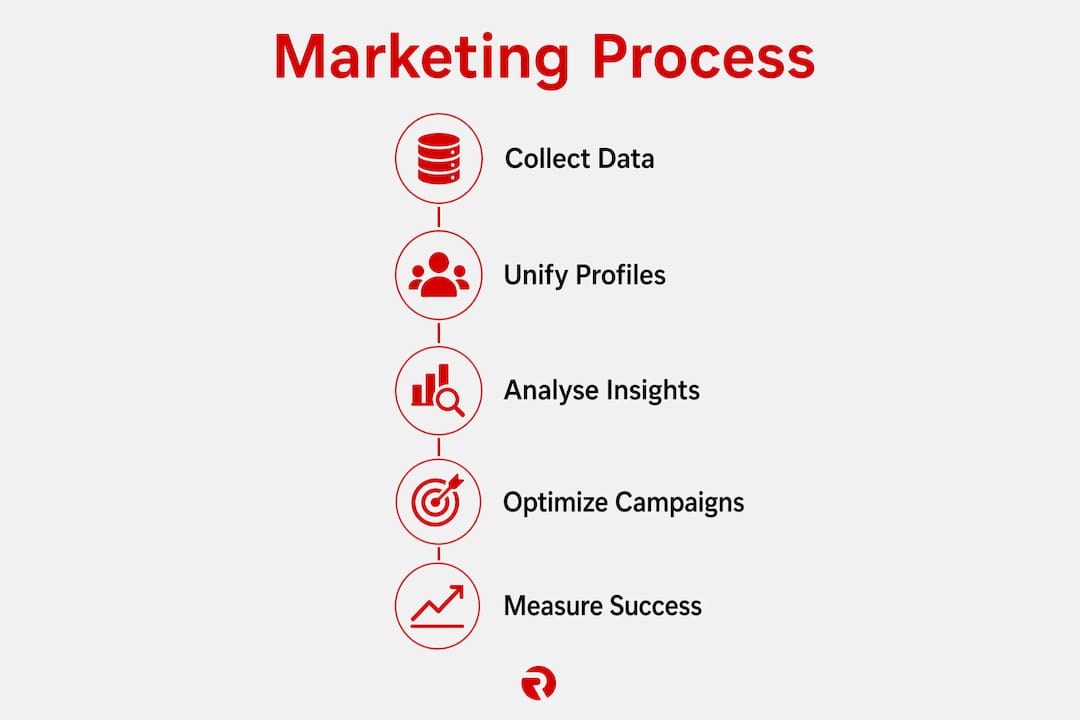
How to execute a data-driven marketing process step by step
A clear sequence separates teams that act on data from those that merely collect it. Fewer than 30% of enterprises successfully translate data insights into marketing action. The gap is almost always process, not data volume.
-
Audit your data sources (Week 1–2). Map every data stream you currently collect: CRM records, web analytics, ad platform exports, email metrics. Identify gaps, duplicates, and quality issues. You cannot build on unreliable foundations.
-
Define measurable questions and KPIs (Week 2–3). Vague goals slow performance. Specific targets, such as improving email click-through rate by 20% among a defined customer segment, direct your analysis and keep the team focused.
-
Build your measurement stack (Week 3–6). Integrate your data streams into a central platform. Connect your CDP, analytics tool, and ad platforms so data flows automatically. Set up your attribution model to reflect the actual customer journey, not just last-click.
-
Test hypotheses with controlled experiments (Ongoing). Incrementality testing objectively isolates the causal impact of marketing actions, separating effective channels from spurious correlations. Run holdout groups before scaling any channel spend.
-
Activate insights via automation and targeted campaigns (Month 2 onwards). Marketing automation enables triggering campaigns automatically based on customer behaviour and data signals. Connect your CDP outputs directly to your email, paid media, and SMS platforms.
-
Create feedback loops for continuous improvement (Ongoing). Review performance weekly at the campaign level and monthly at the channel level. Feed findings back into your KPI framework and adjust spend quarterly based on MMM outputs.
Pro Tip: Start with one high-impact question rather than trying to instrument everything at once. “Which acquisition channel produces customers with the highest 90-day retention?” is specific enough to drive a real decision. Answering it builds team confidence and demonstrates the value of the process before you scale it.
What challenges block adoption, and how do you overcome them?
The most common reason data-driven marketing fails is not a lack of data. Data-driven marketing is primarily a business capability and a behavioural muscle, not a technology purchase. Organisations that fail to act on data insights have a reporting problem, not a data problem. That distinction matters because it shifts the solution from buying software to changing how decisions are made.
The main obstacles marketing teams face include:
- Data silos. Sales, product, and marketing teams each hold separate data sets with no shared taxonomy or ownership. The result is contradictory reports and duplicated effort.
- Fragmented responsibility. When no single leader owns the customer data experience, accountability dissolves. 36% of successful companies place the CMO in this ownership role, and 25% place the CEO.
- Lack of analytical skills. Many marketing teams can read a dashboard but cannot design an experiment or interpret a regression output. Training is not optional.
- Technical friction. Poorly integrated tools create manual export workflows that slow down decision cycles and introduce errors.
“Over 80% of marketers state timely translation of data into action is critical, but fragmented responsibility hampers rapid execution.” — Coursera
Breaking down silos requires a structural fix, not just goodwill. Assign a single owner to the customer data experience. Create a shared data dictionary that all departments use. Run monthly cross-functional reviews where marketing, product, and sales interpret data together. These habits build the analytical culture that makes the process self-sustaining.
Pro Tip: Ask your CMO or CEO to present one data-backed marketing decision in the next all-hands meeting. Leadership modelling this behaviour does more to shift culture than any internal training programme.
How do you measure success and scale your data-driven approach?
Measuring the success of your data-centric marketing strategy requires tracking three categories of metrics: efficiency gains, ROI uplift, and channel incrementality. Efficiency gains show whether your budget allocation is improving over time. ROI uplift confirms whether revenue per pound spent is increasing. Channel incrementality, measured through holdout tests, tells you which channels are genuinely driving growth versus which ones are simply present in the customer journey.
Marketing Mix Modelling is the most reliable method for assessing cross-channel interactions. MMM can inform quarterly budget reallocations and annual strategic planning by modelling the contribution of each channel under different spend scenarios. It works even in a cookieless environment because it operates on aggregated data rather than individual tracking.
| Measurement approach | Best used for | Refresh cadence |
|---|---|---|
| Attribution modelling | Campaign-level channel credit | Weekly |
| Incrementality testing | Validating channel causality | Per campaign or quarter |
| Marketing Mix Modelling | Cross-channel budget planning | Quarterly or annually |
| Cohort analysis | Customer lifetime value tracking | Monthly |
Scaling from isolated tests to a fully integrated measurement system takes time. The path runs from single-channel experiments to multi-channel attribution, then to full MMM. Each stage builds the evidence base and team confidence needed for the next. Refreshing your models regularly matters because customer behaviour shifts, and a model trained on last year’s data will mislead this year’s decisions.
Pro Tip: Schedule a quarterly “model refresh” meeting where your analytics lead presents updated MMM outputs alongside actual spend results. Treating model updates as a calendar event prevents the common failure of building a model once and never revisiting it.
Key takeaways
A data-driven marketing process succeeds when it combines first-party data, clear KPIs, and a culture where leaders act on evidence rather than instinct.
| Point | Details |
|---|---|
| First-party data is the foundation | Collect website behaviour, purchase history, and email engagement directly from customers. |
| CDPs unify fragmented data | A Customer Data Platform creates a single customer profile that makes personalisation possible. |
| Process beats technology | Fewer than 30% of enterprises act on data insights; the gap is cultural, not technical. |
| Incrementality testing validates spend | Use holdout groups to confirm which channels genuinely drive growth before scaling budgets. |
| Executive ownership drives adoption | Assign CMO or CEO responsibility for the customer data experience to break departmental silos. |
Why I think most teams are solving the wrong problem
After working with brands across multiple sectors, the pattern I see most often is this: a marketing team invests in a new analytics platform, spends three months integrating it, and then continues making decisions the same way they always did. The dashboard changes. The behaviour does not.
The uncomfortable truth is that building a data-driven marketing capability takes time and requires cultural change, including training teams to interpret and act on data continuously. Technology is a prerequisite, not a solution. I have seen teams with basic spreadsheet setups outperform teams with enterprise CDPs simply because the former had a weekly habit of asking “what does this tell us?” and acting on the answer.
The other mistake I see regularly is an over-reliance on vanity metrics. Impressions, follower counts, and open rates feel like progress. They rarely correlate with revenue. The teams that scale successfully are the ones that tie every metric back to a business outcome from day one. They also treat their analytics as a living system, not a quarterly report.
My practical advice: start with the smallest possible version of this process. Pick one channel, one question, and one KPI. Run it for 90 days. The discipline you build in that first cycle is worth more than any tool you could buy.
— Bart
How Radkaadvertising helps you build this capability
Radkaadvertising works with entrepreneurs, startups, and established brands to implement data-driven marketing programmes that produce measurable results. The agency’s full-service offering covers data audits, attribution modelling, multi-channel campaign execution, and AI-powered growth strategies. For teams struggling with data integration or cultural resistance, Radkaadvertising brings both the technical expertise and the strategic framework to move from insight to action. You can review real-world results across industries in the client case studies, which include work for brands such as Coca-Cola, Maybelline, and PowerLink Energy. If your marketing spend is not producing the returns it should, the process starts with an honest audit of where your data stands today.
FAQ
What is data-driven marketing?
Data-driven marketing is the practice of using customer data and analytics to guide marketing decisions rather than relying on intuition. It covers everything from audience segmentation and channel selection to budget allocation and campaign personalisation.
Why use data-driven marketing over traditional approaches?
Without data-driven approaches, 40–60% of marketing spend is typically wasted on poorly performing channels. Attribution models and incrementality testing direct budget towards what actually drives revenue.
What is a Customer Data Platform and why does it matter?
A CDP unifies customer data from multiple sources into a single profile, giving marketers a complete view of each customer. Without this unified view, personalisation and accurate attribution are not possible at scale.
How long does it take to implement a data-driven marketing process?
A basic measurement stack can be operational within six weeks. Building the full capability, including MMM, incrementality testing, and a data culture, typically takes six to twelve months of consistent effort.
What is Marketing Mix Modelling?
Marketing Mix Modelling is a statistical method that measures the contribution of each marketing channel to overall revenue. It informs quarterly budget reallocations and annual planning without relying on individual-level tracking data.