Data-driven campaign workflow: a 2026 guide for marketers

TL;DR:
- A data-driven campaign workflow uses customer data, analytics, and automation to improve marketing effectiveness.
- Effective workflows require a single source of truth, proper data sources, governance, and ongoing data hygiene.
- Most teams skip governance, leading to inconsistent campaigns and unreliable results despite advanced tools.
A data-driven campaign workflow is a structured marketing process that uses customer data, analytics, and automation to maximise campaign impact and return on investment. Unlike ad hoc campaign planning, this approach treats data as the operating system of every decision, from audience segmentation through to creative approval and post-launch measurement. Radkaadvertising builds these workflows for brands across sectors, including Coca-Cola, Maybelline, and PowerLink Energy, embedding campaign performance analytics into every stage of execution. The result is a repeatable system that removes guesswork and replaces it with evidence.
What prerequisites and data sources does a data-driven campaign workflow require?
The foundation of any effective workflow is a single source of truth (SSOT) for customer data. Without it, teams pull from contradictory datasets, produce inconsistent segments, and measure results against incompatible baselines. Only 46% of organisations have a fully centralised SSOT for customer data. That gap explains why so many campaigns produce unreliable results despite significant investment in tools.

The three data sources that matter most are CRM systems, data lakes or warehouses, and real-time behavioural feeds. CRM systems hold historical purchase and engagement data. Data lakes aggregate structured and unstructured data from multiple channels. Real-time feeds, such as website event streams or in-app behaviour, provide the live context that makes personalisation possible. Each source serves a different function, and the workflow must connect all three.
Fragmented data systems cause measurement difficulties and hamper personalisation across campaigns. The practical consequence is that a campaign might target the right audience with the wrong message, or the right message at the wrong moment, because the data feeding the decision is stale or incomplete.
Key prerequisites before launching any workflow:
- A unified customer data platform or warehouse that all teams can query from one location
- Defined data governance policies covering collection, storage, and consent
- Integration between your CRM, analytics platform, and campaign execution tools
- A data quality audit completed before automation is introduced
- Clear ownership of data hygiene, assigned to a named person or team
Pro Tip: Clean your data before you build your workflow, not after. Data quality is a bigger blocker than tool choice. Teams that establish a SSOT months ahead of complex campaigns consistently outperform those that try to fix data problems mid-flight.
Compliance considerations are non-negotiable. UK GDPR and the Privacy and Electronic Communications Regulations (PECR) govern how marketing data is collected and used. Any workflow that automates audience targeting must include consent verification as a built-in step, not an afterthought.
How to design and implement a step-by-step data-driven campaign workflow
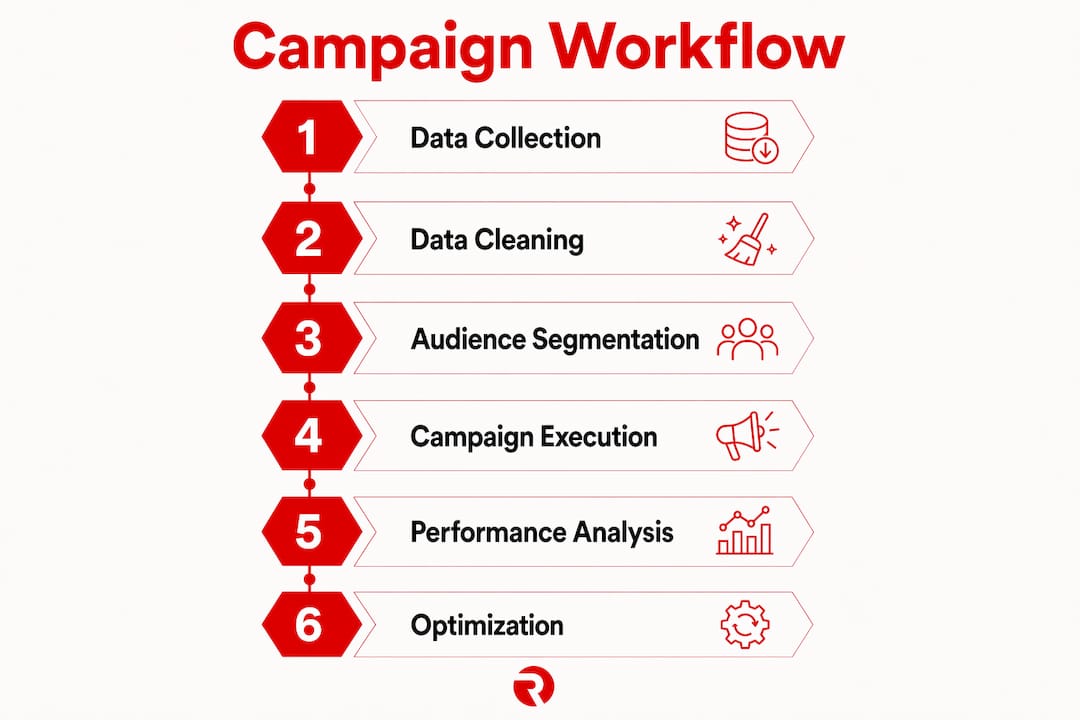
A well-designed workflow moves through six distinct stages. Each stage has a clear input, a defined output, and a named owner. Skipping stages or merging them without governance rules produces the inconsistent outputs that undermine campaign performance.
The six core stages
-
Campaign briefing. Define the objective, target audience, budget, and success metrics before any creative work begins. The brief must reference specific data segments, not broad demographic assumptions.
-
Data segmentation. Pull audience segments from your SSOT using pre-agreed criteria. Segments should be validated against recent behavioural data, not built from static lists. This is where real-time data feeds become critical.
-
Creative development. Build creative assets against the brief and the segment profile. Each creative variant should map to a specific audience hypothesis, which sets up the A/B testing stage cleanly.
-
Approval and governance. Route assets through a defined approval chain before deployment. Governance layers with approval rules and human review distinguish successful data-driven marketing teams from those that automate without oversight.
-
Deployment and automation. Use your campaign execution platform to schedule and trigger delivery based on audience behaviour or time rules. Automation accelerates execution, but the rules governing it must be set by humans.
-
Monitoring and iteration. Track performance against the metrics defined in the brief. Flag underperforming variants within 48 hours and feed findings back into the next briefing cycle.
The comparison below shows how a governed workflow differs from an ungoverned one across key operational dimensions.
| Dimension | Governed workflow | Ungoverned workflow |
|---|---|---|
| Data source | Single centralised SSOT | Multiple disconnected systems |
| Approval process | Defined chain with sign-off records | Ad hoc, verbal, or skipped |
| Creative variants | Mapped to audience hypotheses | Built on instinct or convention |
| Performance review | Scheduled, metric-driven | Reactive, anecdotal |
| Iteration speed | Structured and repeatable | Slow and inconsistent |
Automation works best when it handles repetitive, rules-based tasks: scheduling, audience matching, trigger-based sends, and reporting aggregation. Human oversight remains essential for brand voice decisions, creative judgement, and escalation when data signals are ambiguous.
Pro Tip: Use a marketing automation checklist to map every workflow stage before you configure any platform. Teams that document the process first and build the technology second make far fewer integration errors.
How do you use campaign performance analytics to scale what works?
Measuring campaign success requires tracking the right metrics at the right frequency. Vanity metrics such as impressions and follower counts tell you very little about business impact. The metrics that matter are conversion rate by segment, cost per acquisition, revenue attributed per channel, and engagement rate relative to audience size.
The scaling problem is more common than most marketing teams admit. Only 20% of marketing teams report high-impact results from A/B tests, and 77% of winning experiments fail to scale due to data quality and integration issues. Winning a test in a controlled environment does not guarantee that the same result holds across a broader audience or a different channel.
Real-time data changes this equation significantly. Teams using real-time customer data are more than twice as likely to achieve high-impact experimentation results. Real-time context allows teams to adapt mid-campaign rather than waiting for a post-mortem report to reveal what went wrong.
Key metrics to track across every campaign:
- Conversion rate by segment: shows which audiences respond and which do not
- Cost per acquisition (CPA): the clearest measure of marketing ROI measurement efficiency
- Channel attribution: reveals which touchpoints drive decisions, not just clicks
- Engagement rate: measures relevance of the creative to the audience receiving it
- Test velocity: how quickly you run, measure, and act on experiments
AI-powered optimisation tools now assist with bid management, audience expansion, and creative performance scoring. 36% of marketers identify A/B testing and real-time optimisation as their primary AI opportunity in 2026. That figure reflects a shift from using AI for content generation toward using it for decision support in live campaigns.
What are the most common mistakes in data-driven campaign workflows?
The most damaging mistake is treating data quality as a problem to solve later. 58% of marketers spend significant time on experimentation, but only 20% see high impact. The gap between effort and outcome almost always traces back to poor data or broken processes, not a lack of creativity or budget.
Common failure points include:
- Siloed data systems that prevent a unified view of the customer journey
- Missing consent records that invalidate audience segments under UK GDPR
- Undefined approval chains that allow inconsistent or off-brand creative to reach audiences
- Over-reliance on automation without human checks on output quality
- No feedback loop between campaign results and the next briefing cycle
“Governance layers with clearly defined approval rules and human checks around automated outputs prevent inconsistent marketing messaging and brand voice erosion. Successful teams embed these layers as operational infrastructure, not as a reaction to problems.” Digital Marketing Teams Using AI in Real Businesses
Data hygiene is an ongoing discipline, not a one-time project. Assign a named owner to data quality. Schedule quarterly audits of your audience segments. Archive or delete records that fall outside your consent and retention policies. These habits prevent the slow degradation of data quality that eventually makes your workflow unreliable.
Resource constraints are real, particularly for smaller marketing teams. The answer is not to skip governance but to simplify it. A two-step approval process with a shared checklist is better than no process at all. Build the minimum viable governance layer first, then add complexity as your team and data maturity grow.
Key takeaways
A data-driven campaign workflow succeeds when clean, centralised data, defined governance, and real-time measurement work together as a single operational system.
| Point | Details |
|---|---|
| Centralise your data first | Build a single source of truth before introducing automation or AI tools. |
| Govern every stage | Define approval chains and ownership at each workflow stage to protect brand consistency. |
| Use real-time data | Teams with real-time context are more than twice as likely to achieve high-impact results. |
| Measure the right metrics | Track conversion rate, CPA, and channel attribution rather than impressions or follower counts. |
| Treat data hygiene as ongoing | Schedule quarterly audits and assign named ownership to data quality maintenance. |
Why governance is the part most teams skip
I have worked with marketing teams that had excellent tools, generous budgets, and talented people, yet still produced inconsistent campaigns. The common thread was always the same: no governance layer. Everyone assumed someone else was checking the data, approving the creative, and validating the audience segment. Nobody was.
The instinct is to focus on the technology. Platforms are visible, demonstrable, and easy to justify in a budget conversation. Governance is invisible until it fails. That asymmetry means teams invest in automation before they have defined what the automation is allowed to do. The result is fast, consistent production of the wrong output.
What I have found actually works is treating the workflow document as the primary asset, not the platform. Write down every stage, every owner, and every approval rule before you configure a single integration. Then build the technology around the process, not the other way around. Teams that do this produce campaigns that scale. Teams that skip it spend their time firefighting.
The other lesson is that real-time data is not a luxury for enterprise teams. Even a modest real-time feed from your website or app changes the quality of decisions you can make mid-campaign. The data-driven marketing strategies that consistently outperform are the ones that treat live signals as inputs, not as post-campaign reports.
— Bart
How Radkaadvertising supports data-driven campaign execution
Radkaadvertising works with brands at every stage of campaign workflow design, from data audit and SSOT architecture through to creative governance and real-time performance measurement. The agency’s campaign case studies span sectors including FMCG, energy, and beauty, demonstrating measurable ROI improvements across multi-channel programmes. For marketing professionals and business owners who want a workflow that scales without breaking, Radkaadvertising provides the operational infrastructure and creative expertise to build it correctly from the start. Explore the full range of digital marketing services to see how the agency approaches campaign analytics and automation for brands competing in international markets.
FAQ
What is a data-driven campaign workflow?
A data-driven campaign workflow is a structured marketing process that uses customer data, analytics, and automation to plan, execute, and measure campaigns. It replaces instinct-led decisions with evidence at every stage, from audience segmentation through to post-campaign reporting.
Why do most A/B tests fail to scale?
77% of winning A/B tests fail to scale due to data quality and integration issues. A test that succeeds in a controlled segment often breaks down when applied to a broader audience with inconsistent or incomplete data.
What metrics should I track to measure campaign success?
The most reliable metrics are conversion rate by segment, cost per acquisition, channel attribution, and engagement rate relative to audience size. Impressions and follower counts do not indicate business impact.
How does real-time data improve campaign performance?
Teams using real-time customer data context are more than twice as likely to achieve high-impact experimentation results. Real-time signals allow mid-campaign adjustments rather than waiting for post-mortem analysis.
What is the biggest risk in automating a campaign workflow?
The biggest risk is automating before governance is in place. Without defined approval rules and human oversight, automation produces inconsistent or off-brand outputs at scale, which is harder to correct than a single manual error.