CPM ads explained: when to use them and how to cut costs

A CPM ad charges you for every 1,000 times it is shown, regardless of whether anyone clicks. The formula is straightforward: CPM = (total cost ÷ total impressions) × 1,000. Spend £500 on a campaign that delivers 200,000 impressions and your CPM is £2.50. That single figure tells you exactly what each thousand eyeballs cost. As Wikipedia’s definition of cost per mille confirms, CPM functions both as a pricing model (how publishers charge) and as a benchmarking metric (how advertisers compare buys across channels).
Choose CPM when your goal is reach and brand awareness, not immediate clicks. It is the natural home of top-of-funnel campaigns: product launches, brand repositioning, and any situation where you need a large audience to recognise your name before they are ready to buy.
At a glance:
- CPM = cost per 1,000 impressions; “mille” is Latin for thousand
- Formula: (total cost ÷ total impressions) × 1,000
- Best for: brand awareness, reach, and top-of-funnel presence
- Key variants: eCPM (effective CPM) and vCPM (viewable CPM)
- Watch for: ad fraud, low viewability, and frequency fatigue
Key takeaways
CPM advertising is most effective when paired with strong creative, viewability enforcement, and a clear measurement plan from day one.
| Point | Details |
|---|---|
| CPM definition | Cost per 1,000 impressions; use it for brand awareness and top-of-funnel reach. |
| Calculate CPM fast | Divide total cost by total impressions, then multiply by 1,000. |
| eCPM for comparison | Multiply CPC by CTR, then multiply by 1,000 to normalise any buy into CPM terms. |
| CPM vs CPC vs CPA | CPM for reach, CPC for traffic, CPA for conversions; hybrid sequencing works best. |
| Radkaadvertising | Full-service CPM campaign management: audience strategy, creative, buying, and cross-channel measurement. |
Table of Contents
- How do you calculate CPM and eCPM?
- What are eCPM, vCPM, and related metrics?
- CPM vs CPC vs CPA: which model fits your campaign?
- What counts as a good CPM by channel?
- How do you lower CPM and improve ad efficiency?
- Measurement pitfalls: viewability, fraud, and frequency fatigue
- How a full-service agency builds a CPM-first awareness campaign
- The honest truth about when CPM campaigns actually win
- Run CPM campaigns that actually build your brand
- Sources
- FAQ
How do you calculate CPM and eCPM?
The arithmetic is simple. What trips people up is knowing which numbers to plug in.
Step-by-step CPM calculation:
- Define total cost. This is the gross amount spent on the placement or campaign, before any agency fees unless you are measuring all-in efficiency.
- Define total impressions. Use served impressions (the number the ad server recorded as delivered) unless your platform reports viewable impressions separately.
- Apply the formula. Divide total cost by total impressions, then multiply by 1,000.
Worked example: A display campaign costs £1,200 and records 480,000 served impressions.
CPM = (£1,200 ÷ 480,000) × 1,000 = £2.50
Shopify’s CPM marketing guide uses the same arithmetic and notes that the ×1,000 step exists purely because individual impression costs would otherwise be fractions of a penny — too small to be useful in a media plan.
Calculating eCPM (effective CPM):
eCPM converts a non-CPM buy into CPM terms so you can compare it fairly. As Investopedia explains, the standard conversion is:
eCPM = (CPC × CTR) × 1,000
Example: a CPC campaign with a given cost-per-click and click-through rate produces an eCPM calculated by multiplying CPC by CTR and then by 1,000, giving an equivalent CPM figure. That tells you the CPC buy is costing the equivalent of £6 per thousand impressions — useful when comparing it against a direct CPM offer.
A note on served vs viewable impressions: served impressions count every ad the server dispatched; viewable impressions count only those that actually appeared on screen. The gap between the two can be significant, which is why eCPM calculated on viewable impressions alone gives a truer picture of what you are actually paying for.
What are eCPM, vCPM, and related metrics?
Three terms appear constantly in platform dashboards and media proposals. Knowing the difference keeps you from misreading a report.
- eCPM (effective CPM): A normalisation tool. It converts any pricing model — CPC, flat-fee sponsorship, influencer deal — into a CPM-equivalent so you can rank buys by cost efficiency. A creator charged a flat £2,000 fee who delivers 300,000 views has an eCPM of £6.67. Analytics tools that apply eCPM logic across offline channels use the same principle to compare print and digital spend on equal terms.
- vCPM (viewable CPM): A bid type where you pay only for impressions that meet the IAB viewability standard: at least 50% of the ad’s pixels visible for a minimum of one continuous second (two seconds for video). Because the inventory is filtered, vCPM rates are typically higher than standard CPM rates — but you are buying confirmed exposure, not just delivery.
- Impressions vs viewable impressions vs served impressions: Served = dispatched by the ad server. Viewable = confirmed on screen per IAB criteria. The delta between served and viewable is wasted spend on ads nobody saw.
Why vCPM bids run higher: When a platform guarantees viewability, it excludes below-the-fold and fast-scroll inventory. Less inventory available means higher clearing prices. For brand-awareness campaigns where the goal is genuine exposure, paying a premium for vCPM is often the more efficient choice — you are not funding impressions that never rendered.
Quick conversions between CPM, CPC and effective CPC using CTR:
- Effective CPC from CPM: CPM ÷ (CTR × 10) — e.g. a £5 CPM at 0.5% CTR = £1.00 effective CPC
- eCPM from CPC: (CPC × CTR) × 1,000 — as shown in the calculation section above
CPM vs CPC vs CPA: which model fits your campaign?
The one-sentence rule: use CPM for awareness and reach, CPC for traffic and clicks, CPA for conversions and revenue. Criteo’s comparison of CPC and CPM frames it the same way, noting that platforms commonly let you switch between models and that marketers frequently use CPM at the top of the funnel before shifting to CPC or CPA as intent builds.
Decision checklist:
- Campaign goal: awareness → CPM; traffic → CPC; sales → CPA
- Funnel stage: top (cold audience) → CPM; mid/bottom (warm, retargeting) → CPC or CPA
- Expected CTR: if your creative reliably pulls above 0.5–1%, CPM can be cheaper per click than CPC
- Measurement capability: CPM requires viewability and lift measurement to prove value; CPC and CPA are self-evidencing
Breakeven math: divide your CPM by (CTR × 10) to find the effective CPC your CPM buy is producing. If that number is lower than the CPC you would pay on a click-based buy, CPM is the better deal for traffic too.
Hybrid strategy: Shopify’s CPM guide recommends using CPM to build consistent top-of-funnel presence, then layering CPC-based retargeting to convert the audiences you have already reached. Run CPM for reach, capture who engaged, then retarget with CPC. The two models are not rivals — they are sequential.
Pro Tip: Run a 3–5 day test at launch with CPM, record your CTR, then compute your effective CPC. Hubfluence’s CPM vs CPC analysis recommends exactly this window to gather enough data to calculate the breakeven point and decide whether to stay on CPM or switch to CPC bidding.
What counts as a good CPM by channel?
“Good” is always relative to your audience, placement, and goal. CPMs vary because different inventory carries different audience value: a niche B2B LinkedIn audience costs far more per thousand than a broad run-of-network display placement, and rightly so. Seasonality matters too — Q4 demand from retail advertisers pushes CPMs up across almost every channel.
Typical CPM ranges by channel (indicative; actual rates vary by audience, geography, and bid competition):
| Channel | Typical CPM range | Notes |
|---|---|---|
| Display (run of network) | £2.50–£3.00 | Highly variable; quality inventory costs more |
| Social (Facebook/Instagram) | £6.00–£12.00 | Audience targeting drives cost up |
| Video (pre-roll, YouTube) | £6.00–£20.00 | Skippable vs non-skippable affects rate |
| £20.00–£30.00 | Premium B2B audience; high intent | |
| Native advertising | £3.00–£6.00 | Context-dependent; editorial placements cost more |
| Email newsletter sponsorship | £20.00–£30.00 | Niche lists with high engagement command a premium |
Google Ads cost guidance for local businesses illustrates how platform defaults and audience targeting layers push costs up from base rates — useful context when setting initial bids.
How audience segmentation shifts CPM:
- Custom audiences (your own CRM data) typically cost more to reach but convert better
- Lookalike audiences sit between broad and custom in both cost and performance
- Interest and behavioural layers add cost; each additional layer narrows inventory and raises CPM
- Geographic targeting: tier-one cities and English-speaking markets carry higher CPMs than emerging markets
A CPM that looks expensive in isolation may be cheap per qualified impression. Always evaluate CPM in the context of who you are reaching, not just what you are paying.
How do you lower CPM and improve ad efficiency?
Reducing CPM is not just about cutting bids. The most durable gains come from making your creative more relevant, your targeting more precise, and your inventory choices smarter.
Targeting and audience tactics:
- Build lookalike audiences from your highest-value customers, not your full list
- Exclude recent purchasers and current customers from awareness campaigns
- Layer contextual targeting on top of behavioural to reach intent signals without relying solely on cookie data
- Test private marketplace (PMP) deals for premium inventory at negotiated rates — often cheaper than open-auction equivalents for the same placement
Creative optimisation:
- Shorter video formats (6-second bumpers) tend to clear at lower CPMs than 30-second pre-rolls
- High relevance scores on Meta and Quality Scores on Google reduce auction costs directly
- Rotate at least three creative variants per ad group to avoid fatigue driving up frequency costs
- Test static vs animated vs video within the same audience before scaling spend
Bidding and pacing:
- Use dayparting to concentrate spend in hours when your audience is most active and competition is lower
- Set bid caps on CPM campaigns to prevent runaway auction costs during peak demand periods
- Avoid accelerated delivery — standard pacing spreads budget more evenly and typically produces lower average CPMs
Pro Tip: Frequency capping is one of the most overlooked CPM levers. Once a user has seen an ad 5–7 times without acting, additional impressions rarely convert and actively raise your effective cost-per-result. Cap frequency at the campaign or ad-set level and redirect that budget to fresh audiences.
Measurement pitfalls: viewability, fraud, and frequency fatigue
Raw impression counts are not the same as real exposure. Investopedia’s CPM overview flags this directly: CPM is vulnerable to duplicate view counting, bot traffic, and ad fraud — all of which inflate impression numbers without delivering genuine reach.
Common measurement traps:
- Served ≠ viewable: An ad dispatched by the server may load below the fold and never enter the user’s viewport. Without viewability filtering, you are paying for impressions nobody saw.
- Ad fraud patterns: Invalid traffic (IVT) includes bot-generated impressions, click farms, and domain spoofing. Programmatic open-auction inventory carries higher fraud risk than direct or PMP buys.
- Counting inflation: Ad refresh (auto-refreshing ad slots) and lazy-load misconfiguration can multiply impression counts without multiplying real exposure.
- Frequency fatigue: Showing the same ad to the same person too many times raises CPM (as the algorithm exhausts cheap inventory) and damages brand perception simultaneously.
The IAB viewability standard sets a clear floor: at least 50% of display ad pixels must be visible for one continuous second; for video, two seconds. Campaigns measured against this standard produce impression counts that actually reflect human exposure. Insisting on viewability-filtered reporting is not optional for any serious awareness campaign — it is the baseline for knowing whether your media plan is working.
Mitigations worth building into every CPM campaign:
- Apply viewability targeting at the campaign level (available on Google Display Network, DV360, and Meta)
- Use a third-party verification vendor to audit impression quality independently of the platform’s own reporting
- Set frequency caps at the ad-set or line-item level before launch, not after you notice fatigue
- Reconcile platform-reported impressions against your verification vendor’s numbers monthly; gaps above 10–15% warrant investigation
How a full-service agency builds a CPM-first awareness campaign
A well-structured CPM campaign looks nothing like a boosted post. Here is how an agency-level brief translates into a measurable awareness push.
Campaign brief structure:
- Objectives: Define primary KPI (viewable impressions, reach, brand-lift score) and secondary KPIs (CTR, video completion rate, frequency per user).
- Target audiences: Build three tiers — broad awareness (interest/contextual), mid-funnel (lookalike), and suppression list (existing customers). Each tier gets its own creative and bid strategy.
- Budget allocation: Typically weight 60–70% toward the broad awareness tier at launch, shifting budget toward better-performing segments after the first week of data.
- Creative production: Develop at least three variants per format (static, video, native). Brief creative against the audience insight, not just the brand guidelines.
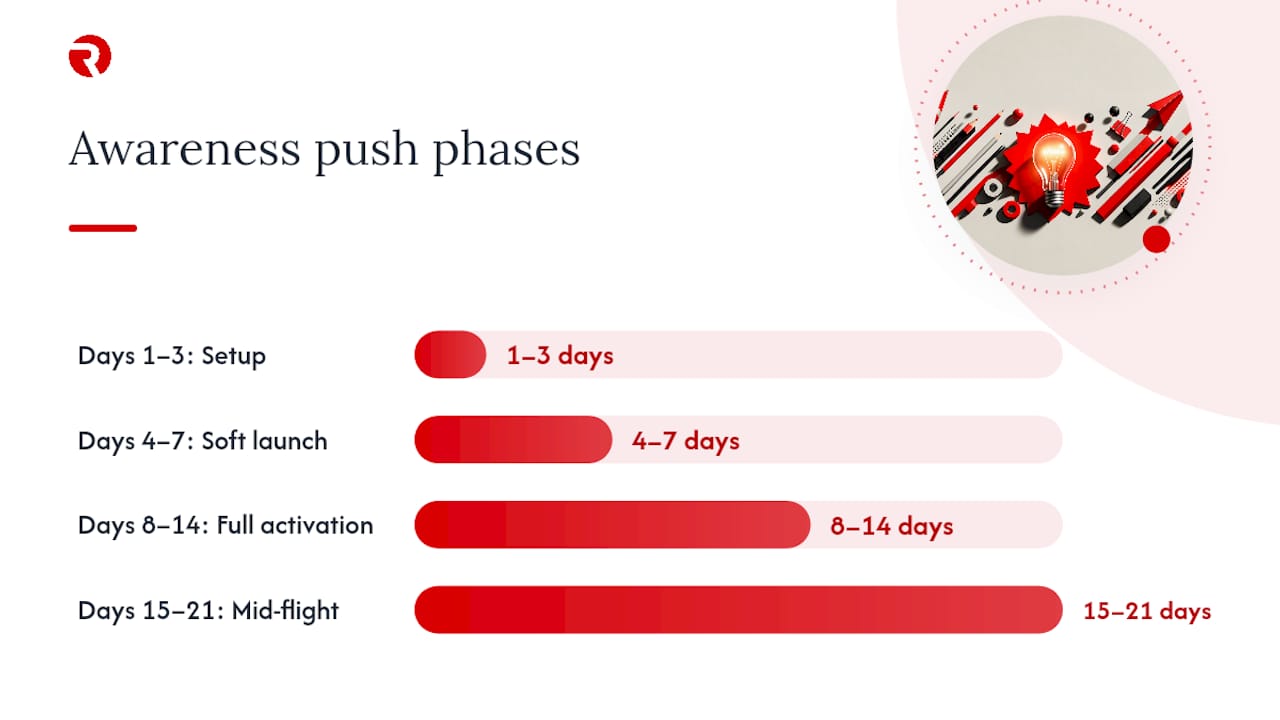
Sample timeline for an awareness push:
- Days 1–3: Creative QA, pixel verification, audience upload, and campaign structure build.
- Days 4–7: Soft launch at reduced budget. Monitor delivery pacing, viewability rate, and frequency.
- Days 8–14: Full budget activation. A/B test creative variants; pause underperformers.
- Days 15–21: Mid-flight optimisation. Adjust bids, refresh creative if frequency exceeds cap, expand or tighten audiences based on CTR data.
- Day 28+: End-of-flight analysis. Pull viewable impression rate, reach, CTR, and any brand-lift data. Compute eCPM across all placements for cross-channel comparison.
Measurement checklist:
- Total impressions and viewable impressions (viewability rate target: 70%+)
- Unique reach and average frequency per user
- CTR by creative variant and placement
- Brand-lift survey results (awareness, recall, consideration) where budget allows
- Cross-channel eCPM comparison to normalise digital and any offline placements
Where an agency adds the most value is not in the buying itself — it is in audience engineering (building the right tiers and suppression logic), creative strategy (ensuring the ad earns attention before asking for it), and measurement architecture (setting up the tracking before spend goes live, not after). Radkaadvertising’s client case studies document this end-to-end approach across brand categories from FMCG to energy.
The honest truth about when CPM campaigns actually win
CPM advertising is genuinely powerful for building brand salience at scale. When the creative is strong, the audience is right, and viewability is enforced, a CPM campaign can shift brand metrics that no CPC campaign ever touches. That is its real job.

The mistakes I see most often are not strategic — they are operational. Brands launch CPM campaigns with a single creative asset and no frequency cap, then wonder why performance degrades after week two. The creative fatigues, the algorithm exhausts cheap inventory, and CPM climbs while results fall. The fix is not a bigger budget; it is three creative variants and a frequency cap set before day one.
The second common error is skipping lift measurement. CPM campaigns do not produce clicks you can count in a dashboard. If you are not running a brand-lift study or a holdout test, you are flying blind on whether the campaign actually moved awareness. That is not a reason to avoid CPM — it is a reason to build measurement in from the brief stage.
My honest recommendation: treat the first 3–5 days of any CPM launch as a data-collection window. Measure CTR, compute your effective CPC, and compare it against what you would pay on a CPC buy. That single calculation tells you whether to stay on CPM or shift budget. Do not skip it.
Run CPM campaigns that actually build your brand
Knowing the formula is one thing. Building a campaign that delivers measurable brand growth is another. Radkaadvertising is a London-based full-service agency that designs CPM-first awareness campaigns from brief to measurement: audience strategy, creative production, paid-media buying across Meta and Google, and cross-channel analytics that translate impressions into business outcomes.
Where most agencies stop at delivery, we track viewable impressions, run frequency controls, and compute eCPM across every placement so you always know what your reach is actually costing. No guesswork, no inflated impression counts passed off as results.
If you are ready to put CPM to work for your brand, explore our services or see how we have done it for other brands.
Sources
The following references informed this guide and are worth bookmarking for deeper reading:
- Cost per mille
- Understanding Cost per Thousand (CPM) in Digital Marketing Metrics
- Why print campaigns need analytics to prove ROI | QRlytics Blog
FAQ
What is a CPM ad?
A CPM ad is one where the advertiser pays per 1,000 impressions rather than per click or conversion. “CPM” stands for cost per mille, with “mille” being Latin for thousand.
What does CPM stand for in advertising?
CPM stands for cost per mille, meaning cost per thousand impressions. It is the standard pricing and measurement unit across display, video, social, and native advertising.
Is CPM calculated per 1,000 views?
Yes. CPM is the cost for every 1,000 times an ad is shown (impressions). Divide your total spend by total impressions and multiply by 1,000 to get your CPM figure.
What is a good CPM for an ad?
It depends on the channel and audience. Display CPMs can sit below £3.00, while LinkedIn B2B placements often exceed £20.00. A “good” CPM is one that delivers your target audience at a cost that makes the campaign profitable relative to your conversion rate and customer value.
When should you use CPM instead of CPC?
Use CPM when your goal is brand awareness and reach rather than immediate clicks. If your creative pulls a strong CTR, CPM can also produce a lower effective cost-per-click than a direct CPC buy, making it worth computing the breakeven before committing to either model.