3 Priorities That Make Construction Marketing Credibility First in 2026

Three priorities separate construction firms that win tenders from those chasing them: a website that proves delivery rather than describes it, service and sector pages targeted at exactly what buyers search for, and case studies backed by fast, disciplined follow-up. Get those three right and enquiries shrink in number but rise in quality, filling your pipeline with prospects who already half-believe you can do the job. Everything else, from social media to paid search, works better once this foundation is solid.
TL;DR:
- Targeting specific sectors and services with dedicated pages increases conversion rates compared to generic content, especially if pages reflect buyers’ procurement language.
- Mobile site speed and responsive design are essential for visibility, as most construction inquiries now come from smartphones, and slow-loading pages reduce chance of contact.
- Case studies should clearly outline client problems, your role, measurable outcomes, and safety results to meet pre-qualification standards, not just promotional hype.
- LinkedIn remains the most effective social platform for reaching construction decision-makers, with consistent posting of project updates and technical insights building authority.
- Paid search campaigns succeed mainly in immediate demand scenarios and must direct visitors to highly tailored landing pages that precisely match their search queries.
Table of Contents
- Make your website a commercial asset: proof, sector pages and project content
- What SEO tactics actually produce qualified construction leads?
- How do case studies and accreditations make you tender-ready?
- Which social platforms actually reach construction buyers?
- When should construction firms use paid search?
- Which CRM and follow-up systems shorten long sales cycles?
- How do directories and reviews influence who gets shortlisted?
- What should a 60 to 90 day construction marketing plan look like?
- What metrics actually prove your construction marketing works?
- How does an agency actually execute this strategy?
- A practitioner’s honest take on construction marketing
- Turn this plan into a managed programme
- Sources
- FAQ
Make your website a commercial asset: proof, sector pages and project content
A construction website’s job is not to look impressive. It is to prove you have done the work before, under the conditions this buyer cares about. A professional website with clear project pages and up-to-date contact details remains the single biggest driver of qualified enquiries, and most contractor sites fall short because they describe capability in adjectives instead of evidence.
Each project page needs specifics: scope, contract value, programme length, your firm’s exact role (main contractor, subcontractor, design and build), a measurable outcome, and ideally a short client quote naming the result. Sector pages should speak procurement language, not marketing copy. A page targeting healthcare fit-out work should reference infection control compliance and phased occupation, because that is what a facilities manager actually searches for.
- Structure sector pages around the buyer’s job title and their compliance concerns, not your service categories.
- Use schema markup for projects and organisations so search engines can surface your credentials directly in results.
- Run every page through a mobile performance check; procurement teams increasingly browse and shortlist from a phone between site visits.
- Fix contact funnels so a quote request takes under 90 seconds, and wire up conversion tracking from day one.
Pro Tip: Photograph completed projects the day handover happens, not months later when the client has moved furniture in and the site looks nothing like your finished work.
What SEO tactics actually produce qualified construction leads?
Search visibility only pays off when it attracts buyers who are ready to shortlist, not homeowners browsing for a quick quote. That starts with mapping keywords to specific services and sectors rather than generic terms like “construction company.” A page built around “design and build contractor for care homes” will convert better than one chasing “construction services” because it mirrors the language in a PQQ.
Technical groundwork matters just as much as content. Mobile devices account for the majority of website traffic across most sectors, so site speed and responsive design are not optional extras, they are the baseline. Sector-focused content and dedicated service pages consistently outperform generic pages for organic enquiries because they match commercial intent rather than curiosity.
- Map every core service and sector combination to its own page, using the exact phrasing buyers type into search.
- Prioritise mobile-first design, sub-two-second load times and clean canonicalisation to stop duplicate pages competing against each other.
- Add project and organisation schema so rich results show accreditations and completed work.
- For firms taking local commercial work, optimise your Google Business Profile with categories, service areas and recent project photos.
A full SEO audit will flag most of these gaps in a single pass, which matters when your team’s time is better spent on-site than untangling technical debt.
How do case studies and accreditations make you tender-ready?
Sector commentary is blunt on this point: construction marketing now gets judged against pre-qualification readiness, meaning evidence and compliance now outrank promotional messaging. A polished website with no proof behind it is filtered out before a human ever reads your pitch.
Build case studies to a consistent template:
- State the client’s problem and constraints in one sentence.
- Describe your scope and specific role on the project.
- Quantify the value delivered, cost saved, or programme time reduced.
- Note safety and compliance outcomes, since these often decide PQQ scoring.
- Close with a short client testimonial naming the result, not just the relationship.
Capability documents should map directly onto common PQQ questions, so procurement teams can lift answers straight from your materials. Display accreditations like Constructionline, CHAS and Chartered Institute of Building (CIOB) membership prominently, but state exactly what each one certifies rather than implying blanket competence.
Pro Tip: Keep one master capability document updated quarterly, then tailor a two-page summary for each tender instead of rebuilding from scratch every time.
A case study example shows how this structure looks when it is done properly, with measurable outcomes attached to every project.
Which social platforms actually reach construction buyers?
LinkedIn is where commercial decisions get made in construction, and it should absorb most of your social media time. Specifiers, facilities managers and main contractors research subcontractors there before shortlisting, and a well-maintained company page with regular project updates does more for credibility than any amount of paid promotion elsewhere.
Instagram still earns its place for visually rich residential or fit-out work where the finished result sells itself. TikTok, meanwhile, has become surprisingly effective for recruitment and apprentice-focused content, giving firms a way to show culture and career paths to a younger audience that ignores traditional job adverts entirely.
- Optimise decision-makers’ personal LinkedIn profiles alongside the company page; buyers often check the individual before the business.
- Post site walkthroughs, short technical explainers and employee features rather than static logo graphics.
- Repurpose completed case studies into short outreach messages when contacting new prospects directly.
- Build a weekly routine: one project update, one technical or safety insight, one team or culture post.
Consistency beats frequency here. A firm posting twice a week for a year builds more authority than one that posts daily for a month and then goes quiet.
When should construction firms use paid search?
Pay-per-click works best for construction when demand is immediate and specific, an emergency repair service, a location-based trade shortage or a seasonal spike like storm damage repairs. It works poorly for long, relationship-driven tenders where no amount of ad spend shortens a six-month procurement cycle.
Every paid click needs a landing page that matches the ad’s exact promise. Send someone searching “emergency roof repair Manchester” to a generic homepage and you have wasted the click.
- Match landing page headlines word-for-word to the ad copy and search term.
- Show proof above the fold: a completed project, a review score, an accreditation badge.
- Offer more than one contact route: phone number, short form, and a call-back request for those who won’t fill in forms.
- Strip unnecessary fields from lead forms; every extra field measurably reduces completion rates.
AI tools can speed up bid management and reporting, but leave creative decisions and conversion signal review to someone who understands the sector. Automation optimises bids well; it does not know whether a lead is actually a good commercial fit.
Which CRM and follow-up systems shorten long sales cycles?
Construction sales cycles run for months, sometimes years, which means the businesses that win are usually the ones that never let a lead go cold. A basic CRM with pipeline stages, task reminders and simple automated nudges closes far more of this gap than most owners expect.
- Acknowledge every enquiry within an hour, even if it is a holding message confirming you have received it.
- Ask two or three qualification questions early to sort genuine opportunities from tyre-kickers.
- Set a nurture cadence, useful content and project updates, so cold leads warm back up over months rather than disappearing.
- Track response time and conversion rate by source monthly, and fix whichever step is leaking the most opportunities.
Most firms lose deals not to competitors but to their own delayed replies.
How do directories and reviews influence who gets shortlisted?
Industry directories and review platforms significantly shape trust and discoverability for construction firms, particularly Constructionline and Google Business Profile, which procurement teams check almost by default before shortlisting.
- Keep your profile on every relevant directory accurate, especially services offered, coverage area and accreditation status.
- Ask satisfied clients for a review immediately after project sign-off, when the result is still fresh in their mind.
- Respond to every review, positive or negative, since an unanswered negative review reads worse than the review itself.
A thin or outdated directory presence quietly costs you shortlist places you never even hear about.
What should a 60 to 90 day construction marketing plan look like?
A short, sequenced plan, set targets, choose channels, fix follow-up, then measure, consistently outperforms scattershot activity across every channel at once.
- Days 1 to 30: Fix website proof points, set realistic enquiry and job targets, implement a CRM, and capture baseline metrics before changing anything else.
- Days 31 to 60: Switch on priority channels, core SEO fixes, targeted PPC for urgent demand, and structured LinkedIn outreach, while publishing one or two flagship case studies.
- Days 61 to 90: Review the KPIs against baseline, optimise whichever lead flow underperforms, reallocate budget toward what is working, and plan the next quarter’s priorities.
Pro Tip: Resist the urge to launch every channel in week one. A construction marketing plan sequenced over 90 days beats one attempted all at once, because you can actually tell what caused the improvement.
What metrics actually prove your construction marketing works?
Three numbers matter more than any dashboard full of vanity metrics: cost per lead, booked-job rate, and cost per job. A concise KPI set tied to booked work and margin is enough to judge performance, and cost per job is the decisive one, since a cheap lead that never converts is worth less than an expensive one that books reliably.
- Cost per lead: total spend on a channel divided by enquiries generated.
- Booked-job rate: the percentage of enquiries that convert to signed work, tracked over the full procurement timeline, not just the first month.
- Cost per job: total spend divided by jobs actually booked, the number that should drive every budget decision.
Attribute enquiries to their originating channel from the first contact, and review this monthly rather than quarterly given how slowly construction deals move through the pipeline.
How does an agency actually execute this strategy?
Turning this framework into results means building proof-first websites, producing capability packs that map to real PQQ questions, and measuring performance against booked work rather than vanity traffic numbers. Radkaadvertising structures campaigns around exactly this sequence for construction clients.
- SEO audits that fix mobile performance, schema and page structure before a single pound goes into paid media.
- Case study production that follows the problem, scope, value, outcome template procurement teams expect to see.
- AI-assisted content production to scale sector pages and project updates without losing technical accuracy.
Hire an agency when your team lacks the time to run this consistently, not because a single campaign underperformed. Success in six months looks like fewer, better-fit enquiries and a rising booked-job rate.
A practitioner’s honest take on construction marketing
The biggest mistake I see is firms treating marketing as a campaign rather than a system. A steady monthly programme, however modest, consistently outperforms an expensive quarterly burst because procurement teams reward firms who show up reliably over months, not ones who suddenly appear before a tender deadline.
— Bart
Turn this plan into a managed programme
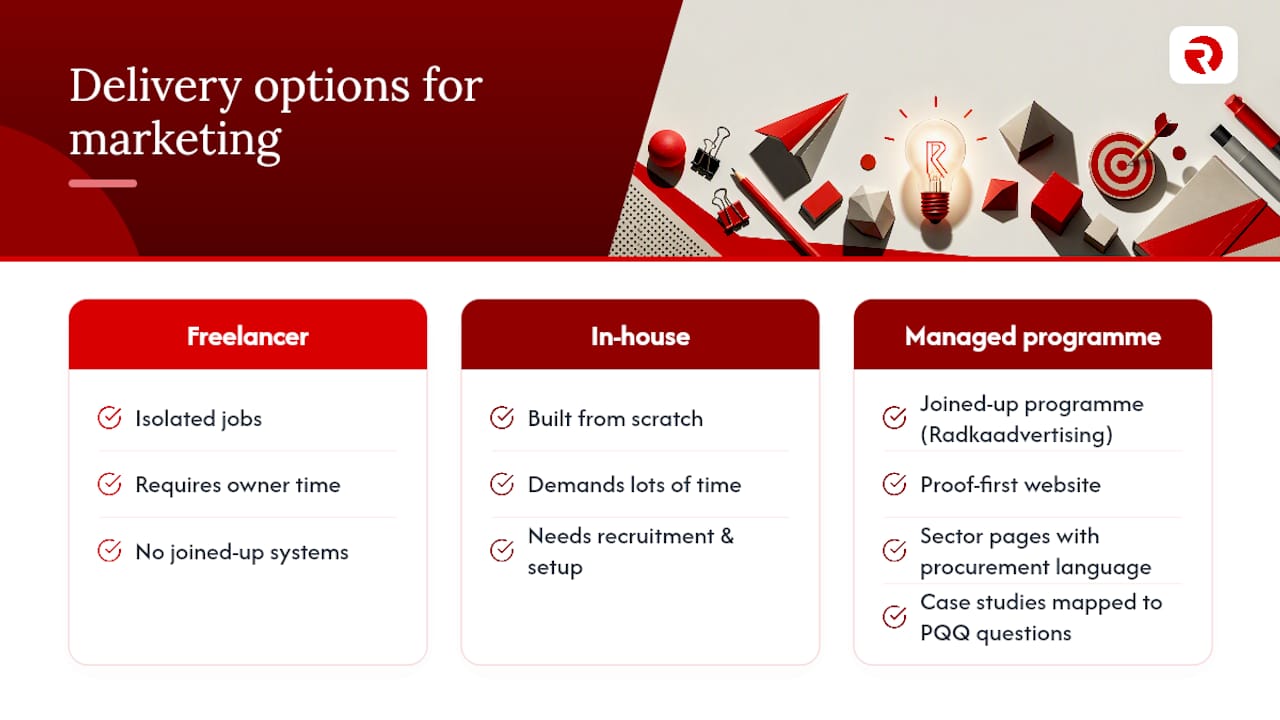
There are other routes here, hiring a freelancer for isolated jobs, or building an in-house marketing function from scratch, but both demand time most construction owners don’t have spare between live sites. Radkaadvertising runs this entire system as one joined-up programme: a proof-first website, sector pages built around procurement language, case studies that map to PQQ questions, and the follow-up systems that stop leads going cold, all measured against cost per job rather than clicks.
Start with an SEO audit to see exactly where your current site is losing qualified enquiries, or browse the full services range to see how brand, content and paid media fit together. If you are already generating decent traffic but struggling to turn it into booked work, that is usually a proof and follow-up problem, not a traffic one, and it is worth fixing before spending another pound on ads.
Sources
The CIOB’s practical guide covers foundational website and directory tactics. The 2026 Think Tank report explains the shift toward credibility-first marketing. Statista’s mobile traffic data supports the technical priorities above, and SMC’s 90-day plan offers a practical sequencing checklist worth bookmarking.
- Marketing strategies to grow your construction business
- Construction Marketing Insights for 2026
- Share of website traffic coming from mobile devices (Statista)
- The 2026 marketing plan every UK trades business needs
FAQ
What is the 3-3-3 rule for marketing?
The 3-3-3 rule suggests spending 3 minutes evaluating a marketing idea, 3 hours testing it, and 3 days validating results before committing further budget, a useful discipline for construction firms testing new channels without overcommitting.
What are the 5 main marketing strategies for construction firms?
The core strategies are a proof-led website, targeted SEO and sector pages, case studies and accreditations, LinkedIn-led social visibility, and disciplined email or CRM follow-up, exactly the priorities covered throughout this construction marketing strategy.
What is the 70/20/10 rule in marketing?
It allocates 70% of budget to proven channels, 20% to promising newer tactics, and 10% to experimental ideas, a sensible split for construction firms balancing reliable SEO investment against newer approaches like video or paid social.
What are the key performance indicators in construction marketing?
The three that matter most are cost per lead, booked-job rate, and cost per job, with cost per job being the figure that should ultimately guide budget decisions.
Should a construction firm hire an agency or handle marketing in-house?
An in-house approach can work if someone owns it consistently every month; an agency like Radkaadvertising makes more sense once the workload of SEO, content and case study production outpaces what your team can maintain alongside live projects.