Buying digital media: a practical UK guide for 2026

Buying digital media is the process of purchasing online advertising inventory and running it to a measurable business outcome. Your first move is always the same: define the single KPI your campaign must move before you touch a platform.
Get that right, and everything else follows. Here are the first three operational steps:
- Set your KPI — cost per acquisition (CPA), return on ad spend (ROAS), or cost per thousand impressions (CPM) depending on your objective.
- Confirm your tracking — pixels, conversion events, and UTM parameters must be live and validated before you spend a pound.
- Pick one or two channels — search for intent-driven demand, paid social for discovery and scale; add more only once you have baseline data.
Key takeaways
Buying digital media delivers measurable business outcomes when you start with a defined KPI, validated tracking, and a channel choice matched to your objective.
| Point | Details |
|---|---|
| Define KPI first | Set CPA, ROAS, or CPM target before touching any platform or allocating budget. |
| Validate tracking before spend | Pixels, UTM parameters, and conversion events must be live and tested before launch. |
| Understand true CPM costs | DSP fees, data costs, and verification stack on top of headline rates; calculate the real cost per result. |
| UK market scale | The UK digital ad market reached £40.5 billion in 2025; video and retail media are the fastest-growing formats. |
| Radkaadvertising | Offers full-service media buying, AI-driven optimisation, and transparent reporting for UK and international campaigns. |
Table of Contents
- What does buying digital media actually mean?
- Which channels should you prioritise when buying media?
- How does programmatic buying actually work?
- What pricing models and fees should you understand?
- How do you run a digital media campaign from brief to report?
- What metrics and attribution models should you use?
- What does the UK digital media market look like in 2026?
- Who does digital media buying, and should you hire or outsource?
- An agency view on when to DIY and when to call in the experts
- How Radkaadvertising can run your next campaign
- Sources
- FAQ
What does buying digital media actually mean?
Digital media buying is the purchase, placement, and ongoing optimisation of paid advertising across online channels. It sits downstream of media planning. Planning decides where and why — which audiences, which channels, which message. Buying executes the how: negotiating rates, setting up campaigns, launching creative, and steering spend based on live performance data.
That distinction matters operationally. Conflating the two leads to well-executed campaigns in the wrong places.
Traditional media buying — print, broadcast, out-of-home — involves long lead times, fixed placements, and upfront commitments measured in weeks. Digital buying can be adjusted in real time, with budgets shifted between channels the same day. You are not buying the media itself; you are purchasing access to an audience at a specific moment. The inventory belongs to the publisher or platform.
The platforms this guide covers span the full buying spectrum: Google Ads (search and display), YouTube (video inventory), Meta Ads (Facebook and Instagram), DV360 (Google Display & Video 360, a demand-side platform), The Trade Desk (independent DSP), and Amazon Ads (retail media). Each sits in a different part of the funnel and suits different buying approaches.
Which channels should you prioritise when buying media?
Channel choice flows from your objective. The table below maps each channel to its primary use case, typical buying method, and the platforms where you will actually execute.
| Channel | Best objective | Buying method | Key platforms |
|---|---|---|---|
| Paid search | Direct response, high-intent demand capture | Self-serve auction | Google Ads |
| Paid social | Awareness, consideration, retargeting | Self-serve auction | Meta Ads (Facebook & Instagram) |
| Programmatic display | Reach, retargeting, brand awareness | DSP (DV360, The Trade Desk) | Open exchange, PMPs |
| Online video / CTV | Brand awareness, mid-funnel storytelling | Self-serve or DSP | YouTube, DV360, The Trade Desk |
| Audio / podcast | Brand awareness, niche audience reach | Direct or DSP | Spotify Ads, programmatic audio |
| Retail media | On-site conversions, ROAS for product brands | Self-serve or managed | Amazon Ads, retailer networks |
A few channel-specific points worth knowing:
- Search targets people already looking for what you sell. Google Ads dominates UK search inventory. CPCs are higher than display, but conversion rates justify the premium for most direct-response campaigns.
- Paid social on Meta reaches audiences by interest, behaviour, and demographic. It is the most accessible entry point for SMEs because the self-serve interface requires no DSP contract.
- Programmatic display via DV360 or The Trade Desk gives you access to millions of publisher sites through a single interface. Scale is the advantage; brand safety requires active management.
- YouTube combines the targeting precision of Google Ads with the storytelling power of video. TrueView and non-skippable formats serve different funnel stages.
- Retail media on Amazon Ads is growing fast and delivers strong ROAS for brands sold through the retailer’s ecosystem, because ads appear at the point of purchase intent.
- Audio suits brands with strong verbal identity and audiences who commute or exercise. Spotify Ads offers self-serve access with granular playlist and mood targeting.
Pro Tip: Don’t spread budget across six channels in month one. Pick the channel that best matches your KPI, prove the model, then expand. A £5,000 monthly budget concentrated on one channel will outperform the same sum split six ways every time.
How does programmatic buying actually work?
Programmatic buying automates the purchase of digital ad inventory using software, data, and real-time auctions. The IAB UK’s industry report explains the full supply chain and why it has added both scale and complexity to the market.
The basic flow: an advertiser loads a campaign into a demand-side platform (DSP) such as DV360 or The Trade Desk. When a user loads a web page, the publisher’s supply-side platform (SSP) sends an auction request to an ad exchange. The DSP bids in milliseconds based on audience data and campaign parameters. The winning bid serves the ad. The whole process takes roughly 100 milliseconds.
There are three main buying modes:
- Open auction (RTB) — any buyer can bid. Highest volume, lowest CPMs, but least control over placement quality.
- Private marketplace (PMP) — a publisher invites selected buyers to bid on premium inventory before it reaches the open exchange. Better brand safety, higher CPMs.
- Preferred deals / programmatic direct — a fixed CPM agreed between buyer and publisher, with guaranteed or first-look access to specific inventory. Closest to a traditional direct buy, but with programmatic delivery.
The trade-off is transparency. Open auctions offer scale but limited visibility into exactly where your ad appeared. PMPs and direct deals cost more but give you the placement control that brand-sensitive campaigns require.
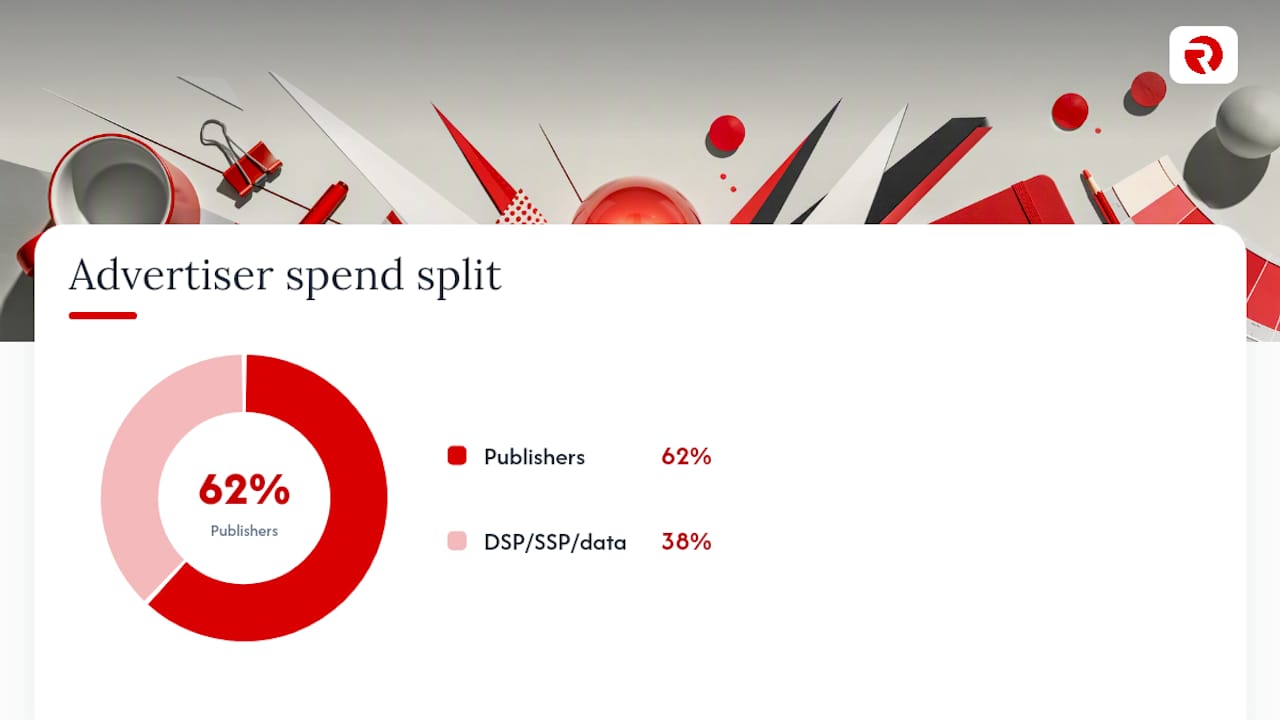
The DCMS/Plum report estimates that publishers receive roughly £0.62 of every pound of advertiser investment in display in an idealised open-exchange scenario. The remainder covers DSP fees, SSP fees, data costs, and ad verification. That fee leakage is why transparency clauses in insertion orders matter.
When does direct negotiation beat programmatic? For premium placements — homepage takeovers, bespoke sponsorships, editorial integrations — a direct conversation with the publisher’s sales team will get you inventory that never reaches an exchange, plus added-value elements like editorial mentions or social amplification.
Pro Tip: Always ask a publisher for a PMP deal before defaulting to the open exchange. You will often pay a similar CPM for meaningfully better inventory and viewability scores.
What pricing models and fees should you understand?
Pricing vocabulary is where many first-time buyers lose money. Here are the core models:
- CPM (cost per thousand impressions) — you pay per 1,000 times your ad is displayed. Standard for awareness campaigns and programmatic display.
- CPC (cost per click) — you pay only when someone clicks. Default for Google Ads search campaigns.
- CPA (cost per acquisition) — you pay per conversion. Often used as a target metric rather than a direct buying model.
- CPL (cost per lead) — a CPA variant where the conversion event is a form submission or sign-up.
- CPV (cost per view) — standard for video; a view is typically counted at 30 seconds or a full watch of shorter formats.
- Flat-rate / fixed buys — a fixed fee for a placement over a defined period. Common in direct publisher deals and sponsorships.
Fees stack. A £10 CPM on a DSP is not a £10 CPM to your business. Add DSP technology fees (typically 10–20% of media spend), SSP fees taken from the publisher side, data costs if you are using third-party audience segments, and ad verification costs (DoubleVerify, Integral Ad Science). The true cost per impression is higher than the headline rate.
Worked example: You negotiate a £5 CPM with a DSP. After a 15% DSP fee, third-party data at £2 CPM, and verification at £0.30 CPM, your true CPM is £8.05. Compare that to a Google Ads CPC of £2.50 for the same keyword and the display buy looks expensive for direct response, but potentially efficient for reach.
Negotiation points worth raising with any publisher or platform:
- Volume discounts for committing to a quarterly or annual spend.
- Added-value placements (run-of-site impressions, social posts, newsletter mentions) in exchange for a higher guaranteed spend.
- Reporting SLAs: agree on weekly delivery reports and a post-campaign analysis with viewability and brand-safety data included.
How do you run a digital media campaign from brief to report?
A clear workflow prevents the most common operational errors: misaligned creative specs, untracked conversions, and budgets that run without optimisation.
Campaign workflow: the eight steps
- Define objectives and KPIs — set one primary KPI (e.g. CPA of £25) and one secondary metric (e.g. CTR above 0.8%). Vague goals produce vague results.
- Audience and channel planning — map your audience to the channels where they are most reachable and most receptive. Confirm budget allocation by channel.
- Creative briefing and production — specify formats, dimensions, copy lengths, and brand guidelines. Build at least three creative variants per ad group for testing.
- Tracking and technical setup — install pixels, configure server-side tracking where possible, validate conversion events in Google Tag Manager or equivalent, and apply a consistent UTM naming convention.
- Campaign build — set up ad groups, targeting parameters, bid strategies, frequency caps, and brand-safety exclusions. Use bulk-upload tools for large campaigns.
- Pre-launch QA — check every item on the checklist below before going live.
- Launch and optimisation — monitor daily for the first week. Apply automation rules to pause underperforming ad sets and scale winners without manual intervention.
- Reporting and debrief — produce a post-campaign report against the original KPIs and document learnings for the next flight.
Campaign brief template
- Objective: (e.g. generate 200 leads at £30 CPA)
- Primary KPI and target: (e.g. CPA ≤ £30)
- Secondary KPI: (e.g. CTR ≥ 0.8%)
- Target audience: (demographics, interests, behaviours, custom audiences)
- Creative requirements: (formats, dimensions, copy, brand assets)
- Flight dates: (start and end date, any blackout periods)
- Budget: (total and per-channel split)
- Success criteria: (what does a good result look like at 30 days?)
Pre-launch QA checklist
- Tracking pixels firing correctly on all conversion pages.
- UTM parameters applied consistently to every ad URL.
- Creative assets meet platform spec (dimensions, file size, video length).
- Landing page loads in under three seconds on mobile.
- Frequency caps set to avoid ad fatigue.
- Brand-safety exclusions and keyword blocklists applied.
- Billing details confirmed and daily budget caps set.
Pro Tip: Set automated rules from day one: pause any ad set that spends more than 3× your target CPA without a conversion, and scale any ad set that hits CPA target with more than five conversions. This removes the most common source of budget waste.
UK timeline estimates: a small campaign (one channel, £2,000–£5,000) can go from brief to live in five to seven working days. A medium campaign (two to three channels, £10,000–£30,000) needs two to three weeks for creative production and tracking setup. A large, multi-channel campaign (£50,000+) typically requires four to six weeks from brief to launch.
What metrics and attribution models should you use?
Good buyers treat performance data as a steering wheel, not a rear-view mirror. Here are the metrics that matter by objective:
| Objective | Primary metric | Secondary metrics | Red flag |
|---|---|---|---|
| Brand awareness | CPM, reach, frequency | Viewability rate, brand lift | Viewability below 50% |
| Mid-funnel consideration | CTR, video completion rate | Engagement rate, time on site | CTR below 1% |
| Direct response | CPA, ROAS | Conversion rate, CPC | CPA trending 20%+ above target |
| On-site conversions | ROAS, revenue per session | Add-to-cart rate, checkout rate | Falling conversion rate with stable traffic |
Attribution is where campaigns mislead their owners most often. Last-touch attribution credits the final click before conversion, which systematically overstates the value of retargeting and search while understating the contribution of awareness channels. A blended approach works better in practice:
- Use platform-reported ROAS as a directional signal, not gospel.
- Layer in Google Analytics 4 (GA4) data-driven attribution to see the full path.
- Run incrementality tests (holdout groups) for channels where you suspect inflated attribution.
- Track blended ROAS (total revenue divided by total ad spend across all channels) as your north-star metric.
Centralised reporting catches duplication and budget waste. When Meta, Google, and DV360 each report conversions independently, the sum often exceeds actual sales because each platform claims credit for the same customer. Pulling all data into a single dashboard (Google Looker Studio, for example) with de-duplicated conversion events gives you the real picture. For guidance on measuring campaign success across channels, a structured KPI framework is the starting point.
Red flags that require immediate investigation: a sudden spike in CPCs with no change in bids (competitor activity or quality score drop), a falling conversion rate with stable traffic (landing page issue or audience fatigue), and viewability below 50% on display (poor inventory quality or ad placement issues).
What does the UK digital media market look like in 2026?
The UK is one of the world’s most developed digital advertising markets. According to IAB UK adspend data, the UK digital advertising market reached £40.5 billion in 2025, with video investment growing 20% to £9.3 billion and retail media reaching £3.75 billion. Those figures set the context for every budget conversation you will have.
Statistic: The UK digital advertising market hit £40.5 billion in 2025. Video grew 20% to £9.3 billion. Retail media reached £3.75 billion. — IAB UK
Search and online display together account for the majority of UK digital ad spend, with mobile advertising a dominant growth driver. That concentration means Google Ads and Meta Ads are non-negotiable channels for most UK advertisers; everything else is additive.
UK compliance: what every buyer must plan for
Privacy and data protection are not optional extras. The UK GDPR and the ICO’s guidance on cookies and consent directly affect how you target, track, and measure campaigns. Key obligations:
- Consent for tracking — you cannot drop a tracking pixel or read a cookie without a valid consent signal from UK users. Implement a consent management platform (CMP) that meets ICO standards.
- First-party data strategy — with third-party cookies phasing out, building your own customer data (email lists, CRM data, on-site behaviour) is the most durable targeting asset.
- Transparency in insertion orders — include clauses requiring the publisher or DSP to disclose fee structures, data usage, and brand-safety measures.
- Legitimate interest vs consent — for B2B campaigns, legitimate interest may apply in some contexts, but the ICO’s guidance is specific; take legal advice before relying on it for ad targeting.
The DCMS/Plum report’s finding that publishers receive roughly £0.62 per £1 of advertiser spend in display underlines why transparency clauses matter: the remaining £0.38 covers the technology stack, and without contractual disclosure you cannot verify where it goes.
| Campaign scale | Indicative UK budget | Typical channels | Minimum viable setup |
|---|---|---|---|
| Small (test) | £2,000–£5,000/month | Google Ads or Meta Ads | Self-serve, basic pixel |
| Medium (growth) | £10,000–£30,000/month | Search + social + display | DSP access, CMP, GA4 |
| Large (scale) | £50,000+/month | Multi-channel + retail media | Full DSP, server-side tracking, DMP |
Who does digital media buying, and should you hire or outsource?
Media buying sits at the intersection of data analysis, negotiation, and creative judgement. The roles vary by organisation size and channel mix.
- Junior media buyer / planner-buyer — typically handles self-serve platforms (Google Ads, Meta Ads), builds campaigns, and monitors daily performance. Entry-level roles often combine planning and buying responsibilities.
- Programmatic specialist / trader — manages DSP campaigns (DV360, The Trade Desk), negotiates PMPs, and handles bid strategy and audience segmentation at scale.
- Performance manager — owns the full-funnel view: CPA, ROAS, attribution, and budget allocation across channels. Usually a senior role reporting to a head of growth or CMO.
The National Careers Service notes that entry routes typically include university degrees and apprenticeships, with many buyers starting in combined planner/buyer roles before specialising. Formal training through bodies such as the IPA and the Digital Marketing Institute supplements on-the-job experience.
When to keep buying in-house:
- You have a dedicated team with platform certifications and active campaign experience.
- Your spend is concentrated on one or two self-serve platforms where in-house management is straightforward.
- You need real-time control and rapid creative iteration that an external team cannot match.
When to outsource to an agency or managed service:
- You are entering programmatic buying for the first time and lack DSP access or expertise.
- Your campaigns span multiple channels, markets, or languages.
- You need specialist skills (retail media, CTV, audio) that do not justify a full-time hire.
- You want access to agency-negotiated rates, PMP deals, and platform betas that are not available to direct advertisers.
The honest threshold: if your monthly media spend is below £5,000, self-serve platforms are manageable in-house with basic training. Above £20,000 per month across multiple channels, the complexity of attribution, brand safety, and optimisation typically justifies specialist support.
An agency view on when to DIY and when to call in the experts
Most founders and marketing managers overestimate how quickly they can master programmatic buying and underestimate how much budget they will waste in the learning curve. That is not a criticism; it is a pattern we see consistently.
The real question is not “can I do this myself?” but “what is the cost of doing it slowly?” A campaign that takes three months to optimise in-house might reach its CPA target in six weeks with experienced hands on the controls. At £15,000 per month, that is £45,000 of spend at suboptimal efficiency.
Here is what a well-structured agency relationship should deliver:
- Week one: tracking audit, pixel validation, UTM framework, and campaign architecture reviewed or built from scratch.
- Month one: baseline performance data, first creative test results, and an initial optimisation report with clear recommendations.
- Quarter one: a statistically meaningful read on CPA or ROAS, a channel-mix recommendation backed by data, and a roadmap for the next quarter.
Transparency is non-negotiable. Your agency should share platform access, not just reports. Fee structures should be disclosed upfront: management fee, any DSP markup, and data costs. If an agency cannot tell you exactly where your money goes, that is a red flag.
AI is reshaping the buying lifecycle, from creative generation to bid optimisation. Teams that build AI-enabled workflows into their processes are seeing meaningful productivity gains. Agencies that will win in the next three years are those that use AI to accelerate testing and reporting, rather than replace strategic thinking.
How Radkaadvertising can run your next campaign
Radkaadvertising is the London-based alternative to building an in-house media buying team from scratch. For UK and international campaigns, the agency handles the full workflow: tracking setup and pixel validation, creative testing across Meta Ads and Google Ads, programmatic buying via DSP, retail media execution on Amazon Ads, and AI-driven optimisation that scales what works and cuts what does not.
The difference is speed and accountability. Clients get platform access, transparent fee structures, and weekly performance reports from day one, not month three. Whether you are launching a first campaign or scaling a multi-channel programme across the UK and Eastern Europe, the process starts with a clear brief and a tracked outcome.
See how the approach works in practice through Radkaadvertising’s case studies, or get in touch at Radkaadvertising to discuss your next campaign.
Sources
- Plum_DCMS_Online_Advertising_in_the_UK.pdf
- What Is Digital Media Buying? - TechRound
- Digital Media Buying Explained | AdLiftr
- Advertising media buyer | Explore Careers | National Careers Service
- Digital Advertising In The UK: Sustaining A Successful Industry (IAB UK)
FAQ
What is digital media buying?
Digital media buying is the process of purchasing online advertising inventory across channels such as search, social, display, video, and retail media, and optimising that spend to a measurable business outcome such as CPA or ROAS.
Do you own the media you buy?
No. When buying digital media you purchase access to an audience at a specific moment, not the media itself. The inventory belongs to the publisher or platform, and your placement rights end when the campaign flight ends.
What are the main types of digital media you can buy?
The five core types are paid search (Google Ads), paid social (Meta Ads), programmatic display, online video including CTV (YouTube, DV360), and retail media (Amazon Ads). Audio and in-app inventory are growing additions to most multi-channel plans.
How do you become a digital media buyer in the UK?
Entry routes typically include a university degree in marketing or communications, or an apprenticeship at an agency. Most buyers start in combined planner/buyer roles and specialise in programmatic, search, or social as they gain experience.
What is a realistic starting budget for a UK digital media campaign?
A small test campaign on one channel (Google Ads or Meta Ads) is viable from around £2,000 per month. Multi-channel campaigns with DSP access and proper tracking infrastructure typically require £10,000 per month or more to generate statistically meaningful performance data.