Brand voice vs tone: a practical guide for brand managers

Brand voice is the personality your brand never changes; tone is how that personality flexes to fit the moment. Voice stays fixed across every channel and every year. Tone moves, sometimes within the same hour, as context demands.
Here’s the same fact, said three ways, to make that concrete. A software company just fixed an outage.
- Celebratory social tone: “We’re back, and honestly, we’re chuffed to bits. Thanks for sticking with us.”
- Formal product update tone: “Service has been fully restored as of 14:32 GMT. All systems are operating normally.”
- Calm incident response tone: “The issue is resolved. We know this disrupted your work, and we’re sorry for that. Here’s what we’re doing to stop it happening again.”
Notice what didn’t change: the plain, direct sentence structure, the total absence of jargon, the habit of addressing the reader like a person rather than a ticket number. That’s voice. What shifted was warmth, formality and pace, which is tone doing its job. Remember it this way: voice sets the boundaries, tone dials the settings within them.
Key Takeaways
Brand voice stays fixed as the brand’s core identity, while tone adjusts that identity’s expression to fit channel, audience and situation, and treating the two as separate documents prevents most consistency failures.
| Point | Details |
|---|---|
| Voice is stable, tone is variable | Define voice first through a short manifesto and lexicon, then build tone rules on top of it. |
| Use a tone matrix | Map scenarios like social, support, incident response and press against dials for warmth, formality, humour and confidence. |
| Consistency has measurable value | Unified brand presentation is linked to revenue increases of up to 33%, while 86% of consumers cite authenticity as key to their support. |
| Split voice and tone documentation | A single combined guide tends to become too rigid or too vague; separate documents keep each one usable. |
| Review on a set cadence | Revisit the tone matrix each time a new channel or scenario appears, and revisit voice only when the brand’s core positioning genuinely changes. |
| Get expert help when scaling | Radkaadvertising runs voice workshops and builds tone-matrix systems for brands managing multiple content partners and AI-assisted copy. |
Table of Contents
- What is brand voice?
- What is brand tone, and how does it operate?
- How do voice, tone and personality actually differ?
- How do you create a brand voice? (a five-step process)
- How do you build a tone matrix?
- Who owns voice and tone as a business scales?
- Why does consistent voice and tone actually matter?
- Ready-to-use voice and tone examples across channels
- Common mistakes to avoid in voice and tone work
- What agencies see when brands get this wrong
- How Radkaadvertising helps you get voice and tone right
- Sources
- FAQ
What is brand voice?
Brand voice is the persistent identity a brand expresses through language, stance and word choice, and it should read the same on a Tuesday morning email as it does in a Black Friday campaign. It’s not a mood. It’s closer to a personality trait, the linguistic equivalent of a person’s accent or sense of humour, something that doesn’t switch off depending on who they’re talking to.
Shopify’s guidance on defining tone makes the distinction cleanly: voice is constant, and it should be established before anyone touches tone at all. Get the sequencing wrong, building tone rules before voice is settled, and every tone guideline you write later has nothing solid to flex from.
A usable voice definition contains five components:
- Purpose or point of view: the underlying belief that drives what the brand says, not just how it says it.
- Three to five voice traits: specific adjectives (not “friendly” and “professional”, which describe almost every brand on earth, but something sharper like “blunt”, “wry” or “matter-of-fact”).
- A signature lexicon: words the brand reaches for repeatedly, plus a forbidden-words list of terms that would never appear in its copy.
- Cadence and sentence rhythm: does the brand favour short, punchy lines or longer, considered ones?
- Behavioural rules: things the brand will never do, regardless of tone. Never mock a competitor by name. Never use exclamation marks in legal copy. Never apologise in passive voice.
A short voice manifesto might read: “We talk like the smartest person in the room who’s also the most direct: no fluff, no hedging, one clear point per sentence.” That single line, if genuinely followed, does more to keep copy consistent than a twenty-adjective mood board ever will.
What is brand tone, and how does it operate?
Brand tone is the adjustable expression of voice: the dials for warmth, formality, pace, humour and confidence that shift depending on channel, audience and situation. Where voice answers “who are we?”, tone answers “how do we sound right now, given what’s happening?” The rule that governs the relationship is simple and non-negotiable: tone can move, but it must never contradict voice. A brand that’s direct and wry in its voice doesn’t suddenly become corporate and evasive because it’s writing a legal disclaimer; it stays direct, just more formal.
A few tone vignettes show the range in practice.
A product launch post can afford confidence and pace: short sentences, present tense, a sense of momentum. “It’s live. Faster checkout, fewer clicks, zero fuss.” A social celebration moment, say hitting a follower milestone, invites more warmth and informality than the brand would use anywhere else: contractions, a touch of humour, maybe an emoji if the brand’s lexicon allows it. A product outage notice needs the humour dial turned to zero and the confidence dial turned up, because vague reassurance reads worse than a direct acknowledgement of the problem. A legal notice, like updated terms of service, needs maximum formality and minimum pace variation. Clarity matters more than personality here, though the brand’s habitual plain sentence structure should still show through. A customer support reply to a frustrated customer needs warmth dialled high and confidence dialled to “we’ve got this”, without tipping into the breezy humour that would suit a social post.
The through-line across all five: the words might change entirely, but the brand’s underlying stance, its refusal to hedge, its habit of short direct sentences, stays recognisable throughout.
How do voice, tone and personality actually differ?
Confusion between these three terms is one of the most common reasons brand guidelines fail in practice, so it’s worth separating them along the same axes: stance, lexicon, warmth and formality.
Brand personality is the broadest concept: the full set of human traits a brand would have if it were a person, think “witty, rebellious, generous”. Brand voice is the linguistic slice of that personality, the specific words, sentence patterns and stance the brand uses to express it in writing. Brand tone is the situational adjustment of that voice, moment to moment, channel to channel.
Here’s a decision rule that resolves most disputes in a content review meeting: if the proposed change would affect core values or the permanent lexicon, it’s a voice decision, and it needs sign-off from whoever owns the brand’s identity. If the change is situational, driven by channel, audience mood or a specific event, it’s a tone decision, and the person writing the copy should be able to make that call using an existing tone matrix, without escalating it.
Two paired examples make this concrete. A fintech brand with a voice built on plain-spoken confidence writes a Twitter thread about a new feature in a punchy, almost cheeky tone, then writes the same feature announcement for a regulator-facing compliance document in a flat, formal tone, dropping the cheekiness entirely but keeping the plain-spoken clarity. A skincare brand with a warm, encouraging voice writes an Instagram caption in a bubbly, exclamation-heavy tone for a product drop, then writes a customer complaint response in a quieter, more serious tone, still warm, but without the exclamation marks. In both cases, voice held. Only the dials moved.
How do you create a brand voice? (a five-step process)
Most teams try to define voice by brainstorming adjectives in a meeting room, which produces exactly the kind of vague, interchangeable result (“authentic”, “innovative”, “customer-centric”) that every competitor’s guide also claims. A better process works from evidence inward, not from adjectives outward.
- Audit current assets. Pull ten to fifteen pieces of existing copy, emails, social posts, website pages, and read them aloud. Flag anything that sounds like it could have been written by any competitor. That’s your starting map of where voice is currently weak or absent.
- Run stakeholder interviews. Ask leadership and frontline staff the same set of questions: “If our brand walked into a room, how would it introduce itself?” “What would it never say?” “Name a person, real or fictional, who talks the way we want to sound.” These questions surface instinctive answers that adjective lists rarely reach.
- Check alignment against audience and personas. Voice has to land with the people actually reading it. A voice that delights internal stakeholders but alienates the target reader has failed regardless of how much the team likes it.
- Distil three to five voice traits. Push past generic descriptors. Instead of “friendly”, try “talks like a colleague, not a brochure”. Instead of “expert”, try “explains complex things in one breath, never two”.
- Write the manifesto and lexicon. One sentence capturing the voice, plus a short list of words the brand uses often and a forbidden-words list it avoids entirely.
A compact manifesto template: “We sound like [comparison, e.g. a sharp friend / a calm expert / a no-nonsense engineer]. We always [one behaviour]. We never [one behaviour].” Pair it with a forbidden-words list of five to ten terms, jargon, hedging phrases, anything that contradicts the manifesto, and you have a one-page document that a freelancer or an AI writing tool can actually follow without a briefing call. HubSpot’s guidance on crafting brand voice makes a similar point: voice documentation works best when it stays short and stable, leaving the situational detail to a separate tone framework.
How do you build a tone matrix?
A tone matrix maps common scenarios against the dials that need adjusting, and it’s the single most useful document a content team can build after the voice manifesto is settled. Contexts run down one side (social, customer support, product update, incident response, press), and dials run across the top (warmth, formality, pace, humour, confidence). Each cell gets a short setting, not a paragraph, so the document stays usable in a live editing session.

Do/don’t pairs sharpen this further. For a product outage, don’t write “oops, we broke something, sorry!”; do write “the issue is fixed. Here’s what caused it.” For a social celebration, don’t default to the formal press-release voice; do let warmth and pace rise, because the audience wants to feel included, not briefed. For a legal notice, don’t try to inject personality through humour; do keep the brand’s habitual plain sentence rhythm, since clarity is the personality here.
Pro Tip: In a genuine incident, set confidence high and humour to zero before you write a single word, then check every sentence against one question: does this sound like we’re in control, or like we’re managing a mood? Readers forgive slow fixes far more readily than they forgive a brand that sounds rattled.
Who owns voice and tone as a business scales?
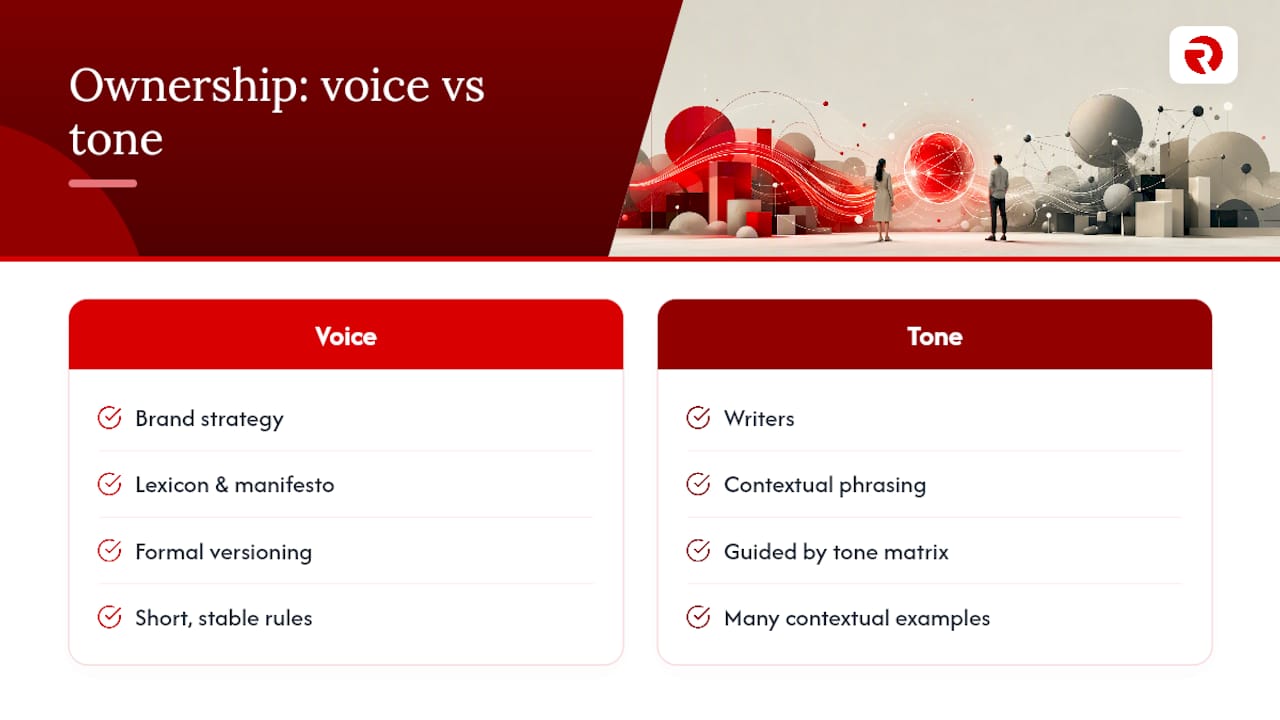
Voice and tone drift the moment more than one person is writing copy, and the fix is a clear ownership model rather than a longer style guide. Voice decisions, anything touching the core lexicon, the manifesto or the forbidden-words list, should sit with whoever owns brand strategy, and changes should go through a formal versioning process, because voice is meant to last years, not campaigns. Tone decisions belong with whoever’s writing the copy in the moment, provided a tone matrix exists to guide the call; escalating every tone choice to a brand director creates bottlenecks and, ironically, makes copy sound less confident, not more.
Mailchimp’s own content style guide is a useful reference point here: it keeps the voice rules short and stable, then does the heavy lifting through dozens of contextual tone examples rather than trying to cram every situation into the voice document itself. That split matters more as teams grow, because a single bloated document trying to cover both voice and tone inevitably gets skimmed rather than followed.
For tooling, three categories cover most needs: a style guide platform (even a well-maintained shared document works, provided it’s versioned), a CMS component library that locks approved headline and CTA formats so tone can’t quietly drift in templated content, and tone-checking tools that flag when copy’s formality or warmth falls outside the agreed range for its channel.
External partners and freelancers need a fast onboarding path: the one-page voice manifesto, the tone matrix, three or four annotated examples of “on-brand” and “off-brand” copy for their specific channel, and a named point of contact for anything ambiguous. The same discipline applies to AI-assisted copy: feed the model the manifesto and forbidden-words list as a standing prompt, review its first ten outputs against the tone matrix before trusting it unsupervised, and treat any AI draft as a first pass, not a final one. Hootsuite’s research on brand voice frames voice as acting like a brand ambassador in situations without a human present, which is exactly the role it needs to play when partners or AI tools are producing copy at volume.
Why does consistent voice and tone actually matter?
The business case isn’t abstract. Maintaining a consistent brand presentation, including a unified voice across every channel, is associated with revenue increases of up to 33%, a figure that reflects how much easier it is for customers to recognise, trust and return to a brand that sounds the same everywhere they encounter it.
Authenticity carries similar weight. Most consumers say authenticity is a primary factor in their affinity for a brand, and authenticity is very hard to fake without a stable voice underneath it. A brand that sounds like a different company on Instagram than it does in its support inbox reads as inconsistent at best and untrustworthy at worst.
There’s a psychological layer too. Harvard Business Review’s research into customer emotions shows that emotional framing and consistency shape how customers perceive a brand and make decisions, which is precisely why tone needs to be right for the moment while voice stays recognisable underneath it. Get the tone wrong in a crisis, and the emotional damage compounds far faster than a delayed fix ever would.
For budgeting, this points one direction: voice definition is a one-off investment, a workshop, a manifesto, a lexicon, that pays back for years. Tone governance is an ongoing cost, because new scenarios keep appearing, and it deserves a standing line in the content budget rather than being treated as a nice-to-have add-on once the voice document is filed away.
Ready-to-use voice and tone examples across channels
Seeing the same brand voice hold steady while tone shifts across six different formats makes the distinction far more concrete than any definition can.
Two micro-templates worth keeping on hand: the voice manifesto (“We sound like [X]. We always [Y]. We never [Z].”) and a three-tone sample set, one line written for social, one for support, one for press, using the exact same underlying fact each time. Writing that trio before a campaign launches is the fastest way to catch a voice that’s slipping, because if the three lines don’t sound like the same brand said them, something in the voice document needs tightening, not the tone matrix.
The quick-swap technique for moving a paragraph between tones: identify which dial needs to shift (usually warmth or formality), rewrite only the words that carry that dial (adjectives, sentence length, contractions), and leave the underlying claim and sentence structure untouched. A well-built visual identity works the same way, consistent underneath, adaptable on the surface, which is worth remembering when briefing a design team alongside a copy team.
Common mistakes to avoid in voice and tone work
Most inconsistency problems trace back to the same handful of errors, and each one has a straightforward fix.
- Conflating voice with tone. Teams write a single document trying to cover both, and it ends up too rigid for daily use and too vague to guide real decisions. Fix: split them into two documents, a short stable voice manifesto and a scenario-based tone matrix, as independent analysis of the two concepts recommends.
- Over-prescriptive adjective lists. Twenty adjectives describing the brand’s personality sound thorough but give writers nothing they can actually apply sentence by sentence. Fix: cut to three to five traits, each with a concrete example of what it looks like in a real sentence.
- No scenario rules for tone. Without a matrix, every writer guesses at tone independently, and guesses diverge fast. Fix: build the tone matrix once, even a rough four-row version, and treat it as a living document that grows with new scenarios.
- Ignoring plain English as the baseline. Some teams treat clarity itself as a tone choice, dressing it up or stripping it back depending on mood. Clarity isn’t a dial; it’s the floor every tone setting should sit above.
On the so-called “3-7-27 rule” that occasionally circulates in branding circles, treat it with caution: it’s repeated widely as shorthand for how quickly impressions form, but it doesn’t trace back to a rigorous, citable source in the way the revenue and authenticity figures above do. Anecdotal rules like this can be useful as a rough prompt for thinking about first impressions, but they shouldn’t be presented as settled research in a style guide.
For remediation, thirty days is enough to audit existing copy and draft a first voice manifesto. Ninety days is realistic for building a working tone matrix, running an onboarding session with any external partners, and testing the whole system on one live campaign before rolling it out everywhere.
What agencies see when brands get this wrong
The problem I see most often isn’t a bad voice, it’s no decision at all. A founder writes the About page, a freelancer writes the social captions, and a support team improvises replies under pressure, and nobody’s ever sat down to ask whether those three voices are the same brand talking. The fix isn’t complicated, but it does require getting the right people in a room, or on a call, at the same time.
Run a ninety minute voice workshop with three stakeholders: whoever owns brand strategy, whoever writes the most customer-facing copy day to day, and one person from outside marketing entirely, ideally someone in support or sales who hears how customers actually talk about the brand. Ask each person independently to name three words the brand would never use and three it reaches for constantly. The overlaps and the disagreements in that exercise tell you more about the current state of voice than any competitor audit will.
That single session, done properly, produces a usable draft manifesto by the end of the ninety minutes. The tone matrix can come later, once the voice is settled. Do it in the wrong order and the tone matrix has nothing solid to flex from.
*— Bart
How Radkaadvertising helps you get voice and tone right
Radkaadvertising is the practical alternative to writing a fifty-page brand book that nobody opens after week one. Rather than handing over a static document, the process runs workshop first, then guide, then tooling handoff: a facilitated voice session with your stakeholders, a compact manifesto and lexicon, a tone matrix built around your actual channels, and a governance model that keeps freelancers, partners and AI-assisted copy on-brand without every sentence needing sign-off.
The services on offer cover brand strategy, work from the ground up, dedicated voice and tone workshops, tone-matrix implementation for teams managing multiple content contributors, and ongoing content governance for brands scaling across agencies and markets. Readers who want to see this approach in action can review the case studies showing how brand positioning work has translated into measurable results for clients across different industries. If your current voice feels inconsistent across channels, a brand audit is the practical next step, and it starts with a conversation about where your copy is losing its shape.
Sources
- Brand tone vs brand voice — definition and how to craft tone | Shopify
- Voice and tone | Mailchimp content style guide
- The new science of customer emotions | HBR
Start with the Mailchimp and Shopify links if you need templates and sequencing guidance; start with Hootsuite and Qualtrics if you’re building a business case for the investment.
FAQ
What is the difference between brand tone and brand voice?
Brand voice is the brand’s stable personality expressed through consistent word choice and stance; brand tone is how that voice adjusts in warmth, formality and pace depending on the situation. Shopify’s guidance confirms voice should be defined first, with tone built as a flexible layer on top.
Are tone and voice the same thing?
No. Voice never changes regardless of channel or circumstance, while tone shifts constantly, sometimes within the same day, to suit the audience and context.
What is an example of brand voice?
A brand with a direct, no-nonsense voice might write “It’s live. Faster checkout, fewer clicks, zero fuss” for a launch and “Fixed. Here’s exactly what changed” for a support reply. The plain, confident sentence structure stays the same in both; only the warmth and formality shift.
What is the 3-7-27 rule of branding?
This rule circulates widely in branding discussions as a rough guide to how quickly first impressions form, but it doesn’t trace back to a rigorously documented source, so treat it as a loose talking point rather than settled research.
How do I create a brand voice from scratch?
Audit existing copy, interview stakeholders about how the brand would “sound” as a person, distil three to five specific voice traits, then write a one-sentence manifesto alongside a lexicon and forbidden-words list. Radkaadvertising runs this exact process as a facilitated workshop for brands that want expert guidance through each step.