Billboard sizes for marketers: essential dimensions and specs

The UK standard billboard is the 48-sheet, measuring 3 m × 6 m (9.84 ft × 19.69 ft). The 96-sheet doubles that width to 3 m × 12 m (9.84 ft × 39.37 ft) and dominates motorway and arterial routes. In the US, the equivalent large-format bulletin runs 14 ft × 48 ft. Those three figures cover the majority of outdoor advertising planning decisions you will face.
Here is a quick reference across all standard UK formats:
- 6-sheet: 1.2 m × 1.8 m — bus shelters, pedestrian zones, high dwell time
- 16-sheet: 2.032 m × 3.048 m — high streets, retail parks, moderate traffic
- 30/32-sheet: 3 m × 3 m (approx.) — arterial roads, urban junctions
- 48-sheet: 3 m × 6 m — A-roads, urban arterials, the UK workhorse format
- 96-sheet: 3 m × 12 m — motorways, major highways, maximum impact
- D48 / D96 (digital equivalents): same physical footprint, specified in pixels per operator network
Digital formats mirror their static counterparts physically but require pixel-based artwork delivery. One network example specifies 864 × 432 px for a landscape digital 48-sheet, though this varies by operator and pixel pitch.
Key takeaways
Standard UK billboard sizes follow a clear hierarchy from 6-sheet bus-shelter panels to 96-sheet motorway formats, and matching the right format to traffic speed is the single most important planning decision you will make.
| Point | Details |
|---|---|
| 48-sheet is the UK standard | The 48-sheet measures 3 m × 6 m (9.84 ft × 19.69 ft) and suits A-roads and urban arterials. |
| Match scale to speed | Use 96-sheet for motorways (3–5 words max); use 6-sheet for pedestrian zones where detail is viable. |
| Digital specs vary by operator | A D48 example spec is 864 × 432 px; always confirm pixel pitch and file format with the network. |
| Allow three weeks minimum | Static print and installation requires at least three weeks lead time; digital needs two weeks. |
| Radkaadvertising plans and delivers | Radkaadvertising provides end-to-end media planning, creative production, and digital asset trafficking for outdoor campaigns. |
Table of Contents
- 1. UK billboard sizes: full dimensions and unit conversions
- 2. What does ‘sheet’ count actually mean?
- 3. Digital billboard formats: pixel specs and file requirements
- 4. How to choose the right billboard size for your campaign
- 5. Artwork and production specs: bleed, safe area, DPI, and file delivery
- 6. Typical costs and lead times for UK outdoor poster orders
- 7. Matching format to traffic behaviour: a media-planning perspective
- 8. Maintenance and durability: what size means for materials and upkeep
- 9. Cost efficiency by format: cost per impression and per square metre
- Why format choice is the most underrated creative decision
- Radkaadvertising’s media planning and creative delivery services
- Sources
- FAQ
1. UK billboard sizes: full dimensions and unit conversions
The table below covers every standard UK format planners and designers need, with metric and imperial measurements side by side.
| Format | Height (m) | Width (m) | Height (ft/in) | Width (ft/in) | Best for |
|---|---|---|---|---|---|
| 6-sheet | 1.2 | 1.8 | 3 ft | 5 ft | Bus shelters, pedestrian areas |
| 16-sheet | 2.032 | 3.048 | 6 ft 8 in | 10 ft | High streets, retail parks |
| 30/32-sheet | 3 | 3 | 9 ft 10 in | 9 ft 10 in | Urban junctions, arterial roads |
| 48-sheet | 3 | 6 | 9 ft 10 in | 19 ft 8 in | A-roads, urban arterials |
| 96-sheet | 3 | 12 | 9 ft 10 in | 39 ft 4 in | Motorways, major highways |
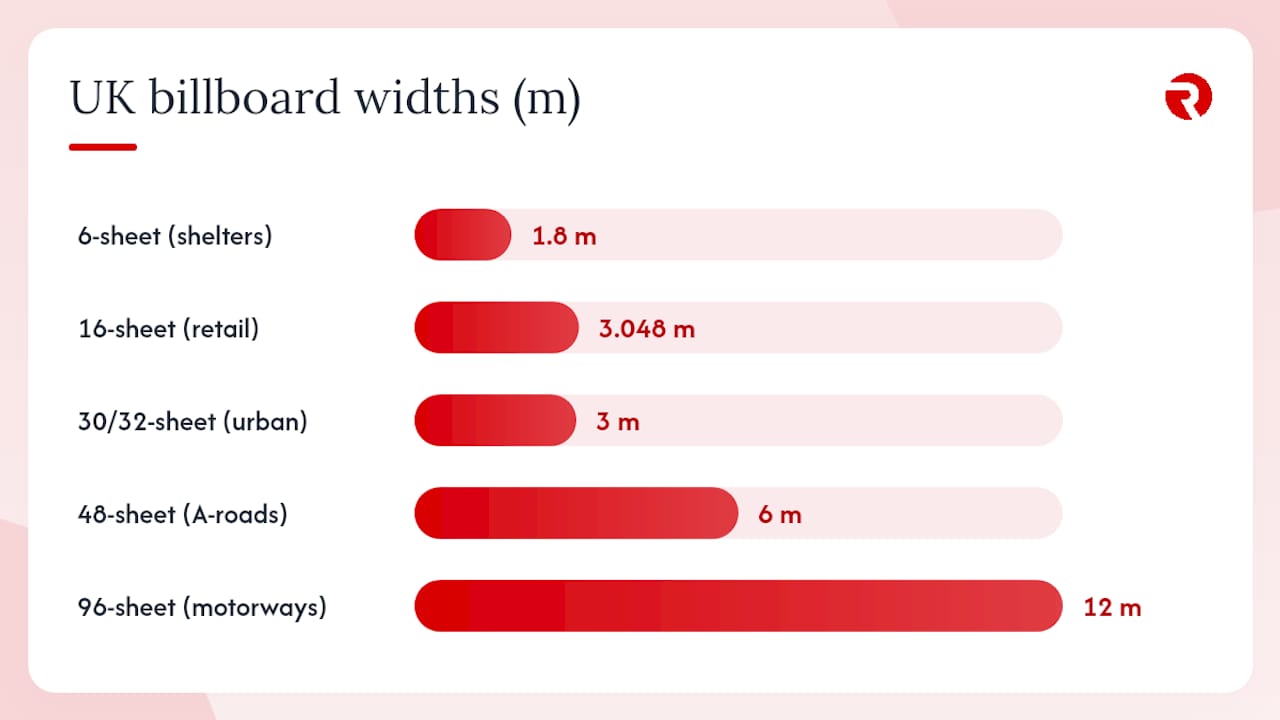
The 16-sheet measures 2,032 mm × 3,048 mm (80" × 120"), making it a practical mid-size option for high-street retail campaigns where a 48-sheet would be physically oversized.
Conversion worked examples:
- 3 m × 6 m (48-sheet) approximately 10 ft × 20 ft
- 3 m × 12 m (96-sheet) approximately 10 ft × 40 ft
For US planning, the standard large bulletin runs 14 ft × 48 ft, which sits between the UK 48-sheet and 96-sheet in total face area. Always confirm live copy area with the media owner before finalising artwork, as structural borders reduce the printable face on some sites.
2. What does ‘sheet’ count actually mean?
The term ‘sheet’ is a legacy of letterpress printing. Early outdoor posters were assembled from multiple printed sheets pasted together on site. A double-crown sheet measured roughly 762 mm × 508 mm, and the sheet count described how many of those sheets tiled the full face.
Today the counts are industry shorthand, not literal sheet numbers. The physical dimensions are what matter:
- 6-sheet: 1.2 m × 1.8 m — the bus-shelter standard
- 16-sheet: 2.032 m × 3.048 m — portrait orientation, mid-size
- 32-sheet: approximately 3 m × 3 m — landscape, urban roadside
- 48-sheet: 3 m × 6 m — the UK’s most widely booked roadside format
- 96-sheet: 3 m × 12 m — the largest standard static format in the UK
Operator variance exists. Some media owners use slightly different live-copy areas within the same sheet count, particularly on older structures. Always request the specific live copy dimensions and bleed requirements from the site owner before briefing your designer, not after.
3. Digital billboard formats: pixel specs and file requirements
Digital out-of-home (DOOH) formats share the same physical footprint as their static equivalents but are specified entirely in pixels. The resolution depends on the cabinet’s pixel pitch — the distance in millimetres between LED clusters. A smaller pitch (P8, P10) produces a denser pixel grid and a sharper image at close range; a larger pitch (P16) suits motorway distances where fine detail is invisible anyway.
The 864 × 432 px figure for a D48 is one published network example; pixel requirements vary by operator, and the US P16 and P10 resolution examples reflect pixel-pitch conversion guidance for a 14 ft × 48 ft face.
File delivery checklist for digital formats:
- Colour profile: sRGB (most LED networks) or operator-specified profile
- File formats: MP4 (H.264), JPEG, PNG — confirm with the network
- Loop length: typically 5–10 seconds per slot; confirm the loop duration with the operator
- Frame rate: 25 fps is standard for UK networks
- Audio: generally disabled on roadside digital; confirm before including
Pro Tip: Always request the operator’s technical delivery specification sheet before building artwork. Pixel pitch and cabinet layout vary between networks, and artwork built to the wrong pixel grid will not display correctly on playback systems.
4. How to choose the right billboard size for your campaign
Format selection is a planning decision, not a creative one. The right size follows from where your audience is and how fast they are moving.
Five-question decision checklist:
- What is the average traffic speed at the site? (Motorway = 70 mph; high street = walking pace)
- How many seconds will a viewer have to read the message?
- How many words does your creative require to communicate the offer?
- Is the objective brand awareness (reach) or direct response (action)?
- What is the nearest competing visual at the site?
Placement matrix:
| Environment | Recommended format | Creative approach |
|---|---|---|
| Motorway / dual carriageway | 96-sheet | 3–5 words maximum, bold single image |
| A-road / arterial | 48-sheet | 5–7 words, clear logo, single CTA |
| Urban junction / arterial | 30/32-sheet | Short headline, strong brand colour |
| High street / retail park | 16-sheet | Moderate detail, product visual |
| Bus shelter / pedestrian | 6-sheet | Full creative, QR code viable |
Larger formats work best on high-speed routes; poster formats suit pedestrianised urban environments where dwell time is measured in seconds rather than fractions of a second. A 96-sheet on a motorway gives you roughly three seconds of visibility. A 6-sheet in a bus shelter gives you thirty. Those two numbers should drive every creative brief.
For urban placements, Gov can help estimate audience volume and dwell patterns at specific sites. Pairing that with behavioural audience data sharpens format decisions further, particularly for local retail and SMB campaigns.
5. Artwork and production specs: bleed, safe area, DPI, and file delivery
Getting the spec right before artwork begins saves days of rework. These are the production standards that matter for large-format print.
Print production checklist:
- Resolution: 100–150 DPI at final print size (not at A4 reduced scale). A 96-sheet requires significantly more image resolution than a 48-sheet at the same DPI — roughly four times the pixel count given the doubled width.
- Bleed: minimum 50 mm on all sides for large-format print; confirm with the printer as some operators require 100 mm on pasted formats.
- Safe zone: keep all critical text and logos at least 100 mm inside the trim edge.
- Colour mode: CMYK with embedded ICC profile (ISO Coated v2 or Fogra39 for most UK printers).
- File format: PDF/X-1a (for single-layer, no transparency) or PDF/X-4 (for layered/transparency-heavy files). Always flatten transparencies before export.
- Image links: embed all images and fonts; do not supply linked files separately.
Multi-panel and wrap considerations: 96-sheet faces are often printed in two or more panels. Artwork must account for the join line, typically 3–5 mm of overlap per panel. Confirm the exact panel split with the printer before placing any critical design element near the centre of the face.
Pro Tip: Request a soft proof from your printer at 1:10 scale before approving a large-format run. Colour shifts between screen and print are amplified at billboard scale, and a single approval round at proof stage costs far less than a reprint.
6. Typical costs and lead times for UK outdoor poster orders
Costs in UK outdoor advertising vary enormously by location, format, and whether the site is static or digital. The figures below are planning-level guidance; actual rates depend on the media owner, the specific site, and campaign duration.
Typical monthly rental ranges (planning guidance only):
- 6-sheet (bus shelter): £150–£500 per panel per month in regional markets; premium city-centre panels run higher
- 48-sheet (roadside): £300–£1,500 per month depending on location and traffic volume
- 96-sheet (motorway/major arterial): £1,000–£5,000+ per month for premium sites
Location quality is the primary cost driver, with premium highway and city-centre sites commanding the highest fees. Digital formats carry slightly higher rental rates than comparable static sites, offset by the elimination of vinyl print and installation costs for each creative change.
Lead times to plan for:
- Print production (vinyl): 3–5 working days for standard formats; 7–10 days for 96-sheet multi-panel
- Installation: 1–3 days depending on access equipment required
- Planning permission (new structures): 8–13 weeks under standard UK permitted development rules
- Digital creative approval: 24–48 hours for most networks
Rush production fees typically add 25–50% to print costs. Book media and brief designers at least three weeks ahead of the campaign start date for static formats, and two weeks for digital.
7. Matching format to traffic behaviour: a media-planning perspective
The core planning rule is simple: match scale to speed. Large formats for high-speed routes, smaller detailed formats for pedestrian and slow urban traffic. Every experienced planner knows this in theory; fewer apply it consistently in practice.
Two anonymised examples illustrate the principle. A national FMCG brand running a motorway awareness campaign on 96-sheet sites achieved strong prompted recall because the creative was a single product image and four words. A regional retailer running the same creative on 6-sheet bus-shelter panels in a city centre saw footfall uplift because the format allowed a promotional price, a store address, and a QR code — detail that would be invisible at motorway speed.
When evaluating sites, request visibility-adjusted impressions rather than raw traffic counts. Raw counts include vehicles that pass at angles or speeds where the panel is not legible. Visibility-adjusted figures, which account for size, angle, and obstruction, give a more accurate media currency for comparing formats.
Pro Tip: Ask the media owner for the live copy area dimensions and the panel’s angle to the road before confirming a booking. A panel facing at 45 degrees to traffic has a materially shorter visibility window than one facing head-on, even at the same traffic volume.
For audience research methods that complement site selection, combining footfall data with demographic profiling sharpens format decisions for local and regional campaigns. For SMBs specifically, low-cost footfall tactics can inform which poster formats and locations drive the best return at smaller budgets.
8. Maintenance and durability: what size means for materials and upkeep
Larger formats cost more to maintain, and the relationship is not linear. A 96-sheet vinyl print exposed to UK weather for four weeks faces wind loading, UV degradation, and moisture ingress across 36 square metres of material. Smaller formats on sheltered bus-shelter panels face far less environmental stress.
Key durability considerations by format:
- 6-sheet (bus shelter): protected by glazing on most modern panels; vinyl or paper substrate lasts the full campaign period with minimal degradation
- 48-sheet (roadside): UV-stabilised vinyl is standard; inspect for lifting edges after high-wind events, particularly on older wooden-frame structures
- 96-sheet (motorway): heavy-gauge vinyl (typically 440–510 gsm) is required; multi-panel joins must be sealed against wind ingress; structural inspection of the gantry is the media owner’s responsibility but worth confirming before booking a long-term campaign
Digital formats eliminate substrate degradation entirely, but LED cabinets require periodic cleaning and pixel-fault monitoring. Most major network operators include maintenance in the rental agreement; confirm this before signing.
Material choice also affects print quality at scale. Solvent-based inks on heavy vinyl hold colour better over extended outdoor exposure than latex alternatives, though latex is increasingly preferred for environmental reasons. For campaigns running longer than four weeks in exposed locations, specify UV-laminated vinyl to protect against colour fade.
9. Cost efficiency by format: cost per impression and per square metre
Bigger is not always better value. The 96-sheet delivers a lower cost per thousand impressions (CPM) on a busy motorway because the audience volume is enormous. On a quiet B-road, the same panel produces a high cost per square metre with a fraction of the reach.
The most useful efficiency metric for comparing formats is CPM, not total rental cost. A 6-sheet bus-shelter panel in a high-footfall city-centre location can outperform a 48-sheet on a secondary road on a pure CPM basis, because the audience volume and dwell time are both higher.
Cost per square metre favours smaller formats almost universally. A 6-sheet at £300 per month covers 2.16 m² — roughly £139 per m². A 48-sheet at £800 per month covers 18 m² — roughly £44 per m². The 48-sheet wins on cost per square metre, but that metric only matters if the additional face area is visible and legible to the audience passing it.
The practical framework: use CPM for awareness campaigns where reach is the objective, and use cost per conversion (tracked via QR code, unique URL, or footfall uplift) for direct-response campaigns. WorldOOH’s member resources provide cross-market audience measurement standards that help planners compare formats on a consistent basis.
Why format choice is the most underrated creative decision
Most briefs arrive at the agency with the format already decided. That is the wrong order. Format is not a media-buying afterthought — it is a creative constraint that determines how many words you can use, whether a QR code is viable, and whether your brand colour reads at 70 mph. Get the format wrong and no amount of creative excellence recovers the campaign.
At Radkaadvertising, we push back on format decisions made before the planning work is done. The question is never “which size looks most impressive?” It is “where is our audience, how fast are they moving, and what is the minimum message that drives the desired action?” A 6-sheet in the right location beats a 96-sheet in the wrong one, every time.
For complex, multi-format, or cross-channel campaigns, involving an agency at the planning stage rather than the production stage saves budget and avoids the most common sizing mistakes. The creative brief should follow the format decision, not precede it.
Radkaadvertising’s media planning and creative delivery services
Planning a billboard campaign involves more than booking a site. It requires format selection grounded in audience data, artwork built to exact production specs, and digital assets delivered to operator pixel requirements. Radkaadvertising handles all of it: media planning, creative production, print trafficking, digital asset preparation, and campaign measurement.
Our full-service offering covers everything from initial format strategy through to post-campaign performance reporting. For B2B clients running multi-format or cross-channel campaigns, our case studies show how integrated planning drives measurably better outcomes than format decisions made in isolation. Get in touch with Radkaadvertising to discuss your next outdoor campaign.
Sources
These are the primary references used in this guide. Each serves a distinct planning purpose:
- Billboard Sizes, Dimensions & Specs | Bauer Media Outdoor | Bauer Media Outdoor
- Billboard Dimensions Guide: Standard Sizes for Media Owners
- Outofhome
- Worldooh
- Gov
FAQ
What is the standard billboard size in the UK?
The standard UK roadside billboard is the 48-sheet, measuring 3 m × 6 m (approximately 9 ft 10 in × 19 ft 8 in). The larger 96-sheet measures 3 m × 12 m and is used primarily on motorways and major arterial routes.
What size is a billboard in pixels?
Pixel dimensions depend on the operator’s LED pixel pitch. One published UK network example specifies 864 × 432 px for a landscape digital 48-sheet; a US 14 ft × 48 ft bulletin at P16 pitch produces approximately 914 × 267 px. Always confirm the exact pixel specification with the display operator before building artwork.
What are the dimensions of a 16-sheet billboard?
A 16-sheet billboard measures approximately 2,032 mm × 3,048 mm (80 inches × 120 inches, or roughly 6 ft 8 in × 10 ft). It is a portrait-format panel commonly used on high streets and at retail parks.
What is the difference between a 48-sheet and a 96-sheet?
Both share the same 3 m height. The 48-sheet is 6 m wide; the 96-sheet is 12 m wide. The 96-sheet is used on motorways and high-speed routes where greater visual impact is needed at distance; the 48-sheet suits A-roads and urban arterials where viewing distances are shorter.
How much does a billboard cost in the UK?
Monthly rental costs vary widely by format and location. As a planning guide, 6-sheet bus-shelter panels range from approximately £150 to £500 per month in regional markets; 48-sheet roadside sites run roughly £300 to £1,500 per month; 96-sheet motorway sites can reach £5,000 or more per month at premium locations. Digital formats carry slightly higher rental rates than equivalent static sites.