Benefits of outdoor advertising for UK SMEs and entrepreneurs
Outdoor advertising (OOH) delivers mass reach, trust, and measurable sales activation that makes it a strategic channel for UK businesses. Industry evidence confirms large brand awareness and sales activation effects for campaigns that include OOH, and a very large majority of the UK population see outdoor ads every week. For entrepreneurs and SMEs, that scale is hard to replicate at comparable cost through digital alone.
The three core benefits at a glance:
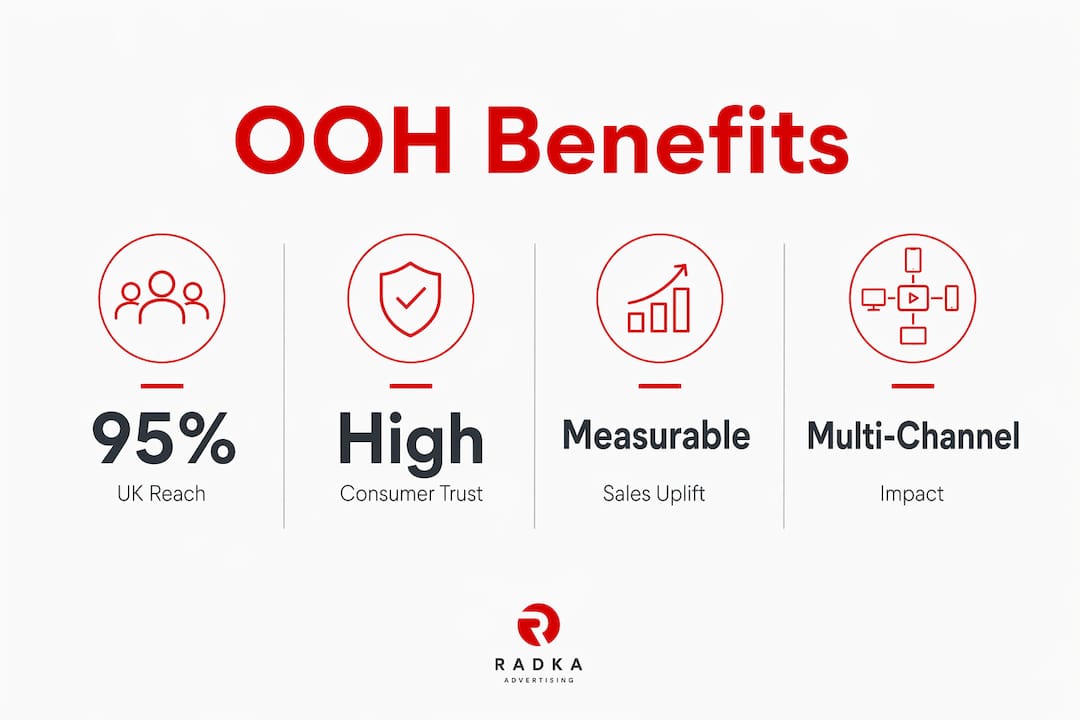
- Reach: OOH connects your brand with 95% of UK adults in the real world every single week.
- Trust: Physical advertising scores higher trust metrics than many online formats, including social media.
- Sales activation: OOH drives branded search, footfall, and purchase intent when combined with digital channels.
Used as part of a multi-channel plan, OOH is a recommended channel for UK businesses at any stage of growth.
Table of Contents
- What are the real benefits of outdoor advertising for your brand?
- How does OOH work alongside your digital channels?
- What UK OOH formats suit your budget and goals?
- When is OOH the right choice for your SME?
- How do you measure OOH performance and prove ROI?
- What are the legal and regulatory basics for UK OOH?
- How Radkaadvertising approaches OOH for SME campaigns
- Key takeaways
- Why OOH is underestimated, and what actually matters in a brief
- Ready to put your brand where it cannot be ignored?
- Useful sources and further reading
- FAQ
What are the real benefits of outdoor advertising for your brand?
OOH builds brand fame fast. Reaching 95% of UK adults weekly, it delivers a scale of exposure that most digital budgets cannot match without significant spend on multiple platforms simultaneously.
Trust is where OOH genuinely surprises. Many people believe OOH is more trustworthy than social media, with a notable proportion actively saying they trust it. Physical presence signals permanence and investment in a way that a banner ad simply cannot. For a growing brand, that credibility transfers directly to consumer perception.
Sales activation is the third pillar. OOH primes audiences so that when they encounter your brand on Google, Instagram, or in-store, they already have a frame of reference. That priming effect shortens the purchase journey. OOH also avoids ad fraud, bots, and banner blindness entirely, because impressions are physical and verifiable. In ROI conversations with boards or investors, that point carries real weight.
Statistic: Industry ROI studies highlight strong returns for combined OOH and digital programmes, with multi-channel campaigns consistently outperforming single-channel spend.
Pro Tip: When presenting OOH to a sceptical board, frame it in two layers: short-term sales activation (search uplift, footfall, QR response) and long-term brand KPIs (awareness lift, trust scores). Separating those two conversations prevents the channel being judged solely on last-click attribution, where it will always lose to paid search.
How does OOH work alongside your digital channels?
Integrating OOH with digital materially improves campaign performance across both channels. The mechanism is straightforward: OOH primes audiences in the real world, and when those same people pick up their phones, they are significantly more likely to search, click, or engage with your digital ads.
Outsmart, the UK OOH trade body, documents branded search uplifts and improved click-through rates when OOH runs alongside online channels. This “two-screen effect” is not theoretical. Consumers see a billboard on their commute, then search the brand name on their phone within hours.
Practical ways to activate the two-screen effect:
- Align OOH creative with your paid search and social ad creative so the visual language is consistent.
- Boost PPC bids in postcodes where your OOH sites are live during the campaign flight.
- Use short, memorable URLs or QR codes on digital OOH (DOOH) screens to drive direct response.
- Coordinate campaign timing so social retargeting ads follow OOH exposure within the same week.
DOOH measured at contextually relevant moments increases brain response, recall, and sales metrics in experimental studies, which means timing your screens to match audience mindset (commuter hours, lunchtime retail footfall) amplifies the effect further.
Pro Tip: To measure the combined effect without double-counting, run a geo-split test: activate OOH in two or three postcodes and hold back one comparable postcode as a control. Compare branded search volume and website sessions across those areas during the flight. It is not perfect, but it gives you a defensible uplift figure.
What UK OOH formats suit your budget and goals?
| Format | Best for | Typical use case |
|---|---|---|
| 48-sheet billboard (classic or digital) | Brand fame, high-traffic routes | National or regional brand launches |
| Bus shelter / 6-sheet (classic or digital) | Local targeting, footfall | SME local campaigns, retail proximity |
| Digital street furniture (DOOH) | Contextual, time-sensitive messaging | Event promotion, daypart targeting |
| Transport (Underground, rail, bus) | Commuter audiences, London reach | B2B and premium consumer brands |
| Adbikes / ambient | Hyperlocal, event activation | Pop-ups, product launches, stunts |
Portrait shelter and free-standing screens start at as little as £49 per week, and digital billboard screens from around £99 per week, making OOH genuinely accessible for SMEs with modest budgets. SMEs can access billboard inventory locally with short weekly bookings, which removes the commitment risk that puts many smaller businesses off the channel.
Budget components to plan for beyond media rental: creative production (design and copywriting), print or digital asset delivery, installation where applicable, and any site permissions or landlord approvals. Production costs vary widely depending on format and whether you are running static or animated DOOH creative.
The OOH industry has invested over £1.1bn in public infrastructure over 14 years, which means the shelters and screens your ads appear on are maintained assets in high-footfall locations, not afterthoughts.
When is OOH the right choice for your SME?
OOH is best for top-of-funnel growth, local dominance, and event or store openings. It is not a standalone conversion channel, and it should not be the only line in a performance-only budget.
Use OOH when:
- Your goal is brand awareness, local fame, or category entry.
- You have a defined geographic focus (borough, postcode, commuter corridor).
- You are launching a product, opening a location, or running a seasonal push.
- Your creative is ready: a clear visual identity and a single, compelling message.
Hold back when:
- Your entire budget is below a viable weekly media and production threshold.
- Your campaign goal is purely last-click conversion with no brand component.
- You have no digital infrastructure to capture the search and social demand OOH generates.
Targeting options for SMEs include postcode or borough-level site selection, proximity to points of sale, commuter corridor coverage, and event footprint targeting. Out-of-home networks allow for region-specific campaigns that serve your local area precisely.
Pro Tip: Book a minimum of two weeks for any OOH flight. One week rarely builds the frequency needed for recall. Four to six weeks is the sweet spot for local brand-building campaigns, and it gives you enough time to see measurable search uplift.
How do you measure OOH performance and prove ROI?
Start with a mix of brand lift, search uplift, footfall attribution, and direct response to capture the full effect of an OOH campaign.
| KPI | Measurement method | Cadence |
|---|---|---|
| Brand awareness lift | Pre/post brand study | Start and end of campaign |
| Branded search uplift | Google Trends, PPC impression share | Weekly during flight |
| Website sessions | geo-segmented website sessions | Weekly during flight |
| Footfall conversion | Mobile location data providers | During and post-flight |
| Direct response | QR scans, unique URLs | Real-time |
| DOOH delivery | Operator verification reports | Post-campaign |
Outsmart provides industry measurement frameworks and lift study guidance that UK planners use as a baseline. For DOOH, operators provide delivery verification reports confirming impressions served, which gives you a verifiable audit trail.
Recommended KPIs to set before launch:
- Awareness lift percentage versus a control group or pre-campaign baseline.
- Branded search volume change in targeted postcodes.
- Website sessions from campaign-area geo-segments.
- Footfall to store or venue during the campaign window.
- Sales attribution within a defined post-exposure window.
Pairing OOH with a branded search capture strategy ensures the demand OOH generates does not leak to competitors on the search results page.
What are the legal and regulatory basics for UK OOH?
Advertising outdoors in the UK must follow ASA/CAP rules and often requires local site permissions or landlord approval before a campaign goes live.
Key compliance points:
- All OOH creative must comply with the CAP Code (Committee of Advertising Practice), covering truthfulness, harm, and responsible advertising standards.
- Ads near schools, on transport networks, or in sensitive locations face additional content restrictions.
- Permanent or semi-permanent structures may require planning permission from the local authority.
- Most media owners handle site permissions for standard inventory; for bespoke or ambient placements, check with the local council directly.
- Lead times for permissions on non-standard sites can run to several weeks, so factor this into your campaign timeline.
- The Advertising Standards Authority (ASA) can require removal of non-compliant ads, which creates both reputational and financial risk.
When in doubt, brief your media owner or agency early. Most established UK OOH operators, including Clear Channel UK, JCDecaux UK, and Ocean Outdoor, have compliance teams that review creative before it goes live.
How Radkaadvertising approaches OOH for SME campaigns
Radkaadvertising frames OOH as a multiplier within a wider media mix, not a standalone buy. For SME and regional campaigns, the approach starts with a clear objective, then selects formats and sites that serve that objective with the available budget.
A typical campaign structure looks like this:
| Stage | Action | Output |
|---|---|---|
| Objective setting | Define KPIs (awareness, footfall, search uplift) | Measurable campaign brief |
| Format selection | Match format to goal and geography | Site plan with rationale |
| Digital integration | Align PPC, social, and OOH creative | Unified campaign assets |
| Measurement | Pre/post brand study, search uplift, QR tracking | ROI report |
Creative is built to work at scale: a single, bold visual message that translates from a 48-sheet billboard to a 6-sheet shelter without losing impact. Visual identity consistency across formats is what makes OOH recognisable and memorable across a campaign flight.
Explore Radkaadvertising case studies for examples of how OOH and digital have been combined for measurable results across different sectors.
Key takeaways
OOH advertising works best as a top-of-funnel multiplier that amplifies digital performance, builds brand trust, and delivers verifiable reach across the UK population.
| Point | Details |
|---|---|
| Reach at scale | OOH reaches 95% of UK adults weekly, making it one of the broadest-reach channels available. |
| Affordable entry point | Digital shelter and screen inventory starts from £49 per week, accessible for SME budgets. |
| Measure the full effect | Use brand lift, branded search uplift, footfall data, and QR tracking together for a complete ROI picture. |
| Pair with digital | Align OOH with PPC and social creative, and boost bids in OOH postcode areas during the campaign flight. |
| Radkaadvertising | Offers integrated OOH planning, creative, media buying, and measurement as a single managed service for UK SMEs. |
Why OOH is underestimated, and what actually matters in a brief
Most businesses that dismiss OOH do so because they tried it once, ran a single site for a fortnight, and saw no measurable last-click return. That is the wrong test. OOH is a priming channel. Its job is to make every other channel work harder, not to close the sale itself.
The briefs that suit OOH well are brand launches, local store growth campaigns, event activations, and any situation where you need to build category awareness quickly in a defined geography. The briefs that do not suit it are purely performance-driven search campaigns with tiny budgets and no brand component whatsoever.
When briefing an agency, set KPIs before you book a single site. Agree on what “success” looks like in terms of search uplift, footfall, or awareness shift, and build the measurement plan before the creative goes to print. Creative asset readiness is also underestimated: a great OOH campaign needs one clear message and one strong visual. Trying to say three things on a billboard is how brands waste their media spend.
On in-house versus agency management: if you have never planned OOH before, the site selection, negotiation, permissions, and measurement complexity will consume more time than the media cost justifies. An experienced OOH partner pays for itself in avoided mistakes alone.
Ready to put your brand where it cannot be ignored?
Radkaadvertising plans, creates, and manages OOH campaigns as part of integrated multi-channel programmes for UK SMEs and growing brands. From site selection and creative production to DOOH activation and post-campaign measurement, everything runs under one roof with no handoff gaps.
The concrete advantage: you get a single team handling your OOH media buying, digital integration, and performance reporting, so the two-screen effect is built into the campaign from day one rather than bolted on afterwards. No separate agency relationships, no misaligned creative, no measurement blind spots.
To get started, request a campaign audit or view our case studies to see how we have delivered measurable results for brands across multiple sectors.
Useful sources and further reading
Practitioners planning a UK OOH campaign should consult these authoritative resources directly:
- Outsmart: The UK OOH trade body. Publishes reach data, measurement frameworks, SME guidance, and industry social value reports. The first stop for any planner needing credible industry benchmarks.
- Alight Media OOH guide: Practical SME-facing guidance on formats, pricing, and local targeting. Includes weekly rate commentary and campaign planning steps.
- Outsmart SME and OOH report: Detailed breakdown of how OOH works for smaller businesses, with case examples and reach statistics.
- ASA / CAP Code: The Advertising Standards Authority’s CAP Code governs all UK OOH creative. Essential reading before any campaign goes to production.
- JCDecaux UK: One of the UK’s largest OOH operators. Their benefits overview covers reach, DOOH impression volumes, and format guidance.
FAQ
What are the main benefits of outdoor advertising for UK businesses?
OOH delivers mass reach (95% of UK adults weekly), higher consumer trust than many digital formats, and measurable sales activation through branded search uplift and footfall. It works best as part of a multi-channel plan.
How much does outdoor advertising cost for a small business in the UK?
Digital shelter and 6-sheet screen inventory starts from around £49 per week, and digital billboard screens from around £99 per week, making OOH accessible for SME budgets with short weekly booking options.
How do you measure the ROI of an OOH campaign?
Use a combination of pre/post brand lift studies, branded search volume in targeted postcodes, geo-segmented website sessions, mobile footfall data, and QR or unique URL tracking to build a full ROI picture.
Does outdoor advertising work alongside digital marketing?
Yes. OOH primes audiences in the real world, which increases branded search volume and improves click-through rates on social and paid search ads. Aligning OOH and digital creative, and boosting PPC bids in OOH postcode areas, maximises the combined effect.
Can Radkaadvertising manage OOH as part of a wider campaign?
Radkaadvertising offers integrated OOH planning, creative, media buying, DOOH activation, and measurement as a managed service, so OOH and digital run as a single coordinated programme rather than separate buys.