Start a 15–30 Prompt Baseline This Week for AI Search Visibility

AI search visibility is how often ChatGPT, Gemini, Perplexity and Google AI Overviews name or cite your brand when someone asks a relevant question. It splits into two things: mentions (your brand’s name in the text) and citations (your URL linked as a source). Start now: build a prompt-sampling baseline this week and track mentions, citations and share of voice as your first three metrics.
TL;DR:
- Mentions, citations, and recommendations all impact AI search visibility, with citations and baseline structured content being crucial for inclusion in AI summaries.
- Consistent, repeatable testing across multiple AI engines and tracking mentions and citations over time is essential, as visibility fluctuates widely between platforms and updates.
- Structuring content with clear, snippable answers, earning third-party mentions, and fixing technical issues like hidden content and PDFs improve chances of being cited in AI responses.
- Measuring AI visibility regularly and displacing existing citations for comparable content is more effective than one-off audits or quick fixes.
- Automated and agency-managed tracking, content optimization, and PR outreach provide scalable solutions to maintain and grow AI search presence amid frequent platform updates.
Table of Contents
- What is AI search visibility and why does it matter?
- How do you measure AI search visibility?
- Manual checks versus dedicated AI visibility tools
- An operational playbook to improve AI visibility
- How do ChatGPT, Gemini and Perplexity differ?
- What mistakes reduce AI search eligibility?
- How do AI algorithms change search ranking factors?
- What role does natural language processing play?
- Why does content relevance matter for AI engines?
- How do you write for AI-generated search summaries?
- How do AI updates affect visibility over time?
- Editorial take: measurement beats guesswork every time
- Radka Advertising: managed AI visibility, done for you
- Sources
- FAQ
What is AI search visibility and why does it matter?
AI search visibility measures whether generative engines surface your brand when answering a buyer’s question, not whether you rank on a results page. Three distinct signals make up the picture: a mention (your brand name appears in the generated text), a citation (your URL is linked as a source), and a recommendation (the engine actively suggests you over alternatives). A brand can be mentioned without being cited, and cited without being recommended. All three matter, and they behave differently across engines.
Traditional SEO chases a click. AI visibility often replaces the click entirely, because the assistant assembles its answer from several sources and presents a synthesis, quoting or naming the brands it trusts most. Being absent from that synthesis means losing the interaction before the reader ever reaches a results page.
The business case is concrete. Visitors arriving via AI referral convert markedly better than typical organic search visitors, because they arrive pre-qualified: the engine has already vetted your brand as relevant before sending anyone your way.
- Mentions build brand familiarity even without a click.
- Citations drive qualified referral traffic.
- Recommendations influence purchase decisions directly, often before a competitor gets a look-in.
Pro Tip: Treat a mention with no citation as a discovery opportunity, not a failure. It usually means your content answers the question but isn’t structured cleanly enough to earn a source link yet.
How do you measure AI search visibility?
Measurement needs to be reproducible, or the numbers you get this month mean nothing next month. Visibility varies significantly between ChatGPT, Perplexity, Gemini and Google AI Overviews, so a single spot check on one engine tells you almost nothing about the others.
- Build a stable prompt set. Write 15 to 30 prompts that reflect real buyer questions at different funnel stages, not brand-name searches. Keep the wording fixed so results are comparable over time.
- Run the set across engines. Test the same prompts on ChatGPT, Gemini, Perplexity and Google AI Overviews, logging each response verbatim.
- Record five data points per response: whether you’re mentioned, whether your URL is cited, your position in the answer (first, mid, buried), the sentiment (positive, neutral, negative), and which competitors appear alongside you.
- Repeat on a fixed cadence. Single spot checks are unreliable, since only a minority of brands hold their position across consecutive runs of the same prompt. Weekly or fortnightly sampling catches that volatility.
- Calculate a composite score. Combine mention rate, recommendation rate (appearing in the top three suggestions), and share of voice against named competitors into one composite visibility score per engine, then track the trend line rather than any single week’s result.
| Metric | What it captures | How often to check |
|---|---|---|
| Mention rate | % of prompts where brand is named | Weekly |
| Citation rate | % of prompts where URL is linked | Weekly |
| Share of voice | Your mentions vs total competitor mentions | Fortnightly |
| Sentiment | Positive/neutral/negative framing | Fortnightly |
Don’t skip URL-only citations in your log. A meaningful share of AI citations link to a page without ever naming the brand, and ignoring those “ghost citations” undercounts your real visibility.
Manual checks versus dedicated AI visibility tools
Running the prompt set by hand costs nothing but time, and it’s the right starting point for most businesses. Open each engine, paste your prompt list, and log the results in a spreadsheet. It’s tedious past a handful of prompts, but it teaches you exactly how each engine talks about your category before you spend on software.
Dedicated tools earn their price when you need scale or multi-brand tracking. When comparing options, look for:
- Multi-engine coverage, not just ChatGPT, since visibility on one engine rarely transfers to another.
- Prompt tracking over time, so you see trend lines rather than one-off snapshots.
- Citation mapping that distinguishes mentions from URL citations.
- Actionable output, meaning the tool names specific pages to fix or publishers to approach rather than just a score. Tools that surface concrete recommendations save real hours translating data into work.
- Transparent pricing that scales with prompt volume, not a flat fee disguising limited coverage.
Pro Tip: During any free trial, run your own hand-built prompt set through the tool first. If its output doesn’t match what you see manually testing the same prompts, the coverage claims are worth questioning before you sign a contract.
An operational playbook to improve AI visibility
Visibility improves through three levers working together: content structure, third-party coverage, and technical hygiene. Ignore any one of them and the other two underperform.
- Write snippable content. Open each key page with a two-sentence answer to the exact question it targets, follow it with a Q&A block, and use short, self-contained sentences that read correctly when lifted out of context. Clear, structured, snippable content is consistently more likely to appear in AI answers than dense prose.
- Earn third-party mentions. Citations from independent sources often carry more weight than backlinks alone, so targeted PR, listicle placement, and review-site coverage move the needle more than another blog post on your own domain. If your source mix is entirely owned pages, that’s the gap to close first.
- Fix technical blockers. Keep facts in visible HTML, never buried in PDFs or behind tabs. Add JSON-LD schema and confirm pages are indexable, since Google explicitly ties eligibility for its generative features to core technical hygiene. A technical SEO audit is the fastest way to surface what’s currently invisible to crawlers.
- Close the loop. Feed your citation log back into content priorities. If Perplexity keeps citing a competitor’s comparison page and never yours, that’s your next brief, not a vague content calendar item.
Practical fixes that pay off fast:
- Rewrite your top five landing pages with a direct-answer opening paragraph.
- Pitch three trade publications for the quote or data your competitors are currently earning citations from.
- Add FAQ schema to every page that already answers a common buyer question.
Pro Tip: Prioritise the source that’s already citing a competitor for the exact question you can answer better. Displacing an existing citation is usually faster than creating demand for a brand-new one.
How do ChatGPT, Gemini and Perplexity differ?
Each engine draws from a different pool of sources, and visibility on one rarely predicts visibility on another. Treat every platform as its own campaign, not a single “AI SEO” project.
- ChatGPT leans on a comparatively narrow set of trusted domains. Authoritative research, original data, and clearly quotable passages perform best here.
- Perplexity and Google AI Overviews pull from a broader citation mix. Standard Google indexing and structured snippets (clear headings, tables, FAQ schema) matter more than domain authority alone.
- Gemini and other engines need their own measurement lane. A win on ChatGPT is not evidence of a win on Gemini, and budgeting time to test both separately avoids false confidence.
The practical takeaway: don’t optimise for “AI search” as a single target. Optimise content structure once, then measure each engine’s response independently, because the source sets genuinely don’t overlap as much as most guides imply.
What mistakes reduce AI search eligibility?
Several common habits quietly disqualify content from ever being cited, regardless of how good the underlying information is.
- Hidden or tabbed content. If the answer sits behind a “read more” toggle or a second tab, most crawlers never see it. Move the critical facts into visible HTML on first load.
- PDFs as the only source. Specification sheets and reports locked in PDF format are far harder for AI systems to parse and quote cleanly than an HTML page.
- Long, unstructured text. A single 2,000-word paragraph with no headings gives an engine nothing clean to lift. Structured headings and concise answers are a practical signal that helps extraction.
- Relying only on owned pages. If every citation an engine could use comes from your own domain, you have no third-party validation to draw on. Diversify deliberately.
How do AI algorithms change search ranking factors?
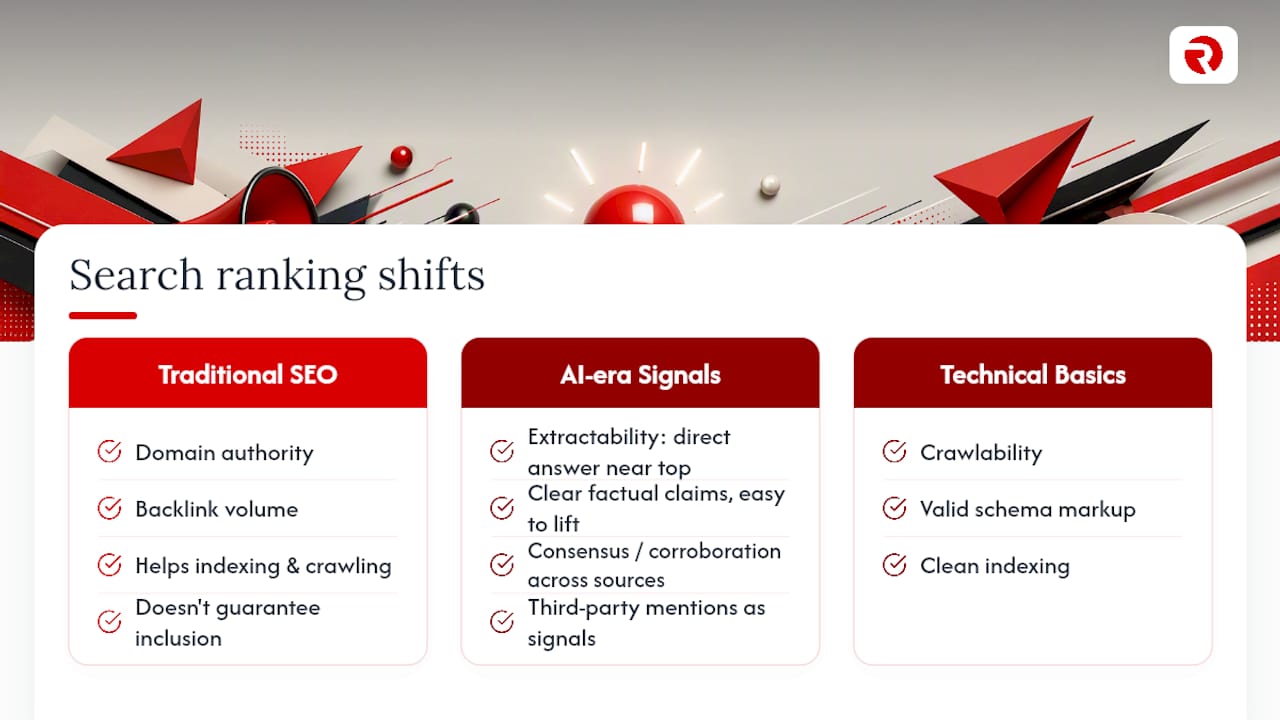
Generative engines don’t rank ten blue links, they select and synthesise a handful of sources, which shifts what counts as a “ranking factor” in the first place. Traditional signals like domain authority and backlink volume still matter for getting indexed and crawled in the first place, but they no longer guarantee inclusion in the generated answer itself.
What replaces raw authority is extractability. An engine building an answer needs a passage it can lift cleanly, attribute confidently, and trust enough to cite by name. That favours pages with a direct answer near the top, clear factual claims, and language that doesn’t require heavy interpretation to summarise. Google’s own guidance ties eligibility for its generative features to core SEO fundamentals plus the technical basics: crawlability, valid schema, and clean indexing.
Consensus and corroboration matter more too. When multiple independent sources state the same fact, an engine treats it as safer to cite than a single unverified claim, even from a high-authority domain. That’s a structural shift away from “who ranks highest” and toward “who gets repeated most consistently across the web.” Third-party mentions, review sites, and independent coverage now function as a kind of ranking signal in their own right, separate from your backlink profile entirely.
The practical result: a smaller, lesser-known site with tightly structured, frequently corroborated content can out-cite a larger competitor whose pages are authoritative but dense and hard to extract from.
What role does natural language processing play?
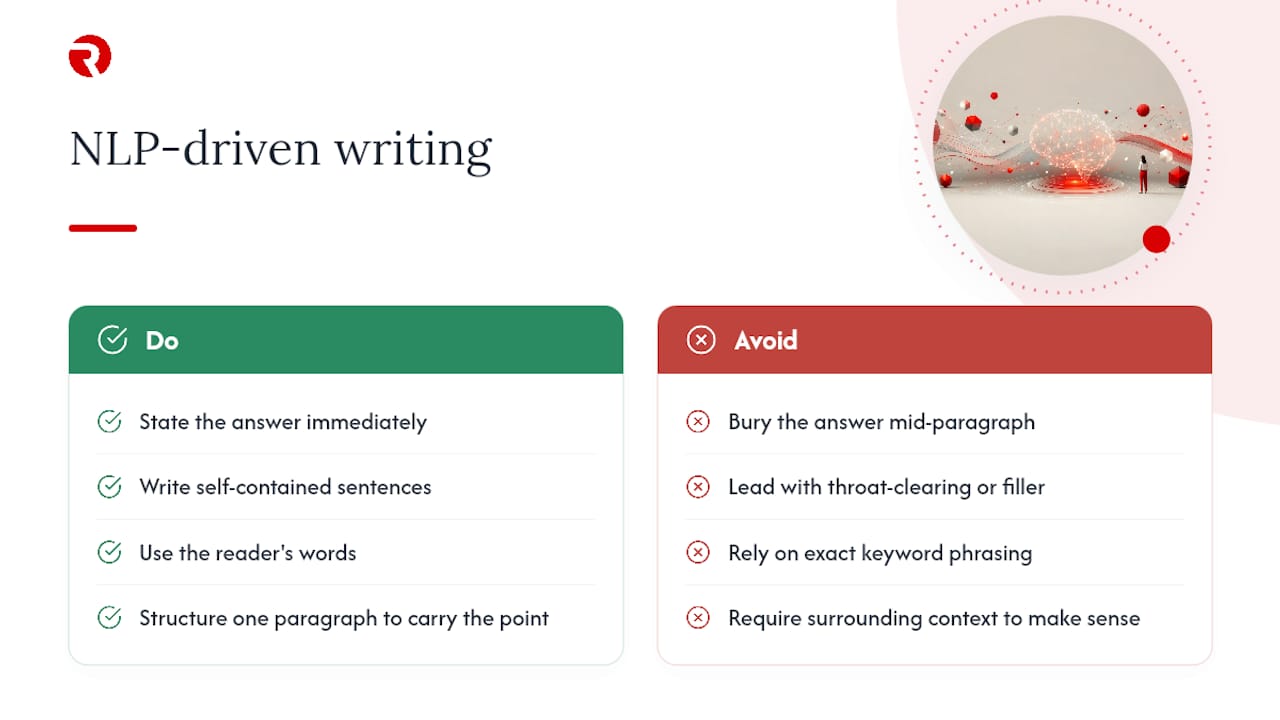
Natural language processing is the technology AI systems use to parse a question, understand intent, and match it against candidate passages of text, and it decides which of your sentences actually gets used. NLP models don’t read a page the way a human does. They break content into chunks, score each chunk’s relevance to the query, and select the passage most likely to answer the question directly.
This has a direct practical implication for how you write. A sentence buried in the middle of a long paragraph, answering the question only after two sentences of throat-clearing, scores worse than a sentence that states the answer immediately and stands on its own. NLP systems reward self-contained clarity because a chunk that needs surrounding context to make sense is harder to extract and harder to trust in isolation.
Semantic matching also means exact keyword phrasing matters less than it used to. NLP models understand that “how to improve search visibility” and “boosting AI-driven search presence” are asking roughly the same thing, so writing naturally for the reader’s actual question tends to outperform keyword-matched phrasing aimed at an older style of search engine. The models are increasingly good at recognising synonyms, related concepts, and implied intent, which rewards clarity over repetition.
Write for the question a real person is asking, in the words they’d actually use, and structure the answer so a single paragraph carries the full point without needing the rest of the page for context.
Why does content relevance matter for AI engines?
Relevance and context decide whether an engine trusts your page enough to use it at all, before extractability even comes into play. An AI system assembling an answer is effectively asking: does this source directly address what was asked, and does it fit the surrounding context of the query? A page that’s broadly about the right topic but doesn’t answer the specific question gets passed over for a narrower, more precisely matched competitor.
Context works at the page level and the sentence level simultaneously. A page needs clear topical framing (a strong title, a focused introduction, consistent terminology) so the engine understands what it’s for. Individual sentences then need to carry enough context internally that they make sense pulled out of the page entirely, since that’s exactly what happens when a sentence gets quoted in a generated answer.
This is also where a lot of otherwise strong content underperforms. A page written for a broad audience, covering ten related subtopics loosely, gives an engine no single sharp passage to lift. A page written to answer one specific question precisely, even if it’s shorter, gives the engine exactly what it needs. Depth still matters, but depth without focus doesn’t help you get cited.
How do you write for AI-generated search summaries?
Optimising for AI summaries means writing so a machine can lift a clean, accurate answer without misrepresenting your point, which is a different discipline from writing for skim-reading humans alone. A handful of concrete techniques consistently help:
Open each section with the direct answer, then explain. An engine summarising your page will often use your opening sentence as the basis for its own summary, so if that sentence hedges, qualifies, or buries the point, the resulting AI summary tends to do the same.
Use question-based subheadings where they match how people actually phrase queries. This aligns your structure with the query pattern the engine is trying to match, and it makes each section independently answerable.
Keep factual claims in plain HTML text, not inside images, video, or interactive widgets an engine can’t parse. Tables, defined lists, and short paragraphs all outperform long narrative blocks for this specific purpose, because content that’s clear and structured has a demonstrably higher chance of inclusion in generated answers.
Add schema markup, particularly FAQ and Article schema, to reinforce the structure you’ve already written in visible text. It doesn’t replace good writing, but it gives the engine an unambiguous map of where the answers sit. AI-focused content production tools can help teams produce this kind of structured output at volume without sacrificing accuracy.
How do AI updates affect visibility over time?
AI search visibility is not a fixed score you earn once. The engines themselves change frequently, and each update can reshuffle which sources get cited without any change on your part. Google has repeatedly adjusted how its AI Overviews select and display sources since launch, and both OpenAI and Perplexity update their retrieval and citation logic on a rolling basis, sometimes without public announcement.
The practical consequence is that a citation you hold today isn’t guaranteed next month. A brand that ranked strongly in an engine’s answers for a given query can drop out entirely after a model update changes which sources it trusts or how it weighs corroboration, with no warning and no clear changelog to explain why. This is precisely why a one-off audit is weaker than ongoing sampling: it captures a snapshot of a system that keeps moving.
The businesses that hold visibility over time tend to be the ones treating measurement as a standing process rather than a project with an end date. Rerunning the same prompt set monthly catches a drop early enough to investigate and respond, whether that means a content update, a fresh round of PR outreach, or a technical fix. Waiting for a quarterly review to notice a decline means losing weeks of citations you can’t easily win back, particularly if a competitor has filled the gap in the meantime.
Editorial take: measurement beats guesswork every time
Most advice on this topic front-loads tactics, structured data, snippable paragraphs, PR outreach, while treating measurement as an afterthought. That ordering is backwards. Without a reproducible prompt-sampling baseline, you can’t tell whether a tactic worked or whether the engine simply changed its mind between updates.
The conventional wisdom also oversells transferability. Plenty of guides imply that fixing your content once solves “AI search” as a category. It doesn’t. ChatGPT, Perplexity and Google AI Overviews draw from different source pools and update independently, so a citation win on one is a data point, not a trend.
What the research actually supports is narrower and more disciplined: build a stable prompt set, sample it on a fixed cadence, log mentions and citations separately, and prioritise fixing the source that’s already citing a competitor for a question you answer better. That’s less exciting than a list of ten AI SEO hacks, but it’s the version that survives the next model update.
For businesses without the internal capacity to run this cycle continuously, an agency-managed approach removes the maintenance burden without removing the discipline. That’s precisely where structured PR outreach and content rework earn their keep.
— Bart
Radka Advertising: managed AI visibility, done for you
Running a prompt-sampling baseline, auditing your source mix, and chasing third-party citations takes ongoing attention most marketing teams don’t have spare hours for. This can be built as a managed service: engine-by-engine measurement, a source-mix audit that shows exactly where your citations are missing, snippable content rewrites, and a targeted PR outreach plan aimed at the publishers your competitors are already being cited from.
What that typically looks like in practice:
- A baseline audit across ChatGPT, Gemini, Perplexity and Google AI Overviews.
- A prioritised content plan targeting the pages most likely to earn citations.
- PR and outreach execution to close third-party mention gaps.
- Ongoing tracking so a model update gets caught and acted on, not discovered three months later.
If you’d rather have this run for you than build it internally, explore Radkaadvertising’s AI growth services and get a plan built around your own prompt set and current source mix.
Sources
- The complete AI visibility guide for SEOs, marketers, and site owners — Ahrefs
- Optimizing your content for inclusion in AI search answers — Microsoft Ads blog
- How to measure brand AI visibility (HubSpot example) — Search Engine Journal
- AI visibility guide — Semrush
FAQ
How do you check your AI search visibility?
Run a fixed set of buyer-intent prompts across ChatGPT, Gemini, Perplexity and Google AI Overviews, then log whether you’re mentioned, whether your URL is cited, and where you appear relative to competitors. Repeat weekly rather than relying on a single check.
How do you increase AI search visibility?
Structure content with direct-answer openings and clear headings, earn third-party citations through PR and listings, and fix technical blockers like hidden content, PDFs and missing schema. Google’s own guidance ties eligibility to core SEO fundamentals and technical hygiene.
What are the best AI search visibility tools?
The strongest tools cover multiple engines, distinguish mentions from URL citations, track prompts over time, and return specific pages or publishers to act on rather than a bare score. Manual prompt testing works well as a starting point before investing in paid tooling.
Does AI search visibility replace traditional SEO?
No. Technical SEO fundamentals, crawlability, indexing, and schema remain the foundation AI systems build on, and Google explicitly requires core SEO best practice as a baseline for generative eligibility. AI visibility adds a second, separate layer of measurement on top.