40 to 60 Words That Optimize AI Overviews for SEO Teams

Yes, you can improve your odds of being cited in Google AI Overviews, and it comes down to two things done well: foundational SEO and passage-level extractability. Ensure your pages are crawlable, indexable and snippet-eligible, then structure priority content as question-form H2s followed by a tight 40 to 60 word answer. Track progress through Search Console’s generative AI reporting, and treat this the way Radkaadvertising treats every client brief: as a measurable programme, not a guess.
TL;DR:
- Prioritize rewriting key H2 questions into clear, concise questions with 40 to 60 word answers directly underneath to maximize citation chances.
- Convert comparison content into native HTML tables and process steps into ordered lists to improve passage extractability for AI Overviews.
- Ensure pages are crawlable, indexable, and free of noindex or snippet-blocking tags before implementing content improvements.
- Build off-site entity signals such as third-party mentions, Wikidata presence, and references in video transcripts to strengthen AI citation likelihood.
- Regularly refresh and recrawl high-traffic pages within a 30 to 60 day cycle to maintain relevance and improve automatic AI citation chances.
Table of Contents
- What are AI Overviews and when do they appear?
- How do AI Overviews select which passages to cite?
- Practical checklist: which tactics to prioritise first
- Technical eligibility: Search Console and publisher controls
- How do you measure AI Overview performance?
- Common myths and pitfalls to avoid
- Turning the playbook into an audit: what an agency actually checks
- Do featured snippets still matter for AI citations?
- What techniques and mechanisms actually drive AI optimisation?
- Best practices across different content contexts
- What are the real limitations of AI optimisation right now?
- Where is AI Overview optimisation heading next?
- How does this compare with traditional SEO?
- Balancing citation optimisation against conversion: an editorial view
- Managed AI visibility without the guesswork: Radkaadvertising’s AI Growth Package
- Sources
- FAQ
What are AI Overviews and when do they appear?
AI Overviews are Google’s generated summaries that sit above traditional organic results, synthesising an answer from multiple sources rather than lifting a single passage the way classic featured snippets do. That difference matters. A featured snippet quotes one page. An AI Overview blends several, which means your content is competing to be one voice in a chorus, not the sole answer.
The mechanism behind this is retrieval-augmented generation combined with query fan-out. Google doesn’t just answer the query you typed. It silently generates related sub-questions, retrieves passages that answer each one, and stitches the results together. A page that only addresses the headline question misses every fan-out opportunity that a more thorough competitor captures.
This is why AI Overviews trigger most reliably on informational, higher-complexity queries: “best time to visit,” “how does X work,” “is X worth it.” Simple navigational or transactional searches rarely need synthesis. If your target keywords sit in that informational, multi-angle territory, you’re already in the zone where this work pays off.
Practitioners who map five to ten sub-questions per priority page and answer each as its own H2 tend to earn more citation opportunities per query, because they’ve pre-built the exact passages Google’s fan-out process is hunting for.
How do AI Overviews select which passages to cite?
Google’s systems favour short, self-contained passages that answer a question cleanly without requiring the reader to parse three paragraphs of throat-clearing first. The structural pattern that works is consistent across the independent analyses on this: phrase the H2 as a question or a tightly extractable noun phrase, then answer it immediately in 40 to 60 words directly underneath, according to research on AI Overview optimisation.
Why that specific range? Long enough to be genuinely useful, short enough to lift cleanly as a standalone unit. Bury the answer under three sentences of preamble and you’ve made the passage harder to extract, even if the information is technically there.
Format matters just as much as phrasing. Native HTML tables, numbered lists and short bullets create clean, unambiguous extraction targets. A comparison written as flowing prose forces the model to interpret relationships between items; the same comparison in a table states them outright.
Format choices that consistently help extraction:
- Use real HTML
<table>markup for comparisons, not an image of a table or a PDF export. - Keep list items to one clear point each, not a paragraph disguised as a bullet.
- Put the direct answer in the first sentence after the H2, not the third.
- Avoid burying key figures or steps inside dense paragraphs when a table or list would isolate them.
Visible, crawlable text also matters more than people assume. Text baked into an image, a chart graphic, or JavaScript that doesn’t render server-side is effectively invisible to the extraction process, whatever it communicates to a human reader. If a number matters, it needs to exist as text in the HTML.
Practical checklist: which tactics to prioritise first
Not every tactic here carries equal weight, and treating them as equal is how teams burn a quarter on low-yield edits while the high-impact ones sit untouched. Here’s the order that gets results fastest, based on how industry playbooks sequence this work.
- Rewrite your priority H2s as questions and add the 40 to 60 word answer directly beneath. This is the single highest-leverage edit on the list. Take your top 10 to 20 pages by informational search volume, identify the H2s that already loosely match a question a searcher would type, and tighten each one plus its immediate answer.
- Convert comparison content into native HTML tables, and convert process content into ordered lists. If a paragraph currently says “first you do X, then Y, then Z,” it should be a numbered list. If it compares three options across four criteria, it should be a table.
- Set a 30 to 60 day refresh cadence for category and comparison pages, and request recrawl after every meaningful edit. Freshness genuinely factors into retrieval likelihood for pages covering fast-moving topics; a page last touched two years ago is a weaker retrieval candidate than one updated last month, all else equal.
- Earn third-party mentions. citations in earned media, a presence on Wikidata, and mentions in YouTube video descriptions or transcripts. These strengthen the entity signals that help Google’s systems trust your brand as a source worth retrieving from, independent of anything on your own domain.
- Consolidate rather than fragment. One thorough URL covering eight sub-questions on a topic outperforms eight thin pages each covering one sub-question. Splitting content dilutes authority signals and multiplies the crawl and maintenance burden without multiplying citation opportunities proportionally.
Pro Tip: Run your target query today and screenshot the current AI Overview citations before you touch anything. Without a “before” snapshot, you have no way to prove the edit worked when you check again in four weeks.
The practical sequence, in short: fix eligibility first, because no amount of beautiful formatting rescues a page Google can’t retrieve. Then fix structure, because a crawlable page with buried answers still loses to a competitor’s cleaner passage. Then build entity signals, because those compound slowly and separate durable citation sources from one-off lucky hits. Refresh and re-measure last, because this is a cycle, not a one-time project.
Teams that treat this as a single afternoon of H2 rewrites tend to plateau fast. The pages that keep earning citations month after month are the ones on a maintenance schedule, not the ones optimised once and forgotten.
Technical eligibility: Search Console and publisher controls
None of the structural work above matters if Google can’t crawl, index, or legally quote your page. Google’s own 2026 guidance is explicit that AI Overviews run on core Search ranking and quality systems, with no separate AI-only schema requirement to satisfy. The eligibility rules you already know still govern everything.
Check these before anything else:
- Robots.txt must not block the crawler from reaching the page you want cited.
- Canonical tags should point to the version you want indexed, not accidentally to a different URL.
- Noindex removes a page from Search entirely, including AI Overviews. Obvious, but a shocking number of “why aren’t we cited” audits find a stray noindex tag left over from a staging deploy.
- Nosnippet and data-nosnippet explicitly block Google from showing extracted text from that page or that specific HTML element, which blocks AI Overview citation of that content by design.
- The Search generative AI inclusion control in Search Console lets you include or exclude your entire property from supported generative AI features. Google confirms exclusion removes your links from AI features specifically without affecting your standard organic rankings elsewhere.
After any structural edit, run the page through URL Inspection in Search Console and use Request Indexing to push the recrawl rather than waiting for Google’s natural crawl schedule. For high-priority pages, this can shave days off the validation cycle. Radkaadvertising builds this recrawl step into every technical SEO audit it runs for clients, because an edit nobody recrawls is an edit that doesn’t exist yet as far as Google’s index is concerned.
How do you measure AI Overview performance?
Two Search Console reports do the heavy lifting here: the Generative AI performance report, which shows impressions and clicks specifically for appearances within AI features, and the standard Web performance report, which shows your classic organic numbers for the same query. Comparing the two reveals whether a query is shifting toward AI-mediated visibility.
Watch for the pattern where AI impressions rise while clicks stay flat or fall. That’s not necessarily a failure. It often means you’re being cited and read within the overview itself, without the reader needing to click through. Pew Research’s data confirms users click through less often when an AI summary appears at all, regardless of whose content is cited, so a click-through drop alone tells you little without checking whether you’re the cited source.
That’s where share of answer becomes useful as a working metric: the proportion of queries in a defined cluster where your domain appears as a cited source in the AI Overview, checked by manually sampling or spot-checking your top 20 to 30 informational queries. There’s no single official dashboard for this yet, so most teams track it as a simple spreadsheet tally updated on a schedule.
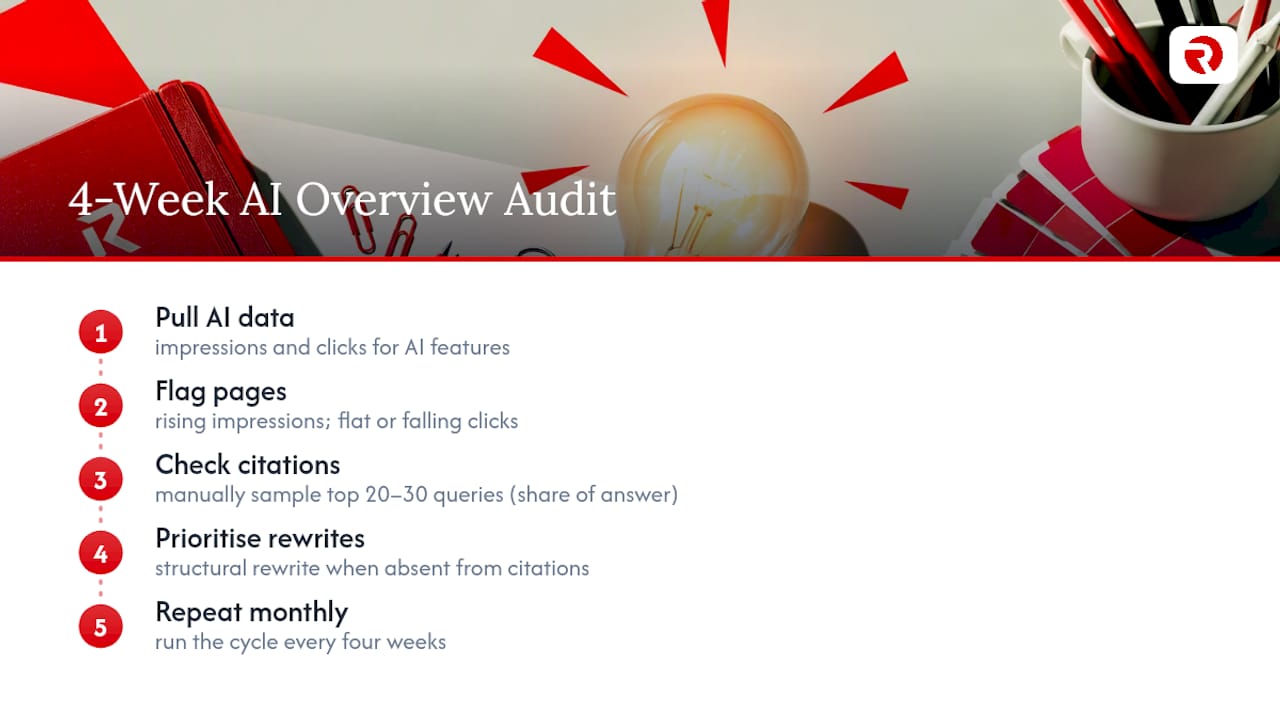
Run a four-week audit cycle: pull Generative AI performance data, flag pages with rising impressions but falling or flat clicks, check whether you’re actually cited on those queries, and prioritise the ones where you’re absent for a structural rewrite. Repeat monthly. This is the same discipline as any other conversion funnel audit, just applied to a newer surface.
Common myths and pitfalls to avoid
A few tactics circulating in SEO forums right now waste effort or actively backfire. Worth clearing up before you sink a sprint into any of them.
- llms.txt and other “AI-only” files do nothing for Google. No official Google guidance recognises them; rely on the standard robots.txt, canonical, and Search Console controls instead.
- Schema markup doesn’t guarantee a citation. It helps only when it accurately reflects visible on-page content; mismatched or decorative schema adds no citation benefit and can create trust problems if it misrepresents the page.
- Don’t bury the answer under a long preamble. If the direct answer sits three paragraphs below the H2, you’ve built a passage that’s harder to extract, not easier.
- Don’t split one topic into ten thin pages hoping to rank each sub-question separately. Consolidated depth on one URL nearly always outperforms fragmentation for both citation frequency and maintenance cost.
Turning the playbook into an audit: what an agency actually checks
A workable audit runs in four passes: eligibility (crawlability, indexation, no stray noindex tags), extractability (H2 phrasing, answer length, table and list conversion), entity building (third-party mentions, structured outreach for citations and Wikidata presence), and freshness (a scheduled recrawl cadence rather than a one-off push).
In practice, editing looks like this: take an H2 reading “Pricing Options” and rewrite it as “How much does X cost?” Add a 50-word answer stating the figure and the variable that changes it. Where the page currently lists three pricing tiers in prose, convert that block into a table with tier, price and inclusions as columns. Small edits, applied consistently across a site’s highest-traffic informational pages, compound.
Radkaadvertising built its client work around exactly this cycle, drawing on years of brand strategy and digital campaign work across sectors from FMCG to energy. The agency’s own SEO audit process folds citation-readiness checks into the same technical review it’s always run for crawlability and indexation, because the underlying fundamentals never actually changed. What changed is what you build on top of them.
Do featured snippets still matter for AI citations?
Featured snippets and AI Overview citations aren’t the same feature, but they’re closely related, and the correlation is strong enough to matter strategically. Pages already structured to win a featured snippet, direct question, immediate concise answer, clean formatting, tend to be strong AI Overview citation candidates too, because both features reward the same underlying passage qualities.
That’s genuinely useful news for teams wondering where to start. If you’ve already invested in snippet optimisation, you’re not starting from zero on AI Overviews; you’re extending existing work rather than building a parallel discipline.
The overlap isn’t total. A featured snippet lifts one exact passage verbatim. An AI Overview synthesises across sources and paraphrases, which means a page can contribute to an overview’s answer without being quoted word-for-word or credited with the same prominence a snippet gives. Passage-level extractability, the 40 to 60 word answer block, remains the shared foundation either way. Optimise for that unit and you’re hedging across both features rather than betting on one.
Where the two diverge most is volume of queries triggering each. Featured snippets appear on a narrower set of query types than AI Overviews now cover, so treating snippet optimisation as your entire strategy leaves the broader, newer surface under-served.
What techniques and mechanisms actually drive AI optimisation?
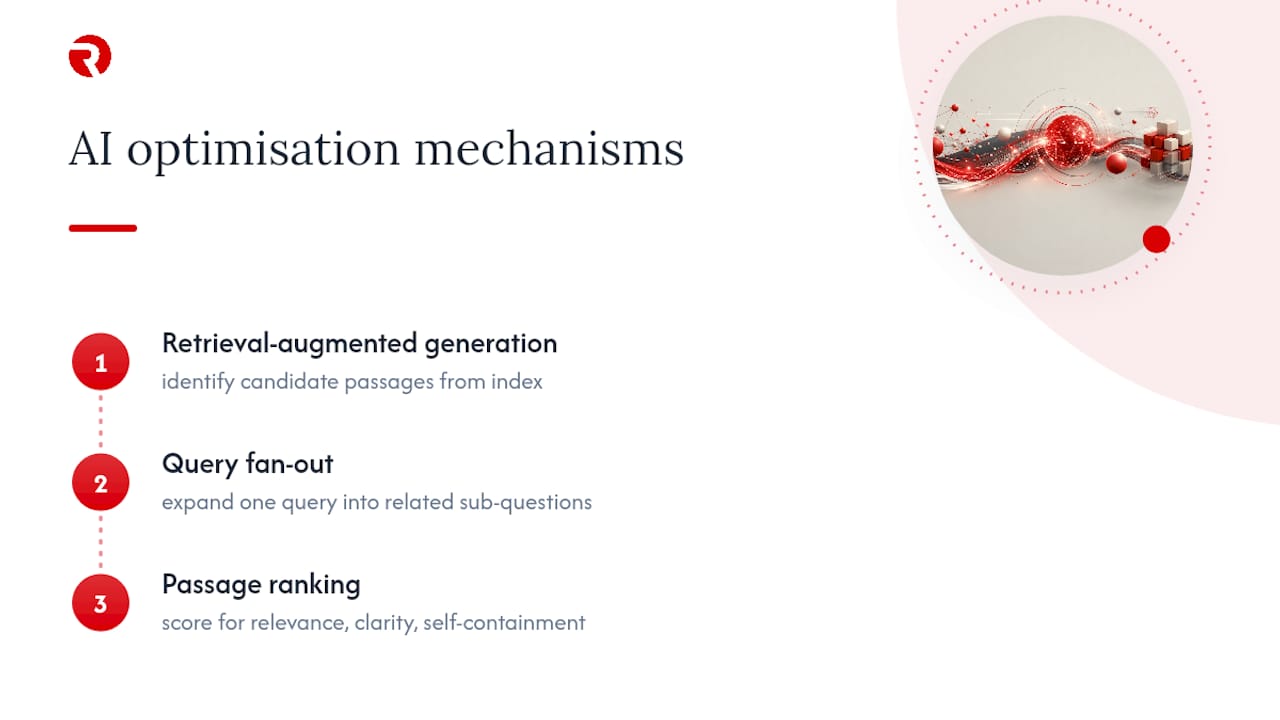
Strip away the buzzwords and AI optimisation for search rests on a handful of concrete mechanisms rather than a mysterious algorithm. Retrieval-augmented generation identifies candidate passages from the index. Query fan-out expands one search into several related sub-questions, each retrieving separately. Passage ranking then scores candidate text blocks for relevance, clarity and self-containment before selecting which get synthesised into the final overview.
None of that replaces classic ranking signals. A page still needs to rank reasonably well for the underlying query cluster to be in the retrieval pool at all; AI Overviews don’t cite pages Google wouldn’t otherwise consider relevant. What’s added on top is a second filter, extractability, that classic ranking never had to reward explicitly.
Entity recognition plays a growing role too. Google’s systems increasingly weigh whether a brand or author is a recognised entity with a consistent presence across the web, not just a domain with backlinks. That’s a slower signal to build than a formatting fix, and it’s exactly the kind of asset that earned media, case studies and consistent brand mentions accumulate over months, not days.
Best practices across different content contexts
A news publisher, an e-commerce category page and a B2B service page all need the same underlying discipline, applied differently. News content benefits most from freshness and speed to publish, since fan-out for breaking topics rewards whoever’s indexed first with a clean, current answer. Refresh cadence matters more than depth here.
E-commerce category and comparison pages benefit most from tables. Price, feature and stock comparisons are exactly the content type that native HTML tables extract cleanly, and it’s also the content type most often left as unstructured prose or, worse, an image-based comparison chart.
B2B service pages, the kind Radkaadvertising builds for clients across brand strategy, paid media and content, benefit most from sub-question coverage. A prospective client researching “how much does a brand identity project cost” is also silently asking “how long does it take,” “what’s included,” and “how is it different from a logo design service.” Answering all four on one page, each under its own question-form H2, covers the fan-out that a single narrow answer misses.
What are the real limitations of AI optimisation right now?
The honest limitation is that nobody outside Google has full visibility into how citations are actually weighted, which means every tactic here is evidence-based rather than guaranteed. You can do everything right, structurally, and still lose a citation to a competitor with stronger entity signals or simply better timing on a fast-moving topic.
Measurement is also genuinely harder than classic rank tracking. There’s no single, universally agreed dashboard metric for “share of answer,” so most teams are building their own tracking spreadsheets and manual query sampling, which takes real analyst time each month.
There’s also a click economics problem that won’t go away with better optimisation. Pew’s research on reduced click-through when an AI summary appears means even a well-optimised, frequently cited page may see flat or declining traffic, because the overview satisfies the searcher before they ever reach your site. Optimising for citation and optimising for traffic are related goals, but they’re not identical, and teams need to decide which one a given page is actually serving.
Finally, this is a moving target. Google adjusts how and when AI Overviews trigger regularly, and a tactic that works well this quarter may need revisiting next quarter as the underlying models and retrieval systems evolve.
Where is AI Overview optimisation heading next?
Expect entity signals to matter more, not less, as these systems mature. Original data, proprietary research and genuinely first-hand process descriptions are harder for a model to synthesise from competitors, which makes them more likely to be treated as information gain worth citing rather than one more restatement of common knowledge already available elsewhere.
Multimodal retrieval is the other direction worth watching. As AI Overviews increasingly pull from video transcripts and structured data beyond standard web text, a page’s citations in YouTube descriptions or transcripts start contributing to the same entity and topical authority signals that off-site earned media already builds.
Expect Search Console’s generative AI reporting maturing too, moving from the current impressions and clicks view toward something closer to genuine citation tracking. Until that arrives, manual share-of-answer tracking remains the practical workaround, imperfect but better than flying blind on a feature that’s only going to cover more query volume over time.
How does this compare with traditional SEO?
The honest answer is that AI Overview optimisation isn’t a replacement discipline. It’s an additional layer sitting on top of foundational SEO, not a substitute for it. Every technical requirement, crawlability, indexation, relevant ranking signals, still governs whether a page is even eligible to be considered.
What’s genuinely new is the unit being optimised. Traditional SEO optimises a whole page to rank for a query. AI Overview optimisation optimises individual passages within that page to be extracted cleanly for a cluster of related sub-questions. A page can rank well and still contribute nothing to an AI Overview if its answers are structurally buried, and a page can be cited in an overview even from a middling ranking position if its passage-level extractability is strong enough.
The measurement discipline diverges too. Classic SEO success is rankings and clicks. AI Overview success adds a layer that doesn’t always convert to a click at all, citation without traffic, which means teams need a second success metric rather than forcing every win through the same click-based lens.
Balancing citation optimisation against conversion: an editorial view
Citation optimisation earns priority on high-impression informational query clusters, the “what is,” “how does,” “is it worth it” searches where a click was never guaranteed anyway. Pour effort there first. Product and service pages closer to purchase intent deserve a different priority order entirely: conversion-focused UX and clear calls to action beat passage extraction, because a citation without a click on a page whose job is to convert helps nobody’s revenue.
Fold this into your existing SEO programme rather than spinning up a separate “AI team.” The governance is the same, content briefs, technical audits, refresh cadences, just with an added extractability check and a share-of-answer KPI sitting alongside your usual rank and traffic dashboards.
The durable wins here are the boring ones: original data, genuine first-hand process detail, consistent brand mentions across earned media. Formatting fixes earn quick, real gains, but they plateau. Entity signals compound.
— Bart
Managed AI visibility without the guesswork: Radkaadvertising’s AI Growth Package
Radkaadvertising is the practical alternative to running this playbook alone, in-house, on top of an already stretched content calendar. The agency’s bilingual, cross-cultural background, with proven results for Polish-owned businesses trading in the UK, means the same data-driven discipline behind its brand and paid media work now extends into AI-driven visibility and managed SEO.
The AI Growth Package covers the eligibility audits, H2 and answer restructuring, table conversions, and entity-building outreach outlined throughout this guide, targeting real outcomes: stronger share of answer across your priority query clusters, rising AI impressions in Search Console, and a genuine 30 to 60 day content refresh cadence that most in-house teams struggle to sustain alongside everything else on their plate.
If your pages are eligible but invisible in AI Overviews, that’s a structural fix, not a mystery. Get in touch through the AI Growth Package page to scope an audit against your own priority pages.
Sources
- Optimizing your website for generative AI features on Google Search
- Google users are less likely to click on links when an AI summary appears
- AI Overviews SEO 2026: How to Optimize for Google AI Overviews - LLM Pulse
- Use Search generative AI control to manage inclusion in generative AI features
FAQ
How do you optimise for Google AI Overviews?
Ensure the page is crawlable, indexable and snippet-eligible first, since AI Overviews run on core Search systems with no separate requirements. Then rewrite priority H2s as questions and add a 40 to 60 word answer directly beneath each one, using tables and lists wherever content compares options or lists steps.
What is the 80/20 rule for AI Overview SEO?
The remaining tactics, entity outreach, freshness cadence, deeper sub-question coverage, add durable improvement but with slower, smaller returns per hour invested.
How can I improve AI search optimisation beyond formatting?
Formatting fixes hit a ceiling fast; entity signals push past it. Earn third-party mentions in press coverage, build a Wikidata presence, and get cited or referenced in YouTube content, since these off-site signals strengthen how AI systems weigh your brand as a trustworthy source independent of on-page work.
Can you stop your site appearing in AI Overviews?
Yes. Google’s Search generative AI control in Search Console lets you exclude your property from supported generative AI features entirely. Exclusion removes your links from AI Overviews specifically without affecting your standard organic rankings elsewhere.
Does Radkaadvertising offer AI Overview optimisation as a service?
Yes, through the AI Growth Package, which folds eligibility audits, passage restructuring and entity-building outreach into a managed programme. Current pricing is available directly on the AI Growth Package page rather than published as a fixed rate.