4 Week AI Content Strategy Pilot for UK Startups and Small Teams

An AI content strategy is a human-led plan for using artificial intelligence to hit a named business outcome, not just to make more content, faster. The immediate next step is simple: pick one pilot, attach one measurable KPI to it, and run it for four weeks before you scale anything. Nearly 99% of UK advertisers already use generative AI, yet most gains come from the minority who treat AI as a business lever, not a typing assistant.
TL;DR:
- The most effective AI content strategies prioritize measurable goals and KPIs, focusing on outcomes like conversions or quality rather than volume alone.
- Building a robust workflow involves phases of research, drafting, SEO optimization, visual asset creation, and clear handoffs, with integration to avoid duplicate work.
- Strong governance, including a live tool inventory and signed approvals, correlates with higher ROI and prevents quality and brand safety issues.
- Successful pilots follow a four-week process with specific measurement design and governance setup, ensuring results inform longer-term decisions.
- AI content should align tightly with overall marketing and business goals, using audience insights and product timelines to steer automation and content development.
Table of Contents
- What are the core pillars of an AI content strategy?
- What tools and workflows support an AI content workflow?
- How do you govern AI content for brand safety and quality?
- How do you measure the impact of AI content?
- How do you run a 4-week AI content pilot?
- Radka Advertising’s approach to AI content pilots
- How does AI content strategy fit into overall marketing and business strategy?
- What roles and skills does an AI content team need?
- What ethical considerations matter beyond the obvious risks?
- Should you build this in-house or hire an agency?
- How Radka Advertising can help implement your AI content strategy
- Sources
- FAQ
What are the core pillars of an AI content strategy?
Bolting AI onto an existing content plan rarely works. The teams who see returns build five pillars first and let the tools slot in underneath.
Goals and KPIs. Decide early whether you’re chasing efficiency (cheaper, faster production) or effectiveness (better business outcomes). The distinction matters more than most teams assume: ISBA’s 2026 GenAI survey found only a minority of advertisers report significant impact from AI generally, but among those who explicitly prioritise effectiveness over speed, the success rate notably increases. Volume without a target metric is just noise with extra steps.
Audience and intent mapping. Map every content format to a specific stage of intent, not a content calendar slot. A comparison guide serves a different reader than a how-to post, and AI drafting tools only help once you know which job each piece is doing.
Formats and repurposing. Build a “hero asset” (a deep guide, an original data piece, a flagship video) then splinter it into microcontent: social posts, email snippets, short videos, FAQ entries. This is where AI earns its keep, because repurposing is mechanical work that still needs a human eye for tone.
Data inputs and brand control. Feed models your own first-party material: past-performing copy, customer service transcripts, brand style guides, tone-of-voice documents. Generic prompts produce generic output; your own data produces your voice.
Editorial rules and approval. Every piece needs a named approver before it goes live. Without this, quality drifts fast, particularly on anything AI drafted end to end.
The pillars work together, not in sequence:
- Set one primary KPI per content programme, not per piece of content
- Map formats to funnel stage before choosing which AI tool touches them
- Build one hero asset per month and plan its microcontent spin-offs in advance
- Feed models your own brand data, never a blank prompt
- Assign one human sign-off owner per content type, no exceptions
What tools and workflows support an AI content workflow?
A working AI content workflow moves through four phases, each served by a different category of tool.
- Research and topic discovery — tools that mine search queries, competitor gaps and customer language to surface what’s worth writing about.
- Drafting assistants — large language model tools that produce first drafts, outlines or structural variants from a brief.
- SEO optimisers — tools that check on-page structure, keyword coverage and readability against what’s already ranking.
- Image and video generation — tools that produce or adapt visual assets to match the hero asset’s themes.
- Automation and orchestration — platforms that route drafts between tools and people, log versions and trigger approval steps.
A realistic workflow looks like this: research tools surface three viable topics, a human picks one and writes a tight brief, a drafting assistant produces a first pass, an editor rewrites the weak sections and checks facts, an SEO tool flags gaps before publish, and an orchestration layer schedules the repurposed microcontent across channels. Handoffs matter more than any single tool. Salesforce’s guidance for small businesses recommends staged pilots with CRM and CMS integration precisely because disconnected tools create duplicate work rather than saving time.
Integration deserves its own line item. Set British English as the default across every drafting and grammar tool, and build in a UK-specific check for currency, spelling, regulatory references and local examples. Generic AI output frequently fails UK audiences exactly where those settings are ignored, producing copy that reads as translated rather than written for the market.
Pro Tip: Keep a rejected-drafts folder alongside your approved-content library. Reviewing what got rejected and why sharpens your briefs faster than any prompt-engineering course.
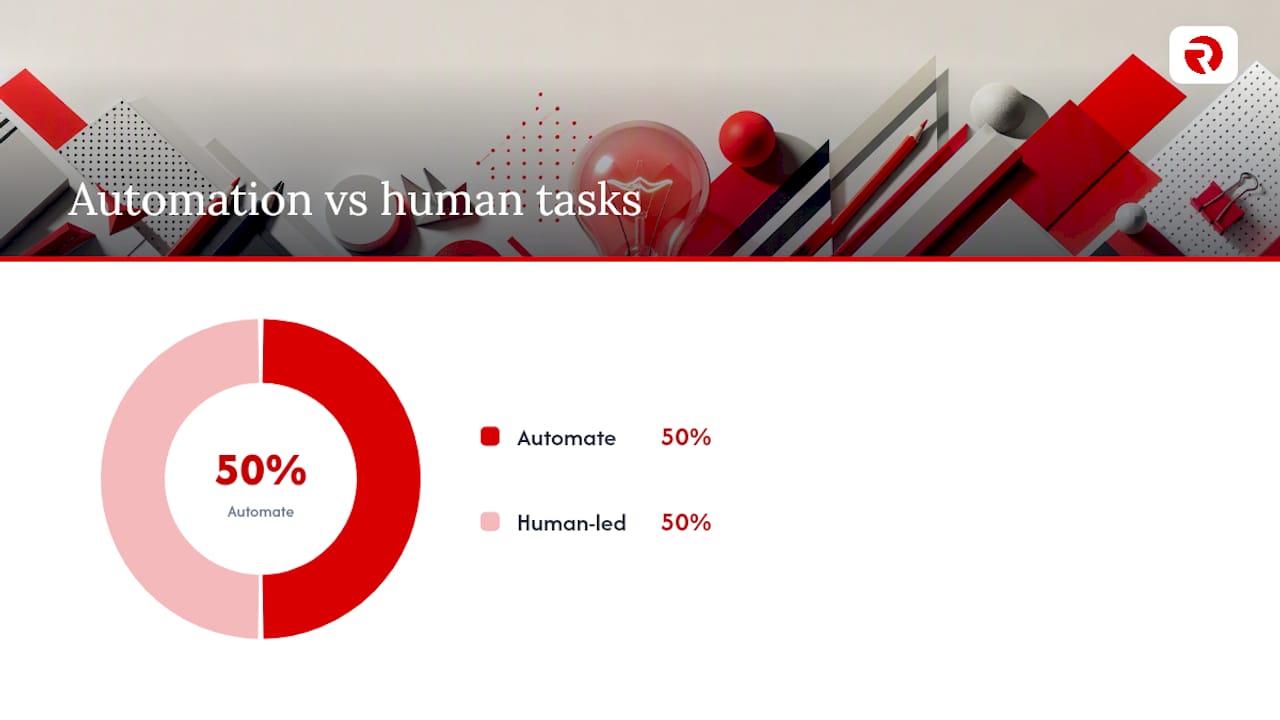
Use this rough decision checklist for what to automate versus keep human-led:
- Automate: first-draft generation, keyword gap analysis, format resizing, scheduling
- Keep human-led: final fact-checking, brand voice sign-off, anything touching legal or medical claims, strategic topic selection
Platforms built specifically for marketing teams, such as AmmarAI’s planning tools, can help formalise this handoff between planning and drafting stages without losing the editorial layer in between.
How do you govern AI content for brand safety and quality?
Governance is the difference between an AI content strategy that compounds and one that quietly degrades your brand. Research from AIBL’s 2026 adoption survey found governance maturity strongly correlates with measurable AI return, with top performers reporting ROI in the 80s compared with low double digits for those without structured governance.
Statistic to hold onto: organisations with mature AI governance report substantially higher measurable ROI than those without it, according to the same AIBL survey. Governance isn’t bureaucracy here. It’s the mechanism that turns adoption into return.
Build governance around four concrete practices:
- Keep a live tool inventory: which AI tools are approved, who owns each licence, and what they’re allowed to touch
- Write a one-page policy covering disclosure, copyright checks, and what content categories require legal review
- Name an approval owner for every content type, with no piece publishing without their sign-off
- Log rejected drafts and the reason for rejection, so briefs improve over successive rounds
On the regulatory side, UK teams should keep half an eye on the Information Commissioner’s Office guidance where AI touches personal data, and the ASA/CAP Code where AI-generated claims edge into advertising standards territory. Neither requires a legal department to manage day to day, but ignoring them until a complaint lands is expensive.
Quality assurance should be boring and repeatable: a brief standard everyone follows, a pre-publish checklist covering facts, tone and formatting, and a short log of what got rejected and why. None of this slows output meaningfully. What it does is stop the slow brand-safety erosion that happens when AI drafts go live with nobody checking whether they sound like you.
How do you measure the impact of AI content?
Measurement separates teams that scale their AI content programme from teams that quietly abandon it six months in. Match your KPIs to the objective, not to whatever’s easiest to pull from a dashboard.
- Traffic objectives: track organic sessions and ranking movement on the specific pages the AI workflow touched
- Assisted conversions: measure how AI-produced content contributes further up the funnel, not just on the final click
- Lead quality: track form-fill quality and sales-accepted lead rate, not just volume of leads
- Customer acquisition cost: compare CAC on AI-assisted content against your existing baseline content
Split AI-referral traffic in your analytics platform as its own channel where possible, so you can see whether AI-driven discovery tools are sending genuinely new visitors or simply relabelling existing search traffic. Industry playbooks on AI advertising recommend running holdout groups, publishing AI-assisted content to one segment and withholding it from a comparable segment, to prove incrementality rather than assuming correlation equals causation. A holdout test doesn’t need a huge sample to be useful; even a modest, consistent split over a few weeks tells you more than a month of unstructured before-and-after comparison.
Set a reporting cadence and stick to it, weekly for the first pilot month, then monthly.
How do you run a 4-week AI content pilot?
Small teams don’t need a full department to test this properly. A four-week pilot, followed by a seven-step rollout, gets you from zero to a defensible answer on whether AI content is working.
- Week 1: Inventory — audit existing content, tools already in use, and current KPI baselines. One person, roughly two days.
- Week 1: Pick two pilots — one production-focused (cut cycle time on a content type) and one effectiveness-focused (lift a conversion metric), per the pairing approach Salesforce recommends for balancing learning with results.
- Week 2: Design measurement — define the holdout or before-and-after comparison, set the scale-or-stop rule, brief whoever owns analytics.
- Week 2: Set governance — name the approval owner, write the one-page policy, choose the tool set.
- Week 3: Launch — publish the first batch under the new workflow, log every rejected draft.
- Week 3: Iterate — adjust briefs and prompts based on what got rejected and why.
- Week 4: Review and decide — compare against your scale-or-stop rule and commit to one direction.
This maps closely to the seven-step framework several industry guides converge on: set goals, identify opportunities, choose tools, integrate and test, personalise, train the team, then monitor and iterate. Founders typically own weeks 1 and 4; a marketing lead or freelance editor can carry weeks 2 and 3.
The most common pitfall in these first four weeks is skipping the measurement design step because launching feels more productive. Resist it. A pilot without a defined comparison point produces opinions, not evidence.
Radka Advertising’s approach to AI content pilots
AI content pilots are built following the approach this article describes: named KPI first, governance second, tools third. That order isn’t accidental, it’s what separates a pilot that produces a decision from one that produces a pile of drafts nobody trusts.
- Briefs are written before any drafting tool opens, with brand voice and first-party data baked in
- Governance sits with a named owner from day one, not retrofitted after the first quality complaint
- Pilots run against a defined comparison point, mirroring the holdout logic used across the industry
- Case examples across sectors are documented in a portfolio of client work
Full details of the services sit alongside this approach for teams weighing agency support against building the capability internally.
How does AI content strategy fit into overall marketing and business strategy?
AI content strategy is not a separate workstream sitting beside your marketing plan. It should sit inside it, feeding the same revenue targets, brand positioning, and channel mix your business already runs on.
Treat every AI-assisted content decision as a marketing decision first. If your business strategy targets a specific customer segment for expansion this year, your AI content pilots should target that segment’s search behaviour and pain points, not the topics that happen to be easiest to automate. This alignment also protects budget: finance teams fund initiatives tied to named business outcomes far more readily than they fund “more content.”
Cross-functional visibility matters too. Sales teams can tell you which objections show up in every closed-lost deal; feed that language into your content briefs. Product teams know what’s shipping next quarter; your content calendar should anticipate it. AI tools make it cheap to produce content reactively, but the strategic value comes from planning content around where the business is actually heading, then using AI to execute that plan faster.
Review your AI content KPIs in the same meeting where you review broader marketing KPIs, not in a separate AI steering group that reports up separately. Separation is how AI content programmes quietly drift from business priorities without anyone noticing until the quarterly numbers land.
What roles and skills does an AI content team need?
Small teams don’t need a dozen new hires to run this well, but they do need clarity on who owns what.
A content strategist or marketing lead owns the goals, KPI selection and format mapping described earlier. This person decides what gets made and why, and should not be the same person drafting content day to day, since that split protects objectivity.
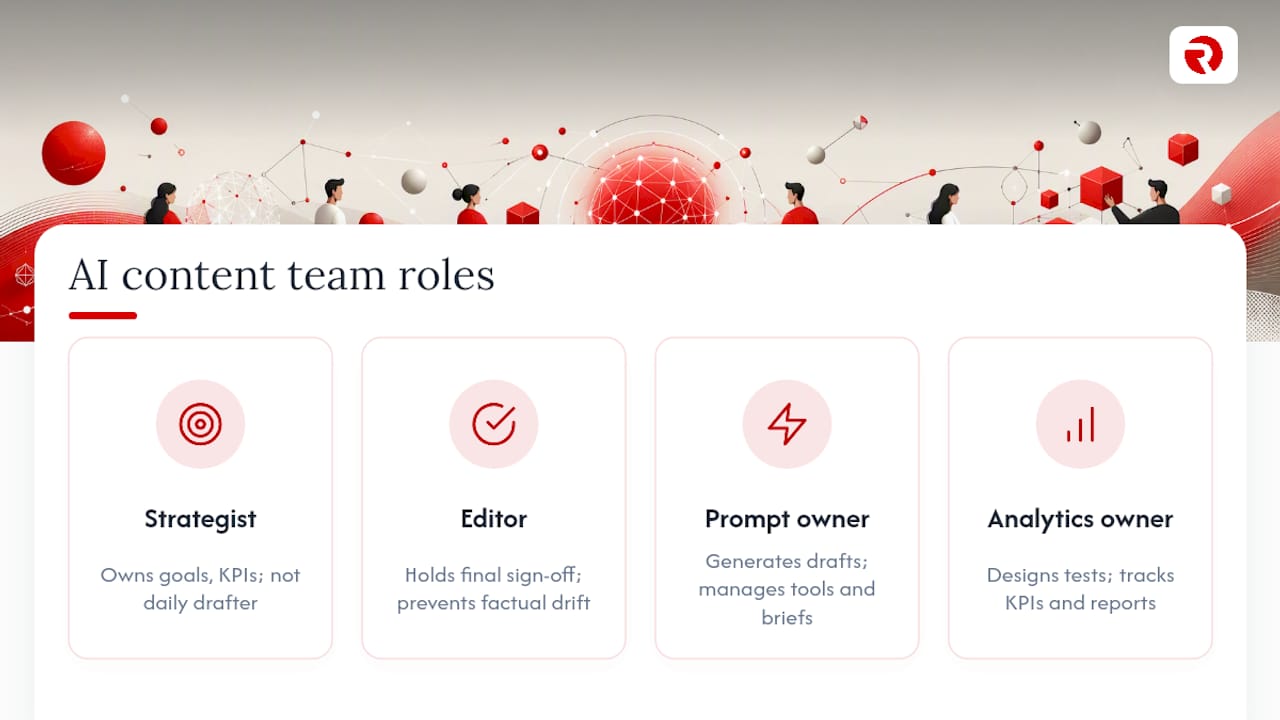
An editor or brand owner holds sign-off authority on every published piece. This role needs strong writing judgement and enough product or industry knowledge to catch factual drift in AI-drafted copy, a skill that matters more than technical AI fluency.
A prompt and workflow owner manages the tool stack, writes and refines briefs that go into drafting assistants, and maintains the rejected-drafts log. This role benefits from genuine curiosity about how different models respond to constraint, since treating AI output as something you generate against explicit constraints rather than a blank request produces measurably better first drafts.
An analytics owner designs the holdout tests, tracks the agreed KPIs and reports against the scale-or-stop rule. In a small business, one person can plausibly hold two of these roles, but sign-off authority should never sit with the same person generating the drafts. That single separation catches more brand-safety issues than any tool ever will.
What ethical considerations matter beyond the obvious risks?
Bias and transparency deserve attention that goes beyond the standard hallucination warning. AI models trained on broad internet data can default to generic phrasing, generic examples and, at times, assumptions that don’t reflect your actual customer base, particularly around gender, profession or cultural context. Reviewing drafts specifically for who they implicitly picture as “the customer” catches problems a fact-check alone won’t.
Transparency with your own audience matters as much as transparency with regulators. Disclosure doesn’t need to be a disclaimer on every paragraph, but readers increasingly notice when content feels hollow or interchangeable with a hundred other AI-drafted pieces on the same topic. Brands that stay recognisably themselves, in voice and in the specific expertise they bring, hold reader trust better than brands chasing volume.
There’s a fairness question too, often overlooked: AI content tools can make it cheap to flood a niche with content, crowding out smaller voices and independent publishers who can’t compete on volume. That’s not a legal risk, but it’s worth weighing if your content strategy leans heavily on out-producing competitors rather than out-thinking them. The ethical baseline is simple: use AI to say something worth saying, faster, not to say very little, more often.
Should you build this in-house or hire an agency?
Building in-house wins on long-term capability and cultural fit; an agency wins on speed and governance maturity you don’t have to build from scratch. The two aren’t mutually exclusive. Many teams run early pilots with agency support, then bring measurement and briefing in-house once the workflow is proven. The decision rule is straightforward: if you can’t name your KPI and your approval owner today, hire the governance before you hire the tools.
— Bart
How Radka Advertising can help implement your AI content strategy
This agency is a direct route for founders and marketing leads who want the governance and measurement discipline this article describes, without spending the next two quarters building it themselves. Its AIGrowth offering covers strategy, brief-writing, pilot design and the editorial governance layer that separates a working AI content programme from a pile of unreviewed drafts, drawing on a staged approach to brand strategy, digital marketing and content production. If you’re weighing whether to run your first pilot internally or with support, request an audit through AIGrowth or browse the full services overview to see where a pilot could slot into your existing marketing plan.
Sources
- ISBA: 99% of brands are using GenAI, few see benefits - DecisionMarketing
- State of UK AI Adoption 2026: key findings (n=755) | aibl
- Content Marketing AI? Writing Made Easy With Smart Tools
- AI-Powered Content Marketing and Strategy Specialization
FAQ
What is an AI content strategy?
It’s a human-led plan for using AI tools to reach a specific business outcome across research, drafting, optimisation and repurposing, governed by named approval owners rather than left to run unchecked.
What are the five pillars of a content strategy?
Most frameworks converge on goals and KPIs, audience and intent mapping, content formats and repurposing, data inputs and brand control, and editorial approval workflow, all covered earlier in this guide.
What is the 30% rule in AI?
There’s no single agreed definition of a “30% rule” in AI content; where the term appears, it’s typically used loosely to describe capping the share of fully AI-generated material a team publishes without human rewriting, and definitions vary by source.
What is the 10/20/70 rule for AI?
The 10/20/70 framing suggests roughly 10% of AI value comes from algorithms, 20% from data and technology, and 70% from people, process and governance, a rough proportion consistent with why governance maturity, not tool choice, drives measurable ROI.
What are the seven steps in creating a content strategy?
Set goals, identify opportunities, choose tools, integrate and test, personalise, train the team, then monitor and iterate, the same sequence used for the four-week pilot outlined above.